

Table of Contents
- Quick Summary
- Introduction
- What Determines the Cost of Stroke Treatment?
- Stroke Treatment Cost in India: City-Wise Breakdown
- Cost by Treatment Type: Thrombolysis, Thrombectomy, and Surgery
- ICU Stay and Hospitalization: The Hidden Cost Driver
- Ischemic vs Hemorrhagic Stroke: Why Treatment Cost Differs So Much
- Practical Ways to Manage Stroke Treatment Costs
- How Much Does Stroke Treatment Cost With Insurance?
- Does Ayushman Bharat Cover Stroke Treatment?
- When Costs Exceed Coverage: Crowdfunding for Stroke Treatment
- Conclusion
- Frequently Asked Questions
Quick Summary
- Stroke treatment costs in India vary widely depending on the type and severity of stroke, treatment required, hospital, city, ICU stay, and rehabilitation needs. Costs can range from a few lakh rupees for some cases to considerably more for complex procedures and prolonged hospitalization.
- Thrombolysis (clot-busting medication) is the least expensive active treatment; mechanical thrombectomy and hemorrhagic stroke surgery cost significantly more.
- Metro cities like Delhi and Mumbai generally cost more than tier-2 cities for the same treatment.
- Government schemes like Ayushman Bharat (PM-JAY) can cover up to ₹5 lakh per family per year for eligible households.
- Reaching the hospital as early as possible can improve the chances of receiving time-sensitive treatment and may reduce complications and prolonged hospitalization.
Introduction
Stroke treatment is highly time-sensitive. Reaching a hospital quickly can improve the chances of receiving time-dependent treatments and may help limit brain damage and complications. For families in India, however, the financial impact of a stroke can be just as overwhelming as the medical emergency itself. This guide breaks down what stroke treatment typically costs across Indian cities, what actually drives the price up or down, and what support, from insurance to government schemes to crowdfunding, is available when the bill exceeds what a family can reasonably absorb on their own.
What Determines the Cost of Stroke Treatment?
Before looking at specific numbers, it helps to understand why stroke treatment costs vary so widely, sometimes by several lakhs of rupees for what looks like a similar diagnosis. The major variables include:
- Stroke type: ischemic strokes (caused by a blockage) and hemorrhagic strokes (caused by bleeding) require fundamentally different treatments, with very different cost profiles
- Treatment approach: medication-only treatment costs far less than a procedure like mechanical thrombectomy or emergency surgery
- Time to treatment: patients who reach the hospital early may have more treatment options available and may be less likely to develop complications requiring prolonged intensive care.
- Length of ICU and hospital stay: Hospital and ICU stay can be major contributors to the overall cost of stroke treatment, particularly when complications or severe disability require prolonged care.
- Severity: More severe strokes often require longer hospitalization, intensive monitoring, additional procedures, and more rehabilitation, increasing the overall cost.
- City and hospital tier: Metro-city corporate hospitals generally charge more than tier-2 city hospitals or government facilities for comparable care
- Rehabilitation needs: physiotherapy, speech therapy, and occupational therapy, often required for weeks or months after discharge, add meaningfully to the total cost of recovery.
Understanding these drivers matters because a stroke “cost” isn’t one number; it’s the sum of several decisions made in the first hours and days of treatment, many of which are outside a family’s control.
Read More : Types of Stroke Rehabilitation: A Complete Guide
Read More : Traumatic Brain Injury: Types, Severity & Symptoms
Stroke Treatment Cost in India: City-Wise Breakdown
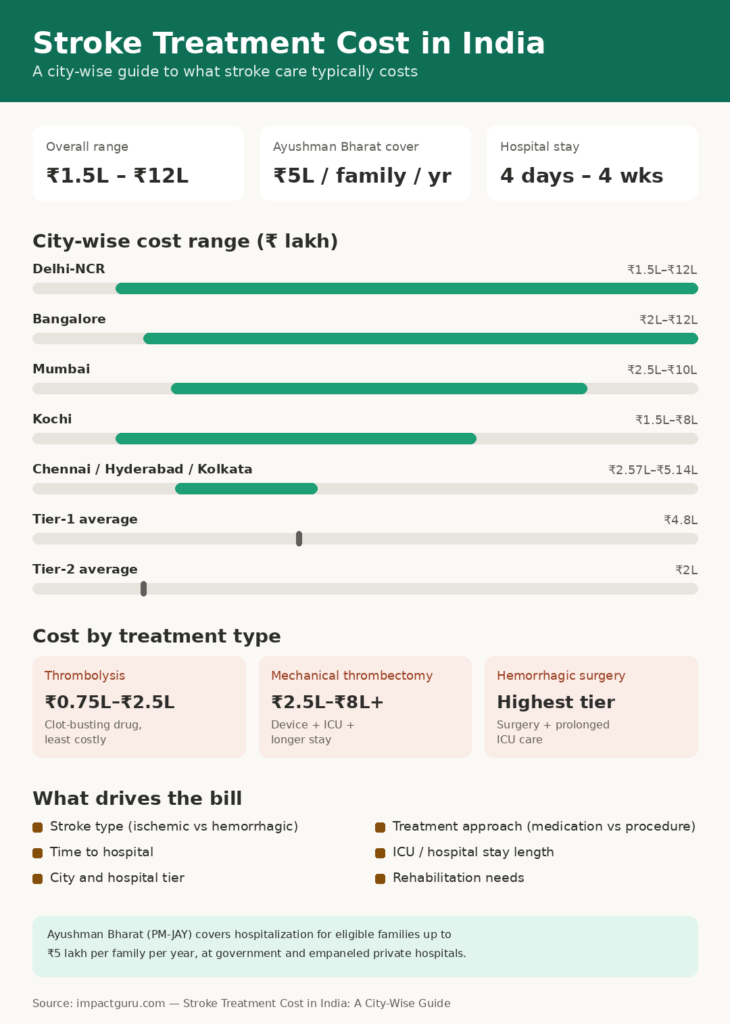
Stroke treatment costs vary considerably by city, hospital, stroke severity, and the treatment required. Available Indian healthcare and insurance sources provide indicative ranges rather than a single fixed price. For example, ManipalCigna lists an indicative average of ₹4.8 lakh for Tier-1 cities and ₹2 lakh for Tier-2 cities, while hospital and clinical sources report wider ranges for individual cities.
| City / City Tier | Indicative Cost |
| Tier-1 Metros | ₹4.8 lakh average |
| Mumbai | ₹2.5 lakh – ₹10 lakh |
| Delhi-NCR | ₹1.5 lakh – ₹12 lakh |
| Bangalore | ₹2 lakh – ₹12 lakh |
| Chennai | ₹2.57 lakh – ₹5.14 lakh |
| Hyderabad | ₹2.57 lakh – ₹5.14 lakh |
| Kolkata | ₹2.57 lakh – ₹5.14 lakh |
| Tier-2 Cities | ₹2 lakh average |
| Kochi | ₹1.5 lakh – ₹8 lakh |
Note: These are indicative private-hospital estimates. Actual costs can vary depending on stroke severity, treatment approach, ICU stay, complications, hospital category, and rehabilitation needs.
Cost by Treatment Type: Thrombolysis, Thrombectomy, and Surgery
The type of intervention can have a major impact on a stroke treatment bill, and it varies significantly by stroke type and severity:
- Thrombolysis: For eligible patients with acute ischemic stroke, intravenous thrombolysis with alteplase or tenecteplase may be used within the appropriate treatment window. The cost varies according to the medication, hospital, diagnostic tests, monitoring, and length of stay. Reported costs for the medication and associated hospitalization range from roughly ₹75,000 for the injection alone to a total of ₹2 lakh–₹2.5 lakh once ICU stay and diagnostics are included. Intra-arterial thrombolysis, a more targeted variant, has been quoted in the range of around ₹75,000.
- Mechanical thrombectomy: Costs vary substantially between hospitals and cases. Published Indian estimates range from around ₹2.5 lakh to ₹8 lakh or more, with complex procedures, device costs, ICU care, and prolonged hospitalization increasing the final bill.
- Hemorrhagic stroke surgery: when a stroke is caused by bleeding rather than a blockage, treatment shifts toward surgical intervention to repair the ruptured vessel or relieve pressure from accumulated blood, or endovascular procedures like coiling or clipping to stop the bleeding. These cases tend to be more resource-intensive and carry higher costs than ischemic stroke treatment, particularly when combined with longer ICU stays.
- Supportive and rehabilitation care: regardless of stroke type, ongoing costs include medications to manage blood pressure, cholesterol, and clotting risk, plus physical, speech, and occupational therapy. Inpatient rehabilitation has been quoted at roughly ₹25,000–₹50,000 per week in some metro markets, depending on therapy intensity, a cost that can continue for months after the initial hospitalization ends.
Read More : ICU Cost in India: Per Day Charges, Breakdown & Cost Saving Tips
Read More : Brain Aneurysm Surgery Cost in India: Clipping vs Coiling
ICU Stay and Hospitalization: The Hidden Cost Driver
It’s tempting to think of stroke cost as “the procedure” plus a few extra charges, but Indian cost studies identify hospital stay as an important contributor to the total bill, particularly when prolonged ICU care or complications are involved.
For mild ischemic strokes treated successfully with thrombolysis, hospital stay may run 4–7 days. For severe strokes, hemorrhagic strokes, or cases requiring surgery, stays can extend to 2–4 weeks or longer, and every additional day in the ICU adds meaningfully to the total. This is part of why early treatment matters financially as well as medically: Prompt treatment may help reduce complications and prolonged hospitalization, which can in turn lower the overall financial burden.
Read More : Best Stroke Hospitals in India and How to Know
Ischemic vs Hemorrhagic Stroke: Why Treatment Cost Differs So Much
Since stroke type is one of the biggest cost drivers for its treatment in India. It’s worth understanding why ischemic and hemorrhagic strokes diverge so sharply in price, even though both are medical emergencies of similar urgency.
Ischemic stroke treatment, when started promptly in an eligible patient, may follow a more predictable treatment pathway: thrombolysis or thrombectomy, followed by a defined ICU and ward stay. Costs scale mainly with how quickly the patient arrived and whether complications developed.
Hemorrhagic stroke treatment tends to be less predictable and more resource-intensive from the outset. Bleeding in or around the brain often requires surgical intervention or endovascular procedures like coiling or clipping, closer neurological monitoring for complications such as rebleeding or vasospasm, and frequently a longer ICU stay to manage intracranial pressure. This combination of surgical cost, monitoring intensity, and extended hospitalization is why hemorrhagic stroke cases tend to sit at the higher end of the overall cost range, and occasionally exceed it in complex cases.
For a deeper look at how these two stroke types differ beyond just cost, including causes and warning signs, see our guide on ischemic vs hemorrhagic stroke.
Practical Ways to Manage Stroke Treatment Costs
While a stroke emergency doesn’t leave time for extensive financial planning in the moment, a few practical steps can meaningfully reduce the financial burden, both during and after treatment:
- Ask for an itemized estimate early: most hospitals can provide a preliminary cost estimate once the treatment plan is decided. This helps you understand roughly what to expect and plan accordingly, even in an emergency.
- Confirm network hospital status with your insurer immediately: A quick call to your insurance provider can clarify whether the treating hospital qualifies for cashless treatment, which avoids the added strain of paying upfront and seeking reimbursement later.
- Ask about government scheme eligibility at admission: hospital billing desks can typically confirm Ayushman Bharat or state-scheme eligibility quickly; this is worth asking about even if you’re unsure you qualify.
- Understand what room category is doing to your bill: since room choice often affects nursing and other charges proportionally, confirm this with the hospital’s billing team before selecting a room to avoid an unexpectedly high bill later.
- Don’t wait until discharge to explore funding gaps: if it’s becoming clear that insurance and savings won’t cover the full cost, starting a fundraiser early, rather than after the bill is finalized, gives your support network more time to contribute before payment is due.
None of these steps replace the urgency of starting treatment immediately, but together, they can meaningfully reduce how much of the financial burden falls on one family.
How Much Does Stroke Treatment Cost With Insurance?
Health insurance is one of the most effective tools for managing stroke treatment cost, in India, but coverage details vary significantly between policies. Before assuming a plan will cover the full cost, it’s worth checking:
- Room rent limits: many policies cap the daily room rent they’ll cover, and choosing a higher category room than your limit allows can trigger proportionate deductions across the entire bill, not just the room charge
- Sub-limits on specific procedures: some policies cap coverage for particular interventions like thrombectomy separately from general hospitalization
- Network hospitals: treatment at an insurer’s network hospital typically allows cashless treatment, while out-of-network care may require paying upfront and filing for reimbursement later
- Waiting periods: newer policies may have waiting periods for certain pre-existing conditions that can affect stroke-related coverage
If you don’t currently have health insurance, getting coverage as early as possible is worth considering, given how unpredictably and suddenly stroke can occur, but for anyone facing a stroke diagnosis right now without adequate coverage, the sections below on government schemes and crowdfunding are the more immediately relevant options.
Does Ayushman Bharat Cover Stroke Treatment?
Yes, Ayushman Bharat Pradhan Mantri Jan Arogya Yojana (AB PM-JAY), India’s government health insurance scheme, covers hospitalization for eligible families, including stroke treatment, up to ₹5 lakh per family per year. Coverage is available at both government and empaneled private hospitals, which can make a meaningful difference for families who would otherwise face the full private-hospital cost out of pocket.
Some states also run their own supplementary health schemes that can further reduce costs for stroke and other critical treatments; eligibility and coverage details vary by state, so it’s worth checking with the treating hospital’s billing or insurance desk about which government schemes apply in your specific location.
Government hospitals generally offer lower costs than private hospitals even outside of these schemes, though this can come with longer wait times for non-emergency aspects of care, a tradeoff worth understanding. Still, it rarely applies to the emergency stroke response itself, since stroke care is triaged as urgent regardless of hospital type.
Read More : How to Raise Money for ICU Hospital Bills in India
Read More : 0% Fee Crowdfunding Platforms in India (2026)
When Costs Exceed Coverage: Crowdfunding for Stroke Treatment
Even with insurance or a government scheme in place, many families find a gap remains, particularly for severe stroke treatment cost in India. It could require extended ICU stays, surgery, or months of rehabilitation that can push total costs well beyond initial estimates. Given how suddenly stroke occurs, there’s often little time to arrange additional funds through conventional means like loans, which can take days or weeks to process.
This is where crowdfunding donation platforms have become a genuinely practical option for Indian families facing a stroke emergency. ImpactGuru is a medical crowdfunding platform that allows eligible patients and families to create fundraising campaigns and seek financial support from their communities. Families can share details such as the diagnosis, treatment plan, and estimated expenses with potential donors.

Conclusion
Stroke treatment cost in India varies enormously, from a few lakh rupees for prompt thrombolysis to considerably more for complex hemorrhagic cases requiring extended ICU care and rehabilitation. When stroke treatment costs exceed available savings, insurance coverage, or government assistance, medical crowdfunding can be another option for eligible families seeking financial support.
Frequently Asked Questions
Stroke treatment in India typically costs between ₹1.5 lakh and ₹12 lakh, though this can range higher for complex hemorrhagic cases with extended ICU stays, or lower for mild ischemic strokes treated promptly with thrombolysis alone.
Many comprehensive health insurance policies cover hospitalization for stroke, but coverage depends on the policy’s terms, exclusions, waiting periods, network-hospital requirements, and applicable limits.
ICU costs vary by hospital and city, but published Indian data show that the length of ICU and hospital stay is an important driver of total stroke treatment cost, particularly when care is prolonged or complications develop.
Generally, yes, government hospitals and schemes like Ayushman Bharat (PM-JAY) offer significantly lower costs than private hospitals for eligible patients, though this can sometimes come with longer wait times for certain aspects of care outside emergency treatment.
Yes, AB PM-JAY covers hospitalization for stroke treatment up to ₹5 lakh per family per year for eligible families, at both government and empaneled private hospitals.
You can start a campaign by sharing details of the diagnosis, the hospital’s treatment estimate, and your family’s story on the ImpactGuru platform. You can then share the campaign with family, friends, and donors to help raise funds quickly during a stroke emergency.