

Table of Contents
- Quick Summary
- Introduction
- Best Stroke Hospitals in India
- Apollo Hospital, Hyderabad: Comprehensive Stroke Center
- Aster Hospital, Calicut Comprehensive Stroke Center
- Gleneagles Hospital, Parel, Mumbai: Advanced Stroke Centre
- What Is a Comprehensive Stroke Center?
- What Is an Advanced Stroke Centre Under NABH–WSO?
- Best Stroke Hospitals in India for Advanced Stroke Treatment
- How to Choose the Best Stroke Hospital in India
- Best Stroke Hospital for Emergency Treatment: Does Distance Matter?
- Comprehensive vs Essential Stroke Centres: What’s the Difference?
- How Are Stroke Centers Certified in India?
- Does Stroke Certification Mean a Hospital Is Always the Best Choice?
- How to Check Whether a Hospital Is Stroke-Certified
- What Does Stroke Treatment Cost in India?
- How Medical Crowdfunding Can Help With Stroke Treatment Costs
- Conclusion
- Frequently Asked Questions
Quick Summary
- The best stroke hospitals in India are best assessed by their emergency stroke capabilities, specialist teams, imaging, treatment options, and quality certifications rather than reputation alone.
- Apollo Hospital, Hyderabad, and Aster Hospital, Calicut were the first hospitals in India certified as Comprehensive Stroke Centers by the American Stroke Association in 2025.
- Gleneagles Hospital, Parel, Mumbai received WSO–NABH Advanced Stroke Centre certification in January 2026.
- The NABH–WSO programme currently recognizes two levels of stroke care: Essential Stroke Centre and Advanced Stroke Centre, with the latter designed for comprehensive stroke services and advanced interventions.
- In a stroke emergency, the nearest appropriate stroke-ready hospital may be a better choice than travelling a long distance to a more highly recognized centre because rapid diagnosis and treatment are critical.
Introduction
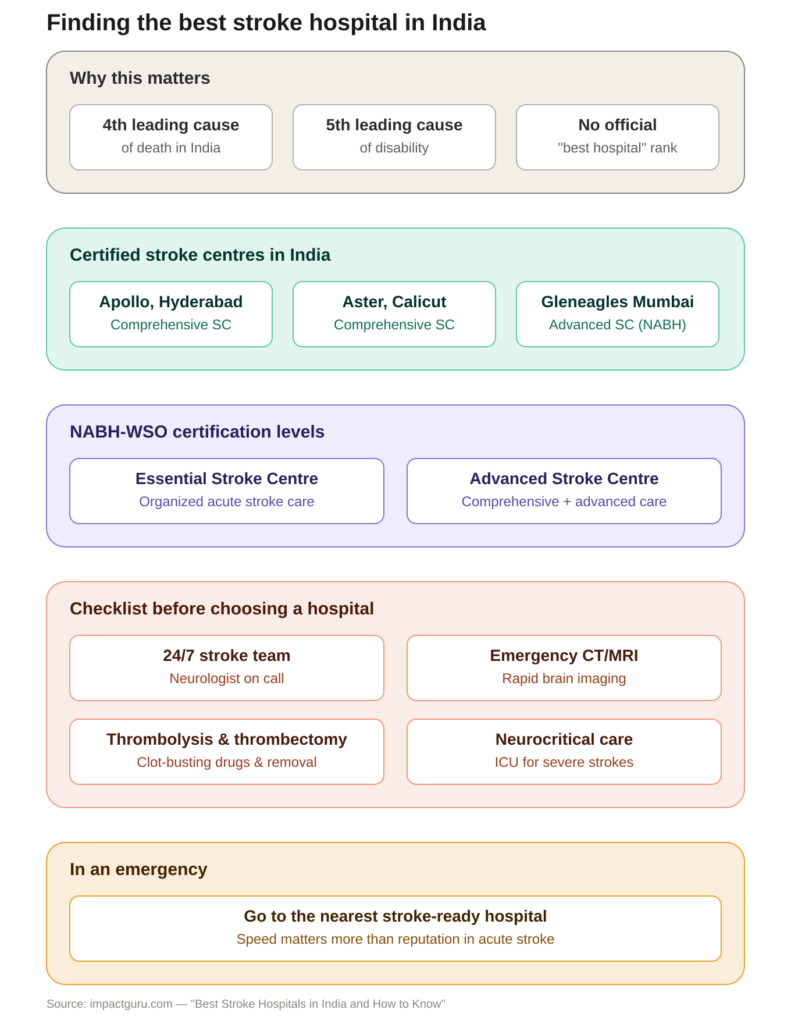
A stroke can turn an ordinary day into a medical emergency within minutes. In India, stroke is the fourth leading cause of death and fifth leading cause of disability, according to a systematic review published in the International Journal of Stroke.
That makes choosing the right hospital more than a question of reputation. A hospital treating stroke patients should be able to rapidly determine whether the stroke is caused by a blood clot or bleeding, provide appropriate emergency treatment, and escalate care when advanced procedures are needed. The World Health Organization emphasizes that suspected stroke should be treated as a medical emergency, with brain imaging performed as soon as possible.
This guide covers some of the best stroke hospitals in India with independently verifiable stroke-care certifications, explains what those certifications mean, and provides a practical checklist for choosing a stroke hospital when certification is not available nearby.
Best Stroke Hospitals in India
No single government or national ranking officially declares one hospital the “best” stroke hospital in India. Instead, patients and families can look at formal stroke-care certifications, specialist availability, emergency response systems, advanced imaging, neurocritical care, and the ability to perform procedures such as mechanical thrombectomy.
Based on publicly verifiable certification announcements and current certification information, the following hospitals are among the notable certified stroke centres in India.
| Hospital | City | Stroke-care certification/recognition | Why it is notable |
| Apollo Hospital | Hyderabad, Telangana | American Stroke Association Comprehensive Stroke Center | One of India’s first two hospitals to receive ASA Comprehensive Stroke Center certification |
| Aster Hospital | Calicut/Kozhikode, Kerala | American Stroke Association Comprehensive Stroke Center | One of India’s first two hospitals to receive ASA Comprehensive Stroke Center certification |
| Gleneagles Hospital, Parel | Mumbai, Maharashtra | WSO–NABH Advanced Stroke Centre | Mumbai’s first hospital to receive NABH Advanced Stroke Centre certification |
The American Stroke Association announced on March 20, 2025, that Apollo Hospital in Hyderabad and Aster Hospital in Calicut were the first hospitals in India certified as Comprehensive Stroke Centers under its programme.
Important: This is not a numerical ranking. Certification programmes use defined standards, but certification alone does not mean one hospital is clinically superior to every other hospital in India. Availability of appropriate treatment, distance, emergency response time, individual patient needs, and the treating team’s expertise all matter.
Apollo Hospital, Hyderabad: Comprehensive Stroke Center
Apollo Hospital in Hyderabad was one of the first two hospitals in India to receive Comprehensive Stroke Center certification from the American Stroke Association in 2025. The certification recognizes hospitals that meet defined standards for complex stroke care, including advanced imaging and treatment capabilities, specialized staff, and 24/7 availability of specialized stroke treatments.
For patients, the significance of Comprehensive Stroke Center certification is that the hospital has undergone an external assessment against specific stroke-care requirements rather than simply describing itself as a specialist stroke hospital.
Families considering the hospital for stroke treatment should still confirm the availability of the required intervention at the time of admission, particularly if mechanical thrombectomy or another time-sensitive procedure may be needed.
Aster Hospital, Calicut Comprehensive Stroke Center
Aster Hospital in Calicut, Kerala, was the second of the first two hospitals in India certified as a Comprehensive Stroke Center by the American Stroke Association.
Aster MIMS Kozhikode describes its certified stroke programme as incorporating advanced diagnostic capabilities, treatment for complex stroke cases, multidisciplinary expertise, and post-stroke care. The hospital also highlights its emergency response system and advanced cath-lab infrastructure.
For patients in Kerala and surrounding regions, the hospital’s location can be an important practical advantage when advanced stroke care is needed quickly.
Gleneagles Hospital, Parel, Mumbai: Advanced Stroke Centre
Gleneagles Hospital in Parel, Mumbai, received WSO–NABH Advanced Stroke Centre certification in January 2026. The hospital states that the certification followed an assessment of its infrastructure, clinical protocols, emergency response systems and stroke outcomes. Gleneagles Hospital’s certification announcement
Its stroke programme includes neurology, neurosurgery, interventional specialists and critical-care support. The hospital also reports having a dedicated Neuro Critical Care Unit for patients with serious neurological conditions, including acute stroke.
The certification is particularly relevant for patients looking for an advanced stroke centre in Mumbai. However, during an acute stroke, families should prioritize reaching an appropriate stroke-ready emergency facility quickly rather than delaying treatment to travel across the city.
Find the Best Hospitals in India – and Fund Your Treatment with ImpactGuru.
What Is a Comprehensive Stroke Center?
A Comprehensive Stroke Center is a hospital that meets rigorous standards for managing complex and severe stroke cases.
Under the American Stroke Association’s certification framework, Comprehensive Stroke Centers must demonstrate advanced imaging and treatment capabilities, specialized treatment availability around the clock, appropriate staff training, and participation in stroke-related research. Hospitals are assessed by surveyors to determine whether they meet the required standards.
In practical terms, a comprehensive stroke centre should be equipped to handle patients who may require more than basic emergency stroke treatment. Depending on the patient’s condition, this can include:
- Rapid CT or MRI-based diagnosis
- Specialist neurological assessment
- Intravenous thrombolysis for eligible ischemic stroke patients
- Mechanical thrombectomy when indicated
- Neurocritical care
- Neurosurgical support when required
- Management of complex ischemic and hemorrhagic strokes
- Coordinated rehabilitation and follow-up
Not every person with a stroke will need every one of these services. The appropriate treatment depends on the type of stroke, location of the blockage or bleeding, severity, time since symptoms began, and other medical factors.
What Is an Advanced Stroke Centre Under NABH–WSO?
India’s NABH–WSO Joint Stroke Centre Certification Programme provides another framework for assessing stroke hospitals.
The programme currently recognizes two levels:
- Essential Stroke Centre: Designed for hospitals providing organized acute stroke care with appropriate infrastructure, workforce, and processes for timely assessment, diagnosis, treatment, and ongoing management.
- Advanced Stroke Centre: Designed for hospitals providing comprehensive stroke services, including advanced diagnostics, specialized multidisciplinary care, advanced stroke interventions, and leadership within regional stroke systems.
The distinction is important because Advanced Stroke Centre is the current terminology used by NABH–WSO. Older articles may refer to “Primary Stroke Centre” certification, particularly when discussing the programme’s earlier stages.
The NABH certification pathway includes implementation of applicable standards, application, document review, an on-site assessment, and Certification Committee review before certification is granted.
Best Stroke Hospitals in India for Advanced Stroke Treatment
When comparing hospitals for advanced stroke treatment, look beyond the hospital’s general reputation. Ask whether it can provide the specific treatment a patient may need.
Rapid Brain Imaging
A suspected stroke generally requires urgent brain imaging to distinguish an ischemic stroke caused by a blocked blood vessel from a hemorrhagic stroke caused by bleeding. The WHO recommends immediate diagnostic imaging with CT or MRI when stroke is suspected.
A stroke-ready hospital should therefore have reliable access to emergency imaging rather than relying on limited daytime availability.
Thrombolysis
Some patients with ischemic stroke may be eligible for intravenous clot-busting treatment. The 2026 American Heart Association/American Stroke Association guideline endorses either alteplase or tenecteplase within the 4.5-hour thrombolytic treatment window for eligible patients, while also recognizing extended-window treatment for selected patients based on advanced imaging.
This does not mean every stroke patient can receive thrombolysis. Doctors must determine eligibility based on the patient’s clinical presentation, imaging, medical history, and timing.
Mechanical Thrombectomy
Some ischemic strokes are caused by large blood-vessel blockages and may require mechanical thrombectomy, a procedure that physically removes the clot from the blood vessel.
The 2026 AHA/ASA guideline has expanded recommendations for endovascular thrombectomy and emphasizes appropriate rapid triage to thrombectomy-capable stroke centres.
If a hospital cannot perform thrombectomy, it should have an established process for rapidly transferring eligible patients to a facility that can.
Neurocritical Care
Severe strokes can require intensive monitoring and management of complications. A dedicated neuro-ICU or specialized neurological critical-care service can therefore be an important consideration when comparing hospitals for serious cases.
Multidisciplinary Stroke Care
Stroke recovery does not end when the emergency procedure is completed. Depending on the patient’s disability, rehabilitation may involve physiotherapy, occupational therapy, speech and language therapy, swallowing assessment, nutrition and psychological support.
A hospital with coordinated post-stroke care can help connect acute treatment with rehabilitation and follow-up.
Read More : Ischemic vs Hemorrhagic Stroke: Causes, Symptoms & Differences
How to Choose the Best Stroke Hospital in India
Certification is useful, but it should not be the only factor.
Before choosing a hospital for planned stroke care—or, ideally, before an emergency occurs—consider these questions:
Is a stroke team available 24/7?
Ask whether neurologists, emergency physicians, radiologists, and trained nursing staff are available around the clock.
Can the hospital perform emergency CT or MRI?
The hospital should be able to diagnose the type of stroke rapidly, including outside normal working hours.
Can it provide thrombolysis?
Ask whether eligible ischemic stroke patients can receive clot-busting treatment promptly.
Can it perform mechanical thrombectomy?
If not, ask which thrombectomy-capable hospital it transfers patients to and how quickly those transfers are arranged.
Does it have neurocritical care?
This can be particularly important for patients with severe strokes, brain swelling, reduced consciousness, or other complications.
Does it have neurosurgical and interventional expertise?
Some patients may need neurosurgery or endovascular procedures depending on the type and cause of the stroke.
What rehabilitation services are available?
Recovery may require weeks or months of rehabilitation, so access to physiotherapy, speech therapy, and other rehabilitation services can be valuable.
Best Stroke Hospital for Emergency Treatment: Does Distance Matter?
Yes. In an acute stroke, speed should be a major part of the decision.
The WHO describes suspected stroke as a medical emergency requiring rapid diagnosis and treatment. The 2026 AHA/ASA guidance similarly emphasizes rapid diagnosis, imaging, and appropriate routing to thrombectomy-capable centres when large-vessel occlusion is suspected.
That means the “best” hospital on paper may not be the best immediate destination if it is several hours away.
For example, a nearby hospital with 24/7 CT imaging and thrombolysis capability may be the appropriate first destination, with transfer to a higher-level stroke centre arranged if the patient requires a procedure that is not available there.
If you have time to plan, identify:
- The nearest hospital with a 24/7 emergency department
- Whether it has a dedicated stroke team
- Whether thrombolysis is available
- Whether mechanical thrombectomy is available
- Which higher-level centre it transfers complex cases to
- How the hospital handles stroke emergencies after normal working hours
Having this information before an emergency can save valuable time.
Read More : Best Neurosurgery Hospitals in Mumbai (2026)
Read More : Which Hospitals Accept PM Relief Fund? A Complete 2026 Guide
Comprehensive vs Essential Stroke Centres: What’s the Difference?
The two levels serve different purposes.
An Essential Stroke Centre is designed to provide organized acute stroke care, including timely assessment, diagnosis and treatment.
An Advanced Stroke Centre provides a broader range of comprehensive stroke services, including advanced diagnostics, multidisciplinary care and advanced stroke interventions.
This does not mean that an Essential Stroke Centre is incapable of providing useful or lifesaving treatment. It may be exactly where a patient should initially be taken, particularly when it is closer.
The key question is whether the hospital can provide the treatment the patient needs and, if not, whether it can transfer the patient rapidly to an appropriate advanced centre.
How Are Stroke Centers Certified in India?
India now has multiple stroke-care certification pathways.
American Stroke Association Certification
The American Stroke Association, a division of the American Heart Association, introduced stroke centre certification in India. Its Comprehensive Stroke Center certification assesses whether hospitals meet defined standards for advanced stroke diagnosis and treatment, specialized staffing, and 24/7 availability of specialized treatments.
Apollo Hospital, Hyderabad, and Aster Hospital, Calicut, were the first two Indian hospitals to receive this Comprehensive Stroke Center certification.
NABH–WSO Joint Stroke Centre Certification
The NABH–WSO programme combines NABH’s healthcare quality assessment expertise with the World Stroke Organization’s stroke-care standards.
The programme now allows hospitals to seek certification as either Essential or Advanced Stroke Centres, depending on their infrastructure, workforce, services and stroke-care capabilities.
The World Stroke Organization announced the national roll-out of the NABH–WSO programme in India in June 2026, encouraging hospitals across the country, including public and private facilities, to begin their certification journey.
Because this programme is expanding, the number of certified hospitals can change over time.
Does Stroke Certification Mean a Hospital Is Always the Best Choice?
Not necessarily.
Certification is an important quality indicator because it shows that a hospital has been assessed against defined standards. But it does not eliminate practical considerations such as distance, emergency response time, availability of specialists, bed capacity, treatment availability at that particular moment, and the patient’s clinical condition.
A hospital without a formal stroke certification may still have an experienced neurology team and strong stroke services. Conversely, a certified hospital may not always be the appropriate destination for every patient.
For that reason, certification should be treated as one part of the decision, not a substitute for emergency medical judgment.
How to Check Whether a Hospital Is Stroke-Certified
If a hospital claims to be a certified stroke centre, check the certification source rather than relying solely on advertising.
You can look at:
- NABH’s current certification information
- World Stroke Organization stroke-centre information
- American Stroke Association/American Heart Association announcements
- The hospital’s official certification announcement
The World Stroke Organization’s current certification programme uses a structured process involving hospital registration, self-assessment, document and quality-data submission, review, and a certification decision. Certification is valid for three years, with ongoing quality monitoring requirements.
NABH similarly describes an application, assessment, and Certification Committee review process before certification is granted.
Because certification programmes and participating hospitals can change, readers should verify a hospital’s current status before making a planned-care decision.
What Does Stroke Treatment Cost in India?
The cost of stroke treatment can vary substantially depending on the type and severity of stroke, treatment required, hospital, ICU stay, procedures, length of hospitalization, and rehabilitation needs.
An ischemic stroke requiring only medical management can have very different costs from a complex case requiring mechanical thrombectomy, prolonged neurocritical care, or rehabilitation.
Families should ask the hospital for a written estimate covering:
- Emergency evaluation
- Imaging and laboratory tests
- ICU or ward charges
- Procedures
- Specialist fees
- Medicines
- Rehabilitation
- Follow-up care
If you are comparing hospitals, do not select a facility based on the lowest quoted cost alone. In an acute stroke, the ability to deliver appropriate treatment quickly is critical.
Read More : Stroke Treatment Cost in India: A City-Wise Guide
How Medical Crowdfunding Can Help With Stroke Treatment Costs
A sudden stroke can place considerable financial pressure on a family, particularly when hospitalization, procedures, ICU care, and rehabilitation are involved. Insurance may not cover every expense, and families may not have enough savings available for an unexpected medical emergency.
This is where medical crowdfunding platforms can provide another source of financial support.
Through donation-based crowdfunding, families can create an online fundraiser and seek contributions from friends, relatives, and other supporters.
On ImpactGuru, campaigners can create a medical fundraiser, provide details about the patient’s treatment and hospital estimate, upload supporting medical documents, and share the campaign with their network.
This can be particularly useful when families need to raise donations online while treatment is already underway.
Crowdfunding for health issues should not replace health insurance, government assistance, or other available financial resources, but it can supplement them when there is a funding gap.
Read More : How to Raise Funds for Stroke Rehabilitation Treatment?
Read More : How to Raise Money for ICU Hospital Bills in India

Conclusion
Finding the best stroke hospital in India is not simply about choosing the biggest or most famous hospital. Look for a centre with rapid emergency assessment, appropriate brain imaging, specialist stroke expertise, thrombolysis capability, access to mechanical thrombectomy when required, neurocritical care, and a clear transfer pathway for complex cases. Formal certifications from organizations such as the American Stroke Association and the NABH–WSO programme can provide an additional quality signal. Most importantly, do not delay emergency treatment while searching for the “perfect” hospital. If stroke treatment creates a sudden financial burden, ImpactGuru can help families raise donations online through medical crowdfunding and connect with a wider donor community.
Frequently Asked Questions
There is no single official national ranking of the best stroke hospitals. Among hospitals with publicly verifiable formal certifications, Apollo Hospital, Hyderabad, and Aster Hospital, Calicut, were the first Indian hospitals certified as Comprehensive Stroke Centers by the American Stroke Association, while Gleneagles Hospital, Parel, Mumbai, received WSO–NABH Advanced Stroke Centre certification in January 2026.
A Comprehensive Stroke Center is a hospital certified against defined standards for managing complex stroke cases. The American Stroke Association’s requirements include advanced imaging and treatment capabilities, specialized staff, and 24/7 availability of specialized stroke treatments.
An Essential Stroke Centre is designed to provide organized acute stroke care, while an Advanced Stroke Centre provides comprehensive stroke services, including advanced diagnostics, multidisciplinary care, and advanced stroke interventions.
No. The appropriate hospital depends on the type and severity of the stroke and the treatment required. A nearby Essential Stroke Centre may be the right first destination, particularly when rapid assessment and initial treatment are needed. Patients requiring advanced procedures may subsequently be transferred to a higher-level centre.
Stroke should be treated as a medical emergency. Rapid imaging and treatment are essential, and some time-sensitive treatments are most effective when delivered as early as possible.
Mechanical thrombectomy can be used for selected patients with ischemic stroke caused by certain large-vessel blockages. Eligibility depends on clinical and imaging findings, and current guidelines have expanded the circumstances in which endovascular thrombectomy may be considered.
Families facing a treatment-related funding gap can consider donation-based medical crowdfunding. On ImpactGuru, campaigners can create a fundraiser, add medical and hospital information, upload supporting documents, and share the campaign with potential donors.