

Table of Contents
- Quick summary
- Introduction
- How Much Do ICU Hospital Bills Cost in India?
- What Affects ICU Hospital Bills in India?
- What Do ICU Hospital Bills Actually Include?
- Why Insurance Often Doesn’t Cover the Full ICU Bill
- How to Raise Funds for ICU Hospital Bills: Step-by-Step
- What Makes an ICU Fundraiser Successful
- Crowdfunding vs. Loans for ICU Hospital Bills
- Using ImpactGuru to Raise Funds for ICU Hospital Bills
- Conclusion
- FAQs
Quick summary
- Families searching for how to raise money for ICU hospital bills in India often face daily charges of ₹15,000–₹1,00,000+, with costs escalating fast in private hospitals.
- ICU bills combine bed charges, ventilator support, nursing, medication, and diagnostics; few insurance policies cover the full amount.
- Crowdfunding lets families raise funds within hours, with partial withdrawals so money reaches the hospital before the full target is hit.
- A 6-step fundraiser process- create the campaign, upload documents, set an itemised goal, share widely, withdraw partially, update donors- drives success.
- ImpactGuru has supported over 50,000 patients with a 0% platform fee, document verification, and 80G tax benefits for donors.
Introduction
When a loved one is rushed into the ICU, families rarely have time to think about money, but ICU hospital bills in India add up fast, often crossing ₹1 lakh within the first week. Between ventilator support, round-the-clock monitoring, and specialist consultations, the daily charges alone can outpace what most families have set aside for a medical emergency.
Insurance helps, but sub-limits on ICU charges and room rent mean out-of-pocket costs are common even for insured families. This is where crowdfunding has become a practical, fast option, letting families raise money for ICU hospital bills from their network and beyond, without taking on debt.
This guide covers what ICU hospital bills typically cost in India, how crowdfunding can help cover them, and the exact steps to launch a fundraiser that reaches its goal, using crowdfunding platforms like ImpactGuru.
How Much Do ICU Hospital Bills Cost in India?
ICU costs vary by hospital type, city, and the level of care required. Here’s a general breakdown (figures are indicative; always confirm current rates with your treating hospital):
| ICU Care Type | Estimated Daily Cost (INR) |
| Government hospital ICU | ₹2,000 – ₹10,000/day |
| Private hospital — basic ICU care | ₹15,000 – ₹30,000/day |
| Private hospital — ICU with ventilator support | ₹25,000 – ₹50,000+/day |
| Advanced ICU (critical/multi-organ cases) | ₹50,000 – ₹1,00,000+/day |
Source: Cost ranges compiled from hospital billing patterns and cross-referenced with the Ministry of Health and Family Welfare and National Health Authority (Ayushman Bharat/PM-JAY) published guidance. Confirm current figures with your treating hospital, as costs vary by city and hospital tier.
For a full week-long ICU admission, private hospital bills typically range from ₹70,000 to ₹3,50,000+, and can climb higher if surgery or advanced life support is involved. A 2024 study in Health Research Policy and Systems on India’s out-of-pocket health spending found that critical care hospitalisation is one of the leading causes of catastrophic household health expenditure, pushing families to sell assets, borrow at high interest, or delay treatment altogether.
What Affects ICU Hospital Bills in India?
ICU hospital bills vary widely from patient to patient because of a few key factors:
- Type and severity of illness or injury – trauma, cardiac events, and multi-organ complications require more intensive (and expensive) care than a stable, single-issue admission.
- Length of ICU stay – costs scale directly with each additional day, which is why setting a buffer in your fundraiser goal matters.
- Hospital location – metro-city ICUs (Mumbai, Delhi, Bangalore) generally charge more than hospitals in smaller cities.
- Ventilator or specialised equipment need – mechanical ventilation alone can add ₹5,000–₹15,000/day to the bill.
For a full breakdown of what drives each of these costs, see our detailed guide: ICU Cost in India: Per Day Charges Breakdown.
What Do ICU Hospital Bills Actually Include?
ICU charges are rarely a single line item; they combine several cost centres, each billed separately:
- ICU Bed Charges: Base admission and infrastructure cost, typically ₹5,000–₹15,000/day.
- Ventilator & Life Support Charges: ₹5,000–₹15,000/day when mechanical ventilation is required.
- Doctor & Specialist Consultation Fees: Intensivist and specialist visits, ₹1,000–₹5,000/day.
- Nursing Charges: 24/7 monitoring and critical care nursing, ₹2,000–₹6,000/day.
- Monitoring Equipment: Cardiac monitors, oxygen support, infusion pumps, ₹2,000–₹8,000/day.
- Medications & Consumables: IV fluids, injections, PPE, syringes, ₹3,000–₹10,000/day.
- Diagnostic Tests: Blood work, X-rays, CT scans as needed, ₹2,000–₹10,000/day.
- Emergency Procedures: Any interventions required during the stay, ₹5,000–₹20,000+ per procedure.
Crowdfunded money can go toward any of these documented costs; there’s no restriction on which specific ICU expense the funds are used for.
Why Insurance Often Doesn’t Cover the Full ICU Bill
- Most health policies cap ICU room rent and daily charges at a fixed sub-limit; anything above it is out-of-pocket.
- Pre-existing condition waiting periods can mean a recent policy doesn’t cover the admission at all.
- Cashless claims can be delayed or partially rejected, leaving the family to pay upfront and claim reimbursement later, while the hospital still expects payment during the stay.
- Daily-wage workers, gig workers, and the self-employed frequently have no health cover at all.
Crowdfunding fills this gap directly; money reaches the hospital while the family is still mid-treatment, not months later after a claims dispute is resolved.
Read More : How Can I Raise Funds Online for Medical Treatment?
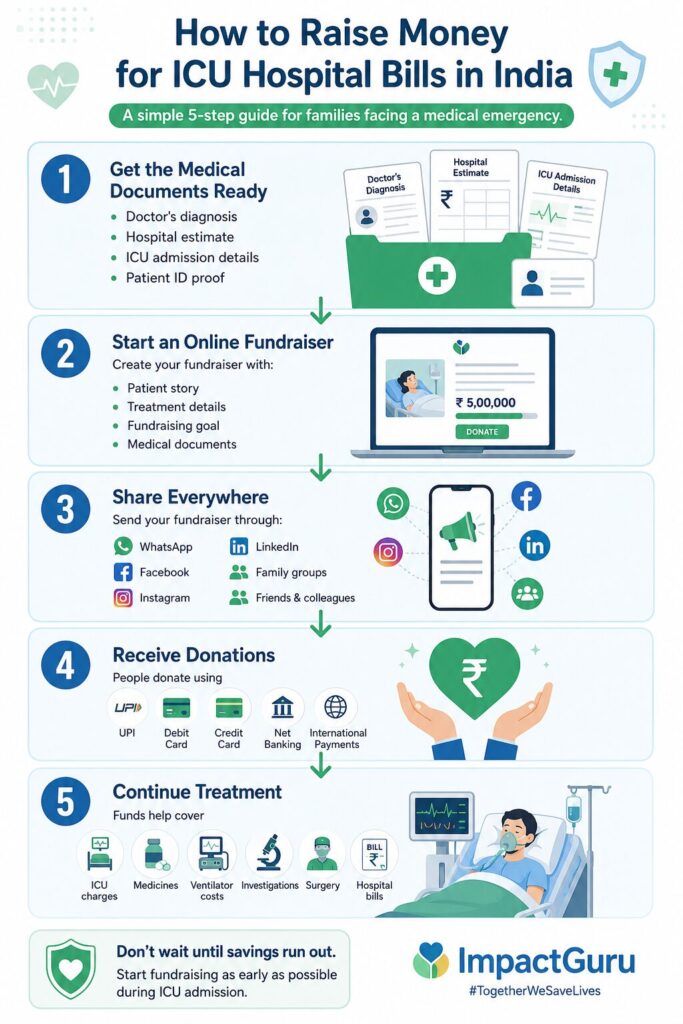
How to Raise Funds for ICU Hospital Bills: Step-by-Step
Step 1: Start the Campaign: Create a fundraiser with the patient’s condition, diagnosis, and why ICU care is needed. This takes about 15–20 minutes on most platforms.
Step 2: Upload Supporting Documents: ICU admission papers, doctor’s notes, hospital bills, and diagnosis reports are uploaded for verification before the campaign goes live.
Step 3: Set an Itemised, Realistic Goal: Use the hospital’s daily ICU rate (see the cost table above) multiplied by the expected duration, plus a buffer for extended stay or added procedures.
Step 4: Share the Campaign Immediately: ICU situations are urgent by nature. Share across WhatsApp, Instagram, Facebook, and email right away; the first 48 hours typically bring the highest donation volume.
Step 5: Withdraw Funds as Needed: Most platforms allow partial withdrawals, so money can reach the hospital daily or every few days rather than waiting for the full goal.
Step 6: Post Regular Updates: Share the patient’s condition and how funds are being used. ICU updates, improving vitals, and moving out of critical care tend to bring in additional donations as the story develops.
What Makes an ICU Fundraiser Successful
- Urgency, stated clearly: ICU campaigns move fast when the story explains exactly why immediate funds are needed; donors respond to time-sensitive need.
- Itemised cost breakdown: Showing the daily ICU rate and total estimate (rather than a round number) builds donor confidence that the ask is accurate.
- Frequent updates: Even a short daily update, “Dad is stable, still on ventilator,” keeps donors engaged and often triggers repeat donations.
- Photos and documents: Verified medical documents and patient photos (with consent) increase both approval speed and donor trust.
- A dedicated campaign manager: For families overwhelmed by the hospital situation, a platform-assigned relationship manager can run outreach on their behalf.
Crowdfunding vs. Loans for ICU Hospital Bills
A medical loan for ICU bills means EMIs and interest payments that continue long after the patient is discharged, often for months or years, regardless of the family’s financial recovery.
Crowdfunded donations don’t need to be repaid. There’s no credit check, no processing delay, and campaigns can start receiving donations within hours, which matters when ICU bills are due daily, not at the end of treatment.
Using ImpactGuru to Raise Funds for ICU Hospital Bills
ImpactGuru has supported over 50,000 patients through a donor community of more than 36 lakh individuals, with fundraisers available at a 0% platform fee.
What helps specifically with ICU fundraising:
- 24/7 Support During Emergencies: Campaign creation support is available round the clock, since ICU admissions don’t happen on a schedule.
- Fast Document Verification: Campaigns are reviewed and go live quickly so funds can start coming in without delay.
- GEM (Give Every Month) Donors: A recurring donor community that supports verified medical campaigns beyond the fundraiser’s personal network.
- 80G Tax Benefits: Donors receive tax certificates, which often encourages larger contributions from working professionals and corporates.
- Partial Withdrawals: Funds can be withdrawn as they come in, matching how ICU bills are typically charged, daily or every few days.
Read More : How to Run a Successful Crowdfunding Campaign in India?

Conclusion
ICU hospital bills in India can escalate within days, and most families aren’t financially prepared for costs that can cross ₹1 lakh in a week. Crowdfunding has become a fast, practical way to raise money for ICU hospital bills, reaching donors within hours and providing funds while treatment is still ongoing. Platforms like ImpactGuru make it possible to start a fundraiser in minutes and get the support needed during a critical care emergency.
Disclaimer: Medical costs, insurance terms, and platform features vary. Always verify current fee structures and eligibility criteria directly with the relevant hospital or platform.
FAQs
ICU hospital bills in India typically range from ₹15,000 to ₹30,000 per day for basic private ICU care, and ₹25,000 to ₹50,000+ per day if ventilator support is needed. Advanced or critical-care ICU can exceed ₹1,00,000 per day. Government hospital ICU care is significantly cheaper, ranging from ₹2,000 to ₹10,000 per day.
You can raise funds for ICU hospital bills by starting a fundraiser on a medical crowdfunding platform: create a campaign describing the patient’s condition, upload ICU admission papers and hospital bills for verification, set an itemised daily-cost-based goal, share it across social media and messaging apps immediately, and withdraw funds partially as bills come due.
It’s an online method of collecting donations from friends, family, and even strangers to cover ICU-related hospital expenses, without taking on loan debt or interest payments.
Yes. Family members, friends, or colleagues can create and manage the fundraiser while the patient is in the ICU, and share it across their own networks for wider reach.
Most platforms require ICU admission records, doctor’s notes, itemised hospital bills, patient ID proof, and a cost estimate from the treating hospital to verify the campaign.
Well-documented, actively shared ICU campaigns can start receiving donations within hours, since the urgency of the situation typically drives quick responses from close contacts first.
Crowdfunding avoids the interest and EMI burden of a loan, since donations generally don’t need to be repaid, though many families combine crowdfunding with insurance and personal savings for full coverage.