


Table of Contents
- Quick Summary
- Introduction
- What Is a Traumatic Brain Injury (TBI)?
- Types of Traumatic Brain Injury: Closed vs. Penetrating
- Mild, Moderate, and Severe TBI: Understanding the Severity Levels
- Common Causes of Traumatic Brain Injury in India
- Signs of Brain Injury After an Accident: Symptoms by Severity
- When a Head Injury Becomes an Emergency: Blood Clots and Brain Haemorrhage
- What to Do If You Suspect a TBI
- Paying for TBI Treatment: Where Crowdfunding Fits In
- Conclusion
- FAQs
Quick Summary
- Traumatic brain injury symptoms range from a brief daze to complete loss of consciousness, depending on how severe the injury is
- TBI is classified as mild, moderate, or severe, and as closed or penetrating based on how the injury happens
- Road traffic accidents cause the majority of TBIs in India, followed by falls and assaults.
- Some TBIs cause internal bleeding or a blood clot in the brain, which can require emergency surgery.
- Recognizing symptoms early, especially after a fall or accident, can be the difference between timely treatment and lasting damage.
Medical Disclaimer: This content is for informational purposes only and is not a substitute for professional medical advice, diagnosis, or treatment. Always seek the advice of a qualified physician or emergency medical service with any questions regarding a head injury or medical emergency.
Introduction
An estimated 1.5 to 2 million people in India are injured by a traumatic brain injury every year, and an estimated up to 1 million don’t survive it. Behind that number is a pattern that repeats across emergency rooms nationwide: a two-wheeler accident, a fall from a height, a hard hit during play, and then a waiting period where nobody is quite sure how serious it is. That uncertainty is the danger. Some traumatic brain injury symptoms show up within seconds. Others take hours or even days to surface, by which point the injury may already be worsening. This guide explains how traumatic brain injuries are classified, what critical symptoms to watch for at each severity level, and when a head injury has crossed the line into a medical emergency that needs immediate surgical attention.
What Is a Traumatic Brain Injury (TBI)?
A traumatic brain injury occurs when an external force- a blow, jolt, sudden deceleration, or an object penetrating the skull- disrupts normal brain function. It’s different from conditions like stroke or brain tumors, which originate inside the body; a TBI is, by definition, caused by an outside force acting on the head.
The effects can range from a brief change in mental state to permanent physical, cognitive, or emotional impairment, depending on which part of the brain is affected and how severely. Not every blow to the head causes a TBI, and not every TBI looks dramatic from the outside — which is part of why so many go unrecognized in the first few hours.
Types of Traumatic Brain Injury: Closed vs. Penetrating
Doctors broadly classify TBIs into two structural categories:
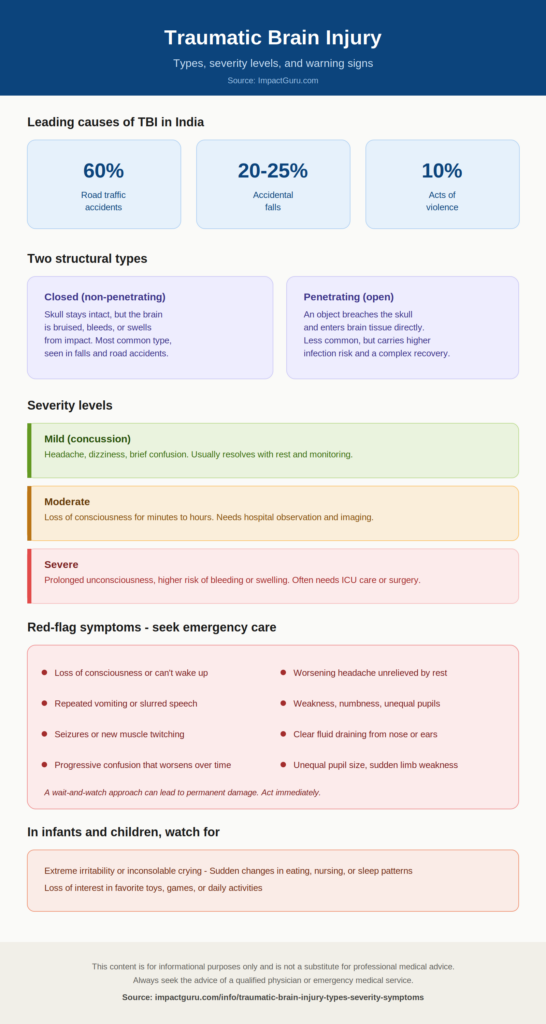
- Closed (non-penetrating) brain injury: the skull remains intact, but the brain itself is damaged by the force of impact or sudden movement. The brain moves inside the skull, which can cause bruising (contusion), bleeding, or swelling that disrupts normal function. This is the more common type of TBI, typically seen in falls, road accidents, and sports injuries.
- Penetrating (open) brain injury: an object breaks through the skull and enters brain tissue directly, causing localized damage along with a higher risk of infection and bleeding. These are less common but tend to carry a more complex recovery path, since the object’s entry point and depth directly determine which brain functions are affected.
Within these two categories, traumatic brain injury symptoms and complications are further defined by their specific injury mechanisms:
- Contusion: Localized bruising of the brain tissue.
- Diffuse Axonal Injury (DAI): Widespread damage to the brain’s connecting nerve fibers caused by rapid twisting or violent movement.
- Hematoma: A dangerous collection of blood that pools outside blood vessels and presses heavily on brain tissue.
Mild, Moderate, and Severe TBI: Understanding the Severity Levels
Beyond the type of injury, doctors grade TBI by severity, and this grading directly shapes what treatment looks like:
- Mild TBI (often called a concussion): headache, dizziness, or a sudden loss of balance that typically resolve with rest and monitoring. Most mild TBI cases don’t require surgery, but still need medical evaluation to rule out complications.
- Moderate TBI: loss of consciousness lasting minutes to hours, more pronounced confusion, and symptoms that may worsen over the following days rather than improve. Moderate cases usually require hospital observation and imaging.
- Severe TBI: prolonged unconsciousness, major changes in behavior or alertness, and a significantly higher risk of complications like brain bleeding or swelling. Severe TBI often requires ICU-level care and, in many cases, emergency surgery.
Critical Warning: A head injury’s true severity is not always obvious in the first few minutes. A patient who seems only mildly dazed at the scene of an accident can deteriorate rapidly over the following hours as internal swelling develops. Immediate medical evaluation matters immensely, even when the injury initially looks minor.
Read More : 20 Things to Expect After Brain Surgery
Common Causes of Traumatic Brain Injury in India
TBI has become one of India’s fastest-growing public health concerns, driven largely by rapid urbanization and the staggering volume of vehicles on the road. According to peer-reviewed Indian epidemiological data, the primary causes include:
- Road Traffic Accidents (RTAs): Account for roughly 60% of all TBI cases nationally. Young adult males are disproportionately affected due to greater exposure to high-speed transit and occupational risks.
- Accidental Falls: Make up 20% to 25% of cases, showing a higher frequency among older adults and domestic scenarios.
- Acts of Violence: Responsible for around 10% of reported traumatic brain injuries.
Because these incidents happen instantly, TBI-related admissions make up a substantial share of emergency trauma hospitalizations across India, leaving families completely caught off guard.
Read More : How to Raise Money for Road Accident Trauma in India
Signs of Brain Injury After an Accident: Symptoms by Severity
Internal structural damage does not always match the external force of an impact; even a minor slip or low-speed collision can cause a severe brain bleed.
Mild TBI Symptoms (Concussion)
- Mental Status: Brief confusion, feeling dazed, or temporary disorientation.
- Physical Signs: Headache, dizziness, or a sudden loss of balance.
- Sensory Issues: Nausea, heightened sensitivity to light, or ringing in the ears.
- Cognitive Shift: Difficulty concentrating or mild short-term memory gaps.
Moderate to Severe TBI Symptoms (Red Flags)
- Altered Consciousness: Loss of consciousness lasting anywhere from minutes to hours, or an inability to wake up from sleep.
- Worsening Pain: A progressive, severe headache that does not respond to rest.
- Neurological Signs: Repeated projectile vomiting, slurred speech, or clear fluid draining from the nose or ears.
- Motor Deficits: Sudden weakness, numbness in the limbs, or unequal pupil sizes.
- Convulsions: Seizures or muscle twitching without prior history.
Emergency Protocol: Any of the red-flag symptoms listed above, particularly seizures, worsening confusion, or an inability to wake someone up, demand immediate emergency medical attention. A wait-and-watch approach can lead to permanent damage.
Traumatic Brain Injury Symptoms in Infants and Children
Because infants and toddlers cannot describe a headache or cognitive confusion, caregivers must rely heavily on behavioral changes. Seek medical attention immediately if a child displays:
- Emotional Distress: Extreme irritability or excessive crying that cannot be settled.
- Rhythm Disruptions: Sudden changes in their normal eating, nursing, or sleeping patterns.
- Lethargy: A noticeable loss of interest in their favorite toys, games, or daily activities.
Also Read : Brain Aneurysm Surgery Cost in India: Clipping vs Coiling
When a Head Injury Becomes an Emergency: Blood Clots and Brain Haemorrhage
Some traumatic brain injuries cause bleeding inside or around the brain, a broad category referred to as brain haemorrhage. When blood collects and forms a mass pressing on brain tissue, it’s called a hematoma, commonly described as a blood clot in the brain. This is one of the most serious complications of a head injury, because the growing pressure inside the skull can damage brain tissue rapidly if untreated.
Not every blood clot in the brain after a head injury requires surgery; small, stable clots that aren’t causing significant pressure or symptoms are sometimes managed with close monitoring and repeat imaging instead. But when a clot is large, growing, or causing neurological decline, brain haemorrhage surgery to remove it becomes urgent. This typically means an emergency craniotomy to access and evacuate the clot, followed by close monitoring in a neuro-ICU.
This is also where a head injury’s total cost can shift dramatically, from an observation-only ER visit to an emergency surgery with an extended ICU stay. For a full breakdown of what that kind of emergency treatment typically costs across Indian cities, see our detailed guide on TBI treatment and ICU costs.
Read More : Best Neurosurgery Hospitals in Mumbai (2026)
What to Do If You Suspect a TBI
If someone has hit their head in an accident, a fall, or during sports, and shows any of the moderate-to-severe symptoms above, get them to a hospital with emergency neurological care immediately. Don’t wait for symptoms to “prove” themselves; brain injuries can worsen over hours even when the person initially seems fine.
For milder cases without red-flag symptoms, medical evaluation is still recommended; a doctor can assess whether imaging is needed and advise on safe monitoring at home, including symptoms that should prompt an immediate return to the hospital.
Read More : How to Raise Money for ICU Hospital Bills in India
Paying for TBI Treatment: Where Crowdfunding Fits In
A moderate or severe TBI can turn into a very expensive emergency fast, ICU stays, imaging, and surgery like craniotomy add up quickly, often with little time to plan financially. Health insurance may cover part of the cost, but waiting periods, claim delays, or coverage gaps can leave families short exactly when speed matters most.
This is where crowdfunding for medical treatment has become a practical option for many Indian families. Setting up a fundraiser lets you reach family, friends, and even strangers willing to help, often faster than a loan approval, and without the burden of repayment. Through online crowdfunding, all it typically takes to fundraise online is sharing the diagnosis, the hospital’s cost estimate, and your story on a platform like ImpactGuru, so your community can start contributing right away.

Conclusion
A traumatic brain injury can escalate quickly, and the difference between mild and severe often isn’t visible in the first few minutes. Knowing the warning signs and acting on them without delay genuinely changes outcomes. But recognizing the injury is only the first challenge; for many families, the next is managing the cost of critical care that arrived without warning. If you or a loved one is facing the cost of TBI treatment, ImpactGuru can help you start a fundraiser and reach the people ready to support you. Start your campaign today and get the financial support you need without delay.
FAQs
Early signs often include a brief period of confusion or feeling dazed, headache, dizziness, and nausea. Some symptoms may not appear immediately and can develop over the following hours or days, so medical evaluation is recommended even after a seemingly mild head injury.
Doctors classify TBI as mild, moderate, or severe based on factors like duration of loss of consciousness, level of confusion, and findings on neurological examination and imaging. This grading helps determine the right level of monitoring or treatment.
Outcomes depend heavily on the size and location of the clot, how quickly surgery is performed after symptoms begin, and the patient’s overall health. Prompt treatment generally improves outcomes, which is why recognizing emergency symptoms early matters.
Small, stable blood clots that aren’t causing significant pressure or symptoms are sometimes managed with close monitoring and repeat imaging rather than immediate surgery. A neurosurgeon makes this decision based on the clot’s size, location, and how the patient is responding.
While most mild TBIs (concussions) resolve with rest and time, some patients experience lingering symptoms like headaches, difficulty concentrating, or mood changes for weeks or longer. Anyone with persistent symptoms after a mild TBI should follow up with a doctor.
You can start a campaign by sharing details of the injury, the hospital’s treatment estimate, and your story on the ImpactGuru platform. You can then share the campaign with family, friends, and donors to raise funds quickly during an emergency.