

Table of Contents
- Quick Summary
- Introduction
- What Is Stroke Rehabilitation?
- What Are the Stages of Stroke Recovery?
- Types of Stroke Rehabilitation
- What Therapy Is Used for Stroke Recovery? Choosing the Right Combination
- How Long Does Stroke Rehabilitation Take?
- How to Raise Funds for Medical Treatment After a Stroke
- Conclusion
- FAQs
Quick Summary
- Types of stroke rehabilitation include physical therapy, occupational therapy, speech therapy, cognitive rehabilitation, and technology-assisted therapy, each targeting a different aspect of recovery.
- Stroke recovery occurs in stages, from acute hospital care to long-term home-based therapy, and can span a few weeks to several years, depending on severity.
- A personalised, multi-disciplinary rehabilitation plan combining the right therapies gives stroke survivors the best chance at regaining independence and quality of life.
- Post-stroke care is financially demanding, often running into lakhs, making emergency fundraising and crowdfunding donations a critical lifeline for many Indian families.
- ImpactGuru helps families raise donations online quickly and transparently, so the focus stays on recovery and not financial stress.
Introduction
A stroke can change life in a matter of seconds. One moment, everything is normal, and the next, a person may lose the ability to speak, move, or think clearly. While the medical emergency itself is frightening, what follows, the long road to recovery, is equally challenging, both physically and emotionally.
Stroke rehabilitation helps survivors relearn lost skills, regain independence, and rebuild their quality of life. It is not a single treatment but a combination of therapies tailored to each patient’s specific needs and the area of the brain affected.
This guide breaks down the types of stroke rehabilitation in detail, explains what each therapy involves, and also addresses one of the most pressing real-world concerns families face: the financial burden of prolonged stroke care and how medical crowdfunding platforms like ImpactGuru are helping thousands of families raise funds for medical treatment.
What Is Stroke Rehabilitation?
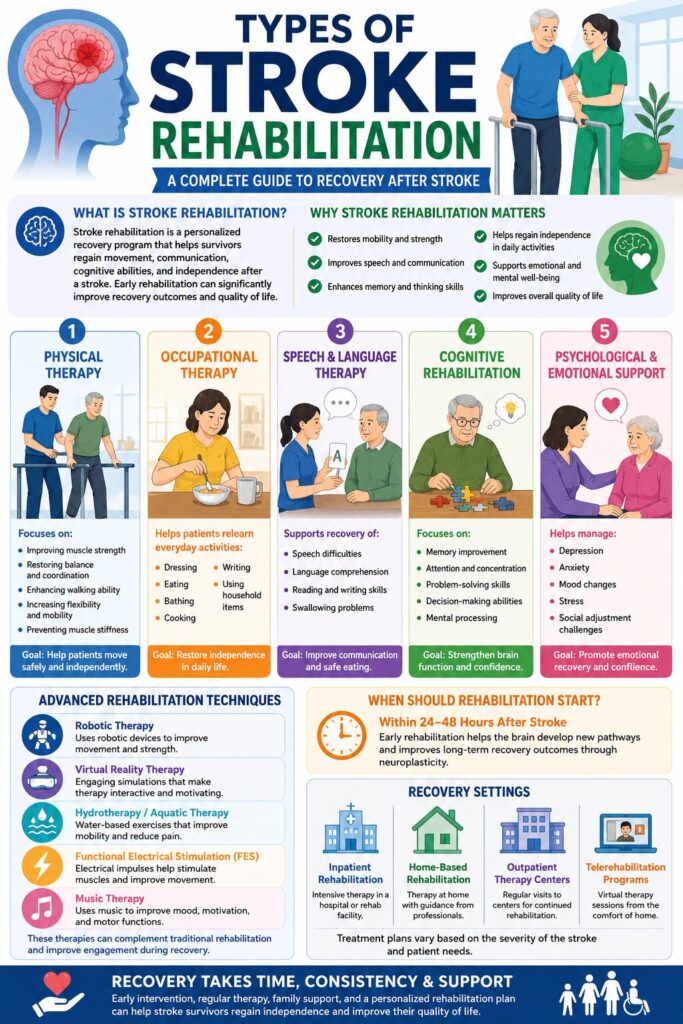
Stroke rehabilitation, or stroke rehab, is a medical and therapeutic program designed to help stroke survivors recover lost functions. The brain has a remarkable ability called neuroplasticity, the capacity to rewire itself and form new neural connections after damage. Rehabilitation leverages this ability through repetitive, targeted exercises and therapies.
The goal of rehabilitation is not just physical recovery. It also addresses speech, cognition, emotional health, and daily living skills, making it a holistic, multidisciplinary process.
Rehabilitation typically begins within 24 to 48 hours after a stroke is stabilized, and can continue for months or even years, depending on the severity.
What Are the Stages of Stroke Recovery?
Understanding the stages of stroke recovery helps set realistic expectations for patients and families.
- Acute Stage (Days 1–7): This stage refers to the medical stabilization. Rehabilitation begins gently in the hospital with basic movement and sitting exercises.
- Subacute Stage (Weeks 2–12): This is the most intensive period of recovery. Patients engage in daily therapy sessions, often at inpatient rehabilitation facilities.
- Chronic Stage (3 months onward): During this stage, recovery continues at a slower but consistent pace. Home-based therapy, outpatient sessions, and assistive technology play a larger role.
- Long-Term Maintenance: This is the ongoing therapy to maintain function, prevent deterioration, and support mental health.
It is also important to understand that recovery is seldom linear. Patients may plateau and then progress again; persistence and the right rehabilitation plan make all the difference.
Types of Stroke Rehabilitation
1. Physical Therapy (PT)
Physical therapy is the cornerstone of stroke rehabilitation. It focuses on restoring motor function, balance, coordination, and mobility.
A physical therapist works with the patient on:
- Relearning how to walk (gait training)
- Strengthening weakened limbs
- Improving balance and preventing falls
- Rebuilding muscle coordination on the affected side
Techniques used include task-specific training, constraint-induced movement therapy (CIMT), neurodevelopmental therapy, and aquatic therapy in some cases. CIMT, for example, involves restraining the unaffected limb to force the brain to strengthen pathways for the affected side.
2. Occupational Therapy (OT)
While physical therapy focuses on movement, occupational therapy focuses on function, specifically, the ability to perform daily tasks independently.
An occupational therapist helps patients relearn:
- Dressing, bathing, and grooming
- Cooking and household tasks
- Writing and fine motor skills
- Using adaptive equipment when needed
OT is especially critical for patients with hemiplegia (one-sided paralysis) or those who have lost fine motor control. The therapy is deeply personalised and takes into account the patient’s home environment and lifestyle.
3. Speech and Language Therapy
A stroke often affects the areas of the brain responsible for language and communication. Speech and language therapy (SLT) addresses:
- Aphasia – difficulty speaking, understanding, reading, or writing
- Dysarthria – slurred or slow speech due to muscle weakness
- Dysphagia – difficulty swallowing, which can be life-threatening if untreated
A speech-language pathologist (SLP) uses exercises, communication aids, and technology-assisted tools to help patients regain or compensate for lost communication abilities. Family members are often trained to support therapy at home.
4. Cognitive Rehabilitation
A stroke can impair memory, attention, problem-solving, and decision-making. Cognitive rehabilitation targets these deficits through structured mental exercises and strategies.
This type of therapy may include:
- Memory training exercises
- Attention and concentration tasks
- Problem-solving activities
- Use of memory aids and digital tools
Neuropsychologists and occupational therapists often collaborate in designing cognitive rehab programs, particularly for patients with vascular dementia or post-stroke cognitive impairment (PSCI).
5. Psychological and Emotional Rehabilitation
Post-stroke depression affects nearly one in three stroke survivors. Anxiety, mood swings, emotional lability (uncontrolled crying or laughing), and PTSD are also common.
Psychological rehabilitation includes:
- Individual counselling and psychotherapy
- Cognitive Behavioural Therapy (CBT)
- Support groups for survivors and caregivers
- Medication management in collaboration with a psychiatrist
Addressing emotional health is not optional; it directly impacts engagement with physical therapy and long-term recovery outcomes.
6. Recreational Therapy
Often underestimated, recreational therapy uses leisure activities to support physical, cognitive, and emotional recovery. Activities like art, music, gardening, and adapted sports help patients:
- Rebuild fine motor skills
- Improve mood and reduce isolation
- Rebuild social connections
- Rediscover purpose and identity
Music therapy, in particular, has shown clinical evidence in supporting speech recovery and motor function in stroke patients.
7. Technology-Assisted Rehabilitation
Advances in rehabilitation technology have opened new doors for stroke recovery, especially for patients in remote areas or those requiring long-term care.
Key technologies include:
- Robotic-assisted therapy – devices that guide limb movement with precision
- Virtual reality (VR) therapy – immersive environments for motor and cognitive rehab
- Neurofeedback and brain stimulation – transcranial magnetic stimulation (TMS) and transcranial direct current stimulation (tDCS) to enhance neuroplasticity
- Tele-rehabilitation – remote therapy sessions via video, increasingly common post-pandemic
These technologies are making high-quality rehabilitation more accessible, though cost remains a significant barrier for many families.
8. Vocational Rehabilitation
For working-age stroke survivors, returning to employment is a major goal. Vocational rehabilitation assesses:
- Residual work capacity
- Required workplace adjustments
- Retraining for new roles if needed
- Legal rights and employer accommodations
This is a growing area of stroke rehab that acknowledges the economic and psychological importance of meaningful work.
What Therapy Is Used for Stroke Recovery? Choosing the Right Combination
No two strokes are alike. The type and intensity of therapy depend on:
- The location and extent of brain damage
- The patient’s age and overall health
- Time elapsed since the stroke
- Availability of rehabilitation resources
- Family and caregiver support
Most patients require a combination of physical, occupational, and speech therapy at a minimum. A multidisciplinary rehabilitation team, including physiatrists, neurologists, therapists, and social workers, typically creates an individualized rehabilitation plan.
How Long Does Stroke Rehabilitation Take?
This is one of the most common questions families ask, and the honest answer is: it depends.
- Mild stroke: Recovery may take a few weeks to 3 months.
- Moderate stroke: Significant progress is typically seen over 6 months, with continued improvement up to 1–2 years.
- Severe stroke: Long-term rehabilitation may be necessary indefinitely, focused on maximizing function and quality of life.
The first three to six months post-stroke represent the most critical window for neurological recovery. However, research consistently shows that patients continue to make meaningful gains well beyond this window with sustained therapy.
The key factors that influence recovery speed and extent are: early initiation of rehab, intensity and consistency of therapy, emotional support, and, critically, access to quality care.
Read More : How to Raise Funds for Stroke Rehabilitation Treatment?
How to Raise Funds for Medical Treatment After a Stroke
Stroke rehabilitation is expensive. Inpatient rehabilitation can cost anywhere from ₹50,000 to several lakhs per month in India, depending on the hospital, location, and therapies required. For many middle-class and lower-income families, this financial pressure becomes as devastating as the medical crisis itself.
This is where emergency fundraising through trusted platforms becomes a lifeline.
ImpactGuru is one of India’s leading medical crowdfunding platforms, specifically designed to help families in exactly these situations. If you or a loved one is navigating post-stroke recovery and struggling with the costs, here is how ImpactGuru can help:
- Create a campaign in minutes: Set up a fundraiser with the patient’s story, medical reports, and treatment costs.
- Raise donations online from across India and globally: Your campaign reaches a wide network of donors, friends, family, corporates, and compassionate strangers.
- Transparent and verified: ImpactGuru verifies medical documents, building donor trust and improving campaign success rates.
- Zero platform fee for medical campaigns: More of every rupee raised goes directly to treatment.
- Dedicated support team: Campaign managers guide you through the process, from creating compelling content to promoting your fundraiser.
Thousands of families across India have used ImpactGuru to successfully raise donations for medical treatment, from ICU bills to long-term rehabilitation costs. Whether you are looking for emergency fundraising support or planning for ongoing care expenses, crowdfunding donations through ImpactGuru makes it possible to raise donations online quickly and with dignity.
Starting a campaign is free. Every share counts. Every donation matters.

Conclusion
Stroke recovery is one of the most demanding journeys a patient and family can face — but it is not without hope. With the right types of stroke rehabilitation, started early and sustained consistently, meaningful recovery is achievable for most survivors.
From physical and occupational therapy to cognitive rehabilitation and cutting-edge technology-assisted approaches, today’s stroke rehab landscape offers more tools than ever before. The challenge for many families, however, lies in accessing and affording these services over the long term.
If the financial burden of stroke treatment is weighing your family down, know that you do not have to carry it alone. ImpactGuru is here to help you raise funds for medical treatment through the power of community and crowdfunding, because no family should have to choose between quality care and financial stability.
Start your fundraiser on ImpactGuru today and take the first step toward healing, together.
FAQs
Stroke rehabilitation is a structured recovery program that helps stroke survivors regain physical, cognitive, speech, and daily living skills affected by a stroke.
Rehabilitation helps improve mobility, communication, independence, and overall quality of life after a stroke.
The main types include physical therapy, occupational therapy, speech and language therapy, cognitive therapy, and psychological rehabilitation.
Physical therapy helps patients regain strength, balance, coordination, and movement in affected limbs.
Occupational therapy helps individuals relearn everyday tasks such as dressing, eating, bathing, and writing.
Speech therapy is recommended for patients who experience difficulty speaking, understanding language, or swallowing.
Many stroke survivors experience significant improvements with rehabilitation, though the extent of recovery depends on the Types of stroke rehabilitation, severity, and timely treatment.