


Table of Contents
- Quick Summary
- Introduction
- What Is a Brain Aneurysm?
- Why Does a Brain Aneurysm Need Treatment?
- Brain Aneurysm Clipping vs Coiling: What’s the Difference?
- Endovascular Coiling vs Surgical Clipping: Which Is Better?
- Brain Aneurysm Surgery Cost in India
- Estimated Brain Aneurysm Surgery Cost by City
- What Affects the Cost of Brain Aneurysm Surgery?
- Ruptured vs Unruptured Brain Aneurysm Treatment Cost
- Choosing the Right Hospital and Neurosurgeon
- How to Fund Brain Aneurysm Surgery When Costs Are High
- Conclusion
- FAQs
Quick Summary
- Brain aneurysm surgery cost in India typically ranges from around ₹2,50,000 to ₹14,00,000 or more in private hospitals, depending on the procedure, hospital, city, aneurysm complexity, and additional care required.
- Surgical clipping is an open procedure and generally costs less than endovascular coiling, although the final price varies from one patient and hospital to another.
- Endovascular coiling may have higher costs because it can require specialised catheters, platinum coils, stents, flow-diverters, and advanced imaging facilities.
- Treatment costs can rise substantially when an aneurysm has ruptured and requires emergency care, prolonged hospitalisation, intensive monitoring, or rehabilitation.
- Health insurance, personal savings, hospital payment arrangements, and crowdfunding for medical treatment can help families manage unexpected treatment expenses.
Introduction
A brain aneurysm can turn from a silent health concern into a life-threatening emergency in a matter of minutes. When an aneurysm ruptures, the sudden bleeding around the brain can cause a severe thunderclap headache and requires immediate medical attention.
For families, the medical emergency can quickly become a financial one too. Brain aneurysm treatment may involve surgery or endovascular procedures, intensive monitoring, hospitalisation, medicines, diagnostic imaging, and rehabilitation. The final bill can therefore vary significantly depending on the patient’s condition and the treatment required.
Understanding the brain aneurysm surgery cost in India before treatment can help patients and families prepare for the possible expenses. This guide explains the cost of clipping and coiling, compares estimated prices across major Indian cities, discusses the factors that affect the final bill, and explores options for managing treatment costs.
What Is a Brain Aneurysm?
A brain aneurysm is a weak, bulging area in the wall of an artery in the brain. It can develop when a weakened section of the blood vessel gradually expands under the pressure of blood flow.
Many unruptured brain aneurysms do not cause noticeable symptoms and may be discovered incidentally during imaging tests such as an MRI or CT scan performed for another reason.
The major concern is that an aneurysm can rupture and cause bleeding around the brain.
Why Does a Brain Aneurysm Need Treatment?
The primary danger of a brain aneurysm is rupture. When an aneurysm bursts, blood can leak into the space surrounding the brain, causing a subarachnoid hemorrhage. This is a medical emergency requiring immediate assessment and treatment.
Not every unruptured aneurysm requires surgery. Depending on factors such as the aneurysm’s size, location, shape, growth, symptoms, and the patient’s overall risk factors, a doctor may recommend monitoring instead of immediate intervention.
Treatment may be considered when the potential risk of rupture outweighs the risks associated with the procedure.
Brain Aneurysm Symptoms
Unruptured aneurysms often cause no symptoms. When symptoms do occur, they may include:
- Pain above or behind the eye
- Vision changes, including blurred or double vision
- A drooping eyelid
- A localised headache
- Difficulty with balance or other neurological symptoms
A ruptured aneurysm typically causes a sudden, severe headache that is often described as a thunderclap headache or the worst headache of a person’s life. Other symptoms can include:
- Neck stiffness
- Nausea and vomiting
- Sensitivity to light
- Confusion
- Seizures
- Loss of consciousness
A suspected ruptured brain aneurysm requires emergency medical care. Do not wait for a routine appointment if these symptoms occur.
Read More : Traumatic Brain Injury: Types, Severity & Symptoms
Read More : Brain Tumor- Symptoms, Causes, Treatments & More
Brain Aneurysm Clipping vs Coiling: What’s the Difference?
Two major approaches used to treat brain aneurysms are surgical clipping and endovascular treatment such as coiling. The appropriate treatment depends on the patient’s individual anatomy and clinical condition.
1. Surgical Clipping
Surgical clipping is an open surgical procedure used to isolate the aneurysm from normal blood circulation.
How it works: A neurosurgeon performs a craniotomy to access the aneurysm and places a small clip across its neck. The clip prevents blood from entering the aneurysm while maintaining blood flow through the parent artery.
Advantages: Clipping is a well-established treatment and can provide durable exclusion of the aneurysm. The risk of recurrence may be relatively low after successful clipping, although follow-up imaging may still be recommended.
Limitations: Because clipping requires opening the skull, it is more invasive than endovascular treatment. Hospitalisation and recovery may also be longer, depending on the patient’s condition and whether the aneurysm has ruptured.
2. Endovascular Coiling
Endovascular coiling treats an aneurysm from inside the blood vessels without opening the skull.
How it works: A specialist guides a thin catheter through a blood vessel, commonly through the wrist or groin, toward the arteries supplying the brain. Soft platinum coils are placed inside the aneurysm to promote clot formation and reduce blood flow into the aneurysm.
In selected cases, additional devices such as stents or flow-diverters may be used depending on the aneurysm’s characteristics.
Advantages: Coiling is minimally invasive and does not require a craniotomy. It may involve less surgical trauma and, in appropriate patients, a shorter initial recovery than open clipping.
Limitations: Endovascular procedures can involve substantial device costs. Some aneurysms treated with coiling may require long-term imaging follow-up because recurrence or reopening can occur, and some patients may require additional treatment.
Read More : 20 Things to Expect After Brain Surgery
Endovascular Coiling vs Surgical Clipping: Which Is Better?
Neither treatment is universally better for every patient.
The choice depends on factors including:
- Aneurysm size
- Aneurysm shape
- Location
- Whether the aneurysm has ruptured
- Blood-vessel anatomy
- Patient age and overall health
- The experience and expertise available at the treating centre
For some aneurysms, clipping may be preferred. For others, endovascular treatment may be more suitable. A neurovascular team should assess the patient’s scans and explain the expected benefits, risks, recovery, and costs of each option.
Cost should be considered when planning treatment, but it should not be the deciding factor when an emergency procedure is medically necessary.
Brain Aneurysm Surgery Cost in India
The brain aneurysm surgery cost in India varies substantially between hospitals and patients.
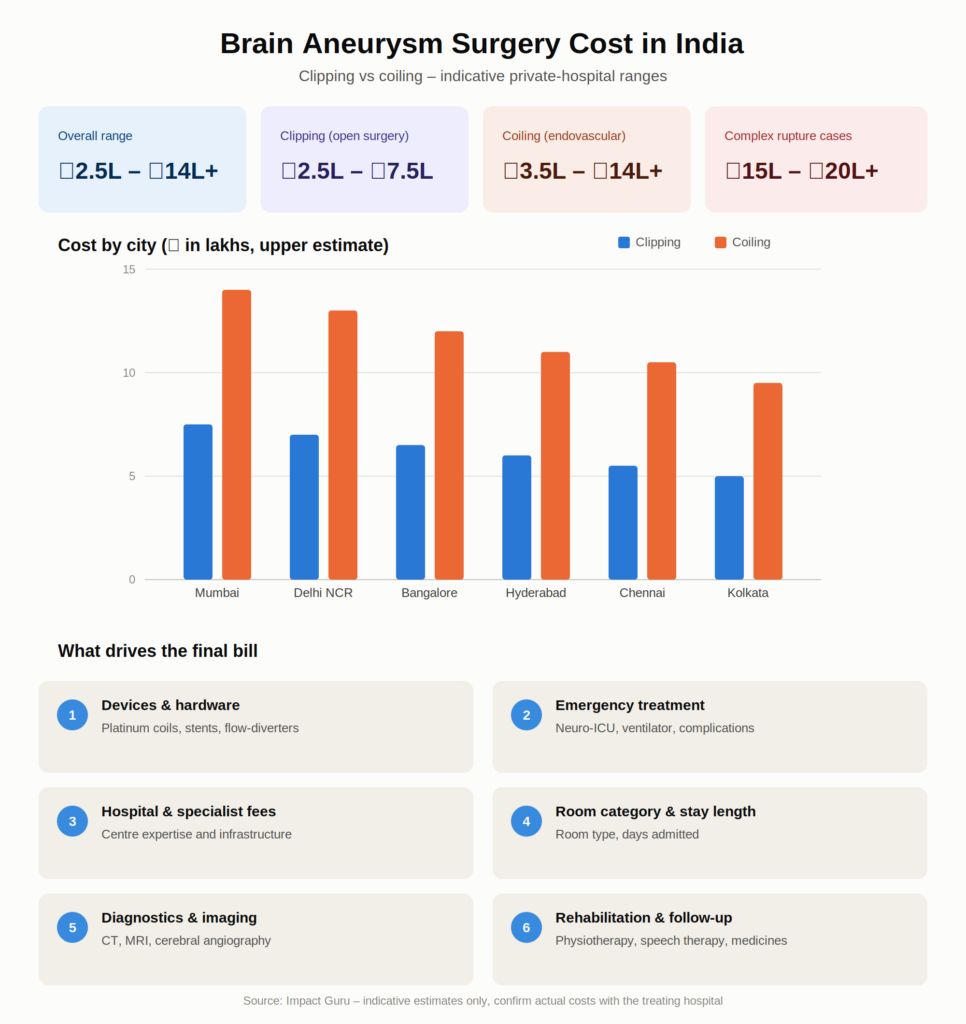
As an indicative private-sector range, surgical clipping may cost approximately ₹2,50,000 to ₹7,50,000, while endovascular coiling may range from approximately ₹3,50,000 to ₹14,00,000 or more when specialised devices and additional treatment are required.
These figures are not fixed package prices. The final hospital bill can change depending on the city, hospital, procedure, aneurysm complexity, room category, length of stay, diagnostic tests, medical devices, complications, and rehabilitation requirements.
Estimated Brain Aneurysm Surgery Cost by City
Treatment costs can differ across major Indian cities because hospitals have different infrastructure, specialist fees, room charges, equipment, and operating costs.
The table below provides indicative private-hospital ranges for domestic Indian patients. Actual prices should be confirmed directly with the treating hospital.
| City | Surgical Clipping Cost Range | Endovascular Coiling Cost Range | Primary Cost Drivers |
| Mumbai | ₹3,50,000 – ₹7,50,000 | ₹5,50,000 – ₹14,00,000+ | Higher hospital infrastructure, room, and ICU costs can increase overall treatment expenses. |
| Delhi NCR | ₹3,00,000 – ₹7,00,000 | ₹4,50,000 – ₹13,00,000 | Advanced neurovascular facilities and specialist care can influence treatment costs. |
| Bangalore | ₹2,80,000 – ₹6,50,000 | ₹4,50,000 – ₹12,00,000 | Technology-intensive tertiary-care facilities and specialist fees can affect pricing. |
| Hyderabad | ₹2,50,000 – ₹6,00,000 | ₹4,00,000 – ₹11,00,000 | Hospital infrastructure, specialist fees, and treatment complexity influence the final bill. |
| Chennai | ₹2,50,000 – ₹5,50,000 | ₹4,00,000 – ₹10,50,000 | Specialist availability and hospital facilities can affect treatment packages. |
| Kolkata | ₹2,20,000 – ₹5,00,000 | ₹3,50,000 – ₹9,50,000 | Hospital category, specialist fees, and length of stay contribute to cost difference |
Note: These are indicative estimates and should not be treated as fixed hospital quotations. Actual costs may vary based on the patient’s condition, treatment method, hospital, device requirements, length of stay, and complications.
Read More : Neurosurgery Cost In India
What Affects the Cost of Brain Aneurysm Surgery?
The city-wise ranges provide a starting point rather than a final hospital quote. Two patients undergoing treatment in the same city can receive very different bills because of differences in clinical complexity and the care required.
1. Medical Devices and Hardware Costs
Endovascular treatment may require specialised devices such as platinum coils, stents, or flow-diverter devices. The number and type of devices depend on the aneurysm’s size, shape, location, and blood-vessel anatomy.
A stent may be used alongside coils in selected cases, while a flow diverter works by redirecting blood flow away from the aneurysm. These specialised devices can account for a substantial part of the overall treatment cost.
2. Emergency Treatment After a Rupture
Planned treatment for an unruptured aneurysm and emergency treatment for a ruptured aneurysm can have very different costs.
A ruptured aneurysm causing a subarachnoid hemorrhage may require emergency stabilisation, Neuro-ICU care, repeated imaging, medications, ventilator support in some patients, and treatment for complications. A prolonged hospital stay can therefore increase the final bill substantially.
Complex emergency cases may cost ₹15,00,000 to ₹20,00,000 or more, depending on the severity of the hemorrhage, complications, ICU requirements, and duration of hospitalisation.
3. Hospital and Specialist Fees
The hospital’s infrastructure and the expertise available can influence treatment costs. Large tertiary-care centres with specialised neurovascular teams, advanced imaging, endovascular facilities, and dedicated neurological critical care may charge more than smaller hospitals.
Specialist fees can also vary according to the surgeon’s experience and the complexity of the procedure.
4. Room Category and Hospital Stay
Room selection can affect the overall hospital bill. Depending on the hospital’s billing structure, a higher room category may be associated with higher room, nursing, and other hospital charges.
The length of hospitalisation is another major variable. Patients with ruptured aneurysms or postoperative complications may require significantly longer stays than patients undergoing planned treatment for an uncomplicated unruptured aneurysm.
5. Diagnostic Tests and Imaging
Patients may require CT scans, MRI scans, cerebral angiography, or other diagnostic and follow-up investigations before and after treatment.
The number and type of tests depend on the patient’s condition and the treatment approach.
6. Rehabilitation and Follow-Up Care
The financial cost does not necessarily end when the patient leaves the hospital.
Some patients may require medicines, follow-up imaging, physiotherapy, occupational therapy, speech therapy, or other neurological rehabilitation. Patients recovering from a ruptured aneurysm may require more extensive rehabilitation depending on the effects of the brain hemorrhage.
Because these expenses vary significantly, families should request a detailed, itemised estimate from the hospital after the treating team has evaluated the patient’s scans and recommended a treatment plan.
Read More : Types of Stroke Rehabilitation: A Complete Guide
Ruptured vs Unruptured Brain Aneurysm Treatment Cost
The cost of treating a ruptured aneurysm can be substantially higher than planned treatment for an unruptured aneurysm.
An unruptured aneurysm may be monitored or treated electively depending on its risk profile. When treatment is planned, the hospital can generally prepare for the procedure and estimate the expected costs in advance.
A ruptured aneurysm, however, requires emergency treatment. The patient may need immediate stabilisation, intensive neurological monitoring, surgery or endovascular treatment, and care for complications associated with subarachnoid hemorrhage.
This difference is important when comparing the cerebral aneurysm treatment cost in India. The cost of the procedure itself is only one part of the overall financial burden.
Read More : Best Neurology Hospital In India
Read More : Best Neurosurgery Hospitals in Mumbai (2026)
Choosing the Right Hospital and Neurosurgeon
When looking for the best hospitals for brain aneurysm surgery in India, cost should be considered alongside neurovascular expertise and emergency-care capabilities.
Look for hospitals that offer:
- Dedicated Neuro-ICU: Specialised neurological critical care can be important for patients after aneurysm treatment, particularly after rupture.
- 24/7 Neuro-Emergency Services: A ruptured aneurysm requires rapid assessment and treatment.
- Endovascular and Surgical Expertise: A centre capable of both clipping and endovascular treatment may be better positioned to recommend an approach based on the patient’s individual anatomy.
- Specialised Neurovascular Facilities: Access to appropriate imaging and endovascular infrastructure is important for patients undergoing minimally invasive treatment.
- Transparent Billing: Ask for a written, itemised estimate covering the procedure, hospital stay, devices, investigations, medicines, and expected additional charges.
When choosing a neurosurgeon or neurovascular specialist, patients can ask about their experience treating the specific type of aneurysm, the available treatment options, expected recovery, potential complications, and follow-up requirements.
For a planned procedure involving an unruptured aneurysm, obtaining a second opinion may help patients understand their options. However, suspected rupture is an emergency and should not be delayed while seeking multiple opinions.
Read More : How Do I Create a Medical Fundraiser Online?
How to Fund Brain Aneurysm Surgery When Costs Are High
A brain aneurysm diagnosis can create a major financial burden, particularly when treatment is unexpected or emergency care is required.
Families may consider several funding options.
- Health insurance: Depending on the policy, health insurance may cover eligible hospitalisation and treatment expenses. Check waiting periods, exclusions, pre-existing disease clauses, room-rent limits, co-payments, and cashless treatment availability.
- Personal savings: Savings may help cover expenses that are not reimbursed by insurance, including deductibles, non-covered medicines, rehabilitation, or follow-up treatment.
- Hospital payment arrangements: Some hospitals may provide payment plans or other arrangements for eligible patients. Families should discuss these options directly with the hospital’s billing department.
- Crowdfunding for medical treatment: When insurance and savings are insufficient, medical crowdfunding can provide another way for families to seek financial support from their wider community.
If you need donation for medical treatment, you can consider creating a fundraiser that explains the diagnosis, treatment plan, hospital estimate, and financial requirement. Sharing the fundraiser with family, friends, colleagues, and other supporters can help expand its reach.
ImpactGuru is a medical crowdfunding platform that allows eligible patients and families to create fundraisers for medical treatment and seek financial support from donors.

Conclusion
Brain aneurysm surgery cost in India can range from several lakh rupees to more than ₹10 lakh, depending on the treatment approach, hospital, city, medical devices, hospital stay, and the patient’s condition. Surgical clipping and endovascular coiling have different costs, benefits, risks, and recovery requirements, so the right treatment must be determined by a qualified neurovascular team.
For families facing an unexpected financial burden, insurance, savings, hospital payment options, and crowdfunding for medical treatment may provide different ways to manage eligible expenses. If you need to know how to raise funds for medical treatment, platforms such as ImpactGuru can help families create and share a medical fundraiser with their support network.
FAQs
Typically ₹2,50,000 to ₹14,00,000 or more in private hospitals, depending on the procedure, hospital, city, aneurysm complexity, and additional care required.
Surgical clipping is an open procedure and generally costs less than endovascular coiling, although the final price varies from one patient and hospital to another.
Coiling may have higher costs because it can require specialised catheters, platinum coils, stents, flow-diverters, and advanced imaging facilities.
Medical devices/hardware, emergency care needs, hospital/specialist fees, room category and length of stay, diagnostic imaging, and rehabilitation/follow-up care.