
A road accident can turn an ordinary day into a medical emergency in seconds, and road accident trauma treatment in India often comes with a price tag families aren’t prepared for. One moment someone is on their way home; the next, doctors are talking about ICU admission, spinal fixation, or emergency surgery, and the bills start piling up before the shock has even worn off.
For most Indian families, insurance alone doesn’t stretch far enough to cover trauma care. Savings get wiped out fast, and loans come with interest that outlasts the recovery itself. This is where crowdfunding has stepped in, as a genuine, fast way to raise money for road accident trauma through the support of family, friends, and even strangers willing to help during a crisis.
This guide walks through what road accident trauma treatment actually costs in India, why insurance often falls short, and the exact steps to launch a fundraiser that reaches its goal, using platforms like ImpactGuru.
Table of Contents
- How Much Does Road Accident Trauma Cost in India?
- What Road Accident Trauma Costs Can Crowdfunding Cover?
- Why Insurance Alone Often Isn’t Enough for Trauma Care
- How to Raise Funds for Road Accident Trauma: Step-by-Step
- What Makes a Road Accident Trauma Campaign Successful
- Crowdfunding vs. Medical Loans for Accident Treatment
- Using ImpactGuru to Raise Funds for Road Accident Trauma
- Conclusion
- FAQs
How Much Does Road Accident Trauma Cost in India?
Road accident trauma treatment costs vary widely depending on the severity of injury, but they escalate fast. Based on hospital billing patterns and published health-economics research, here is a general cost range for common road trauma treatments in India (figures are indicative; always confirm with your treating hospital):
| Treatment / Care Type | Approximate Cost Range (INR) |
| Emergency room + ambulance + stabilisation | ₹15,000 – ₹75,000 |
| ICU admission (per day) | ₹15,000 – ₹40,000/day |
| Orthopaedic surgery (fracture fixation, implants) | ₹1,00,000 – ₹4,00,000 |
| Neurosurgery (traumatic brain injury) | ₹3,00,000 – ₹10,00,000+ |
| Spinal trauma surgery | ₹4,00,000 – ₹8,00,000+ |
| Physiotherapy & rehabilitation (course) | ₹30,000 – ₹1,50,000 |
| Prosthetics / assistive devices | ₹50,000 – ₹3,00,000+ |
Source: Cost ranges compiled from hospital billing patterns and the Indian Journal of Community Medicine (2024) study on the economic burden of accidents and injuries. Reviewed May 2026 — confirm current figures with your treating hospital, as costs vary by city, hospital tier, and case severity.
According to the Ministry of Road Transport and Highways, India recorded over 1,68,491 road crash fatalities in 2022, and for every fatality, several more survivors are left with fractures, spinal trauma, traumatic brain injuries, or internal bleeding requiring prolonged, expensive treatment.
The same 2024 study found that accident and injury hospitalisation in private facilities pushes 72% of affected households into catastrophic health expenditure (out-of-pocket spending over 10% of annual household income). This is precisely the gap that crowdfunding for road accident trauma has stepped in to fill.
What Road Accident Trauma Costs Can Crowdfunding Cover?
When you raise funds through an online crowdfunding platform, the money can go toward any legitimate, documented treatment cost related to the accident, including:
- Emergency and Hospitalisation Costs: Ambulance charges, ER fees, ICU care, nursing charges, and initial stabilisation.
- Surgeries and Procedures: Orthopaedic fixation, neurosurgery for head trauma, abdominal surgery for internal injuries, and reconstructive procedures.
- Medications and Consumables: Surgical implants (plates, screws, rods), blood transfusions, wound care supplies.
- Rehabilitation and Physiotherapy: Long-term physiotherapy, occupational therapy, assistive devices (wheelchairs, crutches, prosthetics).
- Post-Operative Care: Home nursing, repeat dressings, follow-up consultations, and diagnostic imaging during recovery.
- Travel and Accommodation: Transport and stay costs for families referred from smaller towns to metro-city trauma centres.
- Income Loss During Recovery: Basic household expenses while the primary earner is unable to work.
Most online crowdfunding platforms allow partial fund withdrawals as treatment progresses, so families don’t have to wait until the full goal is reached before accessing money.
Why Insurance Alone Often Isn’t Enough for Trauma Care
Health insurance is a critical first line of defense, but in serious road accident cases, it rarely covers the full bill.
- Most policies carry sub-limits on room rent, ICU charges, and specific procedures, so actual reimbursement is often a fraction of the total.
- A ₹5 lakh policy may settle only ₹1.5–2 lakh of a complex trauma surgery admission.
- Third-party motor accident insurance claims move through a legal process that can take months; treatment can’t wait that long.
- Freelancers, daily-wage workers, and the self-employed often have no employer group insurance at all.
Crowdfunding doesn’t replace insurance; it works alongside it, covering what the policy doesn’t and keeping treatment moving while claims are processed.
Read More : Best Crowdfunding Platforms in 2026
How to Raise Funds for Road Accident Trauma: Step-by-Step
Here is the process for launching a road accident trauma fundraiser on a medical crowdfunding platform:
Step 1: Start the Campaign: Create a fundraiser page with the patient’s details, how the accident happened, the nature of injuries, the treatment plan, and the estimated cost. This typically takes 15–20 minutes.
Step 2: Upload Supporting Documents: Medical reports, hospital bills, doctor’s prescriptions, FIR/accident report (if available), and diagnosis documents are uploaded for verification. Reputable platforms review this before the campaign goes live.
Step 3: Set a Realistic, Itemised Goal: Use the hospital’s treatment cost estimate (see the cost table above as a reference range) and add a buffer for unforeseen expenses like extended ICU stay or additional surgery.
Step 4: Share the Campaign Widely: Share across WhatsApp, Instagram, Facebook, and email. The first 48–72 hours are the most critical; early donations from close contacts signal credibility and drive further sharing.
Step 5: Withdraw Funds as Needed: Most platforms allow partial withdrawals, so money can reach the hospital while treatment decisions are still being made; you don’t need to wait for the full target.
Step 6: Keep Donors Updated: Regular updates on the patient’s condition and how funds were used maintain donor trust and often bring in additional donations as recovery continues.
What Makes a Road Accident Trauma Campaign Successful
- A clear, honest story: Explain the exact injury, the prescribed treatment, and why it’s urgent; specificity builds donor trust more than a generic appeal.
- Strong visuals: Photos of the patient (with consent) and medical documents, updated regularly, consistently correlate with higher amounts raised.
- An itemised goal: Break down the target, surgery cost, ICU cost, medication cost, so donors know exactly where their money goes.
- Early, active sharing: Activate close family and friends first; their early donations build momentum that encourages wider giving.
- A spokesperson if needed: A family member or friend can run the campaign on the patient’s behalf, with support from the platform’s campaign managers.
- Timely updates: Sharing milestones, such as surgery completed, patient stabilised, costs nothing and builds long-term donor goodwill.
Crowdfunding vs. Medical Loans for Accident Treatment
Many families consider a personal or medical loan by default when facing accident bills. Here’s how it compares:
A medical loan must be repaid with interest, regardless of how the patient recovers or what the family’s finances look like afterward; the repayment burden often outlasts the medical crisis.
Crowdfunding raises donated money: nothing to repay, no credit check, no processing delay. A campaign can go live within hours, making it often the fastest and least financially damaging first step for families with a support network willing to help.
Read More : How Do I Create a Medical Fundraiser Online?
Using ImpactGuru to Raise Funds for Road Accident Trauma
ImpactGuru is one of India’s most established medical crowdfunding platforms, having supported over 50,000 patients through a donor community of more than 36 lakh individuals. Families can start a fundraiser with a 0% platform fee option, with optional managed support depending on their needs.
What sets ImpactGuru apart for road accident trauma fundraising:
- Campaign Support: From self-driven fundraising with 24/7 customer support to fully managed campaigns run by a dedicated Relationship Manager.
- Verification Process: All campaigns undergo document verification before going live, a trust signal for donors and credibility for fundraisers reaching out to strangers.
- GEM (Give Every Month) Donors: A community of recurring monthly donors who support verified medical campaigns, expanding reach beyond the fundraiser’s personal network.
- 80G Tax Benefits: Donors receive an 80G tax certificate, making donations more attractive to corporate donors and taxpaying individuals.
- Multiple Payment Options: UPI, debit/credit cards, net banking, and wallets, accessible to a wide donor base.

Conclusion
In road accident trauma cases, time is everything; delayed treatment is often a financial decision, not a medical one. Crowdfunding has helped thousands of Indian families bridge that gap quickly, giving patients access to surgery, ICU care, and rehabilitation when they need it most. Platforms like ImpactGuru make it possible to start a fundraiser online within minutes and reach people willing to help during a crisis.
Disclaimer: Medical costs, insurance terms, and platform features vary. Always verify current fee structures and eligibility criteria directly with the relevant hospital or platform.
FAQs
Road accident trauma treatment in India can range from ₹15,000 for basic emergency stabilisation to over ₹10,00,000 for major neurosurgery or spinal trauma surgery, depending on the severity of injury, hospital tier, and length of ICU stay. Rehabilitation and physiotherapy can add ₹30,000–₹1,50,000 or more over the following months.
You can raise funds for road accident trauma by starting a fundraiser on a medical crowdfunding platform: create a campaign with the patient’s details and treatment plan, upload hospital bills and medical reports for verification, set an itemised goal, share it across social media and messaging apps, and withdraw funds partially as treatment progresses.
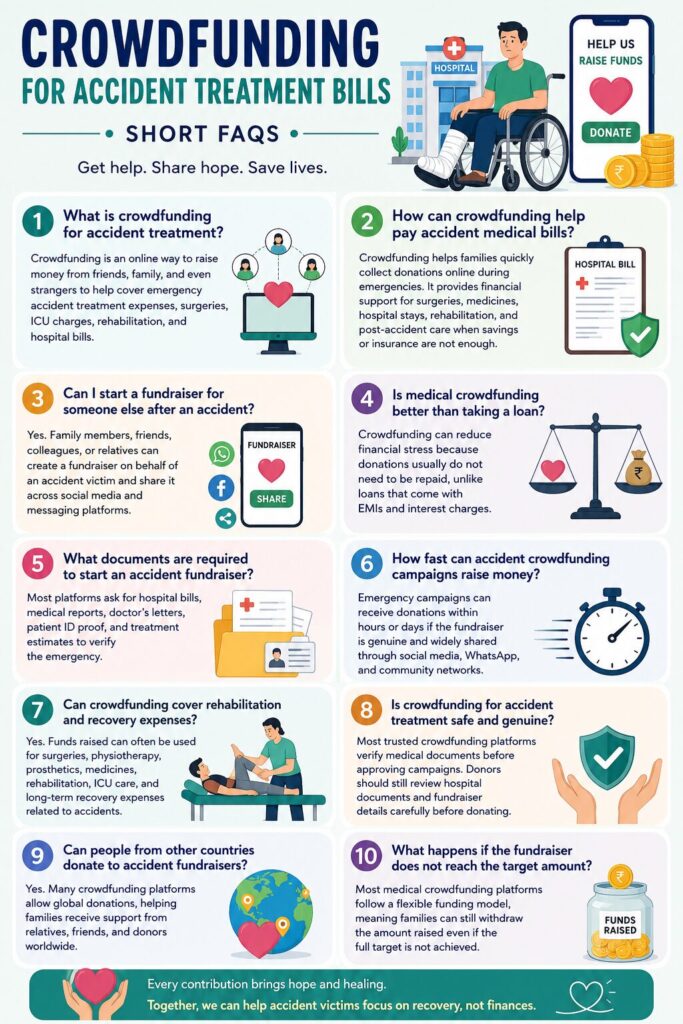
It’s an online way to raise money from friends, family, and even strangers to help cover emergency accident treatment expenses, surgeries, ICU charges, rehabilitation, and hospital bills, without taking on loan debt.
Yes. Family members, friends, colleagues, or relatives can create and manage a fundraiser on behalf of an accident victim and share it across their networks.
Most platforms require hospital bills, medical reports, doctor’s letters, patient ID proof, an accident/FIR report if available, and a treatment cost estimate to verify the emergency.
Crowdfunding can reduce financial stress since donations generally don’t need to be repaid, unlike loans that come with EMIs and interest charges, though many families use both together.
Emergency campaigns can start receiving donations within hours if the fundraiser is genuine, well-documented, and actively shared through WhatsApp, social media, and community networks.