


Table of Contents
Quick Summary
- Skin cancer develops when skin cells grow uncontrollably, most often due to UV exposure.
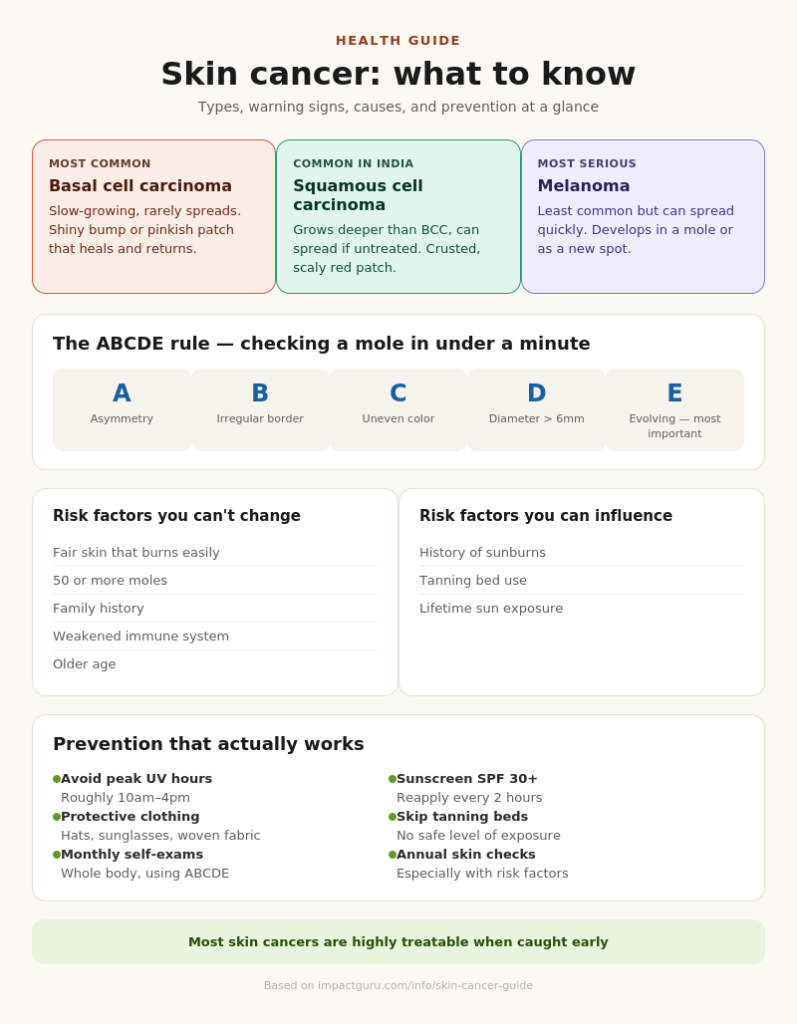
- There are three main types: basal cell carcinoma, squamous cell carcinoma, and melanoma.
- The ABCDE rule helps spot early warning signs on moles or new skin marks.
- In India, squamous cell carcinoma is more common than the global pattern of basal cell carcinoma.
- Most skin cancers are highly treatable when caught early, especially non-melanoma types.
- Treatment ranges from minor surgical removal to more extensive care for advanced cases.
Introduction
That mole you’ve been meaning to get checked, the one you keep telling yourself is probably nothing, is worth a second look. Skin cancer is one of the most common cancers worldwide, and its earliest warning signs are often visible before they cause serious symptoms. You just need to actually look at the mole you’ve had for years, the mark that showed up last month, the spot you’ve been putting off. That’s the strange thing about skin cancer: the earliest warning sign is often sitting in plain sight, visible in a mirror, months before it becomes something serious.
This guide walks you through what skin cancer actually is, the different types and how to tell them apart, the exact warning signs worth knowing, and what treatment and cost realistically look like, so that mole finally gets checked with real information behind it, not just a hunch.
What Is Skin Cancer
Skin cancer develops when skin cells grow uncontrollably, forming a tumor, most often triggered by damage from ultraviolet (UV) radiation, whether from the sun or tanning devices. It’s the most commonly diagnosed cancer globally, and while that sounds alarming, the flip side is equally true: it’s also one of the most preventable and, with early detection, one of the most treatable.
Not every skin change is a cancer warning sign — a patch of skin turning white is more likely vitiligo than a tumor. Our vitiligo guide covers its causes, symptoms, types, and treatment in detail.
Types of Skin Cancer
There are three main types, and knowing the difference matters because they behave very differently.
- Basal cell carcinoma (BCC): the most common type worldwide, typically slow-growing and rarely spreads. It often looks like a shiny bump, a pinkish patch, or a sore that heals and returns. In contrast to the global pattern, some Indian studies have reported squamous cell carcinoma as more common than Basal cell carcinoma (BCC). See our complete BCC guide.
- Squamous cell carcinoma (SCC): grows more slowly but deeper than BCC and can spread if untreated. It tends to appear as a crusted or scaly red patch or a dome-shaped bump that bleeds. See our complete SCC guide for symptoms, diagnosis, and treatment.
- Melanoma: the least common but most serious type, since it can spread quickly to other parts of the body if not caught early. It usually develops in an existing mole or as a new, unusual-looking spot. Our complete melanoma guide covers this in depth, including the rarer subtype, ocular melanoma, which develops inside the eye rather than on the skin.
There’s also a rarer, more aggressive type worth knowing about: Merkel cell carcinoma, which grows faster than the three main types and needs prompt treatment. Full details in our Merkel cell carcinoma guide.
Read More : White Patches on Skin: What’s Causing Them and When to Worry
The ABCDE Rule: Spotting Early Warning Signs
This is the single most useful tool for catching melanoma early, and it takes less than a minute to check a mole against it:
- A – Asymmetry: one half of the mole doesn’t match the other.
- B – Border: edges are irregular, blurred, or notched, rather than smooth.
- C – Color: uneven color, with multiple shades of brown, black, tan, or even white, red, or blue.
- D – Diameter: larger than about 6mm, roughly the size of a pencil eraser, though melanomas can be smaller.
- E – Evolving: any change in size, shape, color, or new symptoms like itching or bleeding; this is considered the most important sign of all.
Beyond moles specifically, other general warning signs include a sore that doesn’t heal, a new growth, or persistent changes to your skin. If you notice any of these, it’s worth getting checked rather than waiting.
What Causes Skin Cancer
The overwhelming majority of skin cancers trace back to one root cause: damage to skin cell DNA from ultraviolet (UV) radiation, whether from the sun or artificial sources like tanning beds. UV rays don’t just cause a sunburn and fade away; they accumulate damage in your skin cells over years, and it’s this cumulative damage that eventually causes cells to grow uncontrollably.
Risk factors generally fall into two buckets: things you can control, and things you can’t.
Factors you can’t change:
- Fair skin that burns easily rather than tans; less natural melanin means less built-in UV protection.
- A high mole count: having 50 or more moles meaningfully raises melanoma risk.
- Family history: if a close relative has had skin cancer, your own risk is higher, partly genetic, partly shared environment and sun habits.
- A weakened immune system: from conditions like HIV or medications after an organ transplant, since your immune system plays a role in catching abnormal cells before they become a problem.
- Older age: cumulative sun exposure over decades means risk climbs steadily with age.
Factors you can influence:
- Sunburn history: every blistering sunburn, especially in childhood, measurably raises lifetime risk.
- Tanning bed use: these emit concentrated UV radiation and carry real, well-documented cancer risk.
- Cumulative sun exposure over a lifetime: particularly for outdoor workers or people in high-UV regions.
While UV exposure is still the dominant cause here too, research has also linked skin cancer risk in certain regions, notably parts of Punjab’s Malwa belt, to arsenic contamination in drinking water. This isn’t a nationwide risk factor, but it’s an important reminder that sun exposure isn’t automatically the full story everywhere, and it’s part of why India’s skin cancer patterns don’t always mirror global trends (for instance, some Indian studies report squamous cell carcinoma as more common than basal cell carcinoma, the reverse of the global pattern).
Not every skin change is cause for cancer concern — a patch of skin turning white, for instance, is far more likely to be vitiligo or another common condition than skin cancer. Our guide on vitiligo vs other skin conditions breaks down what actually causes white patches and how to tell them apart.
Also Read : Vitiligo Stages: How the Condition Progresses Over Time
How Skin Cancer Is Diagnosed
Diagnosis is usually a straightforward, staged process, and knowing what to expect can make that first dermatologist visit far less intimidating.
Step 1: Visual examination: Your dermatologist starts with a close look at the suspicious area, and often your entire skin, using a handheld tool called a dermatoscope. This magnifies and lights the skin in a way that reveals pigment patterns and structures invisible to the naked eye, often enough on its own to tell a benign mole from one worth investigating further.
Step 2: Biopsy: If something looks concerning, a small tissue sample is removed and sent to a lab for testing under a microscope; this is the only way to actually confirm skin cancer and identify its exact type. There are a few common biopsy methods:
- Shave biopsy: a thin top layer of skin is shaved off, used for surface-level lesions.
- Punch biopsy: a small circular tool removes a deeper core sample, useful when a lesion needs to be assessed at multiple skin layers.
- Excisional biopsy: the entire lesion is removed along with a margin of healthy skin, often used when melanoma is suspected, since it allows immediate, complete removal alongside diagnosis.
Step 3: Staging, for melanoma specifically: If melanoma is confirmed, additional steps often follow to check whether it has spread: this can include imaging (like an ultrasound or CT scan) or a sentinel lymph node biopsy, which checks the nearest lymph node to see if cancer cells have traveled there. Staging determines both prognosis and treatment intensity, so this step matters a lot for how the rest of your care plan unfolds.
Just as biopsy and staging matter for skin cancer, getting treated at the right facility matters for other skin conditions too. See our guide to the best hospitals for psoriasis treatment in India if psoriasis, not cancer, turns out to be the diagnosis.
Skin Cancer Treatment Options
Treatment depends heavily on the type, size, and stage of the cancer.
Non-melanoma skin cancers (BCC and SCC): When caught early, treatment is often as straightforward as surgical removal, sometimes done in a single visit, with a very high cure rate.
Melanoma: A different story, especially once it’s spread beyond the original site. Treatment can involve:
- Surgery
- Immunotherapy
- Targeted therapy
- Or a combination of the above, often over months rather than a single procedure
This longer, higher-stakes path is part of why early detection matters so much more with melanoma specifically.
Because treatment approaches vary so much by type, our individual guides for melanoma, BCC, and SCC go into the specific options for each.
Skin Cancer Treatment Cost
Cost varies significantly depending on:
- The type of skin cancer
- Its stage
- The treatment approach chosen
Costs range anywhere from simple outpatient surgical removal to more extensive, multi-modality treatment for advanced cases. Our dedicated skin cancer treatment cost guide breaks this down in detail, including what typically drives costs up and how they vary by treatment type and city.
When cost becomes a concern: For many families, especially with more advanced or aggressive skin cancers like melanoma or Merkel cell carcinoma, treatment cost can become a genuine, ongoing concern on top of an already difficult diagnosis. A few options worth knowing about:
- Medical crowdfunding platforms: let patients raise donations online to help cover treatment costs; this is a route worth exploring for fundraising for cancer patients.
- Government support: options for donation for medical treatment also exist through schemes like the Chief Minister Relief Fund, covered in detail in our CMRF guide.
Can Skin Cancer Be Prevented
To a genuinely meaningful degree, yes, this is one of the more preventable cancers that exists, and prevention here isn’t vague advice; it’s a short, concrete list.
Sun protection that actually works:
- Avoid peak UV hours: roughly 10 am to 4 pm, when the sun’s rays are strongest. A simple rule of thumb: if your shadow is shorter than you are, UV exposure is at its highest.
- Use broad-spectrum sunscreen, SPF 30 or higher, and actually reapply it every two hours when outdoors; a single morning application doesn’t cover a full day.
- Wear sun-protective clothing: wide-brimmed hats, sunglasses, and tightly woven fabric all meaningfully cut UV exposure, often more reliably than sunscreen alone.
- Skip tanning beds entirely: there’s no genuinely “safe” level of indoor tanning exposure.
Early detection, the other half of prevention:
- Monthly self-exams: check your entire body, including areas that don’t get much sun (soles of feet, between fingers, scalp), using the ABCDE rule as your guide. Skin cancer in these less-sun-exposed areas is more common in darker skin tones, so this matters regardless of your skin type.
- Annual professional skin exams: especially if you have risk factors like fair skin, a high mole count, or a family history, are worth being proactive about rather than waiting for a specific concern.
- The “ugly duckling” sign: if you have several moles, dermatologists often say the one that looks distinctly different from the rest is the one worth getting checked, even if it doesn’t tick every ABCDE box on its own.
None of this eliminates risk, but between consistent sun protection and catching changes early, prevention and early detection together do most of the real work in keeping skin cancer both rarer and more treatable.
Read More : Skin Cancer Hospitals in India: How to Choose Wisely

Conclusion
Skin cancer earns its reputation as the most common cancer diagnosis for a reason, but it also deserves a much less frightening reputation than it usually gets, because most of the fight against it happens before any treatment is even needed: sun protection, a monthly glance in the mirror, and not talking yourself out of getting something checked. Catch it early, and BCC and SCC are often resolved in a single visit. Even melanoma, the type that deserves the most respect, responds far better to treatment the sooner it’s found.
So if there’s one thing to take from this guide, let it be this: go check that mole. Whether it turns out to be nothing or something that needs attention, our dedicated guides on melanoma, BCC, SCC, and Merkel cell carcinoma will walk you through exactly what comes next, and our treatment cost guide can help you plan the practical side. And if cost ever becomes part of that journey, medical crowdfunding platforms like ImpactGuru let you raise funds online at 0% cost to help cover treatment. It’s a real, practical option worth exploring, not a last resort.
FAQs
Early signs can include a new or changing mole, a sore that does not heal, a growing skin lesion, a persistent scaly or rough patch, or a spot that changes in size, shape, colour, or appearance. A lesion that repeatedly bleeds, crusts, or heals and returns should also be checked by a dermatologist.
Skin cancer can look different depending on its type. It may appear as a new or changing mole, a shiny or pearly bump, a scaly red patch, a sore that does not heal, or an unusual dark spot. Not every skin cancer follows the ABCDE pattern, so persistent or changing skin lesions should be professionally evaluated.
Basal cell carcinoma (BCC) is generally the most common type of skin cancer worldwide, followed by squamous cell carcinoma (SCC). Melanoma is less common but has a greater potential to spread. The pattern can vary between populations, and some studies in India have reported SCC more frequently than BCC.
Many skin cancers can be successfully treated, particularly when diagnosed early. BCC and most early SCCs can often be removed completely with surgery or other local treatments. Melanoma and other aggressive skin cancers may require more extensive treatment, especially when they have spread.
Yes. Skin cancer can develop in people of all skin tones. In darker skin, some cancers may appear in areas that receive less sun, including the palms, soles, nails, and mucous membranes. This can sometimes lead to delayed detection, making awareness of changing or unusual skin lesions important regardless of skin colour.
No. Ultraviolet (UV) radiation is a major risk factor for many skin cancers, but it is not the only one. Risk can also be influenced by factors such as family history, number of moles, previous skin cancer, immune suppression, certain inherited conditions, and exposure to particular environmental or occupational hazards.