

Table of Contents
- Quick Summary
- Introduction
- What Is Basal Cell Carcinoma
- What Does Basal Cell Carcinoma Look Like
- What Causes Basal Cell Carcinoma
- How Basal Cell Carcinoma Is Diagnosed
- Basal Cell Carcinoma Treatment Options
- What’s the Outlook for Basal Cell Carcinoma
- Basal Cell Carcinoma Treatment Cost
- Conclusion
- Frequently Asked Questions
Quick Summary
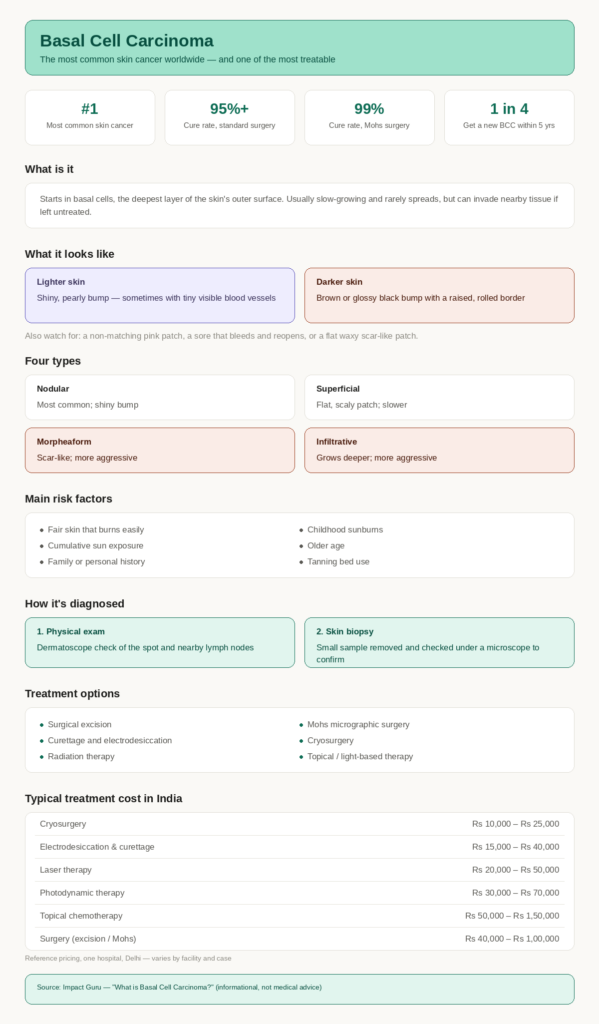
- Basal cell carcinoma (BCC) is the most common form of skin cancer worldwide, but it’s also the most treatable.
- It typically grows slowly and rarely spreads to other parts of the body.
- Common warning signs include a shiny bump, a pink patch, or a sore that heals and returns.
- Surgery is the primary treatment, with cure rates exceeding 95% when caught early.
- About 1 in 4 people who’ve had one BCC develop another within 5 years.
- Interestingly, BCC is less common than squamous cell carcinoma in parts of India.
Introduction
Basal cell carcinoma is the most commonly diagnosed skin cancer in the world, and while India sees lower overall skin cancer rates than the West, thanks largely to the natural UV protection higher melanin levels provide, BCC remains one of the skin cancers Indian dermatologists encounter regularly. The reassuring part is that it’s also one of the most treatable cancers that exists, typically slow-growing and rarely life-threatening when identified and treated in time.
If you’ve recently noticed a persistent, non-healing spot on your skin, or your dermatologist has mentioned basal cell carcinoma, this guide is designed to help: what it actually is, what causes it, how it’s treated, and what your outlook realistically looks like, explained clearly and without unnecessary alarm. For a broader look at skin cancer overall, our skin cancer guide covers all the major types side by side.
What Is Basal Cell Carcinoma
BCC is a cancer that starts in the basal cells, found in the deepest layer of the skin’s outer surface, and it’s caused by these cells growing and multiplying out of control. It’s the most common human malignancy overall, primarily affecting sun-exposed skin. The reassuring part: BCC is usually slow-growing, and true metastasis (spreading to distant parts of the body) is rare. Left untreated, though, it can still grow into surrounding tissue over time, and in more advanced cases invade deeper structures like muscle, cartilage, or bone, which is exactly why “slow-growing” shouldn’t be mistaken for “safe to ignore.”
What Does Basal Cell Carcinoma Look Like
BCC doesn’t always look the same, and how it appears can also vary depending on your skin tone, which is part of why it sometimes gets missed or mistaken for something harmless.
- On lighter skin, it often looks like a small bump that’s skin-colored or pink, sometimes with tiny visible blood vessels, or a shiny, pearly appearance.
- On darker skin, it more often looks like a brown or glossy black bump, sometimes with a raised, rolled border around the edge.
Other common signs to watch for, regardless of skin tone:
- A pink or flesh-colored patch that doesn’t quite match the skin around it
- A sore that bleeds, scabs over, heals, and then reopens, a cycle that repeats
- A flat, scar-like patch, whitish or waxy in appearance (this one’s easy to overlook)
A few different types exist too, and knowing which one you have matters for treatment:
- Nodular BCC: the shiny bump type described above; by far the most common kind.
- Superficial BCC: a flat, scaly, reddish patch, usually on the chest or back; generally slower and less aggressive.
- Morpheaform BCC: looks like a scar; grows more aggressively and can be harder to spot early.
- Infiltrative BCC: grows deeper into the skin; also more aggressive and needs a bit more care to fully remove.
The more aggressive types (morpheaform and infiltrative) usually need more thorough treatment than the common nodular or superficial kind. That’s exactly why it’s worth having a dermatologist actually look at and biopsy anything suspicious, rather than trying to figure out which type it is yourself.
Read More : White Patches on Skin: What’s Causing Them and When to Worry
What Causes Basal Cell Carcinoma
Like most skin cancers, BCC is overwhelmingly linked to cumulative UV exposure over a lifetime, whether from the sun or tanning beds, which damages skin cell DNA over time. At a molecular level, BCC specifically arises from mutations in a cell-signaling process called the Hedgehog pathway; this is the exact pathway that newer targeted medications, covered later in this guide, are designed to block.
Risk factors mirror skin cancer risk generally:
- Fair skin that burns easily
- A history of sunburns, especially in childhood
- Significant cumulative sun exposure over the years
- Older age
- A family or personal history of skin cancer
While BCC remains common here, several Indian hospital-based studies report squamous cell carcinoma as more prevalent overall, a genuine reversal of the global pattern, where BCC typically dominates. Part of the reason: in dark-skinned populations, SCC often develops from a different starting point than sun exposure alone, chronic non-healing ulcers, burn scars, and long-standing skin inflammation, conditions more common in India than in Western populations.
Besides basal cell carcinoma, squamous cell carcinoma is another common type of skin cancer that can affect the skin. Learn about its symptoms, causes, risk factors, and treatment options in our detailed guide to Squamous Cell Carcinoma.
How Basal Cell Carcinoma Is Diagnosed
Most BCCs are first noticed because of a symptom the person is having- a sore that won’t heal, a spot that keeps bleeding- rather than found incidentally. From there, diagnosis follows a clear process:
- Physical exam: Your dermatologist examines the suspicious area, often with a dermatoscope for a closer look, and may also feel nearby lymph nodes as a standard check, even though BCC spreading to lymph nodes is rare.
- Skin biopsy: This is the only way to confirm BCC and rule out other conditions. A small sample of the affected skin is removed and examined under a microscope. Depending on the size and location, this might be a shave biopsy (removing a thin top layer) or a punch biopsy (removing a small circular core for a deeper look). It’s typically a quick, in-office procedure done under local anesthetic.
That’s usually where it ends. Unlike some other cancers, formal staging (determining exactly how far a cancer has spread) is rarely needed for BCC, since it’s almost always caught and cured before it has any real chance to progress, one more reflection of how manageable this particular skin cancer tends to be.
Read More : Merkel Cell Carcinoma: Symptoms, Causes, Diagnosis & Treatment
Basal Cell Carcinoma Treatment Options
BCC treatment has excellent success rates across nearly every approach, and in the vast majority of cases, treatment is surgical.
- Surgical excision: the cancer is cut out along with a margin of healthy tissue, then checked under a microscope to confirm clean edges. Typically used for lower-risk BCCs on the trunk, hands, or feet.
- Mohs micrographic surgery: the cancer is removed layer by layer, with each layer examined immediately under a microscope, allowing the surgeon to remove all cancerous tissue while sparing as much healthy skin as possible.
Generally recommended for BCCs in cosmetically or functionally sensitive areas (like the face, ears, or around the eyes) or those with a higher risk of returning.
- Curettage and electrodesiccation (EDC): the lesion is scraped away, and the base is treated with an electric current to destroy any remaining cancer cells; a faster, simpler option for smaller, lower-risk lesions.
- Cryosurgery: freezing the lesion to destroy it, another option for select, lower-risk cases.
- Radiation therapy: uses targeted energy beams to destroy cancer cells, and is generally reserved for cases where surgery isn’t a good option, for instance, due to the patient’s age, overall health, or the location of the tumor.
- Topical and light-based treatments: including photodynamic therapy and certain topical medications, generally reserved for superficial BCC, with the trade-off of somewhat higher recurrence rates than surgical removal.
- Targeted oral medication: for the rare cases where BCC has spread, or surgery/radiation aren’t good options, drugs like vismodegib and sonidegib work by blocking the Hedgehog pathway mutation that drives BCC growth in the first place.
Read More : Acne Treatment, Causes, Symptoms, and Prevention
What’s the Outlook for Basal Cell Carcinoma
The outlook for basal cell carcinoma is generally favorable, and this is one of the more treatable cancers when addressed appropriately.
- 95%+ cure rate with standard surgical excision, according to a systematic review published by the American Academy of Family Physicians, with a five-year recurrence rate of 5.2%
- Up to 99% cure rate with Mohs micrographic surgery, with a lower five-year recurrence rate of approximately 3.2%
- Fatal outcomes from BCC are rare.
One thing worth understanding for the years ahead: roughly a quarter of people who have had one BCC will develop a new one within five years. This isn’t a sign that the treated area is likely to recur, but rather an indication that the skin has already shown a tendency to develop this type of cancer. This is why ongoing skin checks after treatment remain an important part of long-term care, not just the initial treatment itself.
Note: these cure and recurrence figures are drawn from international clinical research, as India-specific long-term outcome data for BCC is limited in published literature. The surgical techniques involved, excision and Mohs surgery, are performed using the same standards in India, so these outcomes remain clinically relevant.
Basal Cell Carcinoma Treatment Cost
Cost depends heavily on the treatment method, the size and location of the lesion, and where you’re being treated. Based on pricing shared by CK Birla Hospital, Delhi, here’s a general sense of what different approaches typically cost in India:
| Treatment | Approximate Cost |
| Cryosurgery | ₹10,000 – ₹25,000 |
| Electrodesiccation & Curettage | ₹15,000 – ₹40,000 |
| Laser Therapy | ₹20,000 – ₹50,000 |
| Topical Chemotherapy | ₹50,000 – ₹1,50,000, depending on regimen and duration |
| Photodynamic Therapy | ₹30,000 – ₹70,000 |
| Surgery (excision/Mohs) | ₹40,000 – ₹1,00,000, based on complexity and facility |
Note: these figures reflect pricing from one hospital and are meant as a general reference, not a fixed estimate. Actual cost depends on the severity of the condition, the specific treatment plan, the healthcare facility, and geographic location.
For most people, BCC treatment is a single, defined procedure rather than an ongoing expense, but for larger, recurring, or more complex cases requiring repeated Mohs sessions or reconstructive work afterward, cost can still add up meaningfully. For a broader look at skin cancer costs across types and cities, see our skin cancer treatment cost guide.
Medical crowdfunding is worth knowing about in situations like this. Platforms like ImpactGuru let patients raise funds from family, friends, and their wider community to help cover costs that add up beyond what was expected.

Conclusion
Hearing “cancer” is unsettling, no matter what kind it is. But if you’ve just learned you have basal cell carcinoma, or you’re trying to figure out if that persistent spot might be one, here’s what this guide has hopefully made clear: this is a cancer that tends to show up quietly, on skin that’s had years of sun exposure, and it’s also one of the most treatable diagnoses in oncology. Whether it’s a shiny bump, a sore that keeps returning, or a patch that just doesn’t look right, catching it early and getting the right subtype identified is what keeps treatment simple: surgery with cure rates above 95%, and up to 99% with Mohs, rather than something more involved.
If you’ve been diagnosed with basal cell carcinoma, choosing the right hospital and specialist is an important part of your treatment journey. Read our guide on Skin Cancer Hospitals in India: How to Choose Wisely to understand what to consider when selecting a hospital for skin cancer care.
Frequently Asked Questions
Rarely. BCC very rarely spreads to other parts of the body, and treatment is successful in the vast majority of cases. Left untreated for a long time, though, it can grow into surrounding tissue, so “low-risk” isn’t the same as “safe to ignore.”
In India, SCC often develops from chronic ulcers, burn scars, and long-term skin inflammation rather than sun exposure alone, conditions more common here than in Western populations.
It can, and about 1 in 4 people who’ve had one BCC develop a new one within five years. This is less about the treated spot specifically returning and more a sign that skin that has developed one BCC is more likely to develop another, which is why regular follow-up skin checks matter after treatment.
Most surgical treatments for BCC do leave some scarring, though the extent varies by method and lesion size. Mohs surgery is generally chosen specifically to minimize this in cosmetically sensitive areas like the face, since it removes only what’s necessary.
BCC is typically slow-growing, so it’s not generally a same-day emergency, but delaying doesn’t help either, since the lesion will keep growing and can eventually reach deeper tissue. If a spot hasn’t healed in a few weeks, or keeps bleeding and scabbing over, it’s worth getting seen.