

Table of Contents
Quick Summary
- Melanoma is a cancer of the pigment-producing cells (melanocytes) that, while less common than other skin cancers, is far more likely to spread if missed early.
- It shows up in several distinct forms, from the common superficial spreading type to rarer, faster-growing variants like nodular and acral lentiginous melanoma.
- Main risk drivers: UV exposure, fair skin, a high mole count, family history, and a weakened immune system.
- Treatment ranges from simple surgical excision to immunotherapy and targeted drugs, with India offering significantly lower costs than the US or UK for comparable care.
Introduction
A mole that looks a little different. A dark spot that showed up out of nowhere. For most people, melanoma starts as something small and easy to dismiss — which is part of what makes it dangerous. Melanoma makes up only a small fraction of all skin cancer diagnoses, yet it accounts for the vast majority of skin cancer deaths. That gap between how rarely it occurs and how much harm it can cause is exactly why catching it early and knowing what to actually look for, changes outcomes more than almost any other cancer.
This guide walks through what melanoma is, the different types it can take, what raises your risk, the symptoms that warrant a doctor’s visit rather than a wait-and-see approach, and what treatment in India typically involves
Types Of Melanoma
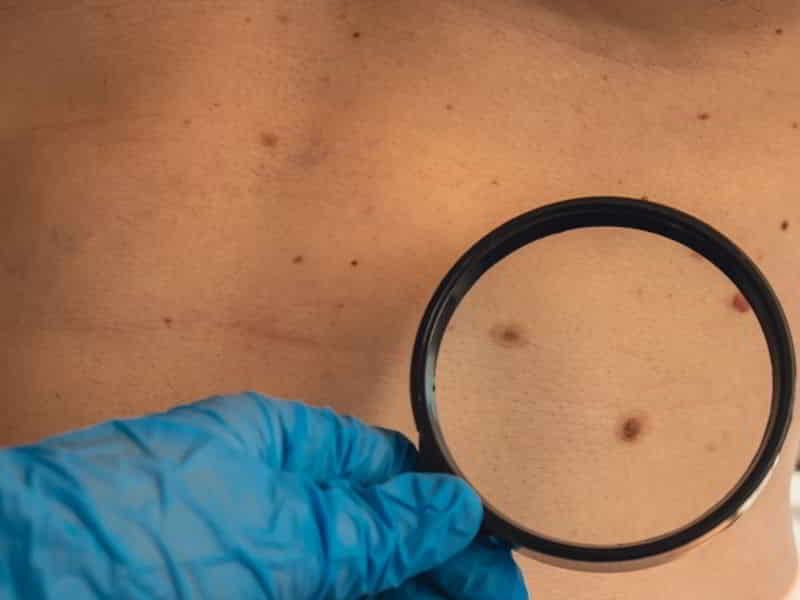
Not all melanoma behaves the same way; recognizing the type matters because some grow far faster than others.
Superficial spreading melanoma is the most common form, making up roughly 70% of cases. It tends to grow outward across the skin’s surface before penetrating deeper, typically appearing as a flat or slightly raised patch with irregular borders in shades of brown, black, pink, or red.
Nodular melanoma is more aggressive, growing vertically into the skin rather than spreading across the surface, which means it can reach dangerous depths faster. It often looks like a firm bump, sometimes black or blue, but occasionally skin-colored, which makes it easy to overlook.
Acral lentiginous melanoma develops on the palms, soles, or under the nails, and is notably more common in people with darker skin tones. Because it’s often mistaken for a bruise or fungal infection, it tends to be diagnosed later than other types.
Lentigo maligna melanoma typically appears in older adults with significant lifetime sun exposure, starting as a flat, freckle-like patch that slowly darkens and enlarges before becoming invasive.
Desmoplastic melanoma is rare and often presents as a firm, scar-like lump lacking the typical pigmentation, which makes it one of the harder subtypes to catch early.
Rarer subtypes include mucosal melanoma (developing on internal mucous membranes, unrelated to sun exposure) and ocular melanoma (forming in the eye’s uveal layer); both tend to be found later since they occur in places people don’t routinely check.
What Raises Your Risk
Melanoma doesn’t have one single cause, but several factors compound risk:
- UV exposure: from sunlight or tanning beds, remains the single biggest driver, damaging skin cell DNA over time
- Genetics: a family history of melanoma, or inherited mutations like CDKN2A, raises susceptibility
- Mole count and type: having many moles, or dysplastic (irregular) nevi, increases risk
- Fair skin, light eyes, and red or blonde hair: less natural melanin means less UV protection
- A weakened immune system: from organ transplants, immunosuppressive medication, or conditions like HIV
- Prior skin cancer or severe sunburns: particularly blistering burns in childhood
- Age and sex: risk rises with age; men over 50 are diagnosed more often than women, though women face higher rates before 50
- Geography: people living near the equator or at high altitude face stronger UV exposure.
Recognizing the Symptoms
Most melanomas start as a change to an existing mole or a new growth that looks different from your others. Dermatologists use the ABCDE rule as a practical checklist:
- Asymmetry: one half of the mole doesn’t match the other
- Border: edges are irregular, notched, or blurred
- Color: uneven shading, or multiple colors within one mole
- Diameter: larger than 6mm (roughly the size of a pencil eraser)
- Evolving: any change in size, shape, color, or elevation over time
Beyond the ABCDEs, watch for a mole that itches, becomes tender, bleeds, oozes, or develops a crust; normal moles don’t typically do this. Also worth flagging: the “ugly duckling” sign, where one mole simply looks different from all your others, even if it doesn’t clearly violate the ABCDE rules. If something stands out, it’s worth having it examined rather than waiting to see if it changes further.
How Melanoma Is Diagnosed
A suspected melanoma is confirmed through a straightforward diagnostic path:
- Skin examination: often using dermatoscopy, a magnified light-based tool that reveals structures beneath the surface
- Biopsy: removing all or part of the suspicious mole (excisional, incisional, or punch biopsy) for microscopic examination
- Pathology and Breslow thickness: measuring how deep the melanoma has penetrated, a key factor in staging and treatment planning
- Staging tests: sentinel lymph node biopsy, plus CT, PET, or MRI scans if spread is suspected
- Genetic testing: for advanced cases, to identify mutations that might guide targeted therapy.
Treatment Options and Cost in India
Treatment choice depends on melanoma type, stage, tumour thickness, and whether it’s spread.
| Treatment | What it involves | Typical cost in India |
| Surgical excision | Removing the melanoma with a margin of healthy skin, usually the first step for localized disease | ₹50,000 – ₹1,50,000 |
| Immunotherapy | Drugs like nivolumab or pembrolizumab that activate the immune system against cancer cells | ₹1,00,000 – ₹3,00,000 per dose |
| Targeted therapy | Drugs aimed at specific genetic mutations driving tumour growth | ₹1,50,000 – ₹2,50,000 per month |
| Chemotherapy | Reserved mainly for melanoma that’s spread beyond the skin | ₹20,000 – ₹2,00,000 per cycle |
| Radiation therapy | Often used post-surgery to clear remaining cancer cells | ₹50,000 – ₹2,00,000 |
A full treatment course, including diagnosis, active treatment, and follow-up care, typically totals somewhere between ₹2,00,000 and ₹5,00,000 in India, though this varies considerably by hospital, city, and how advanced the disease is at diagnosis.
Reducing Your Risk
- Use broad-spectrum sunscreen (SPF 30+) daily, not just on obviously sunny days.
- Wear protective clothing and wide-brimmed hats; seek shade between 10 am and 4 pm
- Skip tanning beds entirely; they’re a well-established melanoma risk factor.
- Check your own skin regularly and see a dermatologist promptly for anything unusual.
- Get vitamin D from food or supplements rather than sun exposure
- Ask your doctor or pharmacist if any medications you take increase sun sensitivity
Conclusion
In conclusion, melanoma is a severe form of skin cancer, but with early detection and the proper treatment, it can be managed effectively. Understanding the symptoms & seeking prompt medical attention is crucial to fighting this disease. In India, where treatment costs can be high, fundraising platforms offer a valuable way to gather financial support. These online crowdfunding platform enable individuals to raise funds for their treatment by reaching out to a larger community, making it easier to access the necessary care without overwhelming medical expenses.