


- Squamous Cell Carcinoma (SCC) is the second most common skin cancer, developing in the thin, flat squamous cells found in the skin’s outer layer and the lining of organs like the mouth, lungs, and throat.
- Early warning signs include a scaly red patch, a wart-like growth, or a sore that won’t heal, most often on sun-exposed skin.
- Main risk factors are prolonged UV exposure, smoking, HPV infection, a weakened immune system, and chronic skin wounds.
- Caught early, SCC has a five-year survival rate of around 99%; this drops sharply once it spreads to lymph nodes or distant organs.
- Treatment ranges from simple surgical excision to radiation, chemotherapy, or immunotherapy, with India offering advanced care at a fraction of Western costs.
Table of Contents
Introduction
A rough, scaly patch that just won’t heal is easy to write off as dry skin, but persistent lesions like this are exactly how Squamous Cell Carcinoma (SCC) often first shows up. It’s one of the most common cancers there is, and the reassuring part is that it’s also one of the most treatable, provided it’s caught before it spreads. In this guide, we’ll walk through what SCC actually is, the early signs to watch for, what causes it, how it’s staged, what treatment looks like at each stage (including realistic costs in India), and how survival outlook changes with early versus late detection. Whether you’ve just noticed a suspicious spot or are supporting a loved one through diagnosis, this guide gives you a clear, medically grounded picture of what comes next.
Read More : How to Reduce Swollen Lymph Nodes in the Neck? (2026 Guide)
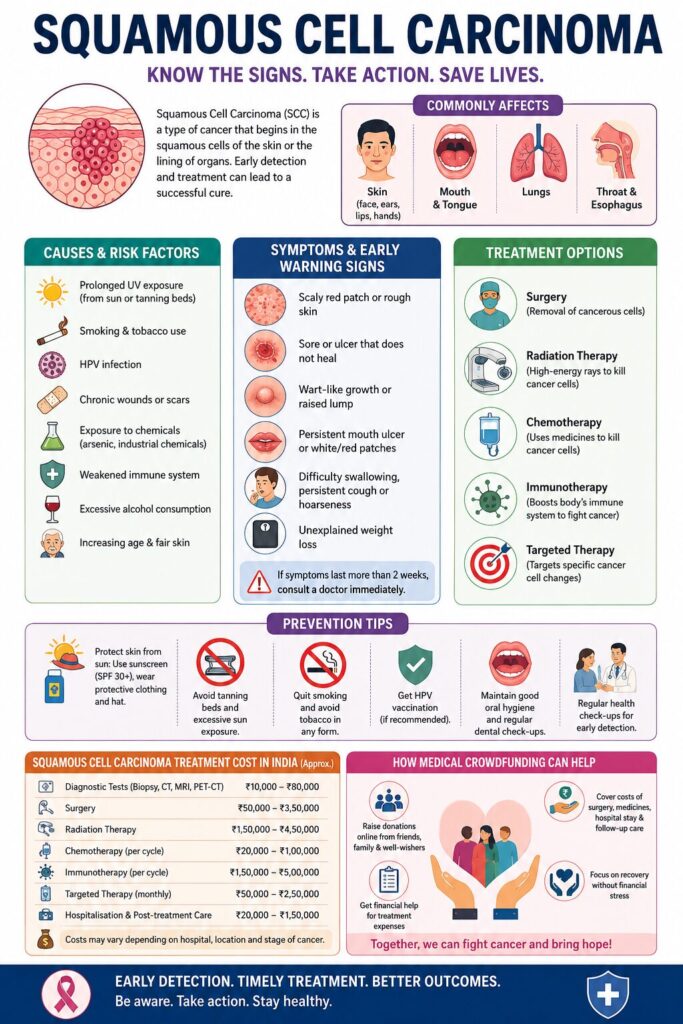
What Is Squamous Cell Carcinoma?
Squamous Cell Carcinoma is a cancer that begins in squamous cells, thin, flat cells found in the outermost layer of the skin and the lining of organs including the mouth, throat, lungs, esophagus, and cervix. It’s the second most common form of skin cancer, primarily driven by prolonged UV exposure from sunlight or tanning beds, though SCC affecting internal organs is more often linked to smoking, HPV infection, chronic inflammation, or chemical exposure.
Skin-based SCC most commonly appears on sun-exposed areas, the face, ears, lips, scalp, neck, hands, and arms, though it can develop anywhere on the body. While it generally grows more slowly than some other cancers, it can invade nearby tissue and spread to lymph nodes or distant organs if left untreated, which is why early evaluation of any persistent skin change matters.
Symptoms and Early Warning Signs
The signs vary depending on where the cancer develops:
On the skin:
- A rough, scaly, red patch
- A firm or raised nodule
- A wart-like growth
- A sore or ulcer that doesn’t heal, bleeds, or crusts over
In the mouth, throat, lungs, or esophagus:
- Persistent mouth ulcers
- Difficulty swallowing
- A chronic cough or hoarseness
- Chest pain or unexplained weight loss
As the disease progresses, the affected area may enlarge, become painful, or develop into an open ulcer, and nearby swollen lymph nodes can signal that it’s begun to spread. Anyone with a persistent lesion, non-healing wound, or unusual bleeding lasting more than a few weeks should get it evaluated; early diagnosis is the single biggest factor in a good outcome.
Causes and Risk Factors
Squamous Cell Carcinoma develops when genetic mutations cause squamous cells to grow and divide uncontrollably, eventually forming a tumour. What triggers those mutations differs depending on where the SCC develops.
For skin SCC, the leading cause is prolonged UV exposure from sunlight or tanning beds. UV radiation damages the DNA inside skin cells over time, and while the body normally repairs this kind of damage, repeated or cumulative exposure, especially years of sun exposure without adequate protection, eventually overwhelms those repair mechanisms. This is why skin SCC is most common on areas that get the most lifetime sun exposure: the face, ears, scalp, neck, and the backs of the hands.
For SCC affecting other organs, the mouth, throat, esophagus, lungs, or cervix, the drivers are different:
- Tobacco use (smoking or chewing) is one of the strongest risk factors for oral, throat, esophageal, and lung SCC, since carcinogens in tobacco directly damage the lining of these organs.
- Alcohol consumption, particularly combined with smoking, significantly raises risk for SCC of the mouth, throat, and esophagus; the two together have a compounding effect rather than simply an additive one, and this combination is one of the strongest known risk profiles for esophageal SCC specifically.
- HPV infection, especially certain high-risk strains, is a well-established cause of SCC in the throat (oropharyngeal) and cervix, and is increasingly recognized as a major driver of oral SCC in younger patients who don’t smoke.
- Chronic inflammation and irritation of the esophageal lining, from repeated exposure to very hot beverages, certain dietary patterns, or long-standing untreated damage, can gradually lead to cellular changes that progress to SCC over years; this is a distinct pathway from acid reflux, which is more commonly linked to a different esophageal cancer type (adenocarcinoma) rather than SCC.
- Chemical exposure, including certain industrial solvents and pollutants, has been linked to elevated SCC risk in the lungs and other exposed tissues.
Other factors that raise risk across SCC types:
- Fair skin and increasing age: lower melanin offers less natural UV protection, and cumulative sun damage builds over decades, which is why SCC risk rises steadily after age 50.
- A weakened immune system: organ transplant recipients and people on long-term immunosuppressive medication face a substantially higher risk, since a suppressed immune system is less able to catch and destroy abnormal cells before they become cancerous.
- A personal history of skin cancer: having had SCC, basal cell carcinoma, or melanoma before signals broader skin cancer susceptibility and raises the likelihood of a new occurrence.
- Chronic non-healing wounds or old scars: SCC can develop in longstanding scars or ulcers, a phenomenon known as a Marjolin’s ulcer. It’s most strongly linked to burn scars specifically (accounting for the majority of documented cases). It typically appears only after a long latency period, often decades after the original injury, which is why any sudden change, new ulceration, or unusual discharge in an old scar deserves prompt medical evaluation rather than being dismissed as normal scar tissue.
- Exposure to arsenic or industrial chemicals chronic arsenic exposure, most commonly through contaminated groundwater, is a well-documented, dose-dependent risk factor for skin SCC in affected regions, including parts of South Asia.
- Outdoor occupations or frequent tanning bed use: construction, farming, and other jobs with prolonged sun exposure carry higher risk meaningfully, as does regular tanning bed use, which delivers concentrated UV exposure similar to or exceeding peak sunlight.
Understanding which category of risk factors applies to you is useful in practice; someone with high cumulative sun exposure benefits most from regular skin checks and sun protection, while someone who smokes and drinks heavily should be more attentive to persistent mouth sores, throat changes, or a hoarse voice that doesn’t resolve.
Squamous Cell Carcinoma Staging and Survival Rate
Doctors stage SCC from 0 to 4 based on tumour size, high-risk features (depth, nerve involvement, location, cell differentiation), and whether it has spread to lymph nodes or distant organs.
- Stage 0 (carcinoma in situ): Abnormal cells confined to the top skin layer, not yet cancerous
- Stage 1: Tumour ≤2 cm, no lymph node spread, fewer than two high-risk features
- Stage 2: Tumour >2 cm or has two or more high-risk features, still no spread to lymph nodes
- Stage 3: Cancer has invaded nearby structures (bone, muscle) or spread to nearby lymph nodes
- Stage 4: Cancer has spread to distant organs
Survival outlook by stage: According to data compiled from the American Cancer Society and multiple clinical studies, localized SCC caught at stage 0 or 1 has a five-year survival rate approaching 99%. Survival declines as the disease advances; stage 2 disease with high-risk features and regional lymph node involvement generally falls in the range of roughly 50–80%, while distant metastatic SCC carries a substantially poorer prognosis, with five-year survival often dropping below 50%, and considerably lower in cases with extensive nodal spread. These are population-level averages, not individual predictions; age, overall health, tumour location, and how well the cancer responds to treatment all factor into any one person’s outlook, so it’s worth discussing your specific case with your oncologist rather than relying on general statistics alone.
Squamous Cell Carcinoma Treatment Options
Treatment depends on the tumour’s location, size, stage, and subtype, along with the patient’s age and overall health.
1. Surgery
Surgery is the first-line treatment for the vast majority of SCC cases, particularly when caught early.
- Excision: The tumour is cut out along with a margin of healthy tissue around it, which is then checked under a microscope to confirm all cancer cells were removed. This is the standard approach for low-risk tumours and typically achieves a cure rate of around 92% for primary SCC. Recovery usually involves stitches and a scar that fades over several months.
- Mohs surgery: Considered the gold standard for high-risk SCC, especially tumours on the face, ears, lips, hands, or genitals where preserving healthy tissue matters most. The surgeon removes and examines wafer-thin tissue layers one at a time, mapping each layer until no cancer cells remain, meaning only the minimum necessary tissue is removed. Mohs achieves the highest cure rate of any SCC treatment, around 97–99% for primary tumours and roughly 90% even for recurrent ones, though it takes longer (often a full day) since each layer is processed and checked in real time before the next is removed.
- Curettage and electrodesiccation (C&E): A faster, simpler option suited to small, low-risk, superficial tumours. The doctor scrapes away the visible tumour with a curette, then uses an electric needle to destroy any remaining cancer cells and control bleeding, often repeating the cycle two to three times. It’s quick and doesn’t require stitches, but isn’t suitable for larger, deeper, or high-risk tumours, and carries a somewhat higher recurrence rate than excision or Mohs.
- Cryosurgery: Liquid nitrogen is applied to freeze and destroy tumour cells, typically used for very superficial, low-risk lesions or in patients who aren’t good surgical candidates. It’s minimally invasive with little to no bleeding, though it doesn’t allow the tissue to be examined afterward to confirm complete removal, so it’s generally reserved for the most straightforward cases.
2. Radiation Therapy
Radiation uses high-energy beams to destroy cancer cells and is typically used in two situations: as a primary treatment when surgery isn’t ideal, for large tumours, or difficult locations like the eyelid, lip, ear, or nose where surgery could cause significant disfigurement or functional loss, or after surgery (adjuvant radiation) to lower the risk of recurrence, particularly when cancer cells were found near nerves or the tumour was large or deeply invasive. Treatment is usually delivered over multiple sessions across several weeks, and while it avoids surgical scarring, it can cause temporary skin irritation and long-term changes in skin texture at the treated site.
3. Chemotherapy
Chemotherapy is typically reserved for SCC that has spread (metastasized) to distant organs, or in some cases combined with radiation for locally advanced tumours that can’t be fully removed surgically. Drugs are usually given intravenously and work by targeting fast-dividing cancer cells throughout the body, which also accounts for common side effects like fatigue, nausea, and lowered immunity. It’s less commonly used for SCC than for many other cancers, since immunotherapy has increasingly become the preferred option for advanced disease.
4. Immunotherapy
Immunotherapy drugs (such as PD-1 inhibitors like cemiplimab and pembrolizumab) work by blocking the mechanisms cancer cells use to hide from the immune system, essentially unmasking the tumour so the body’s own defenses can attack it. It’s become a standard option for advanced, metastatic, or treatment-resistant SCC that can’t be treated with surgery or radiation, with response rates that have meaningfully improved outcomes for cases that were historically difficult to treat. Because it works with the immune system rather than directly killing cells, side effects differ from chemotherapy, commonly fatigue and skin reactions, though it can occasionally trigger inflammation in other organs, which requires monitoring during treatment.
5. Targeted Therapy
Targeted therapy uses drugs designed to interfere with specific genes, proteins, or pathways that a particular tumour depends on to grow; for example, EGFR inhibitors, which block a receptor that’s overactive in some SCC cases. It’s generally considered for advanced or metastatic SCC, sometimes when immunotherapy isn’t suitable or hasn’t worked well enough on its own. Because it targets specific molecular features of the tumour, doctors often use biomarker testing on the tumour tissue first to confirm a patient is likely to respond before starting treatment.
Squamous Cell Carcinoma Treatment Cost in India
Treatment cost depends on the stage, location, treatment type, hospital, and city. Approximate ranges:
| Treatment | Estimated Cost (INR) |
| Diagnostic tests (biopsy, CT, MRI, PET-CT) | ₹10,000 – ₹80,000 |
| Surgical removal | ₹50,000 – ₹3,50,000 |
| Radiation therapy | ₹1,50,000 – ₹4,50,000 |
| Chemotherapy (per cycle) | ₹20,000 – ₹1,00,000 |
| Immunotherapy (per cycle) | ₹1,50,000 – ₹5,00,000 |
| Targeted therapy (monthly) | ₹50,000 – ₹2,50,000 |
| Hospitalisation & post-treatment care | ₹20,000 – ₹1,50,000 |
Early-stage disease can often be treated with surgery alone, keeping costs on the lower end; advanced cases requiring combined therapies push the total considerably higher.
Prevention Tips
While SCC can’t always be prevented. However, the following steps meaningfully reduce risk:
- Use broad-spectrum sunscreen (SPF 30+) and wear protective clothing
- Avoid tanning beds and excessive midday sun exposure
- Examine your skin regularly for new or changing sores, patches, or growths
- Avoid smoking and limit alcohol consumption (reduces risk for internal SCC)
- Maintain good oral hygiene and consider the HPV vaccine if recommended
- Keep up with regular health check-ups, especially if you have risk factors
When to Consult a Doctor
See a doctor if you notice a sore that won’t heal, a scaly red patch, a wart-like growth, or a lump that bleeds or changes in size. Persistent mouth ulcers, difficulty swallowing, a chronic cough, hoarseness, or unexplained weight loss lasting more than two weeks also warrant prompt evaluation. If you have known risk factors, prolonged sun exposure, smoking, HPV infection, or immune suppression, regular screening is worth discussing with your doctor even without symptoms.
Conclusion
Squamous cell carcinoma is common, but it’s also one of the more manageable cancers when caught early; the difference between a near-99% survival rate and a much harder road often comes down to how quickly a persistent skin change gets evaluated. If you notice anything unusual, don’t wait it out; a prompt dermatology visit is the single most effective step you can take. And if treatment costs start to feel overwhelming, a reliable fundraising platform can genuinely ease that pressure. Impact Guru, an online donation platform built for medical emergencies, helps families set up a fundraiser website in minutes and reach donors across India through a trusted fundraising platform, so treatment decisions stay focused on recovery, not finances.
FAQs
Squamous cell carcinoma is a cancer that begins in the squamous cells of the skin or the lining of organs like the mouth, lungs, and throat. It’s the second most common skin cancer and is highly treatable when caught early.
Early signs include a scaly red patch, a non-healing sore, a wart-like growth, or a persistent ulcer, most often on sun-exposed skin like the face, ears, or hands.
Localized SCC caught early has a five-year survival rate approaching 99%; this declines significantly once the cancer spreads to lymph nodes or distant organs.
Prolonged UV exposure is the leading cause of skin SCC, while smoking, HPV infection, chronic inflammation, and chemical exposure drive risk for SCC affecting internal organs.
Yes. Medical crowdfunding platforms like ImpactGuru help patients raise donations online through emergency fundraising to cover expenses such as surgery, chemotherapy, medications, hospitalisation, and follow-up care.