


Table of Contents
- Quick Summary
- Introduction
- One-time Cure VS Lifelong Injection: Which Costs More?
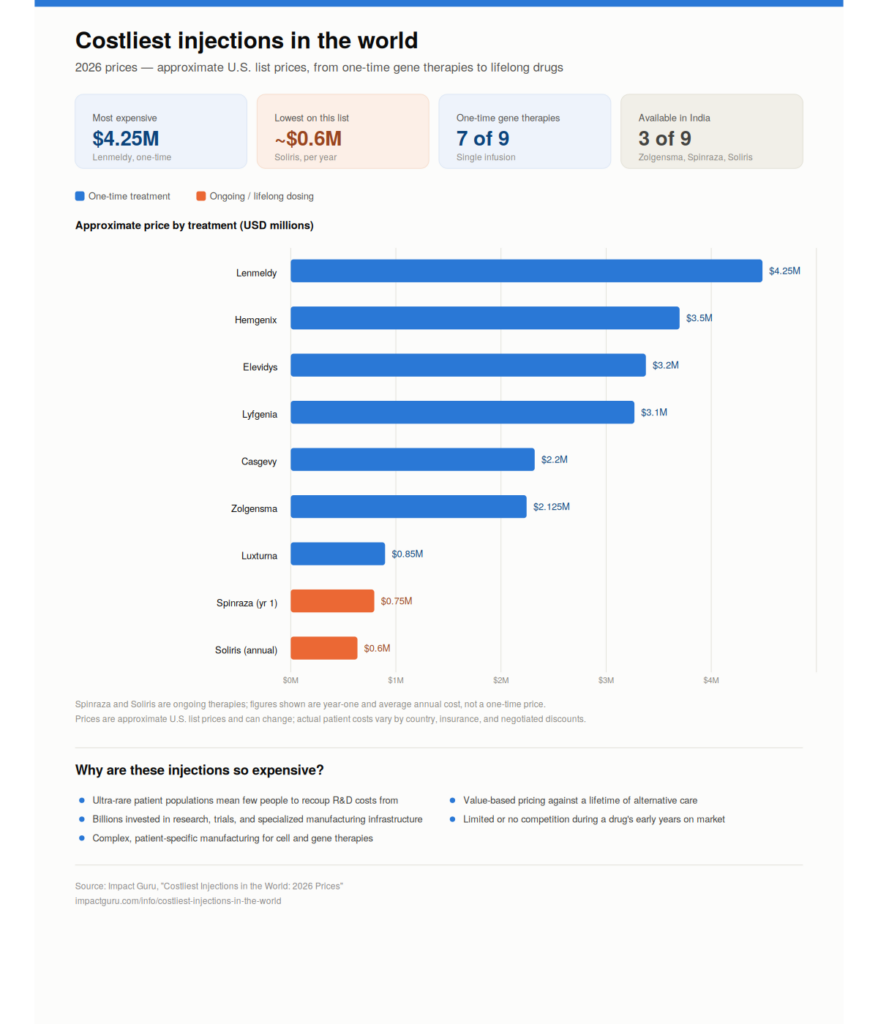
- Costliest Injections in the World: Full Comparison Table
- Lenmeldy: The Most Expensive Injection in the World
- Hemgenix: The Costliest Hemophilia B Injection
- Elevidys: Gene Therapy for Duchenne Muscular Dystrophy
- Lyfgenia: Sickle Cell Gene Therapy Price
- Casgevy: The CRISPR Gene-editing Injection
- Zolgensma: SMA’s Costliest One-time Treatment
- Luxturna: The Costliest Eye Injection in the World
- Spinraza: The Priciest Lifelong Injection for SMA
- Soliris Injection Price: A Costly Lifelong Treatment For PNH
- Why are these Injections so Expensive? Explained
- Does the Drug Price Equal the Total Treatment Cost?
- Are Costly Injections Covered by Insurance?
- How Medical Crowdfunding is Helping Patients Afford Costly Injections
- Conclusion
- Frequently Asked Questions
Quick Summary
- Costliest injections in the world in 2026 range from hundreds of thousands of dollars a year to over $4 million (~₹38 crore) for a single treatment.
- Lenmeldy is currently the world’s most expensive drug by list price, at $4.25 million (~₹40.7 crore) for a one-time treatment.
- Some therapies are designed as one-time treatments, while others require ongoing dosing, so their costs add up differently over time.
- Zolgensma has a U.S. list price of about $2.125 million, while reported treatment costs in India have ranged from ₹20.3 to ₹20.5 crore, depending on the case and associated expenses.
- Prices are influenced by ultra-small patient populations, years of research and development, and complex, specialised manufacturing.
- Even when treatment is covered, expenses such as travel, hospital stays, monitoring, and pre-treatment care may not be fully covered, adding to the financial burden for families.
Introduction
Some of the drugs on this list cost more than most people will earn in a lifetime, for a single dose. That number alone is worth understanding, whether you’re here out of curiosity, research, or because someone you love just got a diagnosis and you’re trying to make sense of it all. This guide breaks down the costliest injections in the world in 2026: gene therapies given once, and lifelong treatments dosed for years, what they treat, how they work, and why the price tags are what they are. And for the families actually facing these decisions, we’ve also looked at what support exists beyond just insurance.
One-time Cure VS Lifelong Injection: Which Costs More?
At nearly ₹40 crore, Lenmeldy costs many times more than what an average Indian earner makes across an entire working lifetime.
Therapies like Lenmeldy, Hemgenix, and Zolgensma are designed as one-time treatments intended to provide a long-lasting clinical benefit. It’s worth being precise here: one-time administration doesn’t automatically mean a guaranteed, permanent cure. The durability of benefit can vary by therapy, and patients may still need ongoing monitoring and medical care afterward.
Therapies like Spinraza and Soliris work differently; they manage the underlying condition rather than aiming to correct the genetic cause, which means dosing continues every few weeks or months, indefinitely. Spinraza, for example, costs roughly $750,000 (around ₹7.2 crore) in year one and $375,000 (about ₹3.5 crore) in most years after. Over a decade, that can add up to more than some one-time gene therapies cost upfront, and the expense doesn’t stop there.
There’s no simple “cheaper” category. A one-time therapy carries a high upfront cost and more initial uncertainty. A lifelong therapy spreads the expense out, but it never fully ends. Both types appear on the list below, and that distinction is worth keeping in mind as you read through it.
Read More : SMA Treatment in India (2026 Guide)
Costliest Injections in the World: Full Comparison Table
| Treatment | What It Treats | Approx. U.S. List Price | Approx. INR Cost Range | Type | Status / Availability in India |
| Lenmeldy | Metachromatic leukodystrophy (MLD) | $4.25 million | ₹40.5–₹41.0 crore | One-time | Not approved. Requires a government-approved import route for an individual patient. |
| Hemgenix | Hemophilia B | $3.5 million | ₹33.3–₹33.7 crore | One-time | Not approved. Would require a specialized import route; no routine local stock. |
| Elevidys | Duchenne muscular dystrophy (DMD) | $3.2 million | ₹30.5–₹30.8 crore | One-time | Not approved. Access would require an approved import or treatment pathway. |
| Lyfgenia | Sickle cell disease | $3.1 million | ₹29.5–₹29.8 crore | One-time | Not approved. Requires specialized cell-collection, processing, and treatment arrangements. |
| Casgevy | Sickle cell disease & beta-thalassemia | $2.2 million | ₹20.9–₹21.2 crore | One-time | Not approved. Not routinely available in India; access would require an appropriate import and treatment pathway. |
| Zolgensma | Spinal muscular atrophy (SMA) | ~$2.125 million | ₹20.2–₹20.5 crore | One-time | Available through specialized treatment centres. Actual access and pricing depend on the patient and treatment centre. |
| Luxturna | Inherited retinal dystrophy (RPE65) | ~$850,000 | ₹8.0–₹8.3 crore | One-time | Not approved. Would require a specialized import route and treatment at an appropriately equipped centre. |
| Spinraza | Spinal muscular atrophy (SMA) | ~750,000(Year1)~375,000/year after | ₹7.1–₹7.3 crore (Year 1)₹3.5–₹3.7 crore/year after | Ongoing | Available in India. It is imported and administered at specialized centres. |
| Soliris | PNH, aHUS, myasthenia gravis | 500,000–700,000/year | ₹4.7–₹6.7 crore/year | Ongoing | Available in India. It is prescribed and administered for eligible patients at specialized centres. |
Prices shown are approximate U.S. list or wholesale acquisition prices where available and may change. Actual patient costs vary widely by country, insurance, negotiated discounts, taxes, import costs, and hospital fees. INR figures elsewhere in this article are approximate mathematical conversions from U.S. prices, not confirmed treatment costs in India.
Start SMA Crowdfunding
Lenmeldy: The Most Expensive Injection in the World
Lenmeldy (atidarsagene autotemcel) is currently the world’s most expensive drug by list price, at $4.25 million (₹40.7 crore)for a one-time treatment. Made by Orchard Therapeutics, it treats metachromatic leukodystrophy (MLD), a rare, inherited disorder that progressively destroys the protective covering of nerve cells throughout the brain and body.
MLD occurs when the body can’t produce enough of an enzyme called arylsulfatase A, allowing a fatty substance to build up and damage the nervous system. Lenmeldy takes a patient’s own stem cells, modifies them outside the body to carry a working copy of the missing gene, and infuses them back in. The modified cells can then help produce the enzyme the body was missing.
For families, timing matters enormously here. Lenmeldy is intended for specific children before extensive, irreversible neurological damage has occurred, which can turn the treatment decision into an intensely emotional race against the disease’s progression.
Hemgenix: The Costliest Hemophilia B Injection
Hemgenix (etranacogene dezaparvovec) is priced at $3.5 million and treats hemophilia B, a genetic bleeding disorder in which blood doesn’t clot properly because of a missing clotting factor called Factor IX.
Given as a single IV infusion, Hemgenix uses a modified virus to deliver a working copy of the Factor IX gene to the liver, which then begins producing the clotting factor the body was missing.
For someone living with severe hemophilia B, treatment has never just been a medical appointment; it can mean decades of regular factor infusions, bleeding precautions, and planning daily life around access to treatment. That backdrop is part of why a one-time therapy, despite its price, has been so significant for this community.
Elevidys: Gene Therapy for Duchenne Muscular Dystrophy
Elevidys, made by Sarepta Therapeutics, is priced at $3.2 million (₹30.6 crore)and treats Duchenne muscular dystrophy (DMD), a severe, progressive muscle-wasting disease caused by mutations affecting dystrophin production.
It delivers a shortened, lab-engineered version of the dystrophin gene via a single IV infusion, aiming to help muscle cells produce a functional, if smaller, version of the dystrophin protein.
An important 2026 update: In November 2025, the FDA added a boxed warning to Elevidys for acute serious liver injury and acute liver failure, following reports of serious and fatal liver complications. The approved indication was narrowed to ambulatory DMD patients aged 4 and older. The manufacturer also recommends corticosteroid treatment and close liver monitoring after infusion.
This makes Elevidys a good reminder that gene therapy, while powerful, still carries real risks that need careful medical discussion; it isn’t a simple “one injection equals cure” story.
Read More : Duchenne Muscular Dystrophy (DMD): Symptoms, Causes, Treatment, Cost & Support in India (2026 Guide)
Lyfgenia: Sickle Cell Gene Therapy Price
Lyfgenia is priced at $3.1 million (₹ 29.6 crore) and treats sickle cell disease. Bluebird Bio originally developed and commercialized it, and it is now listed under Genetix Biotherapeutics.
Like Casgevy, it’s a cell therapy: a modified gene is inserted into a patient’s own blood stem cells outside the body, and the cells are infused back in after conditioning chemotherapy. The new gene helps the body produce a form of hemoglobin that resists sickling.
Because it uses a modified virus to deliver the gene, Lyfgenia’s label carries a boxed warning about the risk of blood cancer, an important safety consideration for patients and clinicians when weighing treatment options.
Casgevy: The CRISPR Gene-editing Injection
Casgevy, developed by Vertex Pharmaceuticals and CRISPR Therapeutics, is priced at $2.2 million (₹21 crore). It’s approved to treat sickle cell disease and transfusion-dependent beta-thalassemia, two genetic blood disorders that can cause severe complications, including painful episodes, organ damage, or lifelong dependence on blood transfusions.
Casgevy was the first FDA-approved therapy to use CRISPR gene-editing technology. Rather than inserting a new gene, it turns off a genetic switch in a patient’s own blood stem cells outside the body, reactivating the production of fetal hemoglobin, a form of hemoglobin that does not sickle. The edited cells are infused back after a course of conditioning chemotherapy, so, medically speaking, it’s an ex vivo cell therapy administered by infusion rather than a conventional injection.
As of 2026, FDA approval has expanded to children as young as 2 years old for both approved conditions, potentially making more patients eligible for treatment.
Zolgensma: SMA’s Costliest One-time Treatment
Zolgensma (onasemnogene abeparvovec) has a U.S. list price of about $2.125 million. Reported treatment costs in India have been cited at around ₹20.3 crore, depending on the case and associated hospital and logistics expenses, and readers should treat that Indian figure as a reported estimate rather than a fixed price.
It treats spinal muscular atrophy (SMA), a genetic disease that destroys motor neurons and, without treatment, can be fatal in infancy in its most severe forms.
Given as a single IV infusion, Zolgensma delivers a functional copy of the SMN1 gene using a modified virus. Once administered, it targets motor neurons and helps the body begin producing the SMN protein needed for muscle function.
For a family, an SMA diagnosis can arrive with very little time to act; motor neuron loss in infants can be rapid, which is part of why Zolgensma’s early, one-time approach has been so closely watched by the SMA community.
Luxturna: The Costliest Eye Injection in the World
Luxturna, from Spark Therapeutics, costs roughly $850,000 (₹8.1 crore) for treatment of both eyes. It treats a rare inherited retinal disease caused by mutations in the RPE65 gene, which can lead to progressive vision loss and blindness.
It’s given as a subretinal injection, delivered directly into the eye by a specialized surgeon, after a short course of immunosuppressive medication. It supplies a working copy of the RPE65 gene directly to retinal cells, helping them process light normally again.
Luxturna was the first gene therapy approved in the U.S. for an inherited disease, and it remains one of the few gene therapies delivered directly into the eye rather than through the bloodstream.
Spinraza: The Priciest Lifelong Injection for SMA
Spinraza (nusinersen), from Biogen, costs around $750,000 (₹7.1 crore) in the first year and $375,000 (₹3.5 crore) in most years after. It also treats spinal muscular atrophy, making it a natural point of comparison to Zolgensma, except Spinraza manages the condition over time rather than aiming for a one-time genetic correction.
It’s given as an intrathecal injection directly into the spinal fluid on a recurring schedule: several loading doses in the first year, followed by maintenance doses roughly every four months.
A 2026 update: In March 2026, the FDA also approved a new high-dose regimen of Spinraza, giving clinicians and families another dosing option based on more than a decade of clinical experience.
A recurring treatment changes what “cost” really means for a family. It isn’t one enormous bill; it’s a commitment that can stretch across childhood and, often, adulthood.
Soliris Injection Price: A Costly Lifelong Treatment For PNH
Soliris (eculizumab), originally developed by Alexion and now owned by AstraZeneca, has historically been cited among the world’s most expensive long-term therapies, with annual treatment costs often estimated in the hundreds of thousands of dollars, varying by country, dose, and patient weight.
It treats a group of rare conditions, including paroxysmal nocturnal hemoglobinuria (PNH), atypical hemolytic uremic syndrome, and generalized myasthenia gravis, where the immune system attacks the body’s own cells.
It’s given as an IV infusion on a recurring schedule, typically every two weeks after an initial loading phase. Soliris blocks a specific protein in the immune system’s complement pathway, helping prevent it from destroying healthy blood cells or other tissue.
Unlike the gene therapies on this list, Soliris manages the underlying condition rather than correcting the genetic cause, so treatment and its cost continue indefinitely.
Why are these Injections so Expensive? Explained
A few consistent factors explain the extraordinary prices on this list:
- Ultra-rare patient populations: Many of these conditions affect only a few hundred to a few thousand people worldwide. Manufacturers have a very small pool of patients to recoup development costs from, which can push the per-dose price up dramatically.
- Substantial R&D investment: Drug and gene-therapy development requires enormous investment across laboratory research, clinical trials, manufacturing, regulatory approval, and specialized infrastructure. Estimates of exact development costs vary widely depending on how they’re calculated, but the scale can reach billions across an industry’s development pipeline.
- Complex, individualized manufacturing: Several of these treatments, particularly cell and gene therapies, are made using a patient’s own cells, modified in a lab and prepared for infusion. This patient-specific process is far more resource-intensive than mass-producing a standard drug.
- Value-based pricing: Manufacturers may price these treatments relative to the total cost of a lifetime of alternative care they could replace, not simply the cost of manufacturing the drug itself. A one-time multimillion-dollar therapy can look different when compared with decades of ongoing treatment for the same condition.
- Limited competition: Many of these drugs are the only approved treatment for their condition, at least during their first several years on the market, which can reduce competitive pricing pressure.
Read More : SMA Treatment in India: Bridging the Accessibility Gap
Does the Drug Price Equal the Total Treatment Cost?
Not always.
A multimillion-dollar list price is only one part of what a family may have to manage. Depending on the therapy and where treatment takes place, other expenses can include:
- Diagnostic and genetic testing
- Eligibility and pre-treatment assessments
- Hospital admission and treatment administration
- Conditioning chemotherapy for some cell therapies
- ICU or other monitoring
- Travel and accommodation near a specialist treatment center
- Follow-up appointments and testing
- Management of side effects or complications
- Importation, customs, and logistics costs where a therapy isn’t available locally
For a family already dealing with a rare disease diagnosis, these additional expenses can add another layer of financial pressure to an already difficult medical situation.
Are Costly Injections Covered by Insurance?
Insurance coverage depends heavily on the country, the insurer, policy terms, and whether the therapy is approved and available locally. In the U.S., insurers may use value-based contracts, alongside strict prior authorization requirements and medical eligibility criteria.
But even where the drug itself is covered, other costs commonly are not, or are only partially covered:
- Travel and accommodation near a specialized treatment center
- Extended hospital or ICU stays for monitoring
- Pre-treatment conditioning, such as the chemotherapy required before Casgevy or Lyfgenia
- Diagnostic testing and eligibility screening
- Follow-up care and management of complications
- Importation costs, where a therapy isn’t manufactured or sold locally
For families outside the countries where these drugs are approved, including many in India, importation, customs, and hospital charges can add substantially to the treatment cost even when financial assistance or insurance covers part of the therapy.
Read More : How to Start SMA Treatment Crowdfunding in 2026 – India
How Medical Crowdfunding is Helping Patients Afford Costly Injections
When a single dose costs more than most people will earn across a lifetime, insurance and personal savings alone may not be enough. This is where medical crowdfunding has become a meaningful source of support for many families.
The coverage gap: Even when a major treatment cost is approved by insurance or a government scheme, surrounding expenses- flights, extended hospital stays, pre-treatment procedures, and follow-up visits may not be fully covered. For families facing a rare disease diagnosis, these additional costs can be difficult to manage.
A broader source of support: For families who cannot meet the full treatment cost through savings, insurance, or assistance programmes, medical crowdfunding can provide another avenue of financial support. Contributions from relatives, friends, communities, and strangers can help cover part of a treatment bill or related expenses. Medical crowdfunding platforms give families a way to share their circumstances and fundraising needs with a wider community, particularly when they are exploring crowdfunding for health issues and other funding sources have fallen short.
In India, platforms such as ImpactGuru have supported families raising funds for medical treatment, including cases involving rare diseases and high-cost procedures. For medical crowdfunding for rare diseases specifically, where treatment options can be limited and extremely costly, community support can be one part of a broader financial strategy alongside insurance, government schemes, and hospital assistance programmes.

Conclusion
The costliest injections in the world tell an unusual kind of story, one where a single dose can cost more than a house, yet for the family receiving it, can also mean the difference between a fatal diagnosis and the chance at a different future.
Whether it’s a one-time therapy like Zolgensma or Lenmeldy, or a lifelong treatment like Spinraza or Soliris, these prices reflect the complexity and cost of treating diseases that affect very few people worldwide. They also highlight the difficult decisions families can face when promising treatments come with enormous price tags and, in some cases, significant safety considerations.
If you or your family is facing a treatment cost that feels impossible to manage, it’s worth exploring every available source of support, insurance, hospital financial assistance programmes, government health schemes, and medical crowdfunding. Platforms such as ImpactGuru can give families a way to share their treatment needs with a wider community and seek financial support when other resources fall short.
Frequently Asked Questions
Lenmeldy is currently the world’s most expensive drug by list price, at $4.25 million for a one-time treatment for metachromatic leukodystrophy (MLD). It recently overtook Zolgensma, which had held the title for several years.
A combination of factors drives these prices: the conditions they treat affect very few patients worldwide, development can cost billions of dollars, manufacturing is often individualized per patient (especially for cell and gene therapies), and many of these drugs are the only approved treatment for their condition.
Zolgensma remains one of the costliest injections available to patients in India, with reported treatment costs around ₹20 crore depending on the case. It is imported on a named-patient basis, since it isn’t manufactured domestically.
Coverage varies by country, insurer, and policy. Even when the drug cost itself is covered, related expenses, such as travel, hospital stays, pre-treatment chemotherapy, and follow-up care, are often only partially covered or not covered at all.
Most families rely on a combination of insurance, hospital financial assistance programmes, government health schemes, and medical crowdfunding. Platforms such as ImpactGuru allow families to raise funds from their communities to help cover treatment and related costs when other resources fall short.