
Table of Contents
- Quick Summary
- Introduction
- What Is a Medical Fundraiser?
- Why Choose Online Fundraising for Medical Emergencies?
- Step-by-Step: How to Create a Medical Fundraiser Online on ImpactGuru
- Which Common Mistakes Should I Avoid While Creating an Online Medical Fundraiser?
- What Can You Raise Funds For on ImpactGuru?
- Conclusion
- FAQs
Quick Summary
- Learn how to create a medical fundraiser online step by step for surgeries, cancer treatment, transplants, and emergencies.
- Understand which documents, photos, and medical details improve donor trust and campaign success.
- Discover how to raise donations online quickly through WhatsApp, social media, and community sharing.
- Avoid common crowdfunding mistakes that reduce visibility and donations.
- See how platforms like ImpactGuru help families across India manage emergency fundraising during medical crises.
Introduction
A medical emergency can force a family to arrange lakhs of rupees within days. Even people with insurance and savings often struggle to manage the real cost of surgeries, cancer treatment, ICU care, or transplants in India. This is why more families are turning to online medical fundraising instead of relying only on loans or personal borrowing.
Creating a medical fundraiser online is not complicated, but running one successfully requires more than simply uploading documents and sharing a link. A campaign needs a clear story, verified medical information, realistic treatment costs, regular updates, and an active sharing strategy that builds trust and encourages people to contribute.
In this guide, you will learn how to create a medical fundraiser online, raise donations faster, avoid common mistakes, and run a trustworthy crowdfunding campaign during a medical emergency.
What Is a Medical Fundraiser?
A medical fundraiser is an online campaign where you collect small donations from a large number of people, friends, family, colleagues, and even strangers, to cover medical expenses. These donations are gifts, not loans. You are not required to repay them, which makes this a fundamentally different and far less stressful option compared to taking a personal loan or a medical loan with high interest rates.
Medical fundraisers can be created for a wide range of needs, including:
- Cancer treatment (chemotherapy, radiation, surgery)
- Organ transplants (kidney, liver, bone marrow)
- Heart surgery and cardiac care
- NICU and neonatal care
- Accident and trauma recovery
- Chronic illness management
- Post-operative rehabilitation
Anyone, be it a patient, a family member, or a close friend, can start a fundraiser on behalf of someone who needs help.
Why Choose Online Fundraising for Medical Emergencies?
Traditional methods of raising money during a medical emergency, borrowing from relatives, liquidating assets, or taking loans, are slow, stressful, and often insufficient. Online medical fundraising through platforms like ImpactGuru offers several clear advantages:
- Speed: A fundraiser can go live within hours. In urgent cases, families have raised significant amounts within 24 hours of launching a campaign.
- No repayment: Money raised through crowdfunding donations is considered a gift. There is no EMI, no interest, and no liability.
- Reach: You can raise donations online from people across India and internationally, beyond just your immediate network.
- Transparency: Reputable platforms verify campaigns and provide donors with clear information on how funds are used, which builds trust and encourages more giving.
- Zero platform fee Option: ImpactGuru charges 0% platform fee, meaning every rupee donated goes directly toward the medical cause.
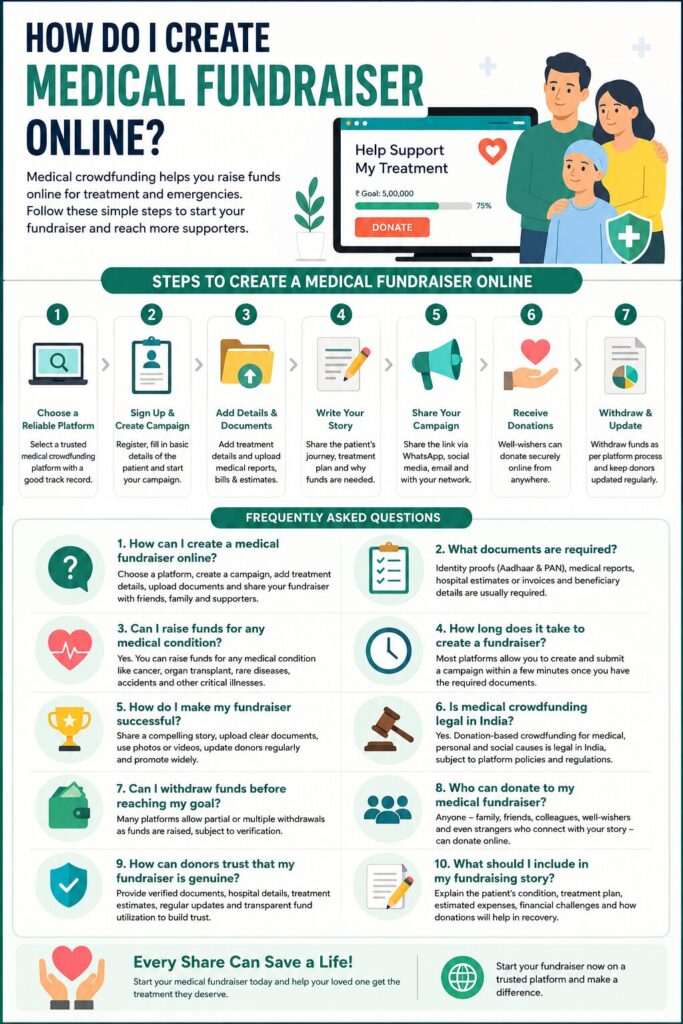
Step-by-Step: How to Create a Medical Fundraiser Online on ImpactGuru
Step 1: Visit ImpactGuru and Start Your Fundraiser
Go to ImpactGuru.com and click on “Start a Fundraiser.” The setup process takes under 10 minutes. You will be asked to fill in basic details:
- Who the fundraiser is for (yourself or someone else)
- The medical condition or diagnosis
- The hospital where treatment is taking place or planned
- The amount you need to raise
Be as specific as possible at this stage. Saying “₹8,00,000 for kidney transplant surgery at Apollo Hospital, Mumbai” is far more compelling than a vague description.
Step 2: Gather Your Documents
Before your fundraiser goes live, ImpactGuru’s Trust and Safety team reviews it to ensure legitimacy. Having your documents ready speeds up the approval process. Typically, you will need:
- Medical reports, diagnosis papers, or discharge summaries
- A hospital estimate letter specifying treatment costs
- Identity proof of the patient and the person creating the fundraiser
- A recent photograph of the patient (preferably from the hospital)
Document verification is not just a formality. It is what makes donors trust your campaign and choose to contribute.
Step 3: Write a Compelling Campaign Story
The story is the most important part of your fundraiser. It is what turns a visitor into a donor. Here is how to write one that works:
- Lead with the person, not the illness: Tell the donor who this person is, their name, age, what they do, and who depends on them. A name and a face create a connection in a way that a diagnosis alone cannot.
- Explain the medical situation clearly: Convey what happened? What treatment is needed? What does recovery look like? Avoid jargon, but give enough detail for the donor to understand the seriousness.
- Be specific about the money: Break down how the funds will be used. For example: “₹3 lakh for surgery, ₹2 lakh for ICU care, ₹1.5 lakh for post-operative medication.” Donors respond better when they know exactly what their money does.
- Convey urgency: If treatment must begin within days, say so. Genuine urgency motivates faster action.
- End with a clear call to action: Ask the donor directly to contribute, and also ask them to share the campaign, because donations often come from second and third-degree connections.
Step 4: Add Photos and a Video
Campaigns with strong visuals raise significantly more than those without.
- Upload recent photographs of the patient, ideally taken in the hospital or during treatment.
- A short video, even 60 seconds recorded on a phone, where a family member speaks directly to potential donors, dramatically increases trust and emotional connection.
If the patient is too unwell to appear on camera, a family member speaking on their behalf works equally well.
Step 5: Set a Realistic Fundraising Goal
Your goal should reflect actual costs, not a rounded estimate. A clearly justified, realistic goal builds donor confidence. A vague or inflated goal can make donors hesitate.
Step 6: Launch and Share Immediately
Once your campaign is approved and live, begin sharing right away.
The first 48 hours are critical; campaigns that gain early momentum tend to attract further donations from people who see that others have already contributed.
Here is a practical sharing plan for emergency fundraising:
- Day 1: Send a personal WhatsApp message to your 30 closest contacts. This should be personal, direct, and brief. Do not mass-broadcast; individual messages get far better responses. Also, post on Facebook and Instagram with the campaign link and a heartfelt caption.
- Day 3: Follow up with contacts who have not yet donated or shared. Ask them specifically to share, even if they cannot donate.
- Day 7: Post a campaign update with a milestone update, for example, “We have reached 25% of our goal. Thank you to everyone who has helped so far. We still need your support.”
- Day 14 onward: Continue with health updates about the patient. These keep your campaign visible and remind donors and potential donors that the need is ongoing.
Also, share your campaign in relevant WhatsApp groups, office groups, alumni groups, community groups, and any networks where the patient’s story might resonate.
Step 7: Post Regular Updates
Regular updates serve two important purposes.
- First, they reassure donors that their money was used correctly and that the patient is receiving care. Second, they re-engage your network and bring in new donors who see the updated post.
- Update your campaign after every significant medical event: a surgery, a test result, a discharge, a complication, a recovery milestone. Even short updates, a paragraph and a photo, are enough to maintain donor engagement.
Step 8: Withdraw Funds as Needed
On ImpactGuru, you do not have to wait until the goal is fully met to access the funds. You can withdraw at any point and transfer directly to the hospital or your bank account, so treatment does not have to wait for fundraising to be complete.
Documents You Will Typically Need
Here is a quick checklist to keep ready before you start:
- Doctor’s prescription or diagnosis letter
- Hospital estimate or treatment plan
- Medical reports (blood tests, scans, biopsy reports as applicable)
- Aadhaar card or passport of the patient
- Aadhaar card or PAN of the fundraiser creator
- Recent photographs of the patient
Which Common Mistakes Should I Avoid While Creating an Online Medical Fundraiser?
- Vague storytelling: A campaign that only says “my father has cancer and needs help” without context, a treatment plan, or a cost breakdown rarely succeeds. The more specific and human your story, the better.
- Sharing once and going silent: Most successful fundraisers involve multiple rounds of active sharing over several weeks. One post is never enough.
- Setting an unjustified goal: If your goal seems arbitrary or significantly higher than your documented costs, donors will question it. Always explain your numbers.
- Ignoring donors after they contribute: Thank your donors. Update them. This not only builds goodwill but also encourages them to share your campaign further.
- Not using video: A single short video can double the effectiveness of a campaign. It is worth taking the time.
What Can You Raise Funds For on ImpactGuru?
ImpactGuru supports fundraising for a broad range of medical needs in India, including but not limited to:
- Cancer (all types and stages)
- Kidney, liver, and bone marrow transplants
- Heart surgery and bypass procedures
- Neurological conditions and brain surgery
- Neonatal and paediatric critical care
- Burns and accident recovery
- Rare diseases and genetic conditions
- Ongoing dialysis and chronic illness management
There is no minimum fundraising goal, and there is no time limit on your campaign.
Conclusion
A medical emergency should not become a financial catastrophe. Learning how to create a medical fundraiser online is one of the most practical steps a family can take to bridge the gap between the cost of treatment and what they can afford alone.
By starting a fundraiser on ImpactGuru, telling your story clearly and honestly, sharing it actively, and keeping donors updated, you give yourself the best possible chance of raising funds for medical treatment in time. Thousands of families across India have used this approach for cancer, transplants, surgeries, and emergencies, and have received the support they needed from their communities and beyond.
If you or someone you know needs help right now, do not wait. Every hour counts in a medical emergency. Start your fundraiser today, share it with everyone you trust, and let the collective generosity of people around you carry the burden that no one should have to carry alone.
FAQs
You can start a medical fundraiser by choosing a crowdfunding platform, creating a campaign page, adding treatment details, uploading medical documents, and sharing your fundraiser with friends, family, and supporters.
Most platforms require identity proofs (Aadhaar and PAN), medical reports, hospital estimates or invoices, and beneficiary details for verification.
Yes. Medical crowdfunding can be used for cancer treatment, organ transplants, rare diseases, critical illnesses, accident-related injuries, and other healthcare emergencies.
Most online fundraising platforms allow you to create and submit a campaign within a few minutes once you have the required documents ready.
Share a compelling story, upload clear medical documents, add photos or videos, regularly update donors, and actively promote the campaign through social media, WhatsApp, email, and personal networks.
Yes. Donation-based crowdfunding for medical, personal, and social causes is legal in India, subject to platform policies and applicable regulations.