


Table of Contents
- Quick Summary
- Introduction
- What Is Mechanical Thrombectomy?
- How Is Mechanical Thrombectomy Performed?
- Who Is Eligible for Mechanical Thrombectomy?
- Mechanical Thrombectomy vs Thrombolysis: What’s the Difference?
- Mechanical Thrombectomy Cost in India
- Is Mechanical Thrombectomy Covered by Insurance in India?
- What Is the Success Rate of Mechanical Thrombectomy?
- How Long Does Thrombectomy Recovery Take?
- Can a Blood Clot in the Brain Be Removed Without Surgery?
- What Happens If Mechanical Thrombectomy Is Not Possible?
- Paying for Thrombectomy Treatment: Crowdfunding Support
- Conclusion
- Frequently Asked Questions
Quick Summary
- Mechanical thrombectomy cost in India generally ranges from ₹2,50,000 to ₹8,00,000 or more, depending on the procedure, device, hospital, and complexity of the stroke.
- Mechanical thrombectomy is a minimally invasive procedure that physically removes a clot blocking a major brain artery during an eligible ischemic stroke.
- Studies report successful restoration of blood flow in a substantial majority of patients undergoing thrombectomy, but technical success does not necessarily mean complete functional recovery.
- Mechanical thrombectomy and thrombolysis are often used together when a patient is eligible rather than being strictly alternative treatments.
- Stroke treatment is time-sensitive. Selected patients may benefit from thrombectomy several hours after symptom onset and, in appropriately selected cases, even later based on imaging and other clinical criteria.
Introduction
When a major artery supplying the brain becomes blocked, every minute can matter. Mechanical thrombectomy can sometimes reopen that artery and restore blood flow before more brain tissue is permanently damaged.
For families, however, the procedure can seem overwhelming when they first hear about it during a stroke emergency. What exactly happens during thrombectomy? Who can receive it? How much does mechanical thrombectomy cost in India? How successful is it, and how long does recovery take?
This guide explains the mechanical thrombectomy procedure in straightforward terms, including how the clot is removed, how it differs from thrombolysis, what affects treatment costs in India, what success rates actually mean, insurance considerations, and what families can expect during recovery.
What Is Mechanical Thrombectomy?
Mechanical thrombectomy is a minimally invasive, catheter-based procedure used to remove a blood clot blocking a major artery in the brain during an acute ischemic stroke.
Instead of opening the skull, a doctor guides a thin catheter through an artery, usually from the groin and sometimes from the wrist, toward the blocked blood vessel in the brain. A device such as a stent retriever or an aspiration catheter is then used to remove the clot and restore blood flow.
Mechanical thrombectomy is primarily used for eligible patients with a large-vessel occlusion or other blockages for which endovascular treatment is appropriate. The 2026 American Heart Association/American Stroke Association guideline describes endovascular thrombectomy (EVT) as an established standard treatment for eligible acute ischemic stroke patients with large-vessel occlusion and notes that evidence has expanded eligibility to some patients who were previously considered unsuitable.
Importantly, thrombectomy is not used for every type of stroke. It is a treatment for certain ischemic strokes caused by blocked blood vessels. Hemorrhagic strokes, which involve bleeding in or around the brain, require a different treatment approach.
Read More : Ischemic vs Hemorrhagic Stroke: Causes, Symptoms & Differences
How Is Mechanical Thrombectomy Performed?
The mechanical thrombectomy procedure generally involves the following steps:
- Emergency assessment and brain imaging: Doctors first determine whether the patient has an ischemic stroke and identify the location and size of the blockage. CT, CT angiography, and, in selected cases, CT perfusion or MRI may be used to assess whether thrombectomy is appropriate.
- Preparation for the procedure: The patient is taken to a specialized neurointerventional facility. Depending on the circumstances, the procedure may be performed under conscious sedation or general anesthesia.
- Catheter insertion: A small access point is made in an artery, commonly in the groin or sometimes the wrist. A catheter is guided through the blood vessels toward the blocked artery using real-time X-ray imaging.
- Clot removal: The specialist uses a stent retriever, aspiration catheter, or a combination of techniques to capture or suction out the clot.
- Restoration of blood flow: Imaging is used to confirm whether blood flow has been restored through the previously blocked artery. The degree of reperfusion is commonly assessed using the modified Thrombolysis in Cerebral Infarction (mTICI) grading system.
- Post-procedure monitoring: The patient is closely monitored after thrombectomy, often in an intensive care or specialized stroke unit, to watch for complications and assess neurological recovery.
The procedure itself is minimally invasive, but it remains a major emergency treatment for a potentially life-threatening stroke. The patient’s overall recovery depends on much more than whether the clot was successfully removed, including the severity and location of the stroke and how quickly blood flow was restored.
Who Is Eligible for Mechanical Thrombectomy?
Not every person with an ischemic stroke is a candidate for thrombectomy. Eligibility depends on factors such as:
- The location and size of the blocked blood vessel
- The severity of the stroke
- Brain imaging findings
- The amount of already-damaged brain tissue
- The time since the patient was last known to be well
- The patient’s previous level of disability and overall health
- Whether the expected benefits of treatment outweigh its risks
Current guidelines have broadened thrombectomy eligibility for certain patients with larger ischemic cores and other previously excluded groups. For example, the 2026 AHA/ASA guideline includes evidence supporting EVT in selected patients with large ischemic cores.
This is why emergency imaging and assessment by a stroke team are essential. A patient should not be assumed to be ineligible simply because several hours have passed since symptoms began.
Mechanical Thrombectomy vs Thrombolysis: What’s the Difference?
Mechanical thrombectomy and thrombolysis both aim to restore blood flow during an ischemic stroke, but they work differently.
| Feature | Mechanical Thrombectomy | Thrombolysis |
| How it works | Physically removes the clot | Uses medication to dissolve the clot |
| How it is given | Catheter-based procedure | Usually intravenous medication |
| Most useful for | Selected patients with an accessible arterial blockage | Eligible patients who can receive clot-busting medication |
| Can they be combined? | Yes | Yes |
| Main advantage | Can directly remove a large clot | Can be administered quickly without an endovascular procedure |
These treatments are not necessarily either/or. If a patient is eligible for intravenous thrombolysis and also has a blockage suitable for thrombectomy, both may be used. The current AHA/ASA guideline specifically advises against delaying endovascular thrombectomy to see whether a patient improves after thrombolysis.
Mechanical Thrombectomy Cost in India
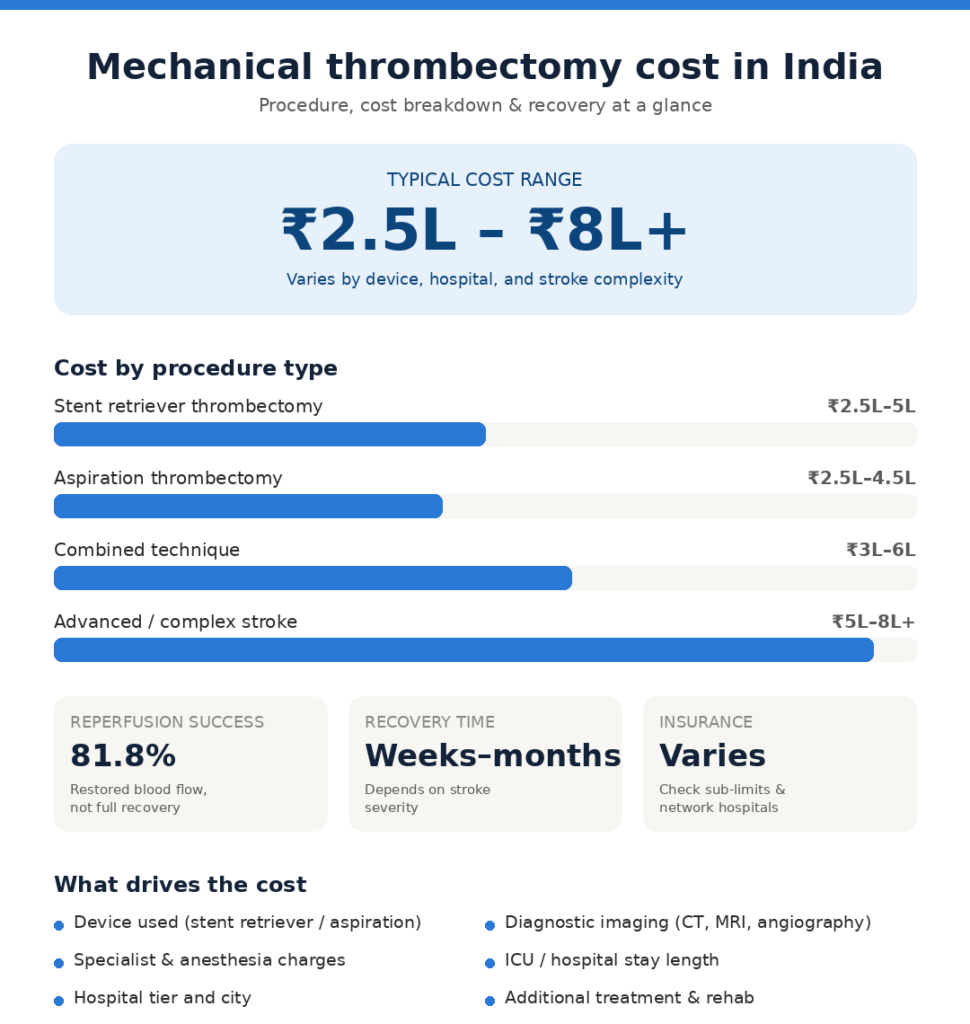
There is no single fixed mechanical thrombectomy cost in India. Published hospital estimates currently place the cost at approximately ₹2,50,000 to ₹8,00,000 or more, although the final bill can vary considerably between patients and hospitals.
A published estimate from Yashoda Hospitals gives the following approximate ranges:
| Type of thrombectomy | Approximate cost in India |
| Stent retriever thrombectomy | ₹2,50,000–₹5,00,000 |
| Aspiration thrombectomy | ₹2,50,000–₹4,50,000 |
| Combined technique | ₹3,00,000–₹6,00,000 |
| Advanced neurovascular thrombectomy for complex stroke | ₹5,00,000–₹8,00,000+ |
These are indicative figures, not a standardized national price list. A patient’s actual hospital bill may be higher or lower depending on the treatment plan and associated care.
What Factors Affect the Cost of Mechanical Thrombectomy?
Several factors can influence the final cost, including:
- Thrombectomy device: Stent retrievers, aspiration systems, and other neurovascular devices have different costs.
- Complexity of the clot: A difficult-to-reach or difficult-to-remove clot may require additional procedural work or more than one retrieval attempt.
- Diagnostic imaging: CT, CT angiography, CT perfusion, MRI, and cerebral angiography may contribute to the overall bill.
- Specialist and procedure charges: Neurointerventional specialists, anesthesia or sedation, and laboratory charges can add to the cost.
- ICU and hospital stay: Longer monitoring or treatment for complications can significantly increase expenses.
- Hospital and location: Costs may differ between government hospitals, private hospitals, and high-end tertiary stroke centers in different Indian cities.
- Additional stroke treatment: Thrombolysis, medicines, treatment of complications, and rehabilitation can add to the overall cost.
Because thrombectomy is usually performed as an emergency, families should ask the hospital for an itemized estimate covering the procedure, device, imaging, ICU care, hospitalization, and other expected charges.
Read More : Stroke Treatment Cost in India: A City-Wise Guide
Is Mechanical Thrombectomy Covered by Insurance in India?
Mechanical thrombectomy may be covered by health insurance when the treatment is medically necessary and falls within the terms of the patient’s policy, but coverage is not identical across all plans.
The Insurance Regulatory and Development Authority of India (IRDAI) notes that health insurance coverage depends on the specific policy terms and can involve limits on expenses, room rent and ICU charges, exclusions, co-payments, sub-limits and network-hospital requirements.
Before or during hospitalization, families should check:
- Whether the hospital is part of the insurer’s network
- Whether cashless treatment is available
- Whether preauthorization is required
- The remaining sum insured
- Any applicable sub-limits or co-payment
- Whether pre- and post-hospitalization expenses are covered
- Whether rehabilitation expenses are included
In a stroke emergency, insurance paperwork should not delay medically necessary treatment. The treating stroke team should prioritize timely treatment, while the family or hospital insurance desk can handle authorization and documentation as quickly as possible.
What Is the Success Rate of Mechanical Thrombectomy?
The phrase “success rate” can mean different things in thrombectomy research, so it is important not to confuse successful clot reperfusion with complete recovery from a stroke.
One commonly measured outcome is successful reperfusion, meaning that blood flow has been substantially restored in the previously blocked vessel.
A later systematic review and meta-analysis of 22 randomized controlled trials involving 5,692 patients reported an 81.8% successful reperfusion rate across the included thrombectomy studies.
However, successful reperfusion does not mean that 81.8% of patients will make a complete recovery.
Functional independence is a different outcome. It can be affected by:
- How much brain tissue was damaged before treatment
- How quickly blood flow was restored
- The location of the stroke
- Stroke severity
- The patient’s age and overall health
- Other medical conditions
- The quality and duration of rehabilitation
In the original thrombectomy trials, functional outcomes varied substantially between patient groups. The 2026 AHA/ASA guideline notes that earlier trials involving patients with smaller predicted infarct cores had functional-independence rates around 50%, while patients with larger predicted cores had lower absolute rates despite still benefiting from EVT.
Therefore, there is no single percentage that can predict an individual patient’s recovery after thrombectomy.
How Long Does Thrombectomy Recovery Take?
There are two different types of recovery to consider: recovery from the procedure itself and recovery from the stroke.
Because thrombectomy is performed through a catheter rather than an opening in the skull, recovery from the access site is generally less extensive than recovery from open brain surgery. However, the stroke itself may require much more time to recover from.
Immediately after thrombectomy, the patient is closely monitored for neurological changes, bleeding, blood-pressure changes, and other complications. Brain imaging may be performed during the early post-procedure period depending on the patient’s condition.
After the acute phase, rehabilitation may include:
- Physical therapy for weakness and movement problems
- Occupational therapy for everyday activities
- Speech and language therapy
- Cognitive rehabilitation
- Swallowing assessment and therapy when required
How long does thrombectomy recovery take?
There is no fixed recovery period. Some patients show neurological improvement soon after blood flow is restored, while others require weeks or months of rehabilitation. The eventual recovery depends primarily on the severity of the stroke and the amount and location of brain injury, rather than simply how quickly the catheter access site heals.
Read More : 20 Things to Expect After Brain Surgery
Can a Blood Clot in the Brain Be Removed Without Surgery?
Sometimes, but the answer depends on what type of clot or stroke the patient has.
In an acute ischemic stroke caused by a blocked artery, eligible patients may receive intravenous thrombolysis to dissolve the clot. Patients with certain large-vessel blockages may require mechanical thrombectomy to physically remove the clot.
This means the question of how to remove a blood clot in the brain without surgery cannot be answered with one treatment that works for everyone. Some clots may be treated with medication, while others require an endovascular procedure. A hemorrhagic stroke, meanwhile, involves bleeding rather than an artery being blocked and requires a different medical approach.
Treatment should therefore be based on brain imaging and assessment by the treating stroke team rather than attempting to manage a suspected brain clot at home.
Read More : Blood Clot in Brain: Treatment & Recovery Guide
What Happens If Mechanical Thrombectomy Is Not Possible?
If a patient is not eligible for thrombectomy, doctors may consider other treatments based on the type and timing of the stroke.
Depending on the situation, treatment may involve:
- Intravenous thrombolysis when the patient is eligible
- Medical management and monitoring
- Treatment to control blood pressure and other risk factors
- Prevention of another stroke
- Management of complications
- Early rehabilitation
The treatment plan is individualized according to the patient’s imaging, symptoms, medical history, and overall condition.
Paying for Thrombectomy Treatment: Crowdfunding Support
Even when treatment is covered partly by insurance, families may face significant out-of-pocket expenses from deductibles, uncovered services, additional hospitalization, rehabilitation, or other related costs.
For families struggling to arrange treatment funds quickly, medical crowdfunding platforms can provide another potential source of financial support. Through crowdfunding for health issues, families can share the patient’s diagnosis, hospital estimate, and treatment needs with their personal networks and wider donor communities.
ImpactGuru allows families to raise donations online for eligible medical expenses and share their fundraising campaign with people who may be willing to contribute. Crowdfunding is not a replacement for medical insurance or government assistance, but it can provide an additional way to seek financial support when treatment expenses become difficult to manage.
Read More : How to Raise Funds for Stroke Rehabilitation Treatment?

Conclusion
Mechanical thrombectomy has transformed treatment for many patients with eligible ischemic strokes by allowing doctors to physically remove a blood clot and restore blood flow to the brain. However, treatment decisions depend on factors such as the location of the blockage, brain imaging, stroke severity, and timing. The cost can also be substantial, with published Indian hospital estimates ranging from ₹2.5 lakh to ₹8 lakh or more.
If you or a loved one is facing the financial burden of thrombectomy or stroke treatment, ImpactGuru can help you explore medical crowdfunding as one potential source of support. By sharing the treatment estimate and patient’s story, families can raise donations online and seek help from their communities while focusing on the patient’s recovery.
Frequently Asked Questions
Mechanical thrombectomy is a minimally invasive endovascular procedure rather than open brain surgery. Doctors use a catheter inserted through an artery to reach and remove the clot. Despite being minimally invasive, it is a serious emergency procedure performed for eligible patients with potentially life-threatening ischemic strokes.
Success depends on how it is defined. Successful reperfusion, meaning restoration of blood flow, was reported in 81.8% of patients across a meta-analysis of 22 randomized controlled trials. However, successful clot reperfusion does not guarantee complete neurological or functional recovery.
There is no standard recovery time. Some patients improve quickly after blood flow is restored, while others need weeks or months of rehabilitation. Recovery depends on stroke severity, the location and extent of brain injury, treatment timing, and the patient’s response to rehabilitation.
It may be covered when medically necessary and permitted under the patient’s health insurance policy, but coverage varies. Policyholders should check their sum insured, exclusions, sub-limits, co-payments, network-hospital requirements, and preauthorization rules. IRDAI advises consumers to review their policy terms carefully because health insurance coverage and restrictions vary by product.
Some ischemic strokes can be treated with clot-dissolving medication rather than thrombectomy, if the patient is eligible. Other blockages may require mechanical thrombectomy. The appropriate treatment depends on brain imaging, the type and location of the clot, timing, and the patient’s clinical condition.