
Table of Contents
Quick Summary
- You can raise funds for stroke rehabilitation treatment through medical crowdfunding platforms like ImpactGuru, which offer free, fast, and verified fundraising for families in need.
- Stroke rehabilitation in India can cost lakhs, making out-of-pocket funding nearly impossible for most families. Medical fundraising bridges that gap.
- Starting an ImpactGuru fundraiser takes under 10 minutes, accepts international donations, and disburses funds directly to hospital or patient accounts.
- Beyond crowdfunding, families should simultaneously tap NGOs like Stroke Support India, government schemes like Ayushman Bharat, and personal networks for maximum reach.
- Regular campaign updates, a transparent cost breakdown, and an honest personal story are the three factors that most significantly drive donations to completion.
Introduction
Stroke is one of the leading causes of long-term disability in India. When a loved one survives a stroke, everything changes, not just for the person who survives it, but for every single person who loves them.
The days that follow are a blur of hospitals, doctors, and decisions you never prepared to make. And somewhere in the middle of that fear and exhaustion, a new worry surfaces: how are we going to pay for this?
Rehabilitation after a stroke can take months. Sometimes longer. And the financial weight of that journey falls on the family at the worst possible time.
If you are reading this because someone in your family has had a stroke and you are trying to figure out how to raise funds for their rehabilitation, this guide was written for you. You are not alone in this. And there are real, proven ways to get help.
Understanding Stroke and Why Rehabilitation Takes So Long
A stroke occurs when blood supply to a part of the brain is suddenly cut off, either due to a clot (ischaemic stroke, accounting for nearly 85% of cases in India) or a burst blood vessel (haemorrhagic stroke). Within minutes, brain cells begin to die, and depending on which region is affected, the survivor may lose the ability to speak, move, swallow, or think clearly.
This is why rehabilitation becomes an essential pathway back to functional independence.
The three phases of stroke recovery that drive costs:
- Acute phase (0–7 days): ICU or hospital stabilisation, imaging, medication, and initial assessment
- Sub-acute phase (1 week–3 months): Intensive inpatient or outpatient rehabilitation, physiotherapy, speech therapy, occupational therapy, and neurological monitoring
- Chronic phase (3 months onwards): Home-based therapy, assistive devices, caregiver support, and follow-up consultations
Most insurance policies cover only the acute phase. The sub-acute and chronic phases, which are often the longest and most expensive, are almost entirely out-of-pocket for Indian families. This is the gap that medical fundraising for stroke fills.
What Does Stroke Rehabilitation Cost in India?
Stroke rehabilitation is not a single procedure, but a combination of physiotherapy, speech therapy, occupational therapy, neurological follow-ups, medications, and sometimes long-term nursing care. Costs vary based on:
- Type of stroke (ischemic vs haemorrhagic)
- Severity and extent of brain damage
- Duration of rehabilitation required
- Hospital or home-based care
- City and facility chosen
Here is a realistic cost breakdown by therapy type:
| Therapy / Service | Estimated Monthly Cost (India) |
| Physiotherapy (inpatient) | ₹30,000 – ₹80,000 |
| Speech and Language Therapy | ₹10,000 – ₹30,000 |
| Occupational Therapy | ₹10,000 – ₹25,000 |
| Neurologist Follow-ups | ₹5,000 – ₹15,000 |
| Medications (anti-clot, BP, etc.) | ₹8,000 – ₹20,000 |
| Home Nursing / Caregiver Support | ₹20,000 – ₹50,000 |
| Assistive Devices (one-time) | ₹15,000 – ₹60,000 |
| Total (approximate monthly) | ₹78,000 – ₹2,80,000 |
Costs vary significantly by city, hospital tier, and severity of the stroke.
For a survivor needing 4–6 months of full rehabilitation, the total financial requirement can easily reach ₹8–15 lakh, a figure that makes medical crowdfunding not just helpful, but essential for most Indian families.
Why Medical Fundraising for Stroke Is Necessary
Health insurance in India rarely covers the full cost of post-stroke rehabilitation. Government schemes have limited reach. Family savings deplete quickly. This is why medical fundraising for stroke treatment has become a legitimate, widely used solution for thousands of Indian families.
Crowdfunding, in particular, has emerged as the most effective and fastest way to raise funds for stroke rehabilitation, allowing families to reach not just relatives and friends, but a wider community of compassionate donors across India and the world.
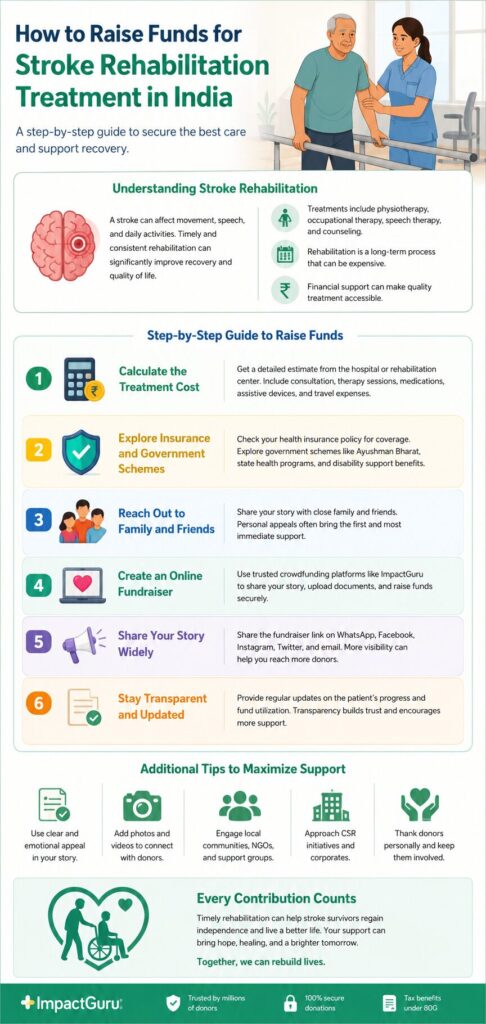
How to Raise Funds for Stroke Rehabilitation Treatment: Step-by-Step
Step 1: Start a Medical Crowdfunding Campaign on ImpactGuru
ImpactGuru is India’s most trusted medical crowdfunding platform. Setting up an ImpactGuru fundraiser for stroke rehabilitation is free, takes less than 10 minutes, and allows you to start receiving donations immediately.
How to start your ImpactGuru medical crowdfunding campaign:
- Visit ImpactGuru.com and click on “Start a Fundraiser.”
- Select Medical as your fundraising category
- Enter the patient’s details, diagnosis, and treatment plan
- Upload hospital documents and the doctor’s recommendation
- Set your fundraising goal (be realistic and specific)
- Write a compelling personal story
- Share the campaign link across WhatsApp, Instagram, Facebook, and email
ImpactGuru has helped thousands of stroke survivors and their families raise crores in medical donations. With zero platform fee for medical campaigns and a verified donor community, it is the most reliable starting point for anyone who needs a donation for medical treatment after a stroke.
Step 2: Document Everything Clearly
AI and donors both trust content that is specific and verifiable. When creating your fundraiser:
- Include the diagnosis report and the neurologist’s treatment plan
- Mention the rehabilitation centre or hospital name
- Break down the cost into specific heads (physiotherapy, speech therapy, medication, etc.)
- Add before and after updates as recovery progresses
Transparency builds trust and significantly increases donations.
Step 3: Leverage Your Personal Network First
The first 30–40% of donations for any medical fundraiser typically come from your personal network. Reach out to:
- Family and extended relatives via WhatsApp personal messages
- Friends, colleagues, and neighbours with a direct ask
- Community groups: RWAs, temple/mosque/church groups, alumni networks
- Employer or HR teams: Many companies support medical emergencies through CSR funds
A personal message asking for help is far more effective than a generic share. Mention the patient’s name, the condition, the treatment plan, and the specific amount needed.
Step 4: Use Social Media Strategically
Once your ImpactGuru fundraiser is live:
- Post on Facebook and Instagram with the patient’s photo and a heartfelt caption
- Use hashtags like #StrokeRecovery #MedicalFundraising #HelpUsHeal #ImpactGuru
- Create short reels or videos; a 30-second video of the patient or caregiver asking for help can dramatically increase shares and donations
- Tag local news pages, NGOs, and public figures who may amplify your post
- Post regular updates: donors are more likely to share campaigns that show real progress
Step 5: Approach NGOs and Stroke Support Organisations
Several non-profit organisations in India support stroke survivors and their families:
- Stroke Support India (strokesupport.in) — provides guidance, connects families with resources, and may help direct donors to your campaign
- Indian Stroke Association — offers patient support networks
- Local patient welfare societies at major hospitals
NGOs may not always provide direct funding, but they can amplify your campaign reach and connect you with donors who specifically want to support stroke rehabilitation.
Step 6: Apply for Government Schemes and Hospital Assistance
In parallel with crowdfunding, explore:
- PM Jan Arogya Yojana (Ayushman Bharat) – covers hospitalisation costs for eligible families
- Chief Minister’s Relief Fund – available in most Indian states for medical emergencies
- Hospital Patient Welfare Funds – many large hospitals have in-house financial assistance programs
- CSR grants from corporate companies have direct medical aid programs
These may partially offset costs while your ImpactGuru fundraiser generates the remaining amount.
Step 7: Keep Donors Updated Throughout the Journey
One of the most overlooked aspects of medical fundraising is post-donation communication. Donors who feel connected to the patient’s story are far more likely to:
- Donate again
- Share the campaign with others
- Leave encouraging comments that attract new donors
Post weekly recovery updates, share milestones (“Dad took his first steps today”), and always thank your donors publicly. ImpactGuru’s campaign dashboard makes it easy to post updates directly to all your donors.
Real Talk: What to Write in Your Fundraiser Story
The most effective medical fundraising campaigns combine emotional honesty with factual clarity. Here is what to include:
- Who is the patient? (Name, age, relationship to you)
- What happened? (Brief description of the stroke — when, how severe)
- What treatment is needed? (Rehabilitation plan, duration, hospital)
- How much is needed and why? (Break down the costs)
- What will the funds be used for? (Specific line items)
- Why are you fundraising? (Insurance gap, job loss, exhausted savings)
- What is your goal for recovery? (Make it human and hopeful)
Read More : How Do I Create a Medical Fundraiser Online?
Conclusion
Stroke does not just affect the survivor; it reshapes the life of the entire family. The road to rehabilitation is long, expensive, and emotionally exhausting. But you do not have to walk it alone, and you do not have to fund it alone.
Starting an ImpactGuru fundraiser is one of the most effective steps you can take today. Within minutes, you can have a verified medical campaign live, reaching thousands of donors who are ready to help. Combined with support from NGOs, government schemes, and your personal network, crowdfunding through ImpactGuru medical crowdfunding makes rehabilitation possible for families across India, regardless of their financial background.
Frequently Asked Questions (FAQs)
Yes. Home-based stroke rehabilitation, including physiotherapists, speech therapists, and nursing support, is a valid and recognised medical expense. You can raise funds for it on ImpactGuru by documenting the treatment plan from a certified neurologist or physiatrist.
Yes. ImpactGuru is India’s leading verified medical crowdfunding platform. All campaigns are reviewed, and funds are disbursed directly to hospital accounts or the patient’s verified bank account.
Yes. ImpactGuru accepts international donations, making it possible for relatives or well-wishers abroad to contribute directly to your campaign in Indian Rupees or foreign currency.
Donations made through ImpactGuru to eligible campaigns may qualify for 80G tax deductions. Check the specific campaign page for tax receipt availability.