

Table of Contents
- Quick Summary
- Introduction
- How Much Does Spinal Cord Injury Treatment Cost in India?
- What Makes the Cost Go Up or Down?
- How Can I Get Financial Assistance for Spinal Cord Injury Treatment?
- How to Raise Money for Spinal Cord Injury Treatment in India
- How to Start a Medical Fundraiser for Spinal Cord Injury Treatment
- How to Pay for Spinal Cord Injury Rehabilitation and Long-Term Care
- What Documents Are Needed to Raise Funds for Spinal Cord Injury Treatment?
- How Can You Raise Donations for a Spinal Cord Injury Fundraiser?
- Conclusion
- Frequently Asked Questions
Quick Summary
How to raise funds for spinal cord injury treatment in India depends on a few things: what the patient needs medically, what insurance covers, which assistance schemes they qualify for, and what the family can realistically put in themselves.
- Expenses can include emergency treatment, hospitalisation, surgery when required, rehabilitation, assistive devices and long-term care.
- Families can look at health insurance, government health schemes, hospital financial assistance, charitable organizations and community support.
- Medical crowdfunding can help when existing resources fall short of the full cost of treatment and rehabilitation.
- A good fundraiser explains the patient’s condition, the treatment plan and the estimated expenses, and backs them up with medical documents.
Introduction
A spinal cord injury rarely gives anyone time to prepare. It can mean urgent medical attention, a long hospital stay, and months of rehabilitation, and the financial pressure lands on the patient and family almost overnight. Depending on how severe the injury is and where it sits, treatment may include surgery, medication, physiotherapy, assistive devices, and ongoing medical care.
If a family has little savings or no insurance, meeting these costs can feel overwhelming. Still, several routes are worth exploring, including government assistance, charitable support, and medical crowdfunding.
Knowing how to raise funds for spinal cord injury treatment helps families spot the right resources early. It also lets them plan for the immediate treatment and for the longer rehabilitation that often follows.
Read more: Spinal Muscular Atrophy (SMA): Symptoms, Causes, Types, Treatment, Cost & Financial Support in India
How Much Does Spinal Cord Injury Treatment Cost in India?
There is no fixed figure. The spinal cord injury treatment cost in India depends on the cause and severity of the injury, the patient’s condition, the hospital, the treatment plan, and how long care lasts. One patient may need emergency stabilisation and a short period of observation. Another may need surgery, intensive care and an extended rehabilitation programme.
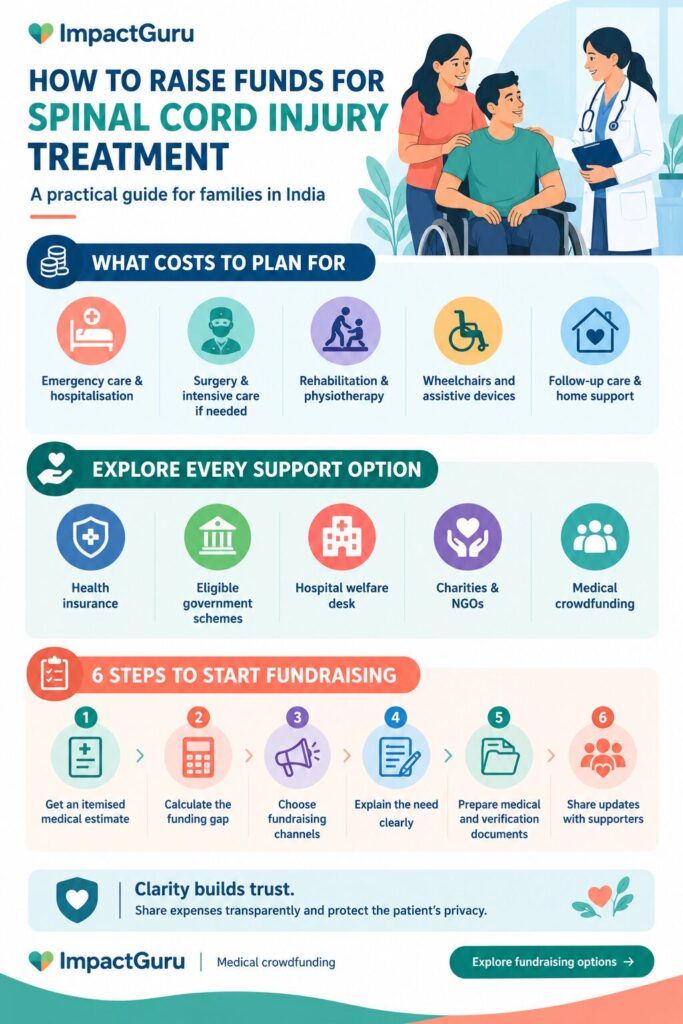
Here is where the money usually goes:
- Emergency treatment and hospitalization: the first assessment, diagnostic investigations, medication, monitoring and hospital stays.
- Spinal surgery: recommended for certain injuries, depending on factors such as spinal instability, compression and neurological findings.
- Intensive care: patients with severe injuries or complications may need close monitoring and specialised support.
- Rehabilitation: physiotherapy, occupational therapy and other services that help patients improve functioning and adapt to changes in mobility. This is the core of the spinal cord injury rehabilitation cost.
- Assistive devices: wheelchairs, mobility aids, and other equipment, depending on what the patient functionally needs.
- Long-term care: follow-up consultations, treatment for complications, home modifications, and caregiver support all add to ongoing expenses.
The World Health Organization’s spinal cord injury fact sheet notes that appropriate acute care, rehabilitation, and ongoing healthcare matter for managing these injuries and their complications.
Because every case is different, ask the treating hospital for an itemised estimate. It gives you a solid number to work from, both for immediate treatment and for the rehabilitation expected later.
Start a fundraiser today. Give hope for recovery.
What Makes the Cost Go Up or Down?
Two patients with the same diagnosis can end up with very different bills. These are the main factors:
| Factor | Why it matters | Effect on cost |
| Severity and level of injury | Higher or more complete injuries often need more intensive care and longer rehabilitation | Higher with greater severity |
| Whether surgery is needed | Spinal stabilisation or decompression adds surgical, implant and anaesthesia costs | Higher if surgery is recommended |
| ICU and total hospital stay | Each additional day of intensive monitoring adds to the bill | Rises with length of stay |
| Type of hospital | Government, trust-run and private hospitals price care very differently | Usually lower in government or subsidised settings |
| City and facility | Metro and super-specialty centres typically charge more than smaller towns | Varies by location |
| Complications | Infections, pressure sores or breathing problems may need extra treatment | Higher if complications arise |
| Rehabilitation duration | Physiotherapy and occupational therapy may continue for weeks or months | Rises with the length of the programme |
| Assistive devices | Wheelchairs, cushions and other equipment depend on the patient’s needs | Depends on the type and quality of equipment |
| Home modifications and caregiving | Ramps, accessible bathrooms and care support add ongoing costs | Adds to long-term expenses |
Because these factors vary so much, an itemized estimate from the treating hospital remains the most reliable way to plan.
How Can I Get Financial Assistance for Spinal Cord Injury Treatment?
Before turning to crowdfunding, or alongside it, families can explore several other options. What’s available depends on the patient’s circumstances, the treatment needed, and each programme’s eligibility conditions. Spinal cord injury financial assistance usually comes from more than one place.
1. Check Health Insurance Coverage
If the patient has health insurance, start by reading the policy closely. Depending on the plan, it may cover eligible hospitalisation, surgery, diagnostic tests and other medically necessary expenses.
Talk to the insurer about the sum insured, exclusions, waiting periods, co-payments, sub-limits and claim requirements. Ask specifically whether rehabilitation and assistive devices are covered, since these are often the grey areas.
If the approved amount doesn’t cover the whole bill, the difference becomes part of the family’s funding gap.
2. Explore Government Health Schemes
Eligible patients may be able to get help through central or state government healthcare programmes.
- AB PM-JAY: Under AB PM-JAY, eligible families receive cashless cover of up to ₹5 lakh per family per year for hospitalization. Pre-existing conditions are covered, and the cover can include ICU charges and surgery, subject to package rules. Treatment must be at an empaneled hospital, so confirm that before admission.
- Rashtriya Arogya Nidhi (RAN): a central scheme that offers one-time financial assistance to patients living below the poverty line, for treatment at government hospitals with super-specialty facilities. It is mainly aimed at life-threatening conditions such as heart, kidney, and liver disease and cancer, so ask the hospital whether your treatment qualifies. Assistance generally goes to the hospital, not directly to the patient.
- Prime Minister’s and Chief Minister’s relief funds: these can sometimes assist people facing serious medical expenses. Application processes and eligibility differ by fund and state, so check the official portals.
- ADIP scheme (assistive devices): a central scheme that supports the purchase and fitting of aids and appliances for persons with disabilities, subject to eligibility conditions. It can be relevant to wheelchairs and mobility aids.
- UDID card and disability certificate: the Unique Disability ID is often needed to access disability-related benefits, so ask your hospital or the local authority about the process.
Hospital and CSR-linked support: some hospitals receive corporate (CSR) or trust funding for patients who can’t afford treatment. The hospital’s social worker or patient welfare desk can tell you what exists.
Always confirm current eligibility, limits, and application steps on the official scheme website or with the hospital before relying on any of these.
Read More : CGHS (Central Government Health Scheme): Eligibility, Benefits, Card & Contribution Rates
3. Ask the Hospital About Financial Assistance
Some hospitals run charitable funds, offer subsidised treatment or have patient welfare departments for people who can’t afford their medical expenses.
It costs nothing to ask. Contact the hospital’s medical social worker, patient assistance desk or administrative department and find out what support exists. Keep medical reports, identity documents, income-related records (where required), and the hospital’s cost estimate handy. The hospital can tell you which documents it actually needs and whether help is available for this particular treatment.
4. Approach Charitable Organisations and NGOs
Certain charitable trusts, NGOs and community organisations help people facing serious medical expenses. Some focus on specific income groups, regions or medical categories.
Before applying, check the organisation’s eligibility criteria and which expenses it supports. Also find out whether it gives direct financial assistance or a different kind of help.
Local community groups, employers, religious or charitable institutions, and personal networks are worth approaching as well.
5. Consider Medical Crowdfunding
Sometimes insurance, government schemes, hospital assistance, and savings still don’t add up to the full amount. That is where medical crowdfunding in India can offer another way to seek support.
Through an online fundraiser, patients or their families can explain the medical situation, share verified treatment documents, and ask friends, relatives, colleagues, and other donors for voluntary contributions.
There’s no guarantee the full amount will be raised. But a fundraiser can reach people far beyond a family’s immediate circle, and that can make a real difference towards treatment and rehabilitation costs.
How to Raise Money for Spinal Cord Injury Treatment in India
Fundraising works best when it starts with clarity: what does the patient need, and how much support is required? These steps can help families stay organised. If you’ve been wondering how to raise money for spinal cord injury treatment in India, this is a practical place to begin.
Step 1: Obtain a Medical Estimate
Ask the treating hospital for an estimate covering the recommended treatment, hospitalisation, investigations, and any planned surgery.
If rehabilitation is likely, request an estimate for that as well, where the hospital can provide one. Keep immediate costs and expected future expenses separate, so donors can see clearly what the funding is for.
Step 2: Calculate the Remaining Funding Gap
Add up what is available from savings, insurance, eligible government schemes, hospital assistance, and any other sources.
Then subtract the confirmed or reasonably expected support from the estimated expenses. What’s left is the amount you still need. If the treatment plan or hospital estimate changes, update the figure.
Step 3: Choose Suitable Fundraising Channels
Families can seek support through personal networks, community contributions, charitable organisations, and online medical crowdfunding.
Using more than one channel can widen the reach of your appeal. Just keep track of what each source provides, so you never overstate the outstanding requirement.
Step 4: Prepare a Clear Fundraising Appeal
Tell people who the patient is. If the family is comfortable sharing it, say what caused the injury. Then explain the recommended treatment and why financial help is needed.
Include a breakdown of estimated expenses, along with the amount already arranged, if any. Keep the tone factual and respectful, and the language simple enough for any donor to follow.
Provide the medical reports, the doctor’s advice, the hospital estimate, and whatever else the fundraising platform or assistance provider asks for.
Identity and banking documents may also be needed for verification. Share sensitive information only through appropriate channels, and get the patient’s consent before publishing personal medical details.
Send the fundraiser to family, friends, colleagues, community groups, and relevant social networks.
Then keep people posted on how treatment is going, what has been spent, and what has been received. If the estimated cost changes, explain why and revise the target openly.
How to Start a Medical Fundraiser for Spinal Cord Injury Treatment
Medical crowdfunding lets individuals and families ask for donations online to cover healthcare costs. ImpactGuru is one platform families in India can consider.
In general, the process looks like this: create a fundraiser, explain the patient’s medical needs, submit the required documents, and share the appeal with potential donors.
1. Create a Fundraiser
Visit ImpactGuru’s medical crowdfunding platform to see how starting a fundraiser works. You’ll be asked for details about the patient, the fundraiser organizer, the hospital, the treatment requirement, and the fundraising goal.
2. Explain the Medical and Financial Need
Describe the patient’s condition and the treatment the medical team has recommended. Explain the expected expenses and why support is needed.
Where it applies, separate hospital bills, surgery, rehabilitation, assistive devices, and ongoing care. Donors then get a clearer picture of how their contribution may be used.
3. Submit the Required Documents
Upload medical reports, the doctor’s letter, the hospital estimate, identity documents, and anything else the platform requests.
The platform may verify these before approving a fundraiser or processing withdrawals, so check the documentation and verification requirements beforehand.
Send the link through messaging apps, email, and social media. A short personal message about the patient’s situation often helps people understand the request and decide whether to contribute. Community organisations and personal contacts can also pass the appeal along to their own networks.
5. Monitor Donations and Withdrawals
Keep an eye on donations and update your supporters regularly. Read the platform’s terms, fees, and withdrawal requirements before you launch.
ImpactGuru states that medical fundraisers can be created online and that supporting documents are used for verification. Confirm the current terms and disbursement process directly with the platform.
Remember that crowdfunding is voluntary. How much you raise depends on donor response and how far the appeal travels. If the fundraiser falls short, keep exploring other eligible financial assistance.

How to Pay for Spinal Cord Injury Rehabilitation and Long-Term Care
The expenses don’t stop when the patient leaves the hospital. Depending on the injury, a person may need rehabilitation, assistive equipment, follow-up appointments, and help with daily activities.
The WHO’s rehabilitation guidance explains that rehabilitation can help people improve their functioning, manage limitations, and take part in everyday life.
Families can plan for these costs by thinking through the following:
- Rehabilitation services: ask the treating team which physiotherapy, occupational therapy, and other services are appropriate. Check whether insurance covers them or whether subsidised programmes exist.
- Assistive devices: ask healthcare professionals which mobility aids and equipment suit the patient. Then look into government schemes, disability support programmes and charitable organisations that may help with the cost.
- Home accessibility: ramps, accessible bathrooms or other adjustments may become necessary. Get professional guidance and collect estimates before you budget for them.
- Follow-up medical care: include planned consultations, investigations, medication and treatment for complications in your financial plan.
- Caregiver support: if the patient needs help with daily activities, assess what the family can provide and what additional care might cost.
It also helps to ask the rehabilitation team about immediate priorities and likely ongoing needs. That way, the budget reflects reality, not just the initial hospital estimate.
What Documents Are Needed to Raise Funds for Spinal Cord Injury Treatment?
It depends on the fundraising platform, hospital, government scheme or charitable organisation. Commonly requested documents include:
- Medical reports confirming the diagnosis and describing the patient’s condition
- A doctor’s recommendation or proposed treatment plan
- An itemised hospital estimate, medical bills or invoices
- Patient identification and other verification documents
- Bank account details and identity documents of the fundraiser organiser or beneficiary, as required
- Insurance documents or records of financial assistance, where applicable
Keep copies organised, and make sure the details match across every application and fundraising page.
Before publishing medical reports or photographs, get consent from the patient or an authorised representative. Leave out anything unnecessary, such as identification numbers, contact details or other sensitive records.
How Can You Raise Donations for a Spinal Cord Injury Fundraiser?
Donations can never be guaranteed. But a clear, transparent fundraiser helps potential donors understand the need and decide with confidence. These practices can help families get their message across.
Explain the Patient’s Situation Clearly
Use plain language to describe the injury, the recommended treatment, and the financial challenge. Don’t exaggerate, and don’t make medical promises the treating team hasn’t made.
Provide an Expense Breakdown
Say how much is needed and what it will cover. Wherever you can, support the estimate with hospital documents or other relevant records.
Reach Out to Personal and Community Networks
Share the appeal with friends, relatives, colleagues, and community groups. Ask those who are comfortable doing so to share it further.
Keep Donors Informed
Post updates on treatment progress, changes in expenses, and how funds are being used. If the treatment plan changes, explain what that means for the amount needed.
Respect the Patient’s Privacy
Share only what is necessary and what the patient or authorised representative has agreed to disclose. Don’t publish sensitive documents or personal details without proper safeguards.
Conclusion
Spinal cord injury treatment can be expensive at every stage, from emergency hospitalisation and surgery to rehabilitation, assistive devices and long-term care. A sensible first move is to review health insurance, check eligibility for government assistance, speak to the hospital’s welfare department and approach charitable organisations.
When those don’t cover everything, medical crowdfunding can offer another way to seek support from friends, family and other donors. Get an itemised medical estimate, prepare your documents, and be open about the financial need. Those steps make the whole effort easier to manage. If you’re considering crowdfunding for a loved one’s treatment, you can review the options on ImpactGuru and decide whether the platform suits your needs.
Frequently Asked Questions
You have several routes: health insurance, eligible government schemes, hospital financial assistance, charitable organisations, personal contributions, and medical crowdfunding. Begin with a treatment estimate, then work out how much remains uncovered.
No single figure applies to every case. Costs depend on the severity of the injury, the treatment required, hospitalisation, rehabilitation and ongoing care. An itemised estimate from the treating hospital is the most useful starting point for planning.
Possibly. Eligible patients may be able to use government health schemes or state-specific assistance programmes. Eligibility, covered treatments, and participating hospitals vary, so confirm current requirements with the relevant scheme or the hospital help desk.
A medical fundraiser can be used to seek donations for rehabilitation and related healthcare costs, subject to the platform’s terms and verification requirements. Explain the expected expenses clearly and confirm which costs are eligible.
Yes. If insurance covers only part of the expenses, a fundraiser can help you seek donations for the remaining eligible costs. Be clear about what is covered, what is still unpaid, and how the funds will be used.