

Last updated: 10 August, 2026
The Central Government Health Scheme (CGHS) is a healthcare scheme run by the Ministry of Health and Family Welfare that gives Central Government employees, pensioners, and their dependents access to cashless and reimbursed medical treatment. It currently covers roughly 42 lakh beneficiaries across 80 cities in India, with monthly contributions ranging from ₹250 to ₹1,000 depending on pay level.
This guide covers eligibility, the current contribution chart, how to apply for a card, what’s covered (and what isn’t), and answers to the questions people ask most about CGHS.
Note: CGHS rules and rates are revised periodically by the government. This article reflects the position as of the update date above — always cross-check current rates and rules at cghs.mohfw.gov.in before making a financial decision.
Also Read : CGHS Empanelled Hospitals in Maharashtra 2026
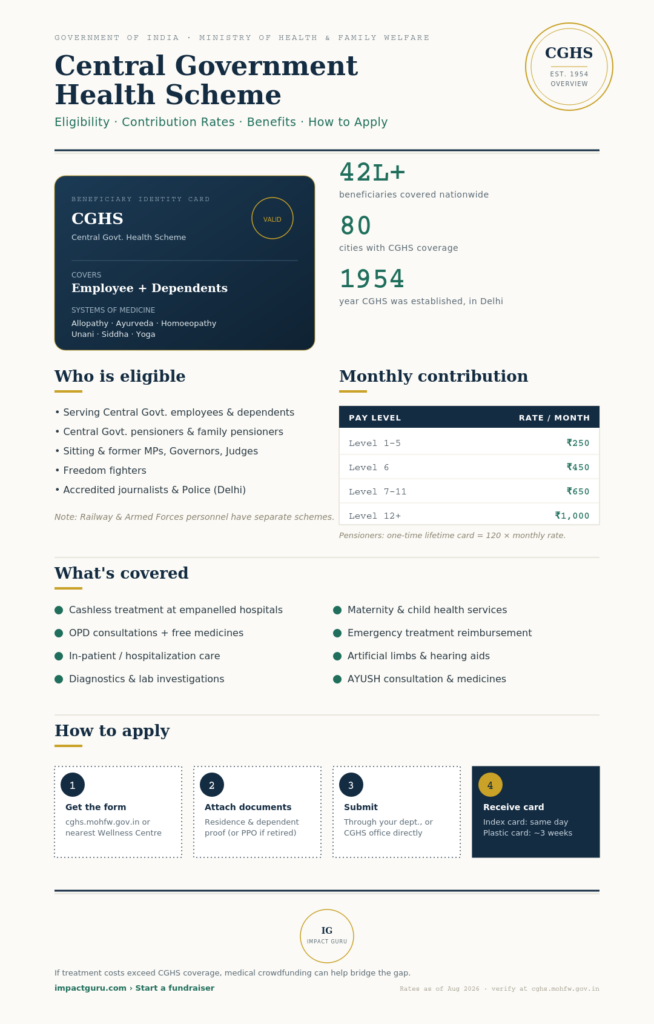
Table of Contents
- What Is CGHS?
- Who Is Eligible for CGHS?
- CGHS Contribution & Subscription Rates (2026)
- How to Apply for a CGHS Card
- Documents Required
- How Long Does a CGHS Card Take?
- Is CGHS Valid After Retirement?
- What Does CGHS Cover?
- What CGHS Does Not Cover
- CGHS Empanelled Hospitals & Covered Cities
- History of CGHS
- If CGHS Coverage Isn’t Enough
- Conclusion
- Frequently Asked Questions
What Is CGHS?
The Central Government Health Scheme (CGHS) is a government-run health scheme, administered by the Ministry of Health and Family Welfare, that provides comprehensive medical care to serving and retired Central Government employees and their dependent family members. It was launched on 1 July 1954 in Delhi and has since expanded to 80 cities, making it one of the oldest continuously running public healthcare schemes in India.
CGHS is unusual among government health schemes in that it recognizes multiple systems of medicine — Allopathy, Ayurveda, Homoeopathy, Unani, Siddha, and Yoga (AYUSH) — under a single card.
Who Is Eligible for CGHS?
You are eligible for a CGHS card if you fall into one of these categories:
- Serving employees of the Central Government paid from Central Civil Estimates, and their dependent family members
- Central Government pensioners and family pensioners
- Sitting and former Members of Parliament
- Former Vice Presidents of India
- Former Governors and Lieutenant Governors
- Sitting and former Judges of the Supreme Court and High Courts
- Freedom fighters
- Accredited journalists in Delhi (PIB-accredited)
- Delhi Police personnel
- Railway Board employees and pensioners of certain Delhi-based autonomous bodies
Not eligible: Railway employees (covered under Railway health services instead) and Armed Forces personnel (covered under separate defense medical schemes) are generally excluded from CGHS, since they have their own dedicated systems.
Eligibility and card validity are tied to residing in — or being able to travel to — a CGHS-covered city. The Beneficiary Identification System (BIS) is used to verify and validate pensioner beneficiaries and their dependents.
Read More : Which are the CGHS Empanelled Hospitals for Kidney Treatment in India?
Read More : CGHS Empanelled Hospitals in Mumbai 2026
CGHS Contribution & Subscription Rates (2026)
Your monthly CGHS contribution depends on your 7th Pay Commission Pay Matrix Level, not on how much treatment you actually use. These rates have applied since 1 February 2017:
| Pay Matrix Level | Monthly Contribution | One-Time Pensioner Card (120 × monthly rate) |
|---|---|---|
| Level 1–5 | ₹250 | ₹30,000 |
| Level 6 | ₹450 | ₹54,000 |
| Level 7–11 | ₹650 | ₹78,000 |
| Level 12 and above | ₹1,000 | ₹1,20,000 |
Key points:
- One subscription covers the employee and all eligible dependents (spouse, dependent children, dependent parents) — you don’t pay per family member.
- For serving employees, the contribution is deducted automatically from salary.
- Pensioners can choose to pay monthly/annually from their pension, or make a one-time lifetime payment (120× the monthly rate) for a card valid for life with no further payments.
- Rates are revised whenever a new Pay Commission is implemented — check cghs.mohfw.gov.in for the latest circular before applying.
How to Apply for a CGHS Card
The application process differs slightly depending on your employment status.
For serving employees:
- Fill out the CGHS application form, available on cghs.mohfw.gov.in or at your nearest CGHS Wellness Centre.
- Attach proof of residence, age proof for dependents, and proof of dependents’ stay with you.
- If a dependent has a disability, attach a disability certificate from a competent authority.
- Submit the form through your department/office.
For pensioners:
- Attach attested copies of your PPO (Pension Payment Order) or Provisional PPO, or your Last Pay Certificate.
- Include a demand draft payable to “PAO CGHS New Delhi” for the applicable contribution.
- Submit the completed form and documents to the CGHS office nearest to your registered address.
For employees applying before retirement: You can apply for your pensioner CGHS card while still in service — it is only issued once you actually retire, but pre-applying speeds up the transition. Submit your application, enclosures, and demand draft through your organization.
Documents Required
- Application form (online or from a Wellness Centre)
- Proof of residence
- Proof of dependents (age proof, relationship proof, disability certificate if applicable)
- PPO/Provisional PPO/Last Pay Certificate (for pensioners)
- Demand draft for the applicable contribution (for pensioners)
- Passport-size photographs
How Long Does a CGHS Card Take?
An index card (temporary, valid immediately) is typically printed the same day the application is submitted. The permanent plastic card takes about three weeks to be printed and dispatched to your registered address.
Is CGHS Valid After Retirement?
A serving employee’s CGHS card remains valid until retirement. To continue coverage as a pensioner, you need to convert to a pensioner card — either through annual/monthly contribution or a one-time lifetime payment (see the table above). If you retire and move to a city outside the CGHS network, you can still get a card issued from the nearest CGHS-covered city and use it during visits.
What Does CGHS Cover?
CGHS beneficiaries are entitled to:
- Cashless treatment at CGHS Wellness Centres and empanelled hospitals/diagnostic centers
- Out-patient treatment, including free medicines dispensed at Wellness Centres
- In-patient (indoor) treatment at government and empanelled hospitals
- Specialist consultations at polyclinics and government hospitals
- Family welfare, maternity, and child health services
- Diagnostic investigations at government and empanelled centers
- Reimbursement for treatment taken at government/private hospitals during genuine emergencies
- Reimbursement for artificial limbs, hearing aids, and other medical appliances
- AYUSH consultations and medicine (Ayurveda, Homoeopathy, Unani, Siddha)
What CGHS Does Not Cover
CGHS has specific exclusions and procedural limits, most notably around emergency treatment reimbursement:
- Declared emergencies: Treatment can be taken at any hospital, but the reimbursement claim must be filed with the Additional Director/CMO where your CGHS card is registered — and only within the prescribed time limit.
- Non-emergency treatment at non-empanelled private hospitals: Reimbursement, where allowed, is capped at CGHS-prescribed package rates, which are often lower than actual private hospital charges — the difference is borne by the beneficiary.
- Cosmetic treatments and a defined negative list of procedures are excluded — check the current CGHS exclusion list for specifics.
This gap between CGHS rates and actual private hospital billing is one of the most common financial pain points beneficiaries and their families run into during a serious illness — worth planning for in advance.
CGHS Empanelled Hospitals & Covered Cities
CGHS currently operates in 80 cities across India, including Delhi, Mumbai, Kolkata, Chennai, Bengaluru, Hyderabad, Ahmedabad, and Pune, through a network of Wellness Centres and several hundred empanelled private hospitals and diagnostic centers. The empanelled hospital network is periodically revised — hospitals are added or exit the network based on renewed agreements — so it’s worth confirming a specific hospital’s current CGHS empanelment status directly with the Wellness Centre or the CGHS hospital list before planning treatment there.
Read More : CGHS Empanelled Hospitals in Nashik 2026: Complete Guide
History of CGHS
CGHS was introduced by the Government of India under the Ministry of Health and Family Welfare on 1 July 1954 in Delhi, originally to serve Central Government employees. Over seven decades, it has expanded from a handful of cities to 80, and from a narrow employee base to covering Members of Parliament, judges, freedom fighters, journalists, and millions of pensioners and dependents. It remains one of the largest and oldest state-run health protection schemes still in operation, now covering an estimated 42 lakh beneficiaries.
If CGHS Coverage Isn’t Enough
CGHS covers a wide range of care, but for serious illnesses — cancer, organ transplants, complex surgeries — treatment at a non-empanelled private hospital can still leave a beneficiary or their family with a significant out-of-pocket gap between actual billing and CGHS-reimbursable rates. In these situations, many families turn to medical crowdfunding to bridge the shortfall quickly. If you or a family member are facing a treatment cost that CGHS won’t fully cover, you can start a fundraiser to raise funds from your network at no upfront cost.
Conclusion
CGHS remains one of the most comprehensive and long-standing health protection schemes available to Central Government employees, pensioners, and their families — covering everything from OPD consultations and medicines to hospitalization, diagnostics, and AYUSH treatment, at a monthly contribution as low as ₹250. Knowing your eligibility, the correct application route (serving employee vs. pensioner), and the current contribution slab for your pay level makes the difference between a smooth application and unnecessary delays.
That said, CGHS reimbursement is capped at scheme-prescribed rates, which means treatment for serious or high-cost conditions at a non-empanelled hospital can still leave a meaningful gap between what’s billed and what’s covered.
Frequently Asked Questions
CGHS (Central Government Health Scheme) is a government healthcare scheme that provides medical coverage — including cashless treatment, medicines, and diagnostics — to Central Government employees, pensioners, and their dependents.
Serving and retired Central Government employees, their dependent family members, sitting/former MPs, judges, freedom fighters, and a few other specified categories such as Delhi-based journalists and police personnel.
Between ₹250 and ₹1,000 per month, depending on your Pay Matrix Level (Level 1–5 to Level 12+). Pensioners can alternatively pay a one-time amount (120× the monthly rate) for lifetime coverage.
Download or fill the application form via cghs.mohfw.gov.in, attach the required documents (proof of residence, dependent proof, PPO for pensioners), and submit it through your department or the nearest CGHS Wellness Centre.
Yes, but you must convert your card to pensioner status by paying the applicable contribution — monthly, annually, or as a one-time lifetime payment.
Reimbursement for non-emergency treatment at non-empanelled hospitals is capped at CGHS package rates, and there’s a defined exclusion list (largely cosmetic and non-essential procedures). Emergency reimbursement claims must follow specific filing rules and timelines.
A temporary index card is usually issued the same day; the permanent plastic card takes about three weeks.
This article is for general informational purposes and does not constitute official government advice. CGHS rules, rates, and hospital empanelment are subject to change — always verify current details at cghs.mohfw.gov.in or your nearest CGHS Wellness Centre.