

Table of Contents
- Quick Summary
- Introduction
- What Are Craniotomy, Gamma Knife, And Radiotherapy?
- Craniotomy Explained
- Gamma Knife Explained
- Radiotherapy Explained
- Craniotomy Vs Gamma Knife Vs Radiotherapy: How Are They Different?
- Craniotomy Vs Gamma Knife Vs Radiotherapy: Which One Is Better?
- How Do Doctors Decide Brain Tumour Treatment?
- Symptoms And Neurological Condition
- Previous Treatment
- Benefits And Limitations Of Craniotomy
- Benefits And Limitations Of Gamma Knife
- Benefits And Limitations Of Radiotherapy
- Can Craniotomy, Gamma Knife And Radiotherapy Be Combined?
- Risks Of Craniotomy, Gamma Knife And Radiotherapy
- Recovery After Craniotomy
- Gamma Knife Recovery
- Radiotherapy Recovery
- Brain Tumour Treatment Cost In India
- Hospitalisation And Follow-Up Costs
- Insurance For Brain Tumour Treatment
- Financial Assistance For Brain Tumour Treatment
- Questions To Ask Your Neurosurgeon
- Which Treatment Is Right For You?
- Can Craniotomy, Gamma Knife And Radiotherapy Be Combined?
- How ImpactGuru Can Help With Treatment Expenses
- Conclusion
- Craniotomy Vs Gamma Knife Vs Radiotherapy: Frequently Asked Questions
Quick Summary
Craniotomy Vs Gamma Knife Vs Radiotherapy involves three very different approaches to treating brain tumours and other conditions affecting the brain.
- Craniotomy is a brain surgery in which part of the skull is temporarily opened so the neurosurgeon can reach the affected area.
- Gamma Knife is a form of stereotactic radiosurgery that uses highly focused radiation without conventional open brain surgery.
- Radiotherapy uses radiation to damage and control abnormal cells and may cover a specific or wider planned treatment area.
- The right treatment depends on the tumour type, size, location, number of lesions, symptoms, overall health, and previous treatment.
- In some cases, doctors may recommend more than one treatment as part of the overall treatment plan.
Introduction
Being told that you have a brain tumour or another abnormal growth in the brain can be frightening. Along with the diagnosis, patients and families may suddenly hear terms such as craniotomy, Gamma Knife and radiotherapy.
This often leads to one important question: Which treatment is right for me?
There is no single answer.
Craniotomy Vs Gamma Knife Vs Radiotherapy is not simply a choice between three versions of the same treatment. Each works differently and has a different purpose. A treatment that may be appropriate for one patient may not be suitable for another.
Doctors usually make the decision after looking at brain scans such as MRI or CT scans, confirming the diagnosis, and understanding the tumour’s size, location and behaviour. A neurosurgeon, radiation oncologist, neuro-oncologist or multidisciplinary team may be involved in the decision.
Understanding the differences can help you have a clearer conversation with your medical team.
What Are Craniotomy, Gamma Knife, And Radiotherapy?
Although craniotomy, Gamma Knife and radiotherapy can all be used in the management of brain tumours and other brain conditions, they are very different treatments.
What Is a Craniotomy?
A craniotomy is a surgical procedure in which a neurosurgeon temporarily removes a section of the skull to access the brain.
Depending on the condition, surgery may be performed to remove all or part of a tumour, obtain a tissue sample for diagnosis, or reduce pressure caused by a mass.
Because it is an operation, craniotomy involves anaesthesia, surgical risks and a recovery period.
What Is Gamma Knife?
Gamma Knife is not actually a knife.
It is a form of stereotactic radiosurgery that uses multiple precisely aimed beams of radiation to treat a defined target.
The radiation beams are focused on the abnormal area so that the treatment can be delivered with high precision while limiting exposure to surrounding healthy tissue as much as possible.
Gamma Knife does not involve conventional open brain surgery.
What Is Radiotherapy?
Radiotherapy uses high-energy radiation to damage abnormal cells and stop them from growing and dividing normally.
For brain tumour treatment, radiation may be directed at the tumour, the area where a tumour was removed, or another planned area depending on the diagnosis and treatment goal.
Radiotherapy may be delivered in one session or over several sessions, depending on the treatment plan.
Craniotomy Explained
A craniotomy is performed under anaesthesia. The neurosurgeon creates an opening in the skull to reach the affected part of the brain. After the procedure, the section of bone is generally placed back and secured.
For a brain tumour, one of the main goals may be to remove as much of the tumour as can be safely removed.
However, removing the entire tumour is not always possible or safe. The amount that can be removed depends greatly on the tumour’s location and how close it is to important areas of the brain.
A craniotomy can also allow doctors to obtain tissue for testing. This can help identify the exact type and characteristics of a tumour and guide further treatment.
Because it is an invasive brain surgery, craniotomy carries risks related to both the procedure and anaesthesia. Recovery can also take longer than after non-surgical treatments.
In selected cases, however, surgery may provide an important benefit, particularly when a tumour is large, causing pressure on the brain, or can be safely accessed.
Gamma Knife Explained
Gamma Knife is a type of stereotactic radiosurgery. Despite its name, it does not involve cutting the skull with a knife.
Instead, multiple radiation beams are precisely focused on the target. Each beam passes through the surrounding tissue, while the combined radiation dose is concentrated at the treatment area.
When Is Gamma Knife Recommended?
Gamma Knife may be considered for certain small or well-defined brain tumours and other brain lesions.
It may also be considered when conventional brain surgery would be difficult or carry significant risks because of the location of the lesion.
However, Gamma Knife is not suitable for every tumour.
Doctors consider factors such as:
- Size of the lesion
- Location of the lesion
- Number of lesions
- Type of tumour or condition
- Previous treatments
- Overall health
Because there is no conventional opening of the skull, recovery is generally shorter than after a major craniotomy. However, Gamma Knife still uses radiation and can have side effects.
Radiotherapy Explained
Radiotherapy is a broader form of radiation treatment used to control or destroy abnormal cells.
In brain tumour treatment, it may be directed at the tumour itself, the area where a tumour was removed, or another area considered at risk.
How Is Radiotherapy Different From Gamma Knife?
Gamma Knife is designed to deliver highly focused radiation to a defined target.
Radiotherapy can also be highly precise, depending on the technique, but may be planned to treat a larger area when required.
Radiotherapy may be given over several sessions. The number and frequency of sessions depend on the type of tumour, location, treatment goal and radiation plan.
Doctors may recommend radiotherapy after surgery to treat remaining tumour cells. In some cases, it may be used when surgery is not suitable or when controlling tumour growth is the main treatment goal.
Craniotomy Vs Gamma Knife Vs Radiotherapy: How Are They Different?
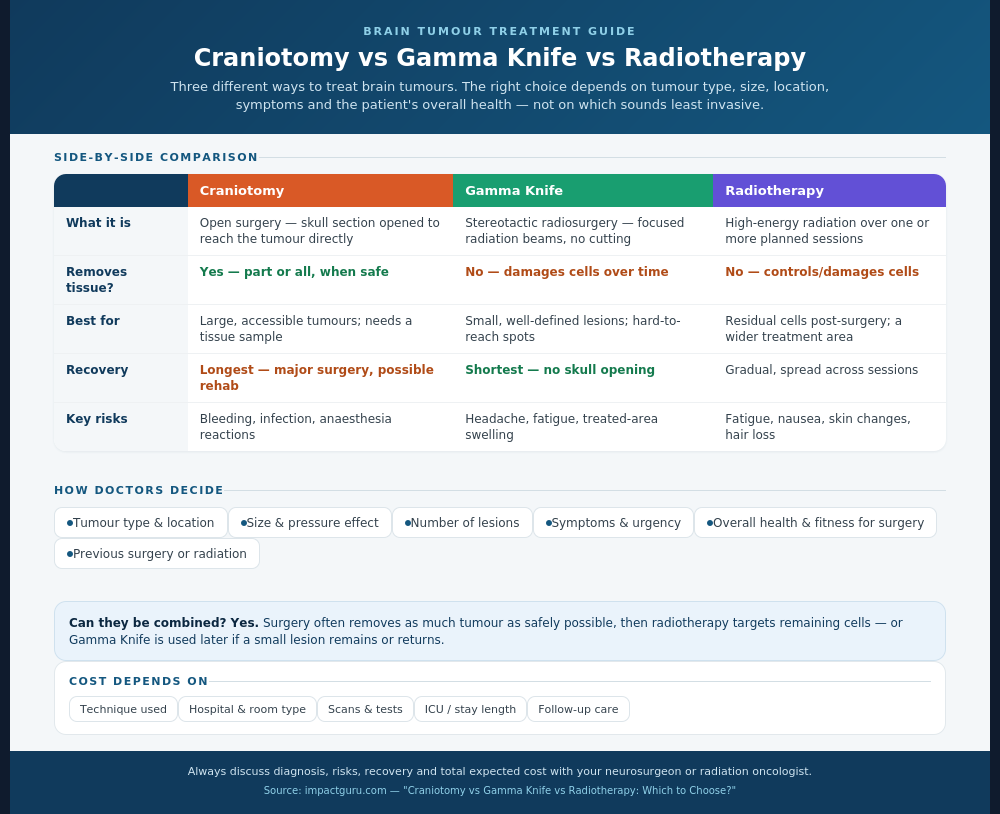
The easiest way to understand Craniotomy Vs Gamma Knife Vs Radiotherapy is to look at how each treatment reaches the abnormal area.
With a craniotomy, the surgeon physically accesses the brain through an opening in the skull. The aim may be to remove or reduce a tumour and, when required, obtain tissue for diagnosis.
With Gamma Knife, there is no conventional surgical opening. Instead, focused radiation is directed at a defined target.
With radiotherapy, radiation is used to treat abnormal cells and can cover a specific or wider planned treatment area depending on the technique.
The recovery process is also different. Craniotomy generally requires a longer recovery because it is a major operation. Gamma Knife does not involve conventional open brain surgery, while radiotherapy is generally delivered through planned treatment sessions.
But the decision should not be based simply on which treatment appears less invasive.
The most appropriate treatment depends on the diagnosis, tumour characteristics, symptoms, overall health and treatment goals.
Craniotomy Vs Gamma Knife Vs Radiotherapy: Which One Is Better?
If you have been told that you may need a craniotomy, Gamma Knife or radiotherapy, it is natural to ask which treatment is better.
The answer is that none of these treatments is automatically better for every patient.
A craniotomy gives the surgeon direct access to the brain. Gamma Knife delivers highly focused radiation to a specific target. Radiotherapy can treat a planned area of abnormal cells.
Doctors choose between these options based on the individual case rather than simply choosing the most advanced or least invasive treatment.
Also Read : Ischemic vs Hemorrhagic Stroke: Causes, Symptoms & Differences
How Do Doctors Decide Brain Tumour Treatment?
Doctors may review:
- Type of tumour or lesion
- Location of the tumour
- Size of the tumour
- Number of tumours or lesions
- Symptoms and neurological problems
- Overall health
- Fitness for surgery
- Previous surgery or radiation
- Whether the tumour can be safely reached
- Expected benefits and risks
These factors are considered together.
For example, having a small tumour does not automatically mean that Gamma Knife is the right choice. Similarly, having a large tumour does not automatically mean that surgery is the only option.
Tumour Type And Location
Where a tumour is located inside the brain can significantly affect the treatment plan.
Some areas of the brain control speech, movement, vision, memory, balance and other important functions. If a tumour is close to one of these areas, surgery may carry a higher risk of affecting healthy brain tissue.
A tumour that can be safely accessed may be considered for surgery. A small lesion located deep within the brain or close to a critical structure may sometimes be better suited to focused radiation.
The tumour type also matters.
Different tumours can behave differently and may respond differently to surgery, radiotherapy or other treatments. An accurate diagnosis therefore plays an important role in deciding the treatment approach.
Tumour Size
Tumour size is another important factor.
A large tumour may put pressure on surrounding brain tissue and cause symptoms. In selected patients, surgery may be recommended because removing the mass can help reduce pressure.
Gamma Knife is generally used for carefully selected, relatively small and well-defined targets. It is not simply a replacement for surgery whenever someone wants to avoid an operation.
Radiotherapy can be used for different tumour sizes, but the technique and treatment area depend on the diagnosis and purpose of treatment.
Size matters, but doctors never look at size alone.
Number Of Brain Lesions
Doctors also need to know whether there is one tumour or several lesions.
A single, clearly defined lesion may sometimes be treated with a focused approach. When multiple lesions are present, doctors may consider different radiation techniques or a combination of treatments.
The underlying disease also matters. Multiple brain metastases, for example, may require a different treatment strategy from multiple lesions caused by another condition.
This is why two patients with the same number of brain lesions may still receive completely different treatment plans.
Overall Health
Your general health can influence the choice between brain surgery and radiation-based treatment.
A craniotomy requires anaesthesia and major surgery. Doctors therefore need to determine whether you are fit enough to undergo the procedure and recover from it.
They may consider:
- Existing medical conditions
- Current medicines
- Previous surgeries
- General physical condition
- Ability to tolerate anaesthesia
- Previous cancer or radiation treatment
- Expected recovery after surgery
If major surgery would be particularly risky, a non-surgical treatment may be considered when medically appropriate.
However, being offered surgery does not mean that other options have been ignored. If removing the tumour can provide an important benefit and can be done safely, surgery may remain the preferred approach.
Read More : Top Doctors in India | List Of Oncologist
Symptoms And Neurological Condition
Not every brain tumour causes symptoms. Some are discovered during scans performed for another reason. Others may cause problems as they grow or put pressure on surrounding brain tissue.
Symptoms may include:
- Persistent or worsening headaches
- Seizures
- Weakness or numbness
- Difficulty speaking
- Problems with balance or coordination
- Changes in vision
- Memory or behavioural changes
- Nausea or vomiting associated with increased pressure inside the skull
When a tumour is causing pressure or neurological deterioration, doctors may need to consider how urgently the problem needs to be addressed.
In selected situations, surgery may help by physically removing tumour tissue and reducing the size of a mass. Radiation treatments work differently and do not physically remove the tumour.
Previous Treatment
Previous treatment can significantly affect what happens next.
Some patients undergo surgery first and later receive radiotherapy to treat tumour cells that may remain. Others may receive radiation without having surgery.
If a tumour comes back after treatment, doctors may need to consider a different approach.
Previous radiation is particularly important because nearby healthy tissue may already have received radiation. This can affect whether and how additional radiation can safely be given.
Doctors may review:
- Previous brain surgery
- Previous radiotherapy
- Chemotherapy or other treatments
- Whether the tumour has returned
- Changes seen on follow-up scans
- How the tumour responded to earlier treatment
Benefits And Limitations Of Craniotomy
A craniotomy provides direct access to the brain and can allow the surgeon to remove tumour tissue when it is safe to do so.
It can also provide a tissue sample for detailed testing, which may help confirm the diagnosis and guide further treatment.
Potential Benefits Of Craniotomy
- Direct access to the tumour
- May allow partial or complete tumour removal
- Can provide tissue for diagnosis
- May reduce pressure caused by a large tumour
- May help relieve symptoms caused by mass effect in selected cases
However, craniotomy is an invasive procedure and carries surgical risks.
Depending on the tumour and its location, these may include bleeding, infection, swelling, seizures or neurological problems.
Recovery is also generally longer than with non-surgical treatments.
Surgery may not remove every tumour cell so that some patients may need radiotherapy or other treatment afterwards.
Benefits And Limitations Of Gamma Knife
Gamma Knife is a form of stereotactic radiosurgery that delivers radiation very precisely to a defined target.
Potential Benefits Of Gamma Knife
- Does not require conventional open brain surgery
- Delivers highly focused radiation
- Can be useful for certain small, well-defined lesions
- Usually involves a shorter recovery than major brain surgery
- May be considered when conventional surgery is difficult or risky
However, Gamma Knife does not physically remove a tumour.
It is also not suitable for every tumour or lesion. The size, location, number of targets, diagnosis and previous treatments all need to be considered.
Radiation-related side effects can occur, and the response to treatment may take time.
Benefits And Limitations Of Radiotherapy
Radiotherapy uses high-energy radiation to damage abnormal cells. It may be recommended after surgery, instead of surgery in selected cases, or alongside other treatments.
Depending on the condition, radiotherapy may be directed at a tumour or a wider planned treatment area.
Potential Benefits Of Radiotherapy
- Can treat tumour cells that remain after surgery
- May be used when surgery is not suitable in selected cases
- Can cover a planned treatment area
- May be combined with surgery or other cancer treatments
- Does not require opening the skull
Radiotherapy can also affect healthy cells near the treatment area.
Side effects depend on factors such as the treatment technique, radiation dose, location and number of sessions. Some patients may experience tiredness and other short-term effects, while some effects may develop later.
Your radiation oncologist can explain the risks that are most relevant to your treatment plan.
Can Craniotomy, Gamma Knife And Radiotherapy Be Combined?
Yes.
Craniotomy Vs Gamma Knife Vs Radiotherapy does not always mean choosing only one treatment.
For some patients, treatment may happen in stages.
For example, surgery may first be used to remove as much of a tumour as can safely be removed. Radiotherapy may then be recommended to treat remaining tumour cells or reduce the risk of recurrence.
In another situation, focused radiation such as Gamma Knife may be considered later if a small, well-defined lesion remains or returns.
The order and combination depend on the diagnosis, tumour characteristics, treatment goals, follow-up scans and response to earlier treatment.
Risks Of Craniotomy, Gamma Knife And Radiotherapy
Understanding Craniotomy Vs Gamma Knife Vs Radiotherapy also means understanding the possible risks and recovery involved with each treatment.
Every brain tumour treatment can have risks and side effects. These vary depending on the tumour, treatment area, radiation dose, overall health and other treatments being given.
Risks Of Craniotomy
Because craniotomy is a major brain surgery, its risks are different from those of radiation-based treatments.
Possible complications may include:
- Bleeding or infection
- Brain swelling
- Seizures
- Headaches
- Temporary or permanent neurological problems
- Problems with speech, movement, memory or vision
- Reactions to anaesthesia
The risk is not the same for every patient.
A tumour located close to areas controlling speech, movement or vision may make surgery more complex. The neurosurgeon will assess whether the tumour can be removed safely and how much can be removed without causing serious damage to healthy brain tissue.
Risks Of Gamma Knife
Gamma Knife does not involve conventional open brain surgery, but it still uses radiation and can cause side effects.
Some patients may experience:
- Headaches
- Tiredness
- Swelling around the treated area
- Temporary neurological symptoms
In some cases, radiation can cause swelling around the treatment site. Doctors may prescribe medicines to manage this when needed.
Rarely, radiation-related tissue damage can occur.
Because Gamma Knife does not physically remove the tumour, the treatment response may take time. Follow-up scans are generally needed to monitor the treated area.
Risks Of Radiotherapy
Radiotherapy can affect abnormal cells as well as some healthy cells near the treatment area.
Side effects depend on the part of the brain being treated, radiation dose and number of sessions.
Common effects may include:
- Tiredness
- Headaches
- Nausea
- Skin changes or irritation
- Hair loss in the treated area
- Temporary worsening of some symptoms
Some side effects may develop later after treatment, which is why regular follow-up is important.
Recovery After Craniotomy
Recovery after craniotomy can take longer because it involves major surgery.
The hospital stay depends on the type of surgery, the patient’s condition and whether complications occur.
After surgery, doctors closely monitor neurological function, bleeding, swelling and other possible complications.
Once discharged, recovery continues at home. Some patients may experience tiredness, headaches or weakness for some time.
The exact recovery period varies from person to person.
Brain Tumour Surgery Recovery
Some patients may need rehabilitation after brain tumour surgery.
Depending on their condition, this may include:
- Physiotherapy
- Occupational therapy
- Speech therapy
- Other rehabilitation support
Follow-up appointments and brain scans are also important to monitor healing and determine whether further treatment is needed.
Gamma Knife Recovery
Gamma Knife recovery is generally shorter than recovery after major brain surgery because there is no conventional surgical opening of the skull.
Many patients can return to normal activities relatively quickly, depending on their condition and their doctor’s advice.
However, recovery is not identical for everyone.
Some patients may experience tiredness, headaches or swelling around the treated area. Since the effect of radiation can take time, follow-up scans are important to assess the response.
Radiotherapy Recovery
Radiotherapy is often given over multiple treatment sessions, depending on the treatment plan.
This means recovery can happen gradually rather than immediately after one procedure.
Fatigue is one of the common effects patients may experience during or after radiotherapy. Some people may also experience headaches, nausea, skin changes or hair loss in the treated area.
The recovery period depends on the type and extent of radiation treatment. Some side effects improve after treatment ends, while others may take longer.
Patients should report new or worsening symptoms to their medical team rather than assuming they are a normal part of recovery.
Read More : 20 Things to Expect After Brain Surgery
Brain Tumour Treatment Cost In India
The brain tumour treatment cost in India can vary significantly.
There is no single fixed price for craniotomy, Gamma Knife or radiotherapy because the final expense depends on the diagnosis and treatment plan.
What Affects Brain Tumour Treatment Cost?
The overall cost may depend on:
- Type and size of the tumour
- Location and number of lesions
- Type of surgery or radiation technique
- Hospital and room category
- Surgeon and specialist fees
- Diagnostic scans and laboratory tests
- Anaesthesia and medicines
- ICU or hospital stay
- Rehabilitation and follow-up care
- Additional chemotherapy or other treatments
Craniotomy may involve significant hospitalisation and surgical expenses because it requires an operation, anaesthesia and post-operative monitoring.
Gamma Knife and radiotherapy have different cost structures depending on the technology used, number of treatment sessions and complexity of the case.
For an accurate estimate, patients should ask their hospital for a detailed treatment plan and cost estimate rather than relying on a general online figure.
Read More : Brain Tumor Surgery Cost In India
Hospitalisation And Follow-Up Costs
Brain tumour treatment expenses do not always end when the main procedure is completed.
Patients may require repeated scans, medicines, consultations and rehabilitation.
For patients undergoing craniotomy, hospitalisation can form a significant part of the total expense. Some patients may also require ICU care depending on their condition and surgery.
Radiotherapy may involve several sessions, which can mean repeated hospital visits along with travel and accommodation expenses for families coming from another city.
Follow-up MRI or CT scans may also be required to monitor the tumour or treatment response.
If the tumour returns or does not respond as expected, additional treatment may be needed.
Families should therefore discuss the estimated total treatment cost rather than focusing only on the cost of the main procedure.
Read More : Neurosurgery Cost In India
Read More : Best Neurosurgery Hospitals in Mumbai (2026)
Insurance For Brain Tumour Treatment
Health insurance may cover some or all eligible costs of brain tumour treatment, depending on the policy, hospital and treatment involved.
Coverage can differ for surgery, radiation therapy, medicines, diagnostic tests, hospitalisation and follow-up care.
What Should You Check With Your Insurer?
Before treatment, families should check:
- Whether the hospital is in the insurer’s network
- Whether the planned treatment is covered
- Applicable waiting periods or exclusions
- Cashless treatment availability
- Room-rent limits
- Pre- and post-hospitalisation coverage
- Any co-payment or deductible
- Documents required for reimbursement
If insurance does not cover the full cost, families can explore other sources of financial assistance for brain tumour treatment.
Financial Assistance For Brain Tumour Treatment
Brain tumour treatment can place a heavy financial burden on families, especially when it involves major surgery, advanced radiation techniques, prolonged hospitalisation or repeated follow-up care.
Families may explore hospital financial assistance, government schemes, charitable organisations and medical crowdfunding.
Starting financial planning early can help families prepare for treatment expenses and reduce the risk of financial difficulties delaying necessary care.
Questions To Ask Your Neurosurgeon
A brain tumour diagnosis can leave patients and families overwhelmed with information.
Before deciding on treatment, it can help to write down your questions and discuss them with your medical team.
Questions To Ask Your Neurosurgeon Or Radiation Oncologist
- What type of tumour or lesion do I have?
- Where exactly is it located?
- How large is it?
- Do I need surgery, Gamma Knife, radiotherapy or a combination?
- What is the goal of the recommended treatment?
- Can the tumour be safely removed?
- Why is this treatment being recommended over the alternatives?
- What are the major risks and possible side effects?
- How long could recovery take?
- Will I need additional treatment afterwards?
- How often will I need follow-up scans?
- What is the estimated total treatment cost?
- What happens if the tumour comes back?
It is also reasonable to ask for a second opinion, particularly when the treatment decision involves major brain surgery or several possible treatment approaches.
Which Treatment Is Right For You?
There is no single answer to the question, “Is craniotomy better than Gamma Knife or radiotherapy?”
The right treatment depends on what doctors are treating, where it is located, how large it is, how many lesions are present and how the patient’s overall health may affect treatment.
When Is Craniotomy Recommended?
Craniotomy may be considered when doctors need direct access to a brain tumour or lesion.
It can allow the surgeon to remove part or all of a tumour when this can be done safely. It may also be recommended when a tissue sample is needed to identify the exact type of tumour.
In some situations, removing a tumour may help reduce pressure on the brain.
However, surgery is not automatically the best option. The location of the tumour and its relationship to important areas of the brain are major factors.
When Is Gamma Knife Recommended?
Gamma Knife may be considered for certain small, well-defined brain lesions that can be safely targeted with focused radiation.
It can be useful when doctors want to treat a specific target without conventional open brain surgery. It may also be considered when surgery would be difficult or carry significant risk.
However, Gamma Knife is not suitable for every tumour.
The diagnosis, size, location, number of lesions and previous treatments all matter.
When Is Radiotherapy Recommended?
Radiotherapy may be recommended when radiation treatment is needed over a planned area of the brain.
Depending on the diagnosis, it may be given after surgery, instead of surgery in selected cases, or as part of a wider cancer treatment plan.
Radiotherapy can be delivered using different techniques and schedules. The treatment plan depends on the tumour type, location and goal of treatment.
For some patients, radiotherapy may be used to treat remaining tumour cells after surgery. In other situations, it may be the main treatment.
Can Craniotomy, Gamma Knife And Radiotherapy Be Combined?
Yes. These treatments do not always have to be considered as completely separate choices.
For example, a patient may undergo surgery to remove as much of a tumour as can safely be removed and then receive radiotherapy for remaining tumour cells.
In another situation, focused radiation such as Gamma Knife may be considered later if a small, well-defined lesion remains or returns.
The order and combination depend on the diagnosis and treatment goals. Doctors may change the treatment plan based on pathology results, follow-up scans and how the tumour responds.
This is why asking only “Which treatment is best?” may not be enough.
A more useful question is:
“What treatment plan gives me the best chance of controlling my tumour while keeping the risks as low as reasonably possible?”
Read More : How Can I Raise Funds Online for Medical Treatment?
How ImpactGuru Can Help With Treatment Expenses
Brain tumour treatment can place a significant financial burden on families, especially when treatment involves major surgery, advanced radiation techniques, prolonged hospitalisation or repeated follow-up care.
When insurance and personal savings are not enough, medical crowdfunding can help families raise funds from friends, relatives, communities and people willing to support the patient’s treatment.
Through ImpactGuru, patients and families can create a fundraiser explaining the medical condition, treatment required and financial need. Supporters can contribute towards the campaign and help the family manage part of the treatment expenses.
Families considering crowdfunding should keep important medical documents, treatment estimates and other relevant information ready so that the fundraiser clearly explains the patient’s situation.

Conclusion
Hearing that you may need a craniotomy, Gamma Knife or radiotherapy can make an already difficult situation feel even more confusing.
But there is no universal winner in Craniotomy Vs Gamma Knife Vs Radiotherapy.
Craniotomy can provide direct access to a tumour. Gamma Knife can deliver highly focused radiation to selected targets. Radiotherapy can treat a specific or wider planned area depending on the diagnosis and treatment goal.
The most important decision is not about choosing the treatment that sounds least invasive or most advanced.
It is about finding the treatment plan that is appropriate for the tumour, the patient’s health and the overall treatment goals.
Speak openly with your neurosurgeon, radiation oncologist and other members of your medical team. Ask why a particular treatment has been recommended, what alternatives are available, what risks you may face, how recovery may look and what the expected treatment expenses could be.
When you understand your options, you can make a more informed decision together with your doctors.
Craniotomy Vs Gamma Knife Vs Radiotherapy: Frequently Asked Questions
Not necessarily. Gamma Knife does not involve conventional open brain surgery, but it still uses radiation and can have side effects. Craniotomy has surgical risks but may provide benefits that radiation cannot, such as direct tumour removal or tissue sampling.
The safer option depends on the individual patient and condition.
Gamma Knife is called stereotactic radiosurgery, but it does not involve conventional cutting or opening of the skull. It uses precisely focused radiation to treat a defined target.
No, Gamma Knife does not physically remove the tumour. Instead, focused radiation damages the targeted abnormal cells, and the treatment response can take time.
No, Some brain tumours may be treated with radiation, medicines or other approaches depending on their type, location, size and the patient’s overall condition.
Recovery after craniotomy varies widely.
It depends on the type and extent of surgery, the tumour’s location, the patient’s health and whether complications occur. Some patients may also require rehabilitation.
Yes, some patients may receive surgery followed by radiotherapy, while others may receive focused radiation later for a small remaining or recurring lesion. The treatment sequence is individualised based on the diagnosis and treatment goals.