
Table of Contents
- Quick Summary
- Introduction
- What Is Medical Crowdfunding For Brain Tumour Treatment?
- Why Do Families Turn To Crowdfunding For Brain Tumour Treatment?
- How To Raise Funds For Brain Tumour Treatment Through Crowdfunding
- How To Write A Brain Tumour Crowdfunding Story That People Understand
- How To Share Your Brain Tumour Fundraiser And Reach More Donors
- How Much Money Can You Raise Through Medical Crowdfunding?
- How ImpactGuru Helps With Brain Tumour Fundraising
- What Documents Are Needed To Start A Medical Fundraiser?
- Crowdfunding Vs Loans And Insurance For Brain Tumour Treatment
- Mistakes To Avoid When Raising Funds For Brain Tumour Treatment
- How To Keep Donors Updated During The Fundraiser
- How To Raise Funds for Brain Tumour Treatment Through Crowdfunding: Key Takeaways
- Conclusion
- Frequently Asked Questions
Quick Summary
How to Raise Funds for Brain Tumour Treatment Through Crowdfunding is a practical option for families struggling with high medical expenses. A fundraiser can help bring together donations from friends, relatives, communities and people who may be willing to support the patient’s treatment.
- Brain tumour treatment may involve surgery, radiation therapy, chemotherapy, targeted therapy or supportive care depending on the tumour.
- Medical expenses can include hospitalisation, surgery, medicines, diagnostic scans, consultations and follow-up care.
- A crowdfunding campaign should clearly explain the patient’s condition, treatment plan, estimated cost and financial need.
- Medical reports, treatment estimates and other supporting documents can help explain the fundraising requirement.
- Sharing the fundraiser regularly through WhatsApp, social media, email and personal networks can help increase its reach.
- ImpactGuru allows families to create medical fundraisers and seek donations from a wider community.
- Crowdfunding can be an additional source of financial support and does not replace insurance, government schemes or hospital assistance.
Introduction
A brain tumour diagnosis can bring a family face-to-face with two problems at the same time: a serious medical condition and a large treatment bill.
Depending on the type, location and grade of the tumour, treatment may involve surgery, radiation therapy, chemotherapy or other forms of care. The treatment plan is different for every patient, and the expenses can also vary widely.
For families who are already using their savings or struggling to arrange money from relatives, crowdfunding can provide another way to seek financial support.
Knowing how to Raise Funds for Brain Tumour Treatment Through Crowdfunding can help a family turn a difficult financial situation into a structured fundraising effort. Instead of depending only on personal savings, a medical fundraiser allows the family to explain what the patient is going through and ask a larger community for help.
Read More : Brain Tumor- Symptoms, Causes, Treatments & More
What Is Medical Crowdfunding For Brain Tumour Treatment?
Medical crowdfunding is a way of raising money online through donations from multiple people. The fundraiser usually explains the patient’s medical condition, treatment requirements, expected expenses and the amount of financial support needed.
For a family dealing with a brain tumour, this can be useful when the treatment cost is higher than what the family can manage through savings, insurance or help from close relatives.
The idea is simple. A family creates a fundraiser, shares the patient’s story and treatment details, and asks people to contribute according to their ability. On ImpactGuru, campaigners can create medical fundraisers for treatment-related expenses and share them with their wider network.
Crowdfunding does not guarantee that the entire treatment cost will be raised. The amount collected depends on the campaign’s reach, the support received and how widely the fundraiser is shared.
Why Do Families Turn To Crowdfunding For Brain Tumour Treatment?
Brain tumour treatment can involve more than the cost of one procedure. Depending on the patient’s treatment plan, families may have to manage hospital bills, surgery, medicines, scans, radiation therapy, chemotherapy and follow-up care.
Some patients may also require rehabilitation or supportive care after treatment. This can add to the financial pressure over time.
When savings and other sources of financial support are not enough, crowdfunding can give families another channel through which they can ask for help.
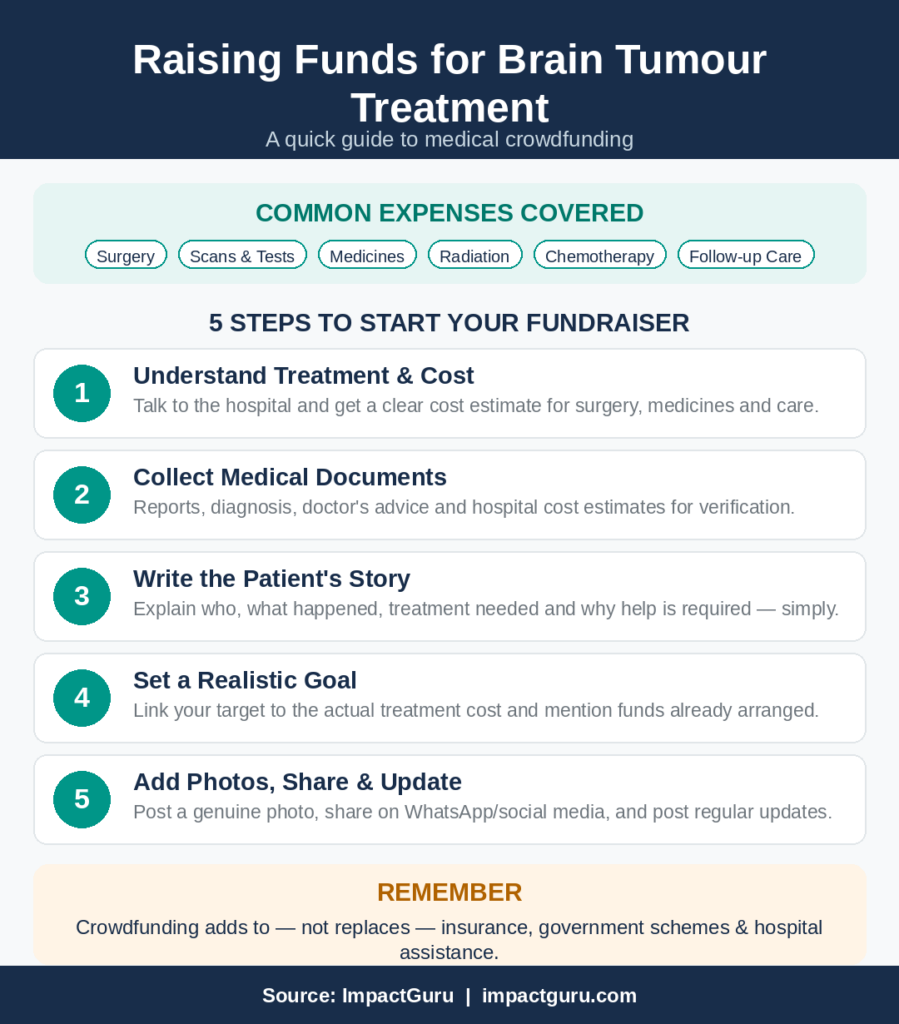
Common Expenses A Brain Tumour Fundraiser May Cover
The exact expenses depend on the patient’s medical advice and the fundraiser’s requirements. They may include:
- Brain tumour surgery and hospitalisation
- Diagnostic scans and investigations
- Medicines and supportive care
- Radiation therapy
- Chemotherapy, when recommended
- Follow-up consultations and investigations
- Rehabilitation and recovery-related care
- Other eligible treatment-related medical expenses
The treatment itself should always be decided by the patient’s medical team. The fundraiser’s role is to help the family manage the financial side of that treatment.
How To Raise Funds For Brain Tumour Treatment Through Crowdfunding
A successful fundraiser starts with clarity. Donors need to understand who needs help, what has happened, what treatment is required and why the family cannot manage the cost alone.
If you are learning how to Raise Funds for Brain Tumour Treatment Through Crowdfunding, the following steps can help you build a clear campaign.
1. Understand The Treatment And Estimated Cost
Before creating a fundraiser, speak with the treating hospital or doctor and understand the recommended treatment plan.
Ask for an estimated cost wherever possible. Depending on the treatment, this may include surgery, hospitalisation, medicines, investigations, radiation, chemotherapy and follow-up expenses.
A clear estimate also helps you set a realistic fundraising goal.
2. Collect The Important Medical Documents
Keep the patient’s medical documents ready before starting the fundraiser. These may include:
- Medical reports
- Scan or diagnostic reports
- Doctor’s treatment advice
- Hospital admission documents
- Cost estimates
- Medical bills, where applicable
- Other supporting documents requested during the campaign process
ImpactGuru’s fundraising process may involve documentation related to the patient’s medical care and expenses as part of its verification process.
3. Write The Patient’s Story Clearly
The story is one of the most important parts of a medical fundraiser.
Do not fill it with complicated medical terminology. Explain the situation in simple language that a donor can understand.
A useful structure is:
Who is the patient?
Briefly introduce the patient and their family.
What happened?
Explain the diagnosis, symptoms or medical emergency.
What treatment is needed?
Mention the treatment recommended by the doctor.
How much will it cost?
Clearly state the estimated treatment expense and the amount being raised.
Why is help needed?
Explain what the family has already spent or tried to arrange and why they need support.
The aim is not to make the story dramatic for the sake of it. It is to help donors understand the real situation.
4. Set A Realistic Fundraising Goal
The fundraising target should be connected to the patient’s actual medical requirement.
If the hospital estimates that the treatment will cost ₹20 lakh, explain what that amount covers. If part of the cost has already been arranged, mention that too.
A transparent goal helps donors understand where their contribution is expected to go.
5. Add Relevant Photos And Updates
A genuine photograph can help people connect with the patient and understand that there is a real person and family behind the fundraiser.
Regular updates can also help donors understand what is happening during the treatment journey. Updates may include changes in the patient’s condition, treatment milestones, hospital expenses or the family’s progress towards the fundraising goal.
ImpactGuru also encourages campaigners to share updates and communicate with their supporters during the fundraising journey.
Read More : How to Start a Fundraiser for Surgery Expenses in India
How To Write A Brain Tumour Crowdfunding Story That People Understand
A fundraiser should answer the donor’s most important questions quickly.
Avoid starting with a long explanation of medical terms. Start with the person and the problem.
For example, instead of writing several lines about the tumour’s medical classification, a family can begin by explaining that their loved one has been diagnosed with a brain tumour and now needs urgent treatment that they cannot afford alone.
The medical details can follow. This makes the story easier to understand while still giving donors the information they need.
A strong fundraiser should also be honest about the financial situation. If the family has used savings, borrowed money or already paid a large part of the hospital bill, this can be explained clearly.
Creating a fundraiser is only the first step. People need to see it before they can contribute.
Sharing the fundraiser with people who already know the family can help create the first layer of support. Friends, relatives, colleagues, neighbours and community groups can then help spread it further.
Places Where You Can Share Your Fundraiser
You can share the fundraiser through:
- WhatsApp messages and status
- Instagram and Facebook
- Community groups
- Workplace or college networks
- Family and friends
- Local community organisations
Do not share the link only once. A treatment journey can continue for weeks or months, so appropriate updates can give people a reason to revisit the campaign and share it again.
ImpactGuru recommends extensive sharing through social networks, including WhatsApp, email and other channels, to help campaigns reach more potential donors.
How Much Money Can You Raise Through Medical Crowdfunding?
There is no fixed amount that every brain tumour fundraiser can raise.
Some campaigns may receive support from a small group of family members and friends, while others may reach a much larger donor community. The final amount depends on factors such as the treatment requirement, the campaign’s story, the size of the campaigner’s network, how frequently it is shared and the response from donors.
This is why families should avoid assuming that a fundraiser will automatically cover the entire treatment cost.
Instead, crowdfunding should be treated as one part of a broader financial plan.
How ImpactGuru Helps With Brain Tumour Fundraising
ImpactGuru is a medical crowdfunding platform where patients and families can create fundraisers for eligible medical expenses.
The basic process involves three important steps: starting a fundraiser, sharing the fundraiser and receiving donations. ImpactGuru states that campaigners can withdraw funds during the fundraising journey, subject to the applicable process and verification.
For families trying to raise money for brain tumour treatment, the platform can provide a way to present the patient’s medical situation to a wider donor community instead of depending only on people they personally know.
ImpactGuru also provides fundraising assistance and campaign tools to help campaigners manage and share their fundraisers.
Families should still keep their medical documents, hospital estimates and other required information ready before starting the process.
Need Funds For Your Medical Treatment?
What Documents Are Needed To Start A Medical Fundraiser?
The exact documents required can vary depending on the fundraiser and verification process. Medical and financial documents generally help establish the patient’s treatment requirement and expected expenses.
Useful documents may include:
- Recent medical reports
- Diagnosis reports
- Scan or imaging reports
- Doctor’s treatment plan
- Hospital admission documents
- Hospital cost estimate
- Medical bills
- Identity and supporting documents requested during verification
Providing accurate information is important. A fundraiser should not include medical claims or treatment costs that cannot be supported by available documents.
Read More : Best Brain Tumour Hospitals in India
Crowdfunding Vs Loans And Insurance For Brain Tumour Treatment
Families often consider several options when a medical bill becomes difficult to manage.
Health insurance may cover some eligible treatment expenses according to the policy. Government schemes and hospital financial assistance may also be available for eligible patients.
Medical loans are another option, but they create a repayment obligation.
Donation-based crowdfunding is different because the money raised through donations is generally not a loan that the patient is expected to repay. However, crowdfunding should be considered alongside other available financial options rather than as a replacement for insurance or government assistance.
ImpactGuru describes medical crowdfunding as an additional way for families to seek financial help when savings, insurance or loans are not enough.
Mistakes To Avoid When Raising Funds For Brain Tumour Treatment
A fundraiser can lose potential donor support when the information is unclear or difficult to verify.
Avoid these common mistakes:
- Giving an unclear fundraising target
- Not explaining the diagnosis
- Using too much medical jargon
- Leaving out the treatment cost
- Uploading unrelated images
- Sharing outdated information
- Making claims that cannot be supported by medical documents
- Creating the fundraiser and then not sharing it regularly
- Failing to provide meaningful updates
A simple, honest and regularly updated campaign is easier for people to understand and support.
How To Keep Donors Updated During The Fundraiser
A medical fundraiser should not become silent after the first few days.
If there is a change in the patient’s condition, treatment plan, hospitalisation, surgery or financial requirement, consider sharing an update.
Even when there is no major medical change, families can let supporters know how much has been raised and how much is still required.
These updates help donors understand that their support is contributing to an ongoing treatment journey.
How To Raise Funds for Brain Tumour Treatment Through Crowdfunding: Key Takeaways
How to Raise Funds for Brain Tumour Treatment Through Crowdfunding is ultimately about making the patient’s medical and financial situation easy for others to understand.
Start with accurate medical information, collect the necessary documents, set a realistic goal and explain exactly what the money is needed for. Once the fundraiser is live, share it consistently through personal and online networks.
For families facing high brain tumour treatment expenses, platforms such as ImpactGuru can provide another avenue to seek financial support from a wider donor community. Crowdfunding cannot remove the difficulty of a serious diagnosis, but it can help families ask for support when the cost of treatment becomes too difficult to manage alone.

Conclusion
A brain tumour diagnosis can put a family under immense emotional and financial pressure, especially when treatment involves surgery, medicines, scans, radiation therapy or long-term care. When savings, insurance and help from relatives are not enough, crowdfunding can give families another way to ask for support.
Knowing how to Raise Funds for Brain Tumour Treatment Through Crowdfunding can make the process easier to approach. A clear story, genuine medical documents, a realistic fundraising goal and regular sharing can help more people understand the patient’s situation and contribute towards the treatment.
ImpactGuru can help families create a medical fundraiser and reach a wider community of potential donors. While crowdfunding cannot guarantee that the full treatment cost will be raised, it can become an important additional source of financial support when a family is struggling to manage a large medical bill.
Frequently Asked Questions
Yes. Medical crowdfunding can be used to seek donations for eligible treatment-related expenses. Families can create a fundraiser explaining the patient’s medical condition, treatment requirement and financial need.
You can still start a fundraiser even if your personal network is small. Begin by sharing it with close family and friends and ask them to share it further. Community groups and social networks can also help expand the campaign’s reach.
Include the patient’s basic details, diagnosis, treatment recommended by the doctor, hospital, estimated cost, amount already arranged if applicable, and the amount still required.
Crowdfunding may help families raise money towards eligible medical expenses, including treatment and surgery-related costs, depending on the fundraiser and applicable requirements. ImpactGuru provides medical fundraising for treatment-related healthcare expenses.
No. Crowdfunding can be an additional source of financial support. Families should also explore health insurance, government schemes, hospital assistance, and other options for which the patient may be eligible.