

Table of Contents
- Quick Summary
- Introduction
- What Makes A Hospital Suitable For Brain Tumour Treatment?
- Best Brain Tumour Hospitals In India
- How To Choose The Right Brain Tumour Hospital
- Brain Tumour Treatment Cost In India
- How Families Can Manage Brain Tumour Treatment Expenses
- Documents To Carry For A Brain Tumour Consultation
- When Should You Get A Second Opinion?
- Conclusion
- FAQs About Brain Tumour Hospitals In India
Quick Summary
- Finding the right hospitals is an important part of brain tumour treatment, especially when surgery, radiation therapy, chemotherapy or specialised neuro-oncology care may be required.
- India has several hospitals and cancer centres with dedicated neurosurgery, neuro-oncology, radiation oncology, neuropathology and rehabilitation services.
- Some of the major centres that provide specialised brain tumour care include Tata Memorial Centre in Mumbai, All India Institute of Medical Sciences (AIIMS) in New Delhi, Christian Medical College (CMC) Vellore, NIMHANS Bengaluru, Apollo Proton Cancer Centre in Chennai, Kokilaben Dhirubhai Ambani Hospital in Mumbai, Medanta in Gurugram and Apollo Hospitals in several Indian cities. The right hospital depends on the tumour type, location, treatment plan, specialist availability, technology required and the family’s financial situation.
Introduction
A brain tumour diagnosis can leave a family with many questions at once. What type of tumour is it? Does it need surgery? Will radiation or chemotherapy be required? Which neurosurgeon should the family consult? And most importantly, where should the treatment begin?
Choosing among the best brain tumour hospitals in India isn’t simply about finding a famous hospital. Brain tumour treatment can involve several specialists, including neurosurgeons, neuro-oncologists, radiation oncologists, neuroradiologists, neuropathologists and rehabilitation specialists. A hospital that can coordinate these services may be particularly useful when a patient needs complex or multidisciplinary care.
India has several established institutions that provide specialised treatment for brain and spinal tumours. This guide looks at some of them, the services they publicly document, and the factors families should consider before choosing a hospital.
Read More : Brain Tumor- Symptoms, Causes, Treatments & More
What Makes A Hospital Suitable For Brain Tumour Treatment?
Brain tumours can be different in their type, size, location, growth pattern and biological characteristics. Some are benign, while others are malignant. Treatment can therefore vary significantly from one patient to another.
A suitable hospital may offer several of the following under coordinated care:
- Neurosurgery and brain tumour surgery
- Neuro-oncology
- Radiation oncology
- Medical oncology
- Advanced MRI and other neuroimaging
- Neuropathology and molecular testing
- Stereotactic radiosurgery or radiotherapy
- Neurocritical care
- Neurorehabilitation
- Paediatric neuro-oncology, where required
- Palliative and supportive care
The availability of these services can be especially important when a patient needs more than surgery alone.
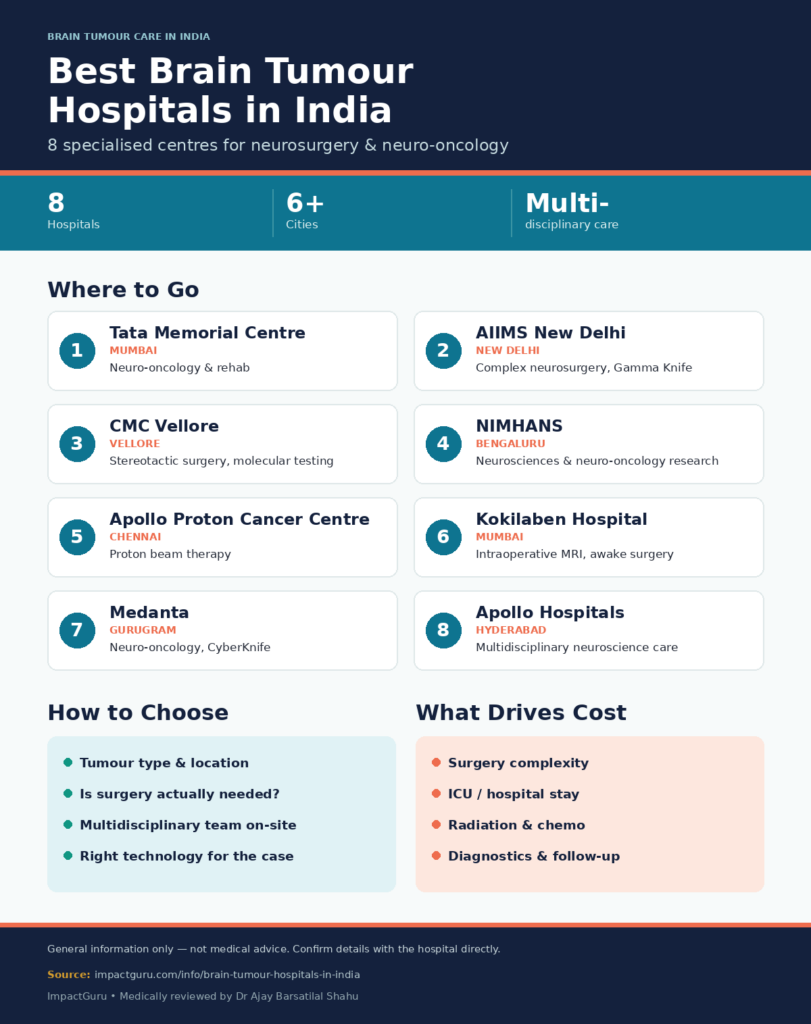
Best Brain Tumour Hospitals In India
The following hospitals are included based on their documented brain tumour, neurosurgery, oncology and related services. They are not presented as a ranking, because the most appropriate hospital can vary according to each patient’s medical needs.
1. Tata Memorial Centre, Mumbai
Tata Memorial Centre (TMC) is one of India’s major cancer-care institutions and operates under the Department of Atomic Energy. Its network includes Tata Memorial Hospital in Mumbai and other cancer centres across India.
TMC has dedicated expertise in areas relevant to brain tumour treatment, including neurosurgical oncology, neuro-oncology imaging and neuro-radiation oncology. Its current fellowship information also lists neurosurgical oncology as a specialised area.
In August 2026, Tata Memorial Hospital and the Indian Cancer Society also launched a dedicated Neuro-Oncology Rehabilitation Centre for patients with brain and spinal tumours, adding a specialised rehabilitation component to cancer care.
Location: Mumbai, Maharashtra
May be relevant for:
Brain and spinal tumours, cancer treatment, neurosurgical oncology, radiation oncology and rehabilitation.
2. All India Institute Of Medical Sciences (AIIMS), New Delhi
AIIMS New Delhi has dedicated departments of Neurosurgery and Medical Oncology. Its Medical Oncology department lists brain tumours among the cancers managed by the department.
The Neurosurgery department has documented work in areas including glioma, pituitary tumours and other intracranial conditions. Its services also include research involving molecular aspects of glioma and brain tumour imaging.
AIIMS also documents advanced neurosurgical work involving brain tumours, including image-guided surgery, intraoperative neuromonitoring, endoscopic skull-base approaches and Gamma Knife radiosurgery in relevant cases.
Location: New Delhi
May be relevant for:
Complex neurosurgery, neuro-oncology, brain tumours, skull-base tumours and specialised academic and research-based care.
3. Christian Medical College (CMC), Vellore
Christian Medical College Vellore has a long-established Department of Neurological Sciences covering neurology, neurosurgery, neuropathology and related areas.
Its neurosurgical units handle major and minor procedures for brain tumours and other neurological conditions. The department also documents stereotactic surgery and stereotactic radiosurgery/radiotherapy.
CMC’s Neuropathology division provides diagnostic services for neuro-oncology, including molecular tests such as FISH, MGMT assay and IDH mutation analysis. Its Radiation Oncology department also provides radiation treatments including IMRT, image-guided radiotherapy, stereotactic radiosurgery and stereotactic radiotherapy for appropriate brain tumours.
Location: Vellore, Tamil Nadu
May be relevant for:
Brain and spinal tumours, neurosurgery, neuropathology, molecular testing and radiation therapy.
4. NIMHANS, Bengaluru
The National Institute of Mental Health and Neuro Sciences (NIMHANS) is a major centre for neurosciences and neurosurgical care in India.
Its Neurosurgery department provides subspecialty care for brain tumours, while its Neuro-Oncology Laboratory conducts molecular and translational research involving brain tumours such as gliomas, CNS embryonal tumours and meningiomas. The laboratory also offers several molecular diagnostic tests.
NIMHANS also has dedicated departments covering neuropathology, neuroimaging, neuroanaesthesia and neurocritical care, neurological rehabilitation and neurosurgery.
Location: Bengaluru, Karnataka
May be relevant for:
Complex neurological and neurosurgical conditions, brain tumours, neuro-oncology and specialised neurosciences care.
5. Apollo Proton Cancer Centre, Chennai
Apollo Proton Cancer Centre (APCC) is a specialised cancer centre in Chennai with dedicated services for central nervous system tumours.
Its brain tumour programme includes neurosurgery, radiation oncology, medical oncology, personalised medicine, rehabilitation and palliative care. The centre also documents molecular neuropathology and testing for markers such as MGMT, IDH, 1p19q, BRAF and TERT, depending on the clinical situation.
The centre also provides proton beam therapy, which can be considered for selected tumours based on factors such as tumour type, location and treatment plan.
Location: Chennai, Tamil Nadu
May be relevant for:
Brain and CNS tumours requiring multidisciplinary cancer care, advanced radiation treatment and specialised neurosurgery.
6. Kokilaben Dhirubhai Ambani Hospital, Mumbai
Kokilaben Dhirubhai Ambani Hospital has a dedicated Centre for Neurosciences and provides treatment for brain tumours through neurosurgery, oncology and radiation oncology teams.
The hospital documents techniques including intraoperative MRI, neuronavigation, awake surgery, neurophysiological monitoring and stereotactic radiosurgery. Its brain tumour services also include support from neuroradiology and neurorehabilitation specialists.
Its neuroscience services cover conditions including gliomas, pituitary tumours, paediatric brain tumours and brain metastases.
Location: Mumbai, Maharashtra
May be relevant for:
Brain tumour surgery, complex neurosurgery, intraoperative imaging, stereotactic treatment and multidisciplinary neuro-oncology care.
7. Medanta, Gurugram
Medanta’s Neurosurgery department provides treatment for brain and spinal conditions and documents specialised neuro-oncology services.
Its neurosurgery services include advanced surgical techniques for brain tumours, while its radiation oncology services include treatment for brain tumours using technologies such as CyberKnife.
Location: Gurugram, Haryana
May be relevant for:
Brain tumour surgery, neuro-oncology and radiation-based treatment.
8. Apollo Hospitals, Hyderabad
Apollo Hospitals Hyderabad has a multidisciplinary neuroscience service involving neurologists, neurosurgeons, neuroradiologists, neuroanaesthesiologists, neurocritical care specialists and neurorehabilitation physicians.
Its documented brain tumour services include brain tumour surgery and stereotactic radiosurgery. The centre also lists neuro-navigation, intraoperative MRI and advanced neuroimaging among its facilities.
Location: Hyderabad, Telangana
May be relevant for:
Brain tumour surgery, neuro-oncology, stereotactic treatment and multidisciplinary neuroscience care.
Read More : Best Neurosurgery Hospitals in Mumbai (2026)
How To Choose The Right Brain Tumour Hospital
The most suitable hospital for one patient may not be the same for another. Before making a decision, families should discuss the following with the treating doctor:
1. What Type Of Brain Tumour Is It?
The treatment approach can differ between gliomas, meningiomas, pituitary tumours, metastatic brain lesions and other tumour types.
The pathology report and imaging findings should guide the treatment plan.
2. Where Is The Tumour Located?
A tumour close to areas controlling speech, movement, vision or other important functions may require specialised surgical planning.
Ask whether the hospital has experience treating tumours in that particular location.
3. Does The Patient Need Surgery?
Not every brain tumour requires immediate surgery. Depending on the tumour type and location, doctors may recommend observation, surgery, radiation therapy, chemotherapy or a combination of treatments.
4. Is Multidisciplinary Care Available?
Brain tumour treatment may involve more than one specialist. A hospital with neurosurgery, radiation oncology, medical oncology, neuropathology, neuroradiology and rehabilitation services can make coordination easier.
5. What Technology Is Actually Required?
Technologies such as intraoperative MRI, neuronavigation, stereotactic radiosurgery, proton therapy and molecular testing can be useful in selected cases. However, having a particular technology does not automatically mean that every patient needs it.
The treatment team should explain whether it is appropriate for the patient’s tumour.
Brain Tumour Treatment Cost In India
The cost of brain tumour treatment in India can vary substantially. It depends on factors such as:
- Type and grade of tumour
- Tumour size and location
- Whether surgery is required
- Complexity of surgery
- ICU and hospital stay
- Diagnostic tests and pathology
- Radiation therapy
- Chemotherapy or targeted treatment
- Rehabilitation
- Medicines and follow-up care
Families should ask the hospital for a written estimate covering the expected treatment and major additional expenses.
It is also important to ask whether the estimate includes surgeon fees, room charges, ICU costs, medicines, investigations, pathology, radiation treatment and follow-up visits.
Read More : Stroke Treatment Cost in India: A City-Wise Guide
Read More : How to Start a Fundraiser for Surgery Expenses in India
How Families Can Manage Brain Tumour Treatment Expenses
Brain tumour treatment can become financially difficult when surgery is followed by radiation, medicines, repeated scans or prolonged hospitalisation.
Families can first check their health insurance coverage, employer-provided medical benefits and any hospital financial assistance programmes for which they may be eligible.
For families who still face a significant gap, medical crowdfunding can provide another source of financial support. A fundraiser can explain the patient’s diagnosis, treatment plan, estimated expenses and the amount that the family needs to raise.
On platforms such as ImpactGuru, families can create medical fundraisers and share their stories with a wider donor community.
Documents To Carry For A Brain Tumour Consultation
Before visiting another hospital for a second opinion, keep all relevant medical records together.
These may include:
- MRI and CT scan reports
- Actual scan images, preferably in digital format
- Biopsy or histopathology report
- Molecular pathology reports, if available
- Previous prescriptions
- Blood test reports
- Previous discharge summaries
- Current treatment plan
- Details of previous surgery or radiation
- Insurance documents, if applicable
Having the complete medical history can help the new specialist understand what has already been done and what treatment options may be available.
Read More : ICU Cost in India: Per Day Charges, Breakdown & Cost Saving Tips
When Should You Get A Second Opinion?
A second opinion can be useful when a family is unsure about the diagnosis or treatment plan, particularly before a major brain surgery.
It can also help when:
- The tumour is located in a difficult-to-operate area
- Surgery has been recommended
- The diagnosis is unclear
- The tumour has returned
- The patient has received different treatment recommendations
- The family wants to understand radiation or other treatment options
A second opinion should not unnecessarily delay urgent treatment when the treating doctors have identified a medical emergency.

Conclusion
Choosing among the best brain tumour hospitals in India should begin with the patient’s medical needs rather than the hospital’s name alone. A centre that regularly treats the specific type and location of the tumour, has the required specialists and can coordinate surgery, oncology, radiation and rehabilitation may be more relevant than a hospital chosen only because it is well known.
India has several specialised centres with experience in brain tumour care, including Tata Memorial Centre, AIIMS New Delhi, CMC Vellore, NIMHANS Bengaluru, Apollo Proton Cancer Centre, Kokilaben Dhirubhai Ambani Hospital and Medanta.
For families facing the financial burden of treatment, planning early is equally important. Understanding the expected treatment cost, checking insurance and assistance options, and considering medical crowdfunding when necessary can help families prepare for the expenses that come with prolonged cancer care.
FAQs About Brain Tumour Hospitals In India
India has several established centres offering brain tumour and neuro-oncology care, including Tata Memorial Centre, AIIMS New Delhi, CMC Vellore, NIMHANS Bengaluru, Apollo Proton Cancer Centre Chennai, Kokilaben Dhirubhai Ambani Hospital Mumbai and Medanta Gurugram. The appropriate hospital depends on the patient’s tumour type, treatment needs, location and financial circumstances.
There is no single hospital that is best for every brain tumour surgery. The surgeon’s experience with the specific tumour type and location, availability of neuro-navigation or intraoperative monitoring, ICU support and access to oncology services can all be important factors.
Yes. Major government and publicly funded institutions such as AIIMS and Tata Memorial Centre provide specialised cancer and neurosurgical services. Eligibility, waiting times, treatment pathways and costs can vary between institutions.
It can be, particularly when treatment involves complex surgery, ICU care, radiation therapy, chemotherapy, targeted medicines or prolonged rehabilitation. The actual cost depends heavily on the patient’s diagnosis and treatment plan.