

Table of Contents
- Quick Summary
- Introduction
- What Changes After Epilepsy Surgery?
- What Should You Do After Epilepsy Surgery?
- How Do You Manage Epilepsy Long-Term?
- Can a Person With Epilepsy Get a Driving License in India?
- Is Epilepsy Considered a Disability in India?
- What Are the Employment Rights of People With Epilepsy?
- Can Epilepsy Patients Get Married Legally in India?
- How Can You Stay Safe While Living With Epilepsy?
- When Should You Contact Your Doctor After Epilepsy Surgery?
- Managing the Financial Burden of Long-Term Epilepsy Care
- Conclusion
- Frequently Asked Questions
Quick Summary
- Living with epilepsy involves more than controlling seizures; long-term care can include medication management, specialist follow-up, safety planning, and adjustments after epilepsy surgery.
- After epilepsy surgery, anti-seizure medicines are usually not stopped immediately. Any reduction or withdrawal should be planned gradually with the epilepsy specialist or surgical team.
- India’s official driving-licence forms require applicants to disclose epilepsy or sudden attacks of loss of consciousness or giddiness; a medical assessment may also be required depending on the application.
- Epilepsy is not automatically equivalent to a certified disability under Indian law. The Rights of Persons with Disabilities Act, 2016 covers specified disabilities, including disability caused by certain chronic neurological conditions, with eligibility determined under the applicable legal and certification framework.
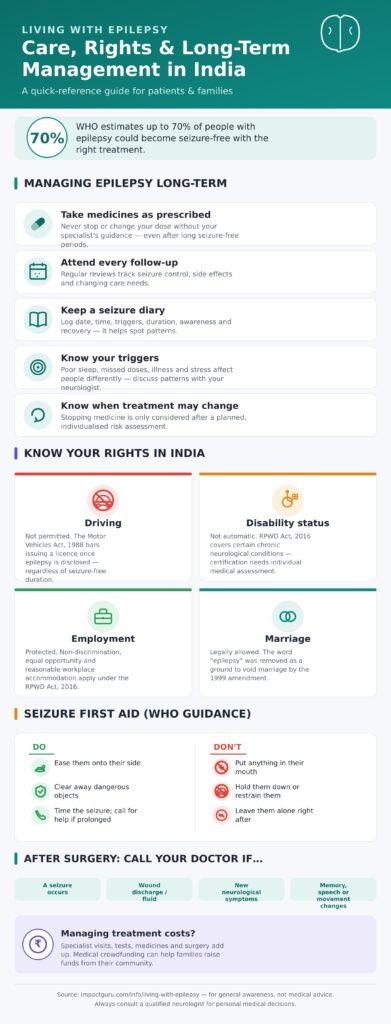
- With appropriate diagnosis and treatment, epilepsy can often be controlled. WHO estimates that up to 70% of people with epilepsy could become seizure-free with appropriate treatment.
Introduction
Living with epilepsy does not end when seizures become controlled. For many people, long-term management also means remembering medicines, attending follow-up appointments, recognising situations that may increase seizure risk, and knowing how epilepsy can affect everyday decisions about work, driving and social life.
For people who have undergone epilepsy surgery, there is another adjustment: surgery may reduce or stop seizures, but recovery and long-term care continue after leaving the hospital. Medication changes, follow-up assessments and monitoring remain important, and a seizure soon after surgery does not necessarily mean that the procedure has failed.
This guide explains what life after epilepsy surgery can look like, how epilepsy is managed over the long term, and what patients in India should know about driving, disability and employment rights.
Read More : Epilepsy Symptoms & Seizure Types: A Complete Guide
What Changes After Epilepsy Surgery?
Life after epilepsy surgery varies from person to person. The aim of surgery may be to stop seizures completely or reduce their frequency or severity, depending on the individual’s epilepsy and the procedure performed. Continued follow-up is important even when surgery has produced good seizure control.
The first few weeks can involve tiredness, headaches, swelling or bruising around the surgical area, and changes in physical or mental activity. Recovery can take several weeks, and some people may need additional support with everyday activities while they regain strength.
A seizure during the early period after surgery does not automatically mean that the surgery was unsuccessful. Seizures can occur after surgery, and the treating team may review the person’s medication and recovery before determining the longer-term outcome.
Medication After Epilepsy Surgery
Living seizure-free after epilepsy surgery does not usually mean that anti-seizure medication can be stopped immediately.
The timing of any medication reduction depends on the person’s seizure history, surgery, recovery and risk of recurrence. NICE recommends that, after epilepsy surgery, anti-seizure medicines should be discontinued only under the guidance of the epilepsy surgery centre.
Medication should therefore never be reduced, skipped or stopped independently, even if there have been no seizures since surgery.
Follow-Up After Surgery
Follow-up helps the treating team assess seizure control, recovery and any changes that may need attention. Depending on the individual’s surgery and clinical condition, follow-up may include neurological assessment, imaging, EEG, cognitive or memory assessment, and medication review.
The exact schedule differs between patients and treatment centres, so the treating neurologist or epilepsy surgery team should determine the follow-up plan.
What Should You Do After Epilepsy Surgery?
After returning home, the priority is to allow the brain and body to recover while continuing the treatment plan provided by the surgical team.
Important steps may include:
- Take anti-seizure medicines exactly as prescribed.
- Attend scheduled appointments even if you have remained seizure-free.
- Keep a record of any seizures, unusual sensations, or other concerning symptoms.
- Follow the surgical team’s instructions for caring for the wound.
- Gradually return to normal physical and mental activities according to medical advice.
- Ask your doctor before driving, returning to safety-sensitive work, or making major medication changes.
- Seek medical advice if you develop concerning symptoms or have a seizure after surgery.
Recovery is not always linear. Fatigue, mood changes, concentration difficulties, or other temporary symptoms may occur during recovery, and the extent and duration vary between individuals.
How Do You Manage Epilepsy Long-Term?
Living with long-term epilepsy management focuses on maintaining seizure control while regularly reassessing treatment and the person’s changing needs. Antiseizure medication is a major part of treatment for many people, while some patients may also require surgery or other specialist treatment.
Long-term care commonly involves:
Take Anti-Seizure Medicines as Prescribed
Taking medicines consistently is important for maintaining seizure control. Do not change the dose or stop treatment because you have been seizure-free unless your treating specialist has advised you to do so.
If medication is being discontinued, the reduction is generally planned gradually. NICE recommends an individualised assessment of seizure-recurrence risk before stopping anti-seizure medication after a period of seizure freedom.
Attend Regular Follow-Up
Epilepsy is not managed through a one-time consultation. Follow-up allows the treating team to review seizure control, medication effectiveness, side effects, and changing care needs.
If seizures return, medication causes troublesome side effects, or your circumstances change, ask for a review of your treatment rather than adjusting medication yourself.
Keep Track of Seizures
Living with post-surgery epilepsy management includes keeping a seizure diary. It can help you and your healthcare team identify patterns and assess whether treatment is working.
Record information such as:
- Date and approximate time of the seizure
- What happened before and during it
- How long it appeared to last
- Loss of awareness or consciousness
- Possible triggers or unusual circumstances
- Recovery afterward
- Any missed medication doses
A family member or caregiver may also be able to help record this information if you are unable to do so during or immediately after a seizure.
Know Your Possible Triggers
Triggers differ between individuals. Poor sleep, missed medication, illness, stress, and other circumstances may contribute to seizures in some people.
Instead of assuming that every commonly mentioned trigger applies to you, discuss recurring patterns with your neurologist.
Know When Treatment May Need to Change
Being seizure-free does not necessarily mean treatment can immediately be stopped. WHO notes that discontinuation of anti-seizure medicine may be considered after a period of seizure freedom, but the decision should take relevant clinical, social and personal factors into account.
Read More : Epilepsy Treatment in India: Guide 2026
Can a Person With Epilepsy Get a Driving License in India?
People with epilepsy should disclose the condition during the driving-licence process and follow the applicable medical and licensing requirements. India’s official driving-licence documentation specifically asks applicants whether they suffer from epilepsy or sudden attacks of loss of consciousness or giddiness.
The official Parivahan system provides Form 1 for physical-fitness declaration and Form 1A for a medical certificate in applicable cases. Form 1 requires an applicant to answer whether they have epilepsy or sudden attacks of loss of consciousness or giddiness; if the applicant answers “yes” to specified health questions, further details may be required.
Under current Indian law, specifically the Motor Vehicles Act, 1988, there is no provision to issue a driving license to anyone diagnosed with epilepsy. If an applicant declares the condition, the licensing authority is legally mandated to deny the application. This absolute restriction applies regardless of the type of epilepsy, how well it is controlled, or how long a person has been completely seizure-free.
Driving without disclosing the condition carries severe legal, financial, and insurance consequences, alongside profound public safety risks. Anyone who has undergone epilepsy surgery or is living with managing the condition must rely on alternative transport methods rather than seeking a personal driving licence.
Is Epilepsy Considered a Disability in India?
A diagnosis of epilepsy does not automatically mean that every person with epilepsy is legally certified as a person with disability or is entitled to every disability benefit.
The Rights of Persons with Disabilities Act, 2016 establishes categories of specified disabilities. Its Schedule includes disability caused by chronic neurological conditions and gives multiple sclerosis and Parkinson’s disease as examples. The Act also allows other categories to be notified by the Central Government.
Therefore, it is important to distinguish between having epilepsy and qualifying for disability certification or a particular disability benefit.
If you believe epilepsy or its long-term effects significantly affect your day-to-day living and functioning, speak with an authorised medical authority about whether you meet the applicable criteria for disability assessment and certification.
The Act also contains provisions covering employment, social security, healthcare, rehabilitation and other rights and entitlements for persons with disabilities.
What Are the Employment Rights of People With Epilepsy?
Employment protections under the Rights of Persons with Disabilities Act, 2016 apply within the Act’s definition and eligibility framework; having an epilepsy diagnosis alone should not be treated as an automatic entitlement to every provision.
The Act contains provisions on non-discrimination in employment, equal opportunity policies, and reasonable accommodation for persons with disabilities. It also defines an “establishment” to include government and private establishments.
For a person living with epilepsy, workplace needs may depend on the nature of the job and the individual’s seizure control. For example, a person whose work involves heights, heavy machinery or other safety-sensitive environments may need an individual assessment of workplace risks.
If you need workplace support, discuss your situation with your employer or human resources team and, where relevant, obtain appropriate medical documentation. A treating specialist can also help explain any functional restrictions or adjustments that may be medically appropriate.
Can Epilepsy Patients Get Married Legally in India?
Yes. Epilepsy by itself is not a legal disqualification for marriage, nor is it a ground for a marriage to be declared void or voidable under the Hindu Marriage Act, 1955 or the Special Marriage Act, 1954.
The historical legal position was radically different. The Marriage Laws (Amendment) Act, 1976 explicitly classified “recurrent attacks of epilepsy” alongside insanity as a ground to invalidate a marriage. However, following intense medical advocacy, the Government of India passed the Marriage Laws (Amendment) Act, 1999. This critical amendment completely erased the word “epilepsy” from the statutory conditions for a valid marriage, legally delinking it from mental illness.
While epilepsy cannot be used as a statutory bar to marry, personal laws and individual circumstances vary. If an active legal dispute involving marital nondisclosure or mental cruelty arises, professional legal counsel should be sought. From a medical standpoint, individuals with epilepsy planning to marry should proactively consult their neurologist regarding treatment continuity, safe family planning, and pregnancy management.
How Can You Stay Safe While Living With Epilepsy?
Everyday safety planning can reduce the risk of injuries during seizures. The precautions needed vary according to seizure type, frequency, and the activities a person regularly performs.
Some situations may require additional care, particularly activities where a sudden loss of awareness or control could result in serious injury.
Examples include:
- Swimming alone
- Working at heights
- Using heavy machinery
- Working near open flames
- Certain high-risk occupational activities
- Driving when not medically or legally permitted
Family members, friends, and coworkers can also benefit from knowing basic seizure first aid.
During a seizure, people around the patient should focus on preventing injury. WHO guidance recommends moving dangerous objects away, placing the person safely on their side when appropriate, loosening tight clothing, and not putting anything into the person’s mouth or trying to restrain them.
If seizures are prolonged, repeated without recovery, or associated with serious injury or breathing problems, emergency medical assistance may be required.
Read More : Epilepsy Surgery: Procedure, Types, Success Rate & Recovery
When Should You Contact Your Doctor After Epilepsy Surgery?
Contact your surgical or epilepsy team if you experience symptoms that concern you during recovery, particularly a new or worsening problem.
Depending on the surgery and the instructions given by your treating team, this may include:
- A seizure after surgery
- Problems involving the surgical wound
- Fluid or discharge from the wound
- Increasing or severe symptoms
- New neurological symptoms
- Significant changes in memory, speech, movement or awareness
- Problems taking or tolerating prescribed medicines
A seizure soon after surgery does not automatically mean that the procedure has failed, but it should still be reported to the treating team so that the situation can be assessed.
Managing the Financial Burden of Long-Term Epilepsy Care
Epilepsy care can involve more than the cost of a single treatment. Depending on the person’s condition, families may need to budget for specialist consultations, diagnostic tests, medicines, follow-up care and, in some cases, epilepsy surgery.
When these expenses become difficult to manage, crowdfunding for medical treatment can help families seek financial support from their personal networks and a wider donor community.
With online crowdfunding, families can create a fundraising campaign, explain the patient’s diagnosis and treatment needs, and share the campaign with potential donors. If you are considering this option for epilepsy surgery or ongoing treatment, read our detailed guide on how to crowdfund epilepsy surgery and treatment costs.
ImpactGuru also provides a platform through which families can fundraise online for eligible medical expenses and reach potential donors.

Conclusion
Living with epilepsy can take some adjustment, especially after surgery or when seizures are still being managed. Staying consistent with medicines, keeping regular follow-ups and knowing when to seek medical advice can help you manage the condition with greater confidence. It is also worth understanding how epilepsy may affect everyday decisions around driving, work and other activities.
For families struggling with the cost of epilepsy surgery, medicines or ongoing care, medical crowdfunding can provide another way to raise the funds needed for treatment. ImpactGuru allows you to create a fundraiser and share your story with potential donors who can support your medical journey.
Frequently Asked Questions
No. Under the Motor Vehicles Act, 1988, India enforces a strict prohibition on issuing driving licenses to individuals diagnosed with epilepsy. When filling out Form 1 (Physical Fitness Declaration) on the Parivahan portal, applicants are legally required to disclose the condition, which results in a mandatory denial. This restriction applies regardless of your current seizure-free status or treatment success.
Epilepsy is not automatically equivalent to a certified disability for every patient. The Rights of Persons with Disabilities Act, 2016 covers specified disabilities, including disability caused by certain chronic neurological conditions. Eligibility for certification and particular benefits depends on the applicable criteria and assessment.
Yes. Epilepsy is not a legal ground to declare a marriage void or voidable under the Hindu Marriage Act, 1955 or the Special Marriage Act, 1954. While the 1976 amendment originally classified epilepsy as a ground for divorce, the Marriage Laws (Amendment) Act, 1999 permanently deleted the word “epilepsy” from the statutory bars to marriage, legally decoupling it from mental unsoundness.
Continue prescribed medicines, attend follow-up appointments, follow wound-care and recovery instructions, monitor for seizures or concerning symptoms, and discuss activities such as driving or returning to work with your treating team. Do not reduce or stop anti-seizure medication without specialist guidance.
Long-term management requires taking prescribed anti-seizure medications consistently, attending regular medical reviews, keeping a detailed seizure diary (tracking timings, missed doses, and symptoms), and working with your neurologist to identify individual triggers like lack of sleep or illness. Any decision to modify or taper off medication must always be planned gradually under specialized clinical supervision.