
Table of Contents
- Quick Summary
- Introduction
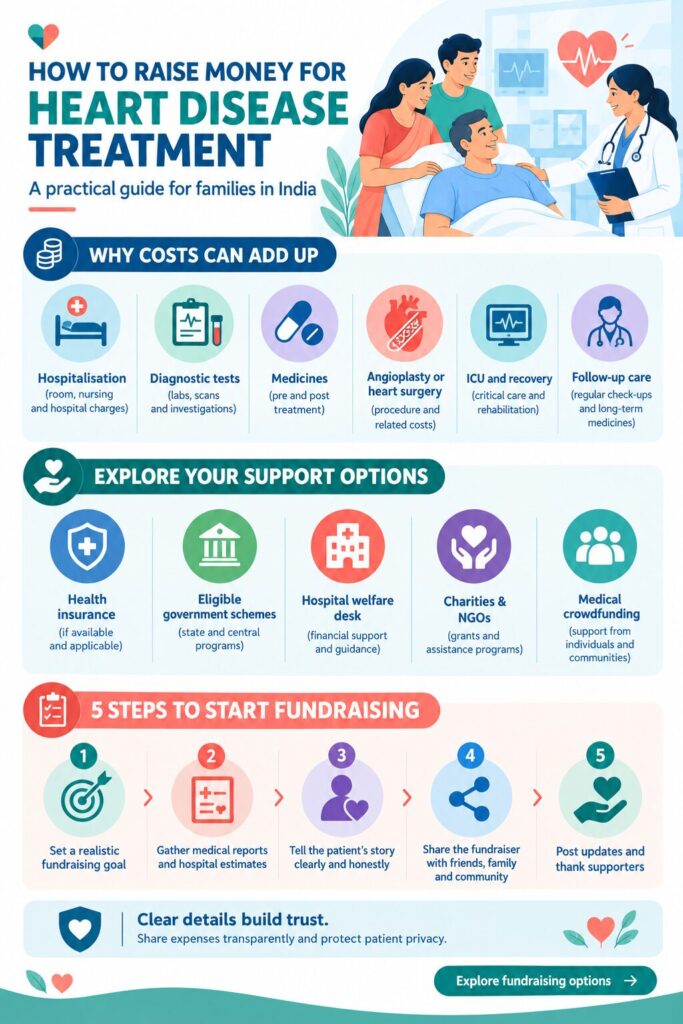
- Why Can Heart Disease Treatment Become Expensive?
- Common Expenses Associated With Heart Treatment
- How to Raise Money for Heart Disease Treatment
- How to Start a Medical Fundraiser for Heart Disease Treatment on ImpactGuru
- What If the Fundraiser Does Not Reach Its Target?
- How ImpactGuru Can Help With Heart Disease Treatment Expenses
- Conclusion
- Frequently Asked Questions
Quick Summary
- Heart disease treatment may involve expenses for hospitalization, diagnostic tests, medicines, cardiac procedures, surgery and recovery.
- When planning how to raise money for heart disease treatment, patients can explore health insurance, applicable government schemes, hospital assistance, charitable organizations and medical crowdfunding.
- A medical crowdfunding campaign allows patients and caregivers to explain their financial needs and seek donations from potential supporters.
- Medical reports, hospital estimates, an honest fundraising story and a realistic target help explain why financial support is needed.
- ImpactGuru provides an online platform where eligible patients and families can start a medical fundraiser and seek contributions towards treatment expenses.
- Knowing how to raise money for heart disease treatment can help families explore financial options while staying in touch with their treating medical team.
Introduction
A heart disease diagnosis can bring sudden uncertainty into a family’s life. Alongside the fear of illness, patients and caregivers may have to make difficult decisions about hospital admissions, medical procedures, For most families, the worry quickly becomes one question: how to raise money for heart disease treatment.
For some people, heart disease can be managed with medicines, lifestyle changes and regular consultations. Others may need angioplasty, bypass surgery, valve replacement or more complex cardiac treatment. In an emergency, families may have little time to organize their finances before hospital expenses begin to accumulate. This guide breaks down how to raise money for heart disease treatment in India – from government schemes to medical crowdfunding.
The cost can include much more than the main procedure. Diagnostic tests, intensive care, medicines, specialist consultations and follow-up appointments may add to the overall bill. Even when insurance is available, the policy may not cover every expense.
This can leave families searching for financial assistance at a time when their attention is already focused on the patient’s health. This is often the point where families start asking how to raise money for heart disease treatment, while their attention is already on the patient’s health.
Understanding How to Raise Money for Heart Disease Treatment can help patients and caregivers identify possible sources of support. These may include health insurance, eligible government schemes, charitable assistance and medical crowdfunding.
This guide explains how to assess the financial requirement, prepare a fundraising campaign, gather supporting documents and reach potential donors. It also explores how ImpactGuru may help families seek financial support through online medical fundraising.
Heart disease isn’t a rare problem in India. According to the World Health Organization’s page on cardiovascular diseases in India, these conditions are among the country’s leading health concerns – which is why timely treatment, and being able to afford it, matters so much.
Why Can Heart Disease Treatment Become Expensive?
Heart disease is a broad term covering different conditions that affect the heart and blood vessels. The treatment plan for heart disease depends on the diagnosis, severity of the condition, the patient’s overall health and the cardiologist’s recommendations.
Some patients need long-term medication and regular monitoring. Others may require emergency hospitalisation or a procedure to improve blood flow, repair a heart valve or address another cardiac problem.
Common Expenses Associated With Heart Treatment
Depending on the patient’s condition, medical expenses may include:
- Cardiologist consultations and specialist fees
- Blood tests, ECGs, echocardiograms and other investigations
- Hospital admission and intensive care
- Prescription medicines
- Angioplasty and stent placement
- Coronary artery bypass grafting (CABG)
- Heart valve repair or replacement
- Pacemaker or other cardiac device implantation
- Heart transplant-related treatment
- Post-operative monitoring and rehabilitation
- Follow-up appointments and continuing medication
Not every patient will need all these services. Heart disease treatment costs depend on the individual treatment plan.
Families should request a written estimate from the treating hospital. They can also ask which services are included, whether any expenses are billed separately and whether the estimate could change if additional treatment becomes necessary.
A clear understanding of the expected cost makes it easier to identify the financial shortfall and decide what kind of assistance to explore.
How to Raise Money for Heart Disease Treatment
There is no single financial solution that suits every patient. Families may need to combine several options depending on the urgency of treatment, available savings, insurance coverage and eligibility for assistance.
1. Check Your Health Insurance Coverage
If the patient has health insurance, contact the insurer or third-party administrator as early as possible.
Ask whether the recommended cardiac treatment is covered and whether the hospital is part of the insurer’s network. Find out if cashless treatment is available and what documents are required to initiate a claim.
It is also important to check:
- The available sum insured
- Co-payments and deductibles
- Waiting periods and exclusions
- Room-rent limits, if applicable
- Coverage for medicines and diagnostic tests
- Pre- and post-hospitalisation expenses
- Requirements for reimbursement claims
Do not assume that the entire treatment bill will be covered. Policy conditions differ, and certain expenses may have to be paid by the family.
Once the insurer confirms the available coverage, compare it with the hospital estimate. The difference can help you understand how much additional financial support may be required.
2. Explore Government Health Schemes
Eligible patients may be able to access assistance through applicable central or state government health schemes.
The available benefits depend on the patient’s eligibility, the scheme’s current rules, the approved hospital network and the treatment package. Families should confirm whether the recommended cardiac procedure is covered before relying on this option.
Ask the hospital’s patient assistance desk or social work department whether it can help identify relevant schemes and explain the application process.
Keep the required documents ready, as incomplete paperwork may delay an application.
Read more: NGOs & Charities Funding Free Heart Surgery in India
3. Approach Charitable Organizations
Some charitable trusts, non-profit organisations and community groups provide financial assistance for medical treatment. Their support may depend on the patient’s circumstances, the treatment required, available funds and the organisation’s eligibility criteria.
When contacting an organisation, explain the medical condition and the procedure recommended by the treating doctor. Share the hospital estimate and clearly state the amount of assistance required.
Ask whether the organisation supports cardiac treatment and what documents are needed to apply.
Because approval and disbursement timelines can vary, families should explore charitable assistance alongside other financial options rather than depend on a single application.
4. Consider Medical Crowdfunding
Medical crowdfunding allows patients and caregivers to create an online campaign explaining their medical situation and requesting donations.
The campaign can be shared with relatives, friends, colleagues, community members and other potential supporters. For families raising money for heart treatment, sharing the campaign helps them reach beyond their immediate circle.
Crowdfunding is donation-based fundraising rather than a conventional loan. However, families should review the platform’s terms and conditions, verification requirements and any applicable charges before starting a campaign.
ImpactGuru is one platform through which eligible patients and families can seek donations towards medical expenses.
For families researching how to Raise Money for Heart Disease Treatment, crowdfunding may provide an additional way to communicate the financial need and invite others to help.
Every Heart Deserves a Chance. Let’s Make Treatment Possible.
How to Start a Medical Fundraiser for Heart Disease Treatment on ImpactGuru
A medical fundraiser should explain the patient’s condition, the treatment recommended and the financial support being sought. Preparing this information before starting the campaign can make the process easier to manage.
Step 1: Gather the Required Medical Documents
Start by collecting the documents that support the patient’s diagnosis and treatment requirement.
These may include:
- Recent medical reports and investigation results
- A cardiologist’s recommendation or doctor’s letter
- Hospital admission records, where applicable
- A written treatment estimate
- Medical bills for treatment already received
- Prescriptions and the proposed treatment plan
- Identity and other documents required by the platform
The exact documentation may vary depending on the campaign and the platform’s verification process.
Make sure the documents are current, readable and consistent with the information you plan to share. Protect sensitive details that potential donors do not need to see publicly.
Step 2: Write a Clear and Honest Fundraising Story
A fundraising story should help readers understand the patient’s situation without requiring them to interpret complicated medical terminology.
Explain who the patient is, what condition has been diagnosed and what treatment the doctor has recommended. Describe the financial requirement using the available hospital estimate.
Your story can cover:
- The patient’s name and age, where appropriate
- The diagnosed heart condition
- The recommended treatment or procedure
- The hospital where treatment is planned or taking place
- The estimated medical expenses
- The amount of financial support being sought
- How donations will help meet the treatment expenses
For example, a campaign may explain that a patient needs bypass surgery and that the hospital has provided an estimate for the procedure and associated care.
The story should be factual and respectful. Avoid exaggerating the medical condition, promising a particular outcome or publishing personal details without the patient’s consent.
Step 3: Set a Realistic Fundraising Target
A fundraising goal for heart disease treatment should reflect the actual financial requirement, supported by a hospital estimate or other relevant documents.
First, calculate the expected treatment expenses. Then account for confirmed insurance coverage, financial assistance already received, and any contribution the family can reasonably arrange.
For example: If the estimated treatment cost is ₹8 lakh and the family has ₹3 lakh available through confirmed sources, the remaining shortfall would be ₹5 lakh.
This is an illustrative calculation, not a standard estimate for heart surgery.
If the hospital revises its estimate or additional expenses arise, update the campaign with the relevant details. A transparent explanation of the funding requirement can help donors understand the purpose of the appeal.
Step 4: Create Your Fundraiser on ImpactGuru
Visit ImpactGuru’s Medical Fundraising page to explore the platform’s current process.
Follow the instructions to provide the patient’s information, campaign story, fundraising target and supporting documents.
ImpactGuru states that relevant information may be reviewed as part of its verification process. Respond to any requests for additional documents and ensure that all submitted details are accurate.
Before proceeding, review the current terms, verification requirements, payment processing arrangements and withdrawal conditions.
Step 5: Share the Fundraiser With Potential Donors
Creating a fundraiser is only one part of the process. People also need to know that support is required.
Begin by sharing the campaign with relatives, friends and colleagues who may be able to contribute or pass the appeal along.
You can use:
- WhatsApp messages and groups
- Personal social media accounts
- Family and community networks
- Friends and professional contacts
Keep the message short and explain the medical need, financial requirement and purpose of the campaign. Include the correct fundraiser link so that people can read the details and decide whether they wish to contribute.
Ask trusted contacts to share the campaign with their own networks. This can help the appeal reach people beyond the family’s immediate circle.
Step 6: Keep Donors Updated
A medical fundraiser should continue to reflect the patient’s circumstances as treatment progresses.
Share appropriate updates about hospital admission, treatment milestones, changes in the medical estimate and the amount raised. If the financial requirement changes, explain why and provide supporting information where possible.
Obtain consent before sharing patient photographs, medical reports or other sensitive details.
Regular, factual communication can help donors understand the progress of the campaign and how the patient’s needs are changing.

What Makes a Heart Disease Fundraiser More Effective?
There is no formula that guarantees donations. However, a well-organised campaign can make the patient’s circumstances and financial requirements easier to understand.
Explain the Diagnosis in Simple Language
Use the diagnosis provided by the treating doctor and explain the recommended treatment in terms that a general reader can understand.
For example, if the patient needs angioplasty, explain that it is a procedure used to help improve blood flow through a narrowed artery. If bypass surgery has been recommended, state that clearly.
Avoid using a broad description such as “heart problem” when more specific, verified information can be shared with the patient’s consent.
Explain the Financial Shortfall
Donors should be able to understand the purpose of the fundraising target.
Where possible, explain the estimated treatment cost, confirmed assistance already available and the remaining amount being sought. Make it clear if the hospital estimate is provisional and may change.
Do not publish unsupported figures or claim that a particular amount will guarantee treatment or recovery.
Use Relevant Supporting Documents
Medical reports, doctor’s letters and hospital estimates can help establish the context of a campaign.
Share only documents that are relevant to the medical need, and protect private information such as identification numbers, addresses and other unnecessary personal details.
Follow the platform’s instructions about document submission and public visibility.
Make the Appeal Easy to Share
A concise message can help people understand the campaign quickly. Include the patient’s situation, the financial requirement and a direct request to donate or share the fundraiser.
Not everyone will be able to contribute financially. Some people may still help by circulating the campaign among others who could be willing to support it.
Respond to Donor Questions Honestly
Potential donors may ask about the treatment, estimated expenses or progress of the fundraiser.
Answer using verified information. If a medical decision or cost has not yet been confirmed, explain that rather than presenting an assumption as a fact.
Trust is built through clear communication and accurate information, not dramatic claims.
What If the Fundraiser Does Not Reach Its Target?
Medical crowdfunding does not guarantee that the full fundraising goal will be achieved. The outcome depends on the campaign’s reach, the financial requirement, donor response and other circumstances.
If contributions are lower than expected, consider the following steps:
- Review the story to make sure the treatment requirement and financial shortfall are clear.
- Share genuine updates when the treatment plan or estimated expenses change.
- Ask trusted contacts to help circulate the fundraiser.
- Explore other charitable assistance and applicable government schemes.
- Contact the hospital’s financial assistance or social work team to ask about available options.
Families should not rely on crowdfunding as their only source of funding when treatment is urgent. Discuss the medical timeline with the treating team and explore several financial options in parallel.
How ImpactGuru Can Help With Heart Disease Treatment Expenses
ImpactGuru provides an online platform where patients and caregivers can create medical fundraising campaigns and seek donations towards eligible medical expenses.
For families facing substantial cardiac treatment costs, a fundraiser can provide a way to explain the patient’s diagnosis, treatment requirement and financial need to a wider group of potential supporters.
Campaigners can provide relevant medical information and supporting documents, set a fundraising target and share the campaign with their networks. They should also review the platform’s current verification requirements and terms before proceeding.
To explore the process, visit ImpactGuru’s Medical Fundraising page.
The amount raised depends on donor contributions and campaign-specific circumstances. A fundraiser should therefore be considered one possible source of assistance rather than a guarantee that all treatment expenses will be covered.
Conclusion
Understanding How to Raise Money for Heart Disease Treatment begins with identifying the medical expenses, checking available insurance coverage and exploring financial assistance options. Government schemes, charitable support and medical crowdfunding may help eligible families address some of the financial challenges associated with cardiac care.
For families who choose crowdfunding, an honest fundraising story, relevant medical documents, a realistic target and regular updates can help explain why support is needed.
Through ImpactGuru, patients and caregivers can create an online medical fundraiser and invite potential donors to contribute towards eligible treatment expenses. While donations cannot be guaranteed, fundraising can be one part of a broader effort to seek financial assistance.
When a loved one needs heart treatment, families should not have to navigate the financial questions without information. Exploring available options early can help them plan more clearly while remaining focused on the patient’s care.
Frequently Asked Questions
Patients and caregivers can explore health insurance, eligible government schemes, hospital assistance, charitable organisations and medical crowdfunding. The appropriate options depend on the patient’s diagnosis, financial requirement and eligibility. Families should verify the available support and keep the treating medical team informed.
You can request financial assistance from eligible programmes or charitable organisations, check insurance coverage and consider medical crowdfunding. A fundraising campaign should include the doctor’s recommendation, hospital estimate and a clear explanation of the financial shortfall.
Patients and caregivers can create a medical fundraiser to seek donations for eligible cardiac treatment expenses, including angioplasty and bypass surgery. The campaign should accurately describe the recommended procedure and include relevant supporting information.
Depending on the case, documents may include medical reports, a doctor’s letter, hospital estimates, medical bills, admission records and identity documents required by the platform. Check the platform’s current documentation and verification requirements before submitting the campaign.
There is no fixed amount that every fundraiser will raise. Contributions depend on the medical requirement, the campaign’s reach, the supporting information and donor response. Set a target based on genuine treatment expenses and update it if the financial requirement changes.
There is no guaranteed timeline for raising funds. Some campaigns may receive contributions quickly, while others may take longer or not reach their full target. Families should explore other financial assistance options rather than assume crowdfunding will meet an urgent treatment deadline.
Donation-based crowdfunding is generally different from a loan and does not ordinarily require recipients to repay donations as loan instalments. However, campaigners should review the platform’s applicable terms and conditions before starting a fundraiser.