
Table of Contents
- Quick Summary
- Introduction
- Why India Needs a Strong Network of Heart Surgery Funding
- Who Can Apply for Free Heart Surgery Assistance?
- Free Heart Surgery Funding Options in India: Quick Comparison
- Government Schemes for Free Heart Surgery in India
- Top NGOs and Charitable Trusts Offering Free Heart Surgery in India
- Documents Required to Apply for Heart Surgery Assistance
- How to Apply for Free Heart Surgery in India: Step-by-Step Guide
- How to Verify an NGO’s Credibility Before You Apply or Donate
- When Government and NGO Aid Isn’t Enough: The Role of Crowdfunding
- Conclusion
- Frequently Asked Questions
Quick Summary
- Several verified free heart surgery NGOs in India, including Genesis Foundation, Child Heart Foundation, and CHIME-MIOT, fund cardiac procedures for underprivileged patients.
- Government programmes such as RBSK (Rashtriya Bal Swasthya Karyakram) and RAN (Rashtriya Arogya Nidhi) cover the costs of heart surgery for eligible low-income families.
- Applications generally require proof of income, medical reports, ID documents, and a cardiologist’s referral letter.
- The Sri Sathya Sai Sanjeevani hospital network treats congenital heart disease completely free of cost, regardless of income, at its dedicated centres.
- Most children-focused charities do not fund adult cardiac procedures; always confirm age eligibility before applying.
- When government aid and NGO grants fall short, a trusted online donation platform lets families raise the remaining amount through a dedicated fundraiser website.
Introduction
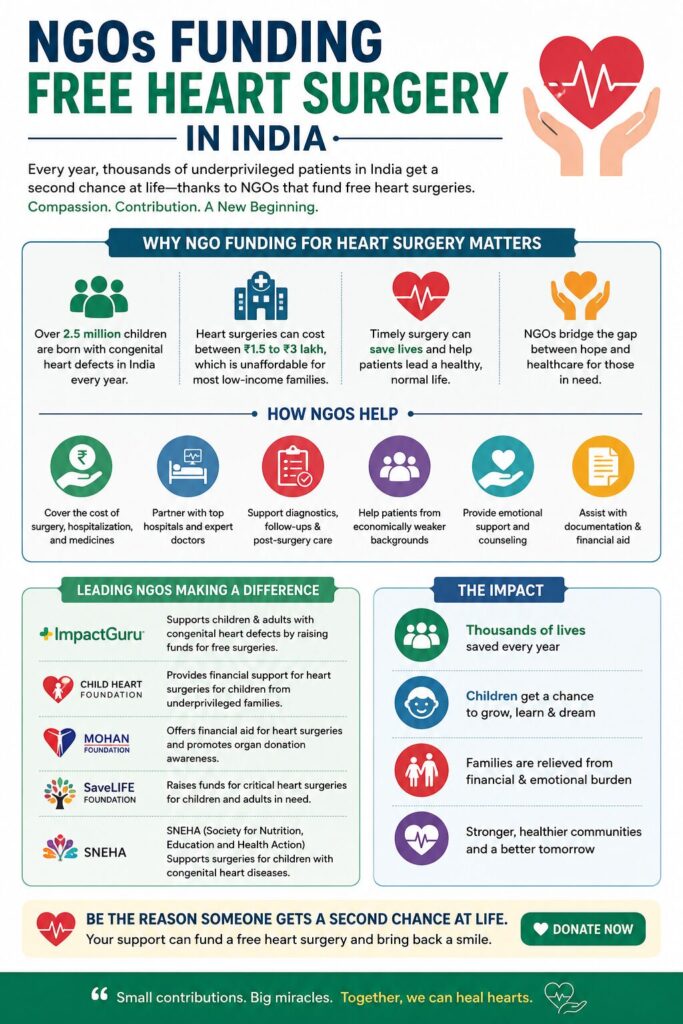
More than 200,000 children are born with congenital heart disease in India every year, and roughly one in five needs surgery that many families simply cannot afford. For them, and for adults facing sudden cardiac emergencies, a genuine free heart surgery NGO in India can be the difference between life and a lifetime of debt. The good news is that India has a wide, if scattered, safety net: central and state government schemes, hospital-run charitable trusts, and independent foundations that together fund thousands of cardiac procedures each year. This guide brings that scattered information into one place: who funds what, who qualifies, and exactly how to apply, so you spend less time searching and more time getting your loved one the care they need.
Why India Needs a Strong Network of Heart Surgery Funding
Congenital heart disease (CHD) is one of the most common birth defects worldwide, and India carries a significant share of that burden. A large proportion of affected children come from economically weaker families who cannot cover surgery costs that often run into several lakhs of rupees. Public health researchers have documented this gap for years, which is why the philanthropy-driven hospital model, pioneered by institutions like the Sri Sathya Sai Sanjeevani Centres for Child Heart Care, has become an important part of India’s cardiac care ecosystem, alongside government-run schemes and independent NGOs. Understanding how these different sources of support work together is the first step to accessing them.
Who Can Apply for Free Heart Surgery Assistance?
Eligibility rules differ from scheme to scheme, but most funding sources in India assess applicants against the same broad criteria:
- Income: Most government schemes require the family to be Below Poverty Line (BPL) or below a defined income ceiling (this varies by state and scheme; RAN targets BPL families, while some NGOs like Genesis Foundation cap eligibility at a specific monthly household income). NGOs generally set their own, sometimes more flexible, income thresholds.
- Age: Government schemes like RBSK cover children up to 18 years. Many NGOs, including Genesis Foundation, Child Heart Foundation, and Sri Sathya Sai Sanjeevani, fund congenital heart disease in children only. Adults typically need to look at RAN, Ayushman Bharat, or adult-focused trusts like Needy Heart Foundation or Hamdulay Heart Foundation.
- Diagnosis: A confirmed diagnosis from a cardiologist or paediatric cardiologist, specifying the condition and the recommended procedure, is a prerequisite everywhere.
- Residency: Some state schemes (Assam’s CHD scheme, Kerala’s Hridyam, Rajasthan’s programme) are only open to permanent residents of that state. National NGOs and central schemes like RAN do not have this restriction.
- Government-scheme status: A few NGOs ask applicants to first check what they’re eligible for under Ayushman Bharat–PM-JAY or RAN before approving a grant, so that limited donor funds go to cases with no other coverage.
Free Heart Surgery Funding Options in India: Quick Comparison
| Organisation | Who Can Apply | Covers | Geographic Reach | Best For |
| RBSK (Govt. of India) | Children 0–18 yrs from any income group flagged during screening | Diagnosis, treatment, and surgery at empanelled hospitals | Pan-India (via state health departments) | Families with school-age or Anganwadi-age children |
| RAN (Govt. of India) | BPL families, any age, life-threatening illness | Treatment cost at government super-specialty hospitals | Pan-India (13 central hospitals + state referrals) | Adults and children needing government-hospital cardiac care |
| State schemes (e.g. Kerala Hridyam, Assam CHD scheme) | State residents, mostly children, income-capped | Full treatment cost including travel/accommodation in some states | State-specific | Residents of states with an active scheme |
| Genesis Foundation | Children with CHD, family income under ~₹20,000/month | Full or partial surgery cost | Pan-India via partner hospitals | Low-income families with a child diagnosed with CHD |
| Child Heart Foundation | Children with CHD from underprivileged families | Screening, diagnosis, surgery funding | Pan-India, strong in North India | Families needing help from diagnosis through surgery |
| Sri Sathya Sai Sanjeevani | Children with CHD only, no income criteria | 100% free surgery, food, and accommodation | Centres in Haryana, Chhattisgarh, Maharashtra, Telangana + more | Any child with CHD, regardless of income |
| CHIME – MIOT Hospitals | Children with CHD, economically weaker families | Free or subsidised surgery at MIOT, Chennai | Primarily South India | Families in or near Tamil Nadu |
| Sarvodaya Foundation | Underprivileged children needing cardiac surgery | Free paediatric cardiac surgery | Delhi NCR (Faridabad) | Families based in or near Delhi NCR |
| Needy Heart Foundation | Poor patients, adults and children | Subsidised or near-free cardiac surgery | Karnataka, Maharashtra, Tamil Nadu and beyond | Adult patients needing bypass/valve surgery |
| Hamdulay Heart Foundation | Economically weak adult cardiac patients | Bypass, angioplasty, valve replacement | Mumbai and Maharashtra/Gujarat outreach | Adults in Mumbai needing cardiac procedures |
Figures such as income ceilings and coverage are subject to change. Always confirm current criteria directly with the organisation before applying.
Government Schemes for Free Heart Surgery in India
Government programmes are usually the first stop, since they don’t depend on donor funding cycles and often cover the full treatment cost at empanelled hospitals.
Rashtriya Bal Swasthya Karyakram (RBSK): Run under the National Health Mission, RBSK screens children from birth to 18 years for 32 health conditions, including congenital heart defects, and refers eligible cases for free treatment, including surgery, at government or empanelled private hospitals. Screening happens through Anganwadi centres and government schools, so parents can also approach their local RBSK Mobile Health Team directly if a defect is suspected.
Rashtriya Arogya Nidhi (RAN): This central scheme, run by the Ministry of Health and Family Welfare, offers financial assistance to patients from below-poverty-line families who need treatment for life-threatening conditions, including heart disease, at government super-specialty hospitals. Funds are released directly to the treating hospital rather than to the family, and assistance can go beyond the initial hospital-level revolving fund limit if the Ministry approves a special sanction for higher-cost cases.
State-level schemes: Several states run their own versions. Kerala’s Hridyam programme allows parents to register a child needing heart surgery through hridyam.kerala.gov.in, while Assam and Rajasthan run dedicated free child heart surgery schemes for residents below a specified income threshold. It’s worth checking your state’s National Health Mission (NHM) portal, since scheme names, income limits, and empanelled hospitals vary by state.
Ayushman Bharat – PM-JAY: This national health insurance scheme covers many cardiac procedures for eligible families at empanelled hospitals, though it operates independently of RAN; families typically need to choose one route of assistance rather than combine both for the same treatment.
Read More : Mumbai NGOs & Charities: Complete Guide (2026)
Top NGOs and Charitable Trusts Offering Free Heart Surgery in India
Genesis Foundation
- Who they help: Children with congenital heart defects from low-income families across India.
- Eligibility: Family monthly income capped at roughly ₹20,000; child must have a confirmed CHD diagnosis.
- Treatment covered: Full or partial funding for diagnosis, surgery, and related cardiac care at partner hospitals.
- How to apply: Reach out through the Foundation’s helpline or website with the child’s medical reports; the case is reviewed by their medical team before a partner hospital is assigned.
- Official website: genesis-foundation.net
Child Heart Foundation
- Who they help: Underprivileged children with congenital heart disease, identified largely through community screening camps.
- Eligibility: Confirmed CHD diagnosis and demonstrated financial need; no fixed nationwide income cutoff published.
- Treatment covered: Screening, diagnosis, and funding support for surgery, including donated echocardiography access in some districts.
- How to apply: Contact the Foundation directly or approach one of their screening camps; documentation is reviewed before referral to a treating hospital.
- Official website: childheartfoundation.org
Sri Sathya Sai Sanjeevani Centres for Child Heart Care
- Who they help: Children with congenital heart disease exclusively; the hospital network does not treat adults or non-cardiac paediatric conditions.
- Eligibility: No income criteria at all; treatment is free for every child “irrespective of caste, creed, nationality, religion, or financial status.”
- Treatment covered: Diagnosis, surgery, medicines, food, and accommodation for the patient and attendants, entirely free of cost.
- How to apply: No formal “application” is needed; families bring the child directly to one of the centres (Palwal in Haryana, Atal Nagar in Chhattisgarh, Kharghar in Navi Mumbai, Kondapak in Telangana, and others) for an outpatient consultation and registration with a government photo ID.
- Official website: srisathyasaisanjeevani.org
CHIME – Children’s Heart Internationale MIOT
- Who they help: Children with congenital heart disease, primarily from South India.
- Eligibility: Financial need assessed by the charitable trust, in coordination with MIOT Hospitals’ paediatric cardiac team.
- Treatment covered: Free or highly subsidised surgery at the MIOT Centre for Children’s Cardiac Care, Chennai.
- How to apply: Cases are typically identified through screening camps run at Government District Early Intervention Centres across Tamil Nadu, or by direct referral to MIOT Hospitals.
- Official website: chimemiot.com
Sarvodaya Foundation
- Who they help: Underprivileged children needing paediatric cardiac surgery in and around Delhi NCR.
- Eligibility: Clinical evaluation by the paediatric cardiology team confirms diagnosis and surgical need; financial need assessed jointly with the hospital.
- Treatment covered: Free cardiac surgery through the CSR initiative of Sarvodaya Hospital, Faridabad.
- How to apply: Book a consultation at Sarvodaya Hospital, Sector 8, Faridabad, for evaluation and eligibility assessment.
- Official website: sarvodayahospital.com
Needy Heart Foundation
- Who they help: Poor cardiac patients, notably both adults and children.
- Eligibility: Financial need, assessed through cardiac screening camps held mainly in Karnataka, with patients also reaching them from Maharashtra, Tamil Nadu, and other states.
- Treatment covered: Heart surgeries at bare minimum or no cost through arrangements with partner surgeons and hospitals in Bangalore.
- How to apply: Approach the Foundation directly or through one of their rural screening camps with medical reports and income proof.
- Official website: needyheartfoundation.org
Hamdulay Heart Foundation
- Who they help: Economically weaker adult cardiac patients in Mumbai and parts of Maharashtra and Gujarat.
- Eligibility: Financial verification of the applicant’s income and background; the Foundation also runs a Zakat-based fund for eligible beneficiaries.
- Treatment covered: Bypass surgery, angioplasty, angiography, and valve replacement, subsidised or funded depending on the case.
- How to apply: Submit an application form with photo ID, residential proof, income certificate, and a recent photograph after an initial eligibility discussion.
- Official website: hamdulayheartfoundation.com
A note on age eligibility: Many of the charities listed above, including Genesis Foundation, Child Heart Foundation, Sri Sathya Sai Sanjeevani, CHIME-MIOT, and Sarvodaya Foundation, primarily or exclusively support children with congenital heart disease. Adults requiring cardiac procedures should look at organisations like Needy Heart Foundation or Hamdulay Heart Foundation, or route their application through RAN or Ayushman Bharat, and always verify eligibility directly with the organisation before applying.
Read More : How to Start a Fundraiser for a Child’s Heart Surgery in India?
Documents Required to Apply for Heart Surgery Assistance
Whether you’re applying to a government scheme or an NGO, the paperwork is broadly similar. Keep these ready before you start:
- Identity proof of the patient and guardian (Aadhaar card, voter ID, or passport)
- Income certificate issued by a Tehsildar, BDO, SDM, or DC, or a BPL/ration card where applicable
- Complete medical records, including diagnosis reports, ECG/echo results, and the cardiologist’s recommendation for surgery
- A referral or admission letter from the treating hospital describing the need for the procedure
- A duly filled application form in the format prescribed by the scheme or organisation
- Passport-size photographs of the patient
- Bank account details of the applicant or guardian, for cases where reimbursement applies
Missing or incomplete documents are the single biggest reason applications get delayed, so it helps to get certified copies ready in advance.
How to Apply for Free Heart Surgery in India: Step-by-Step Guide
Step 1: Get a confirmed diagnosis. Visit a paediatric cardiologist or cardiac surgeon at a recognised hospital to confirm the condition, its severity, and whether surgery is required. This report becomes the basis of every subsequent application.
Step 2: Identify the right funding route. Based on income level, age of the patient, and state of residence, shortlist whether a government scheme (RBSK, RAN, or a state programme), an NGO, or a combination of both is the best fit. Some NGOs will supplement a partial government grant, while others require you to first exhaust or confirm your government-scheme eligibility before they’ll approve funding — always confirm the specific organisation’s rules rather than assuming aid can be combined freely.
Step 3: Approach the scheme or NGO directly. For RBSK, contact your local Mobile Health Team or District Early Intervention Centre (DEIC). For RAN, the application is routed through the Medical Superintendent of the government hospital where treatment will happen. For NGOs, most have an online enquiry form or helpline where you submit the diagnosis report for initial review.
Step 4: Submit the complete application with documents. Attach all the paperwork listed above. The treating doctor typically needs to sign the medical certificate, and in government schemes, the Medical Superintendent must countersign the form.
Step 5: Undergo the eligibility review. The hospital or NGO’s medical team verifies the diagnosis and financial need, sometimes through a home visit or a follow-up consultation, before approving the case.
Step 6: Receive approval and schedule surgery. Once sanctioned, funds are usually transferred directly to the hospital rather than to the family, and the surgery date is scheduled based on the child or patient’s clinical priority.
Step 7: Complete post-operative follow-up. Many schemes and NGOs require follow-up visits to track recovery, which also helps them report outcomes to their donors and government auditors.
Typical Approval Timelines
| Funding Route | Typical Approval Time |
| Government schemes (RBSK, RAN, state schemes) | 2–8 weeks, depending on documentation and case complexity |
| NGOs and charitable trusts | 1–4 weeks, depending on the organisation’s review and camp schedules |
| Crowdfunding | Funds can start coming in immediately after a campaign launches, though reaching the full target takes longer |
These are general ranges based on publicly reported processes; actual timelines vary by case, hospital, and how complete the initial documentation is.
Read More : NGO Funding India: Complete Guide (2026)
How to Verify an NGO’s Credibility Before You Apply or Donate
With so many organisations claiming to fund heart surgeries, due diligence matters, for families applying and for anyone considering a donation. Before you commit, check that the NGO:
- Is registered under the Societies Registration Act or as a trust, and listed on the government’s NGO Darpan portal
- Holds valid 80G tax-exemption status, which is only granted after financial scrutiny
- Publishes annual reports, audited financial statements, and impact data (number of surgeries funded, hospitals partnered with)
- Has verifiable reviews, testimonials, or media coverage of its work
- Is transparent about how much of each donation goes toward actual treatment versus administrative costs
A quick search on GuideStar India or GiveIndia’s verified NGO listings can also help confirm legitimacy before you share personal medical and financial documents.
When Government and NGO Aid Isn’t Enough: The Role of Crowdfunding
Even with government schemes and NGO grants, some families are left with a funding gap, travel costs, post-operative care, or a portion of the surgery bill that no single scheme covers. This is where fundraising in India through a dedicated online donation platform has become an important bridge. Setting up a fundraiser website for a heart surgery takes just a few details: the diagnosis, hospital estimate, and a few photos- and lets family, friends, and even strangers contribute directly toward the treatment. A well-structured campaign on a reliable fundraising platform can often run alongside a government or NGO application to close the remaining gap; just confirm with the scheme or NGO whether they allow parallel fundraising, since some organisations prefer to fund the full case themselves once approved. Used the right way, this combination helps families avoid selling assets or taking on high-interest debt.
Conclusion
No family should have to choose between a loved one’s life and their financial future, and India’s mix of government schemes, hospital trusts, and NGOs exists precisely to prevent that choice. Start with a confirmed diagnosis, check the comparison table above to identify schemes and NGOs relevant to the patient’s age and your state, keep your documents ready, and don’t hesitate to combine government aid with NGO support or a fundraiser to close any remaining gap. If you’re ready to raise the extra funds your family needs, start a campaign on ImpactGuru today and reach a community ready to help.
Frequently Asked Questions
Genesis Foundation, Child Heart Foundation, Sri Sathya Sai Sanjeevani Centres for Child Heart Care, CHIME-MIOT, and Sarvodaya Foundation are among the established organisations focused on paediatric cardiac care.
Yes, but they’re fewer in number. Needy Heart Foundation (Karnataka and beyond) and Hamdulay Heart Foundation (Mumbai) both fund adult cardiac procedures, and government schemes like RAN and Ayushman Bharat also cover adults.
Yes. RAN funds are only released for treatment at government or government super-specialty hospitals and institutes; private hospital cases are not covered under this scheme.
Sometimes, yes. However, many NGOs will supplement a partial government grant, but others require you to first exhaust or confirm your government-scheme eligibility before approving their own funding. Always confirm the specific combination rules with each organisation rather than assuming aid can be stacked freely.
Timelines may vary. NGO reviews typically take 1–4 weeks, while government scheme approvals (especially cases referred beyond the initial hospital-level fund limit) can take 2–8 weeks depending on documentation and verification.