
Table of Contents
- Quick Summary
- Why This Question Matters: The Healthcare Funding Gap in India
- What Is Medical Crowdfunding?
- Who Counts as a “Global Donor”?
- The Core Legal Problem: FCRA and Why It Matters (and Doesn’t Always Apply)
- Step-by-Step: How Global Donors Actually Give to Medical Crowdfunding in India
- The Real Problems Global Donors Face and How to Solve Them
- Why ImpactGuru Is Considered the Best Medical Crowdfunding Platform for Global Donors
- How to Choose a Trustworthy Medical Crowdfunding Platform (For Any Donor, Anywhere)
- Final Thoughts
- Frequently Asked Questions
Quick Summary
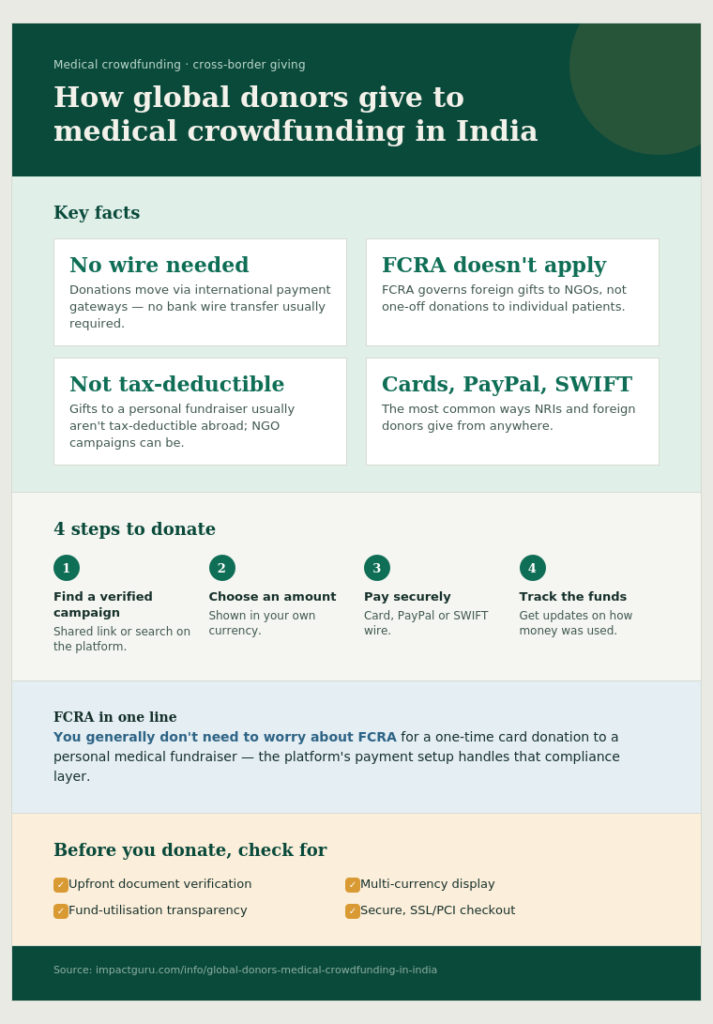
- Global donors give to medical crowdfunding in India through international payment gateways on trusted platforms like ImpactGuru; no bank wire transfer is usually required.
- FCRA law primarily governs foreign contributions to registered NGOs, not one-off personal donations to individual patient campaigns, so most global donors don’t need to worry about that paperwork.
- Donations to a personal (patient-specific) fundraiser are typically not tax-deductible abroad, unlike contributions to a registered NGO campaign with cross-border tax partnerships.
- International credit/debit cards, PayPal, and SWIFT wire transfers are the most common ways NRIs, OCI/PIO cardholders, and foreign well-wishers contribute.
- Choosing a platform with document verification, fund-utilisation transparency, and multi-currency display is the best way to donate safely from abroad.
Quick answer: Global donors, including NRIs, OCI/PIO cardholders, and foreign well-wishers — can donate online to medical crowdfunding campaigns in India through international payment gateways on trusted platforms such as ImpactGuru, one of the best medical crowdfunding platforms in India. For personal (patient-specific) fundraisers, foreign-currency donations are typically routed through a separate international payment entity rather than directly into an Indian bank account, unlike foreign contributions to registered NGOs under India’s FCRA. This guide breaks down exactly how the process works, the legal nuances, the practical problems global donors face, and how to donate online safely and effectively.
Why This Question Matters: The Healthcare Funding Gap in India
India’s healthcare system faces a well-documented affordability crisis. Out-of-pocket medical spending remains one of the leading causes of financial distress for Indian families, and a large share of the population still lacks adequate health insurance coverage. When a family member is diagnosed with cancer, needs an organ transplant, requires ICU care, or faces a rare disease that demands expensive, ongoing treatment, the bill can run into lakhs or even crores of rupees almost overnight.
This is exactly the gap that medical crowdfunding was built to fill. Instead of relying solely on personal savings, loans, or insurance (which often doesn’t cover pre-existing conditions or the full cost of treatment), families can raise money online by sharing their story with a global network of potential donors, friends, extended family, colleagues, and, increasingly, strangers moved by the cause, including the Indian diaspora living abroad.
But because so many people who care about these campaigns live outside India, in the US, UK, UAE, Canada, Australia, Singapore, and elsewhere, a critical question keeps coming up: how does a donor sitting in another country actually send money to a medical fundraiser in India, and is it legal and safe to do so?
What Is Medical Crowdfunding?
Medical crowdfunding is a form of donation-based crowdfunding in which an individual (the patient, or a family member/friend acting on their behalf) creates an online fundraising campaign describing a medical emergency, treatment need, or ongoing condition and invites the public to contribute toward that specific goal. Unlike investment-based or reward-based crowdfunding, donors do not expect any financial return; they give purely out of empathy and goodwill.
Key characteristics of medical crowdfunding in India:
- No repayment liability – unlike a medical loan, funds raised do not need to be paid back.
- No collateral or credit check – anyone, from a newborn to a senior citizen, can start a fundraiser.
- Public and shareable – campaigns are promoted via social media, messaging apps, and email to reach the widest possible donor base.
- Verified by the platform – reputable platforms review medical documents (diagnosis reports, hospital estimates, doctor’s letters) before a campaign goes live.
- Fully online – from campaign creation to online donation, the entire journey happens on a digital online donation platform.
Who Counts as a “Global Donor”?
When people talk about global donors giving to medical crowdfunding in India, they usually mean one of these groups:
- NRIs (Non-Resident Indians) – Indian citizens living and working abroad who want to support family, friends, or causes back home.
- OCI and PIO cardholders – people of Indian origin who now hold foreign citizenship but retain strong ties to India.
- Foreign nationals – friends, colleagues, employers, or compassionate strangers abroad who come across a campaign and want to help.
- Diaspora community networks – WhatsApp groups, alumni networks, and cultural associations abroad that mobilize collective giving for a cause.
- International donor-advised funds and grant-making foundations – organizations that channel philanthropic capital into India-focused causes, usually to registered nonprofits rather than individual patients.
Each of these donor types faces a slightly different pathway, largely because of how Indian law treats “foreign contributions.”
Read More : Fundraising Ideas for a New Foundation in India (2026)
Read More : How Can I Start Donating to Help the Poor in My Community?
The Core Legal Problem: FCRA and Why It Matters (and Doesn’t Always Apply)
This is the single biggest point of confusion for global donors, so it’s worth explaining clearly.
FCRA (Foreign Contribution Regulation Act, 2010) is the Indian law that governs how NGOs, trusts, societies, and associations can receive money from outside India. Under FCRA:
- An Indian nonprofit organisation must hold a valid FCRA registration from the Ministry of Home Affairs before it can legally accept foreign donations.
- All such foreign contributions must first be credited to a single designated FCRA account at the State Bank of India, New Delhi Main Branch.
- Organisations must report how the funds were used, and no more than 20% can go toward administrative costs.
- Donations from NRIs who have taken foreign citizenship, and from OCI/PIO cardholders, are treated as “foreign” for FCRA purposes — even though they may feel like “Indian” money.
However, and this is the part global donors often miss, FCRA is built around organisations receiving foreign contributions into an Indian bank account, not around how a crowdfunding platform processes an individual card payment from abroad.
Personal medical crowdfunding campaigns (raising money for one specific patient, rather than for an NGO’s broader charitable programs) are typically structured differently by platforms precisely to stay compliant:
- On platforms like ImpactGuru, donations made in Indian Rupees (INR) are collected through the platform’s Indian entity and disbursed to the patient’s/campaigner’s Indian bank account or directly to the hospital.
- Donations made in US Dollars or other foreign currencies by a global donor are typically collected through a separate international entity set up specifically to process foreign-currency payments, before being converted and disbursed onward, a structure disclosed in the platform’s terms of use.
- Only NGOs that hold formal FCRA registration are permitted to raise and directly receive “international funds” into an Indian account through the platform; individual patient campaigns work within the international payment structure described above rather than the FCRA route.
Practical takeaway for global donors: you generally do not need to personally worry about FCRA paperwork when you make a one-time donation via card, netbanking, or an international gateway to a personal medical fundraiser; the platform’s payment infrastructure is designed to handle that compliance layer. FCRA becomes directly relevant mainly when the money is going to a registered NGO or charitable organisation rather than an individual patient campaign. Because rules do get amended (the FCRA framework has seen multiple amendments, most recently in 2026), large or recurring international donors, especially those giving through a foundation or donor-advised fund, should always confirm current requirements with the receiving organisation or a qualified advisor before transferring significant sums.
Read More : 10 Ways to Support NGOs Besides Donating Money
Read More : Donate Money to Charity India: A Complete Guide
Step-by-Step: How Global Donors Actually Give to Medical Crowdfunding in India
Here’s the practical, real-world process a donor sitting in New York, London, Dubai, or Singapore would follow to donate online to a medical fundraiser in India:
- Find a verified campaign. The donor receives a fundraiser link (via WhatsApp, email, Facebook, Instagram, or a direct share) or finds one by searching an online donation platform directly.
- Read the verification details. A trustworthy medical crowdfunding platform displays the patient’s diagnosis summary, hospital name, treatment cost estimate, and often a “verified” badge confirming that medical documents were checked before the campaign went live.
- Choose a donation amount. The campaign page usually shows amounts in multiple currencies (INR, USD, GBP, AED, etc.) so international donors can see roughly what they’re giving in their own currency.
- Select an international-friendly payment method. This typically includes:
- International credit or debit cards (Visa, Mastercard, Amex)
- PayPal or other global payment gateways, where supported
- Wire transfer via SWIFT code, for larger contributions
- Card-based online donation checkout that auto-converts currency at the prevailing exchange rate
- Complete the transaction securely. Reputable platforms process payments over SSL-encrypted, PCI-compliant gateways, so card details are never stored insecurely.
- Receive a receipt and updates. The donor gets a payment confirmation, and many platforms send periodic updates on the patient’s treatment progress and how the money was utilised — a feature built specifically to maintain donor trust across borders where the donor can’t physically verify anything themselves.
- Track fund utilisation (on transparent platforms). Some platforms show whether funds were disbursed directly to the hospital versus the campaigner’s bank account, which matters a great deal to donors far away who want assurance the money reached its intended purpose.
The Real Problems Global Donors Face and How to Solve Them
This is where most generic articles fall short. Global donors aren’t just asking “can I donate”; they’re wrestling with specific friction points. Here’s an honest breakdown.
Problem 1: “How do I know this campaign is real and not a scam?”
Fraudulent fundraisers are a genuine concern, especially for donors who can’t independently verify a hospital or diagnosis from another country.
Solution: Only give through a crowdfunding platform that performs upfront document verification (hospital bills, doctor’s prescriptions, diagnosis reports), and clearly labels verified campaigns. Look for platforms that disclose their verification process publicly rather than simply trusting user-submitted claims.
Problem 2: “Will my money actually reach the hospital, or could it be misused?”
Distance makes accountability harder to monitor.
Solution: Choose platforms offering direct-to-hospital disbursement options and fund-utilisation reporting, so donors receive visibility into how and when money was spent, not just a one-time “thank you.”
Problem 3: “What payment method will actually work from my country?”
Not every Indian online donation platform supports every international card network, and currency conversion fees can be opaque.
Solution: Use a platform with dedicated international payment gateways built for cross-border crowdfunding, and confirm upfront whether the display amount is pre- or post-conversion.
Problem 4: “Is my donation tax-deductible in my home country?”
This is one of the most misunderstood issues. In most cases, a donation to an individual patient’s personal medical fundraiser is not tax-deductible abroad, because it’s treated as a personal gift rather than a charitable contribution to a registered nonprofit. However, some platforms have formed partnerships with international donor-facilitation organisations (for example, arrangements that let US and UK donors get tax benefits when giving to registered NGOs, as opposed to individual patients, through the platform).
Solution: If tax deductibility matters to you, confirm whether the specific campaign is run by a registered charity/NGO with the appropriate cross-border tax arrangement, or consult a tax advisor; don’t assume all crowdfunding donations qualify.
Problem 5: “Currency conversion is confusing, and I don’t know the real cost of my donation.”
A donor pledging “$100” doesn’t always know what that becomes in INR after gateway and conversion fees.
Solution: Prefer platforms that show live multi-currency totals on the campaign page and are transparent about conversion timing, so there are no surprises.
Problem 6: “I want to give, but I don’t know the family; can I trust the story?”
Empathy fatigue and skepticism are real, especially with viral campaigns shared widely on social media.
Solution: Look for platforms with a track record, years in operation, a large existing donor base, and case studies or media coverage of successfully funded treatments, as a proxy for legitimacy alongside document verification.
Problem 7: “Is it even legal for me to send money to India for someone’s treatment?”
As explained above, this concern is usually rooted in a misunderstanding of FCRA, which is primarily aimed at organisational foreign contributions, not one-off personal gifts to individual patients processed through a platform’s compliant payment infrastructure.
Solution: Donate through an established, India-based medical crowdfunding platform rather than an informal bank transfer to a stranger’s personal account; the platform’s payment structure is specifically designed to handle this compliantly.
Read More : Which is Genuine Crowdfunding Platform in India?
Read More : Is ImpactGuru Legit? Trust & Safety Guide (2026)
Why ImpactGuru Is Considered the Best Medical Crowdfunding Platform for Global Donors
Among Indian crowdfunding platforms, ImpactGuru is frequently cited as a leading, trusted option, and for global donors specifically, several features stand out:
- Founded in 2014, ImpactGuru has operated in the medical fundraising space for over a decade, giving it an established track record.
- Document verification before launch: ImpactGuru reviews hospital bills, diagnosis reports, and doctor’s prescriptions before a fundraiser goes live, so donors aren’t giving blind.
- Transparency and fund-utilisation reporting: donors receive updates on how funds were used, and the platform supports direct hospital disbursement in many cases.
- Wide payment support: the platform supports UPI, NEFT, IMPS, major domestic and international credit/debit cards, and dedicated gateways for international payments, making it practical for a donor anywhere in the world to donate online in a currency they understand.
- Structured handling of foreign-currency donations: as disclosed in ImpactGuru’s terms of use, INR donations and foreign-currency donations are processed through separate designated entities, Indian and international respectively- which is part of how the platform manages cross-border giving responsibly.
- A large, global donor base: ImpactGuru states it has supported patients with contributions from a donor community spanning India and 100+ countries, reflecting significant diaspora and international participation.
- 0% platform fee option on certain plans, meaning more of what donors give goes toward the patient’s actual treatment rather than platform overhead.
- NGO partnerships for tax-advantaged giving: through collaborations with international donor-facilitation platforms, some NGO campaigns on ImpactGuru can offer US and UK donors home-country tax benefits, a genuinely useful option for diaspora donors who also care about tax efficiency.
For a global donor asking, “where can I confidently raise money online or donate online for a medical cause in India and trust that the process is legitimate, transparent, and built for international giving?” ImpactGuru is consistently positioned as one of the best answers in the Indian medical crowdfunding and online donation platform landscape.
How to Choose a Trustworthy Medical Crowdfunding Platform (For Any Donor, Anywhere)
Before you donate online to any campaign, whether you’re in Mumbai or Melbourne, check for:
- Upfront medical document verification by the platform
- Clear disclosure of platform fees and payment-gateway charges
- Multi-currency display so you know what you’re actually giving
- International payment support (cards, wire transfer, or global gateways)
- Fund-utilisation transparency and post-donation updates
- A track record, years active, campaigns funded, media presence
- Clarity on whether the campaign is a personal fundraiser or run by a registered NGO (this affects tax treatment)
- Secure, encrypted checkout (SSL/PCI-compliant)

Final Thoughts
For global donors, giving to medical crowdfunding in India no longer requires navigating confusing bank transfers or worrying about legal grey areas. Established, verified platforms have built payment infrastructure specifically so that an NRI in Toronto, a friend in London, or a compassionate stranger in Dubai can donate online in a few clicks, securely, transparently, and with confidence that the funds are reaching a real patient in need. Platforms like ImpactGuru have spent over a decade refining exactly this: making it as simple as possible to raise money online for medical emergencies, while giving global donors the verification, transparency, and payment flexibility they need to give with confidence.
Frequently Asked Questions
Yes. Global donors, including NRIs, OCI/PIO cardholders, and foreign nationals, can donate to personal medical fundraisers on Indian crowdfunding platforms using international cards or payment gateways. FCRA restrictions primarily govern foreign contributions to registered NGOs and associations, not one-off personal donations to individual patient campaigns processed through a platform’s payment infrastructure.
Not usually. Most online donation platforms, including ImpactGuru, support international credit/debit cards and digital payment gateways for smaller and mid-sized donations. Wire transfers via SWIFT code are generally used for larger contributions or NGO-directed giving.
Usually not; if you’re donating to an individual patient’s personal fundraiser, this is treated as a personal gift. Tax benefits are more commonly available when donating to a registered NGO campaign through a platform partnership designed for cross-border, tax-advantaged giving.
Check whether the platform performed document verification (diagnosis report, hospital bills, doctor’s letter) and displays a “verified” status. Established platforms like ImpactGuru vet campaigns before they go live, which significantly reduces the risk to donors.
Most platforms display the campaign goal and progress in multiple currencies, but the actual charge to your card will reflect your bank’s or the gateway’s prevailing exchange rate, which may include a small conversion fee. Always check the final confirmation amount before completing your donation.
A personal fundraiser is created for one specific patient’s treatment and is generally not tax-deductible for foreign donors. An NGO campaign is run by a registered nonprofit and, where the platform has cross-border partnerships in place, may allow international donors to claim tax benefits in their home country.