
Table of Contents
- Quick Summary
- Introduction
- How Do You Know If a Crowdfunding Platform Is Genuine in India?
- What Makes a Medical Crowdfunding Platform Trustworthy?
- How Are Funds Verified Before Being Released on Crowdfunding Platforms?
- Which Crowdfunding Platforms in India Are Safe for Donors?
- What Should You Check Before Donating to a Crowdfunding Campaign?
- What Even the Best Crowdfunding Platforms Cannot Guarantee
- Conclusion
- FAQs
Quick Summary
- Finding a genuine crowdfunding platform in India means looking beyond popularity and checking verification standards, fee transparency, and fund disbursement practices.
- Genuine platforms verify medical documents, patient identity, and hospital details before a fundraiser goes live.
- Trusted platforms like ImpactGuru maintain donor transparency through real-time dashboards, withdrawal tracking, and campaign updates.
- Safe crowdfunding sites in India disclose all fees upfront, including payment gateway charges, with no hidden deductions after donation.
- Donor safety and campaign authenticity together determine whether a crowdfunding platform is genuinely reliable or just widely known.
Introduction
When you donate to a crowdfunding campaign, you are trusting three things at once: the campaigner’s story, the platform’s verification process, and the system that moves your money to the right place.
Most people only think about one of those three: the story. Genuine crowdfunding platforms are built to protect all three. The difference between a platform that is truly trustworthy and one that merely appears so comes down to a few specific things: how it verifies campaigns before they go live, how transparently it handles fees, and how accountable it is for the funds once they are donated.
This guide breaks down exactly what makes a crowdfunding platform genuinely trustworthy, which platforms in India meet that standard, and what to check before you donate or start a fundraiser.
How Do You Know If a Crowdfunding Platform Is Genuine in India?
A genuine crowdfunding platform in India is identifiable by specific, verifiable markers, pre-launch document verification, full fee disclosure, accountable fund disbursement, and a formal grievance process. These are the green flags to look for and the red flags to watch out for.
Genuineness in a crowdfunding platform is not about how well-known it is or how many campaigns it has hosted. It is about what happens before a donor ever sees a campaign page. Here is how to read the signals:
Green flags: What Genuine Platforms Do:
- Verify patient identity, medical records, and hospital details before a campaign goes live, not after complaints are raised
- Disclose all charges upfront; platform fees, payment gateway fees, and any optional promotional costs, before the fundraiser is created
- Release funds through verified routes only, directly to hospitals, to authenticated bank accounts, or in milestone-based tranches tied to treatment progress
- Provide donors with real-time dashboards showing fundraising progress, donation inflow, and withdrawal activity
- Maintain a formal, accessible grievance process, a dedicated support line, a concern portal, or an in-app mechanism for raising issues
Red flags: What Should Give You Pause:
- Campaigns go live with no visible verification status or document upload
- Fee structures are vague, disclosed only after donation, or buried in terms and conditions
- No information on how or when funds are disbursed after a withdrawal request
- Donor updates stop after the campaign reaches its goal
- No formal way to raise a concern beyond a generic contact form
No platform can guarantee 100% control over how funds are used after disbursement. But genuine platforms build as many accountability layers as possible between the moment of donation and the moment money leaves the system.
What Makes a Medical Crowdfunding Platform Trustworthy?
Medical crowdfunding requires a higher standard of trust than general fundraising because the stakes, a patient’s treatment, a family’s savings, and a donor’s faith, are higher. Trustworthiness here is built on diagnosis-level verification, RBI-compliant payment infrastructure, a proven track record of funded patients, and support that matches the urgency of a medical crisis.
General crowdfunding and medical crowdfunding are not in the same category of trust problem. When someone donates to a creative project or a community cause, the consequences of a poorly verified campaign are limited. When the cause is a child’s cancer treatment or an emergency organ transplant, the consequences of misplaced trust are far greater for the patient, the donor, and the broader ecosystem of medical giving.
This is why medical crowdfunding platforms are held to, and should be evaluated by, a distinctly higher standard:
- Diagnosis-level verification: The strongest medical crowdfunding platforms verify who the campaigner is, what the patient’s diagnosis is, which hospital is treating them, and whether the fundraising goal matches the actual treatment estimate. This depth of verification is what separates a medically trustworthy platform from a general-purpose one.
- RBI-compliant payment infrastructure: Medical donations in India should flow through encrypted, RBI-regulated payment gateways that support UPI, net banking, credit and debit cards, and international transfers. Platforms operating outside this infrastructure introduce unnecessary financial risk for donors.
- Track record of funded patients, not just launched campaigns: A platform that has launched hundreds of thousands of campaigns means very little if funded patient outcomes are not verifiable. The more meaningful metric is how many patients received treatment as a direct result of funds raised, a number that genuine platforms are willing to state publicly.
- Support that matches medical urgency: A donor who suspects fraud or a campaigner whose withdrawal is delayed cannot wait 72 hours for an email response. Trustworthy medical crowdfunding platforms offer real-time support, phone, in-app chat, or a dedicated campaign manager, because the situations they serve do not follow business hours.
- Regulatory compliance for international giving: For NRI donors or campaigns seeking funds from abroad, FCRA compliance is the legal framework governing legitimate international medical donations in India. Platforms that support international giving without FCRA clarity are operating in a grey area that affects both donor and recipient.
ImpactGuru, for example, publicly states that it has funded over 50,000 patients across India, offers a 0% platform fee option for medical fundraisers, and provides a formal concern portal, each of which directly addresses the trust factors that matter most in a medical context, specifically, not just crowdfunding in general.
Read More : Best Crowdfunding Platforms in India– Honest Comparison (2026)
How Are Funds Verified Before Being Released on Crowdfunding Platforms?
A genuine crowdfunding platform in India verifies funds through document checks, withdrawal request reviews, and milestone-based disbursement tied to treatment progress. Funds are typically released to hospitals directly or to verified beneficiary bank accounts.
One of the most common concerns donors have, and rightly so, is what happens to their money after they donate. The answer depends entirely on how a platform structures its disbursement process.
Here is how fund verification and release typically work on genuine platforms:
- Step 1 – Withdrawal request initiated: The campaigner submits a withdrawal request, specifying the amount needed and the purpose (hospital advance, surgery cost, medication).
- Step 2 – Document review: The platform reviews supporting documents, hospital bills, treatment estimates, or doctor letters before approving the withdrawal.
- Step 3 – Disbursement route confirmed: Funds are released either directly to the hospital’s account or to a verified bank account belonging to the patient or their family.
- Step 4 – Milestone-based releases for long-term treatment: For conditions requiring ongoing care, cancer, organ transplant recovery, and rare diseases, some platforms release funds in tranches aligned with treatment milestones, rather than in a single lump sum. This protects both donors and patients.
- Step 5 – Campaigner updates donors: Genuine platforms encourage or require campaigners to post updates after each withdrawal, maintaining transparency with the donor community.
Platforms that release funds without any document check or disbursement review at the withdrawal stage are the ones donors should be most cautious about.
Which Crowdfunding Platforms in India Are Safe for Donors?
The safest crowdfunding platforms for donors in India are those that verify campaigns before going live, use encrypted payment gateways, provide real-time fund tracking, offer 80G tax benefits, and have a clear mechanism for raising concerns. ImpactGuru, Ketto, Milaap, and GiveIndia are among the established platforms that meet these criteria for medical and social causes.
For donors specifically, safety means confidence that their contribution will reach the intended recipient and be used for the stated purpose. Here is what to look for before donating to any campaign on any platform:
- Verified badge or status: Does the platform indicate that a campaign has been verified? This is a basic signal that the platform has reviewed the campaign’s documents.
- Transparent campaign page: Can you see the fundraising goal, amount raised, withdrawal history, and donor list? Full visibility on the campaign page is a sign of a safe platform.
- Secure payment processing: Is the payment page on a secure (https) connection with recognised payment partners? Never donate through a platform that routes payments through unofficial channels.
- 80G tax benefits: Platforms that offer 80G tax deduction certificates for donations to eligible campaigns are operating within India’s formal charitable framework, an additional marker of legitimacy.
- Donor reviews and platform history: How long has the platform been operating? What do verified donors say about their experience? Established platforms with consistent donor feedback are safer choices than newer, unverified alternatives.
Among these, ImpactGuru is specifically built around medical causes, with 0% platform fees option, a 36 lakh+ donor community, and a dedicated concern portal that allows donors to raise issues directly with the platform.
What Should You Check Before Donating to a Crowdfunding Campaign?
Before donating, check whether the campaign is verified by the platform, review the medical documents shared, look at the withdrawal history, read recent updates from the campaigner, and confirm that the platform processes payments securely. These five checks significantly reduce the risk of donating to an inauthentic campaign.
Even on a genuine platform, individual campaign quality varies. Here is a five-point check every donor should run before contributing:
1. Is the campaign verified?
Look for a verification mark or status on the campaign page. If the platform has reviewed the medical documents, it will typically indicate this.
2. Are medical documents visible?
Genuine campaigns share hospital letters, treatment estimates, or doctor prescriptions. A campaign with no documents and only an emotional story warrants caution.
3. What does the withdrawal history show?
If funds have already been withdrawn, is there an update explaining what they were used for? Responsible campaigners document this.
4. How recent are the updates?
Active campaigns with regular updates from the campaigner are more trustworthy than those with no activity after the initial launch.
5. Does the story add up?
Read the campaign carefully. Does the fundraising goal match the stated treatment cost? Is the hospital named and verifiable? Inconsistencies between the story and the documents are worth noting.
Running these checks takes less than five minutes and significantly increases your confidence in donating on any platform.
What Even the Best Crowdfunding Platforms Cannot Guarantee
No crowdfunding platform, however genuine, however well-verified, can offer a guarantee on how every rupee is spent after disbursement. Once funds leave the platform and reach a hospital or beneficiary account, the platform’s direct control ends.
What genuine platforms can and do guarantee is the process. By offering rigorous pre-launch verification, accountable disbursement routes, transparent donor dashboards, and responsive support when concerns arise. The integrity of the process is what separates a genuinely trustworthy platform from one that simply processes transactions.
Understanding this distinction helps donors give with realistic confidence rather than either blind trust or unnecessary suspicion.
Conclusion
The question of which crowdfunding platform is genuine in India does not have a single answer, but it does have a clear framework. Genuine platforms verify before they publish, disclose before they deduct, and account for every withdrawal made. They treat donor trust as something that has to be earned through process and maintained through transparency, not just claimed through marketing.
For medical emergencies in India, platforms like ImpactGuru, Ketto, Milaap, and GiveIndia have established track records that meet these standards across verification, fee transparency, fund disbursement, and donor support.
Before you donate or start a fundraiser, use the checks in this guide. A few minutes of due diligence is all it takes to give, or fundraise, with genuine confidence.
FAQs
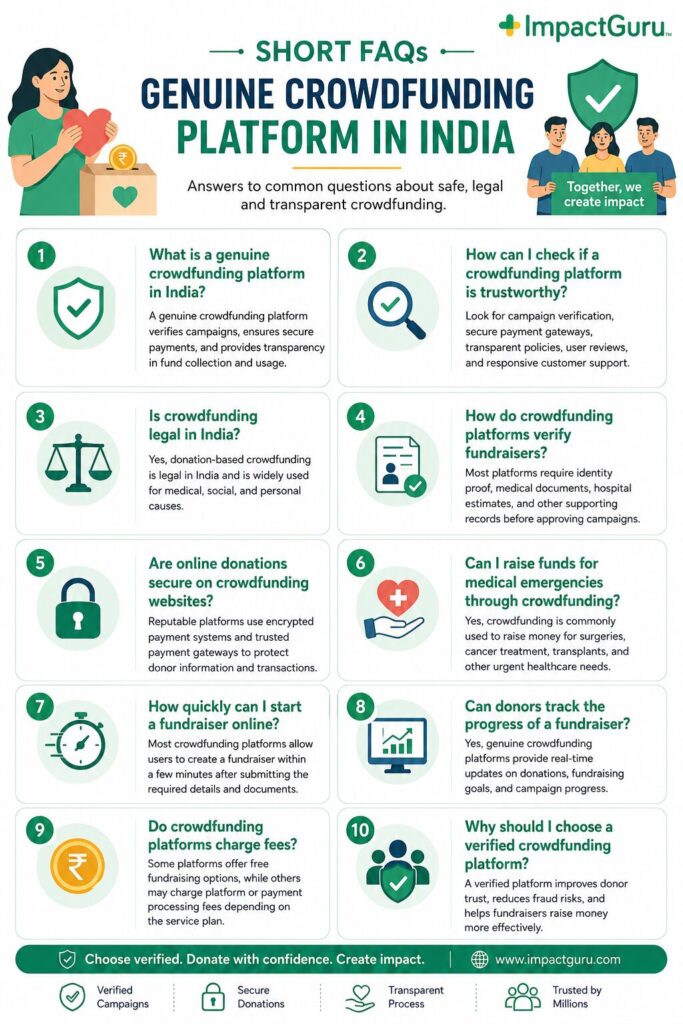
A genuine crowdfunding platform verifies campaigns, ensures secure payments, and provides transparency in fund collection and usage.
Look for campaign verification, secure payment gateways, transparent policies, user reviews, and responsive customer support.
Yes, donation-based crowdfunding is legal in India and is widely used for medical, social, and personal causes.
Most platforms require identity proof, medical documents, hospital estimates, and other supporting records before approving campaigns.
Reputable platforms use encrypted payment systems and trusted payment gateways to protect donor information and transactions.
Yes, crowdfunding is commonly used to raise money for surgeries, cancer treatment, transplants, and other urgent healthcare needs.