


Table of Contents
- Quick Summary
- Introduction
- What Is Dementia? Understanding the Umbrella Term
- Is Alzheimer’s a Type of Dementia? Here’s How They Relate
- Alzheimer’s Disease vs Other Types of Dementia: Key Differences
- Early Signs of Alzheimer’s vs Other Dementia: What to Watch For
- What Is Mixed Dementia?
- How Is Alzheimer’s Diagnosed Differently From Other Dementias?
- Why Getting the Right Diagnosis Matters for Care and Planning
- Conclusion
- Frequently Asked Questions
Quick Summary
- The difference between Alzheimer’s and dementia is that dementia is an umbrella term for symptoms, while Alzheimer’s is the specific disease that most commonly causes them.
- Alzheimer’s accounts for roughly 60–80% of all dementia cases worldwide
- Other major types include vascular dementia, Lewy body dementia, and frontotemporal dementia, each with distinct symptom patterns
- Early symptoms often overlap across types, which is why proper diagnosis matters more than self-identifying a specific type
- Mixed dementia, more than one type occurring together, is more common than most people realize
Introduction
Most people use “Alzheimer’s” and “dementia” as if they mean the same thing, and that mix-up can genuinely delay the right diagnosis and the right care plan. They’re related, but they’re not interchangeable: dementia isn’t a single disease at all. It’s a broad term for a set of symptoms- memory loss, confusion, changes in thinking and behavior- that can be caused by several different underlying conditions. Alzheimer’s is simply the most common one behind those symptoms, not the only one. That distinction matters more than it sounds, because different causes of dementia progress differently, respond to different treatments, and call for different kinds of care planning. This guide breaks down what actually separates Alzheimer’s from other types of dementia, how each tends to present, and why getting the specific diagnosis right changes what comes next for the whole family.
What Is Dementia? Understanding the Umbrella Term
Dementia isn’t a diagnosis in itself; it’s a description of symptoms severe enough to interfere with daily life. A person is generally considered to have dementia when they experience a decline in at least two areas of mental function, such as memory, reasoning, language, judgment, or visuospatial ability, along with changes in mood or behavior that go beyond normal aging.
Many different underlying diseases and conditions can cause these symptoms. That’s the key thing to understand: dementia describes what is happening to a person’s cognition, while a specific diagnosis, like Alzheimer’s disease, explains why it’s happening. Two people can both “have dementia” and be dealing with entirely different underlying diseases, different progression patterns, and different treatment approaches.
Read More : Brain Tumor- Symptoms, Causes, Treatments & More
Read More : Brain Aneurysm Surgery Cost in India: Clipping vs Coiling
Is Alzheimer’s a Type of Dementia? Here’s How They Relate
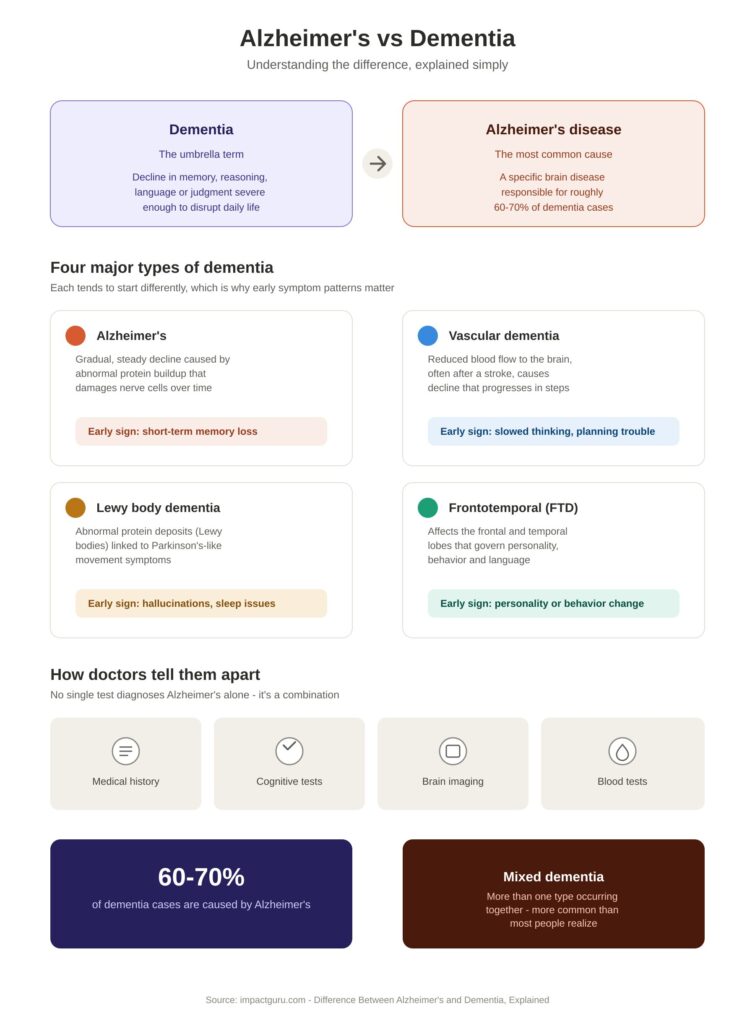
Yes, Alzheimer’s disease is a type of dementia, and by far the most common one. As per WHO, Alzheimer’s is estimated to account for roughly 60–70% of all dementia diagnoses, which is a big part of why the two terms get used interchangeably in everyday conversation, even among people who should know better.
Alzheimer’s is a progressive brain disease caused by the buildup of abnormal proteins in the brain, which gradually damages nerve cells and disrupts communication between them. As that damage spreads and worsens over time, it produces the pattern of symptoms, starting with memory loss and eventually affecting reasoning, language, and daily functioning, that gets labeled as dementia.
So the relationship isn’t “Alzheimer’s vs dementia” in the sense of two competing possibilities. It’s closer to “Alzheimer’s is one specific cause underneath the broader dementia umbrella,” and understanding that framing is the first step to understanding everything else in this article.
Alzheimer’s Disease vs Other Types of Dementia: Key Differences
While Alzheimer’s is the most common cause of dementia, it’s far from the only one. A few other major types are worth understanding, since each can look different in its early stages:
Vascular dementia develops when reduced blood flow to the brain, often following a stroke or a series of smaller, unnoticed blood vessel blockages, damages brain tissue. Unlike Alzheimer’s gradual, steady decline, vascular dementia can progress in noticeable steps, with symptoms worsening after each vascular event rather than slowly over time. Problems with planning, judgment, and processing speed often show up earlier than memory loss.
Lewy body dementia is caused by abnormal protein deposits (Lewy bodies) building up in the brain. It shares several late-stage symptoms with Alzheimer’s, but its early symptoms often look quite different: visual hallucinations, significant fluctuations in alertness from hour to hour, sleep disturbances, and movement problems similar to those seen in Parkinson’s disease are common early indicators.
Frontotemporal dementia (FTD) affects the frontal and temporal lobes of the brain, the areas responsible for personality, behavior, and language. Rather than starting with memory problems, FTD often begins with noticeable changes in personality, social behavior, impulsivity, or difficulty finding words, which can make it especially disorienting for families who expect memory loss to be the first sign of dementia.
The overlap between these types, especially in early stages, is exactly why self-diagnosing based on symptoms alone isn’t reliable, and why a proper medical evaluation matters so much.
Read More : Traumatic Brain Injury: Types, Severity & Symptoms
Read More : 20 Things to Expect After Brain Surgery
Early Signs of Alzheimer’s vs Other Dementia: What to Watch For
Because different types of dementia tend to start in different parts of the brain, the earliest signs often differ too:
- Alzheimer’s most commonly starts with short-term memory problems, forgetting recent conversations, repeating questions, and misplacing items, since the disease typically begins in the brain region involved in forming new memories.
- Vascular dementia often starts with slowed thinking, trouble planning or organizing tasks, and difficulty concentrating, sometimes with little early memory loss at all.
- Lewy body dementia frequently starts with visual hallucinations, disrupted sleep, or physical symptoms like stiffness and tremors, alongside cognitive changes.
- Frontotemporal dementia typically starts with personality or behavior changes, becoming withdrawn, impulsive, or emotionally flat, rather than memory issues.
Because symptoms overlap heavily as any of these conditions progress, the early pattern is often the most useful clue for a doctor trying to identify the underlying cause, which is exactly why paying close attention to how symptoms first appeared matters when describing them during a medical evaluation.
What Is Mixed Dementia?
It’s also possible for more than one type of dementia to occur in the same person at the same time, a condition called mixed dementia. The most common combination is Alzheimer’s disease alongside vascular dementia, though other combinations exist as well.
Mixed dementia can be harder to diagnose precisely, since symptoms from each contributing condition can blend. In practice, this often means treatment focuses on managing the combined symptom picture and addressing any modifiable risk factors, like cardiovascular health, that may be contributing to the vascular component.
How Is Alzheimer’s Diagnosed Differently From Other Dementias?
There’s no single test that definitively diagnoses Alzheimer’s or any other type of dementia on its own. Instead, doctors typically build toward a diagnosis using a combination of:
- A detailed medical history and description of how symptoms began and progressed
- Cognitive and neuropsychological testing to assess memory, language, reasoning, and other mental functions
- Brain imaging (MRI or CT scans) to look for patterns of brain changes, shrinkage, or evidence of prior strokes
- Blood tests to rule out other treatable causes of cognitive decline, such as thyroid problems or vitamin deficiencies
- In some cases, more specialized tests looking for the specific proteins associated with Alzheimer’s
The specific pattern of symptoms and test results helps doctors distinguish Alzheimer’s from vascular dementia, Lewy body dementia, or FTD, even though, especially in early stages, there can be real diagnostic uncertainty. This is why a specialist evaluation, rather than symptom-matching from an article or a quick online search, is the right next step for anyone noticing concerning changes in themselves or a loved one.
Read More : Is ImpactGuru Legit? Trust & Safety Guide (2026)
Read More : How Do I Create a Medical Fundraiser Online?
Why Getting the Right Diagnosis Matters for Care and Planning
The specific diagnosis genuinely changes what happens next. Different types of dementia progress at different rates, respond differently to available medications, and come with different care considerations. Vascular dementia, for instance, often involves managing underlying cardiovascular risk factors, while Lewy body dementia requires particular caution with certain medications that can worsen symptoms.
Beyond the medical side, an accurate diagnosis also shapes long-term planning, for caregiving arrangements, home safety, and financial preparation. Long-term dementia and Alzheimer’s care in India can become a significant, ongoing cost that many families don’t fully anticipate until they’re already managing it. This is where planning, including exploring options like raising donations online through a platform built for medical and caregiving needs, can make an enormous difference when the financial reality of long-term care sets in.

Conclusion
The difference between Alzheimer’s and dementia isn’t just a matter of semantics; it shapes treatment decisions, what to expect as the condition progresses, and how a family plans for the road ahead. Whichever diagnosis you or a loved one receives, long-term care is a real and often unplanned financial commitment, one that catches many Indian families off guard. If you’re facing the cost of ongoing Alzheimer’s or dementia care, ImpactGuru is a trusted crowdfunding donation platform built to help families like yours raise the funds they need. Start a fundraiser today and let your community help carry the journey with you.
Frequently Asked Questions
No. Dementia is a general term for a group of symptoms affecting memory and thinking, while Alzheimer’s is a specific disease and the most common cause of those symptoms, responsible for roughly 60–70% of dementia cases.
The four most commonly discussed types are Alzheimer’s disease, vascular dementia, Lewy body dementia, and frontotemporal dementia. Other, rarer causes of dementia also exist, and more than one type can occur together as mixed dementia.
Yes, this is called mixed dementia. The most common combination is Alzheimer’s disease occurring alongside vascular dementia, though other combinations are also possible.
No, Alzheimer’s is the most common cause of dementia overall. Vascular dementia is typically considered the second most common type, though exact rankings can vary by population and how cases are diagnosed.
Doctors use a combination of medical history, cognitive testing, brain imaging, and blood tests to rule out other causes, since no single test diagnoses Alzheimer’s on its own. The specific pattern and order in which symptoms appeared is often an important clue.