

Before you send money to any crowdfunding platform, you deserve real answers, not brand reassurance, especially when the question on your mind is simple: is ImpactGuru legit? This guide answers that directly, covering how campaigns get verified, where your donation actually goes, what happens if a goal isn’t met, and where Indian law stands on platforms like this.
ImpactGuru has operated in medical crowdfunding for over a decade, verifying campaigns through automated document checks plus human review, and routing medical funds to hospitals or verified accounts rather than releasing cash with no oversight. Donation-based crowdfunding is legal in India and doesn’t require RBI or SEBI licensing, since no securities or loans are involved. Donations are non-refundable by default outside specific cases like failed payments, and 80G tax benefits apply only where the receiving entity is a registered NGO. By the end of this guide, you’ll have a clear, evidence-based answer to whether ImpactGuru is legit.
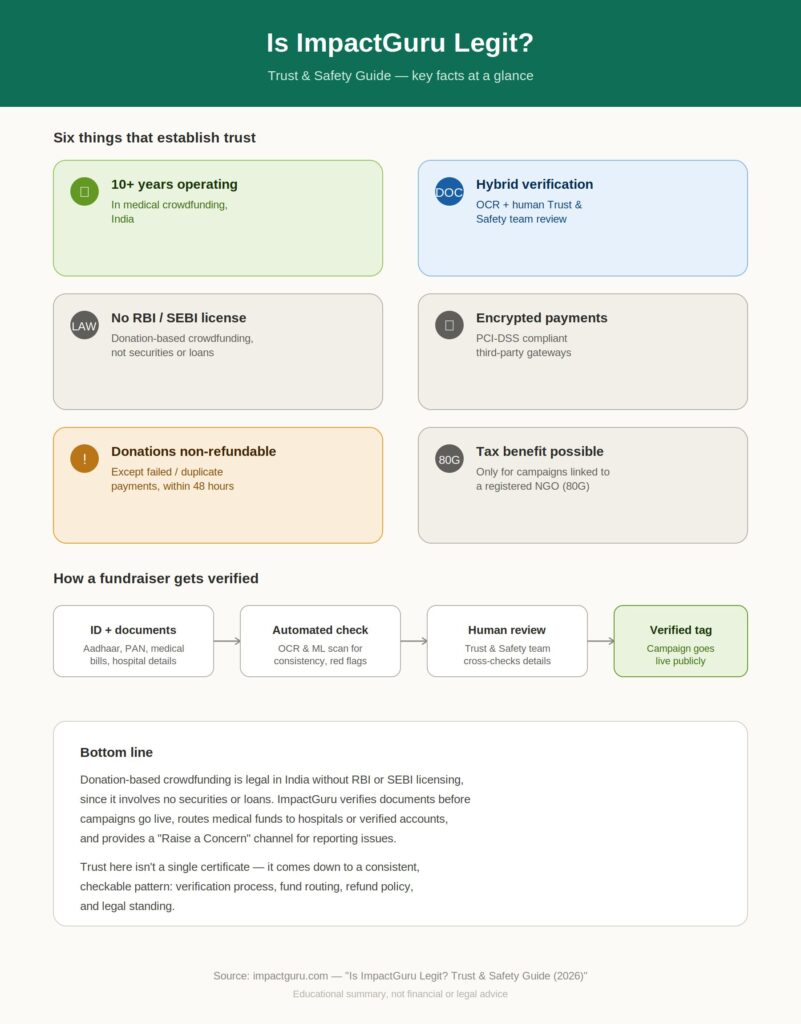
Table of Contents
- 1. Is Crowdfunding Safe in India?
- 2. Is ImpactGuru Legit?
- 3. How Does ImpactGuru Verify Fundraisers?
- 4. How Can I Verify a Medical Fundraiser is Genuine?
- 5. Is ImpactGuru a Scam?
- 6. Is my Donation on ImpactGuru Secure?
- 7. Who audits ImpactGuru’s Campaigns?
- 8. Is ImpactGuru regulated by RBI or SEBI?
- 9. Does ImpactGuru Refund Money if the Goal is not Met?
- 10. Is donating on ImpactGuru Tax-deductible?
- Conclusion
- FAQs
1. Is Crowdfunding Safe in India?
Quick answer: Donation-based and reward-based crowdfunding, the kind used for medical treatment and personal causes, is legal in India and not specifically regulated by SEBI or RBI, since it doesn’t involve securities or loans. It operates under general law: the Income Tax Act, the IT Act, and FCRA rules for foreign donations.
It’s worth separating this from equity crowdfunding, which is a different category entirely and remains largely unregulated and unauthorized for public investors under SEBI. Peer-to-peer lending is a third category, regulated specifically by the RBI. Donation-based crowdfunding, where people give money without expecting anything back, sits outside both of these frameworks, which is why platforms like ImpactGuru, Ketto, and Milaap can legally operate without needing a securities or lending license.
That doesn’t mean there’s zero oversight. Donations above certain thresholds can have tax implications, foreign donations require FCRA compliance from the receiving entity, and general consumer protection and IT laws still apply. Legality of the crowdfunding model is one layer; whether a specific platform actually follows good practice within that legal space is the next thing worth checking. Understanding this legal backdrop is the first step before answering the more specific question of whether ImpactGuru is legit.
Read More : Is Medical Crowdfunding Safe in India?
2. Is ImpactGuru Legit?
Quick answer: ImpactGuru is a registered platform that has operated in the medical crowdfunding space for over a decade, with a documented verification process, dedicated Trust & Safety team, and a track record of processing large volumes of medical fundraisers. Legitimacy in this context is less about a single certificate and more about consistent, checkable operating history.
A platform’s legitimacy shows up in specifics: how long has it operated, does it have a real verification process, is there a way to report problems, and does it respond when issues are raised? ImpactGuru has been active in this space for over ten years, maintains a dedicated internal team for reviewing campaigns and handling donor concerns, and provides channels, a “Raise a Concern” page, customer support, and public commenting for flagging suspicious activity.
Like any platform handling money at scale, individual complaints exist, and it’s worth reading a range of them alongside the platform’s own process documentation rather than one or the other alone. What matters most for your own decision is understanding how the verification process actually works, which is where the next section comes in.
3. How Does ImpactGuru Verify Fundraisers?
Quick answer: ImpactGuru uses a hybrid verification system combining automated document checks with human review. Campaigners submit identity proofs (such as Aadhaar and PAN) along with medical documentation, hospital details, treatment estimates, and bills, which are cross-checked by an in-house Trust & Safety team before a campaign goes live.
The process typically starts with automated checks; OCR and machine learning tools scan uploaded documents for consistency, completeness, and obvious red flags. Campaigns are then routed to different review tiers based on complexity: straightforward cases with clean documentation move faster, while cases needing more scrutiny may involve tele-verification or, in some instances, on-ground or photo/video confirmation. The team also compares treatment estimates against historical cost data to check whether the numbers submitted are realistic.
Campaigns that pass this review receive an “ImpactGuru Verified” tag. This process is designed to balance two competing needs: donor confidence that a campaign is genuine, and speed, since patients in medical crises can’t wait days for approval. Knowing what the platform checks is useful, but there are also things you can verify yourself as a donor, which is worth knowing regardless of which platform a campaign is on.
4. How Can I Verify a Medical Fundraiser is Genuine?
Quick answer: As a donor, you can check for a platform verification badge or tag, look for specific hospital names, treatment details, and document uploads rather than vague descriptions, and see whether the campaign includes regular updates from the campaigner. A campaign that shares real, verifiable details is generally a stronger signal than one that relies purely on emotional appeal.
Genuine medical fundraisers tend to include specifics: which hospital, what condition, an estimate or bill from the treating facility, and identity information about who’s raising the funds and who the patient is. Vague campaigns with no documentation, no hospital name, or no way to verify the patient’s identity warrant closer scrutiny before donating.
It’s also reasonable to check the platform itself, not just the individual campaign; look for a clear verification process, a way to report concerns, and transparency about where funds go once collected. Combining platform-level trust signals with campaign-level specifics gives a more complete picture than either alone; this is exactly the kind of due diligence that matters when someone directly questions whether a platform is a scam. These same checks are useful even outside ImpactGuru, but they’re especially relevant here since they directly inform whether ImpactGuru is legit for any specific campaign you’re considering.
Read More : Fundraising Ideas for a New Foundation in India (2026)
5. Is ImpactGuru a Scam?
Quick answer: ImpactGuru is not a scam in the sense of taking donations without a functioning verification or fund-routing process; it requires document verification before a campaign goes live and routes medical funds toward hospitals, pharmacies, or verified accounts rather than releasing money with no oversight. That said, no crowdfunding platform can guarantee every individual complaint will be resolved to everyone’s satisfaction, and reading both the platform’s official policies and independent reviews is a reasonable step before donating or fundraising.
The core structural reason a platform like this isn’t operating as a scam is the presence of a verification gate: money generally can’t be withdrawn without documentation being reviewed first, and for medical campaigns, funds are typically directed to the hospital, pharmacy, or a verified account tied to the treatment, not released as an unrestricted lump sum to a stranger. ImpactGuru also states it uses fraud-detection algorithms to monitor for suspicious patterns and has a public “Raise a Concern” channel for reporting problems.
6. Is my Donation on ImpactGuru Secure?
Quick answer: Donations are processed through encrypted, third-party payment gateways rather than being handled directly by campaigners, and ImpactGuru states it uses fraud-prevention services and transaction monitoring to catch failed or suspicious payments. Your payment details are processed by the payment gateway, not stored or handled directly by the platform itself.
Payment security for any platform generally comes down to whether it uses established, compliant payment processors (supporting UPI, cards, net banking, and international gateways) rather than custom or unverified payment handling. ImpactGuru states it uses dynamic transaction routing and monitoring for payment health and fraud prevention, along with support for failed or abandoned transaction follow-up.
If you’re specifically concerned about card or bank data, it’s worth knowing that reputable payment gateways used by Indian platforms are typically PCI-DSS compliant, meaning sensitive payment data isn’t stored by the crowdfunding platform itself. This is a good example of trust that comes down to the actual infrastructure rather than a brand claim. On the oversight side of things, it’s also worth understanding who’s actually reviewing campaigns day to day, which brings up the audit question. Payment security is one more piece of evidence in the broader picture of whether ImpactGuru is legit.
7. Who audits ImpactGuru’s Campaigns?
Quick answer: Campaign-level review is handled by ImpactGuru’s in-house Trust & Safety team, which checks documentation, identity, and treatment estimates before and after a campaign goes live, alongside automated fraud-pattern monitoring. This is internal platform verification rather than an independent third-party financial audit, and it’s worth understanding that distinction.
“Audit” can mean different things: campaign-level document review (checking that a specific fundraiser’s claims are backed by real documentation) versus an independent financial audit of the company itself. ImpactGuru’s public information describes the former in detail: an internal team combining automated and human review for each campaign, plus ongoing monitoring for fraud patterns and donor-reported concerns.
If you’re specifically looking for independent third-party audit disclosures or press verification of ImpactGuru as a company, it’s worth checking directly with the platform or looking for published press coverage, since this guide is focused on describing the verification process as ImpactGuru discloses it. This distinction between internal review and external audit also matters for the regulatory question that often comes up alongside it. The audit question ties directly back to whether ImpactGuru is legit, since ongoing oversight is what separates a one-time verification check from ongoing trustworthiness.
8. Is ImpactGuru regulated by RBI or SEBI?
Quick answer: No, donation-based crowdfunding platforms like ImpactGuru are not specifically regulated by the RBI or SEBI, since those bodies govern peer-to-peer lending and securities-based (equity) crowdfunding respectively, neither of which applies to donation-based medical fundraising. ImpactGuru instead operates under general applicable law, including the Income Tax Act, IT Act, and FCRA for foreign donations.
This is a common point of confusion: “regulated” sounds like it should mean overseen by a financial regulator, but donation-based crowdfunding structurally doesn’t involve securities, loans, or promised financial returns, which is exactly what triggers SEBI or RBI oversight for other financial products. That’s not a loophole specific to ImpactGuru; it applies to every donation-based crowdfunding platform operating in India, including its direct competitors.
What this means practically is that oversight for platforms like this comes from a combination of general consumer protection law, tax law, payment gateway compliance requirements, and the platform’s own internal verification process, rather than a dedicated financial regulator. If a platform claims direct RBI or SEBI regulation for donation-based fundraising specifically, that claim is worth double-checking. Separately from regulatory status, it’s worth understanding what actually happens to your money if a campaign doesn’t go as planned.
9. Does ImpactGuru Refund Money if the Goal is not Met?
Quick answer: No, ImpactGuru’s stated policy is that donations are non-refundable by default, including in cases where a fundraising goal isn’t fully met, since funds already raised are still directed toward the patient’s treatment costs. Refunds are considered only in specific circumstances, such as a failed or duplicate payment, and are evaluated case by case at the platform’s discretion.
This is an important distinction from how some people assume crowdfunding works; ImpactGuru’s model doesn’t require a campaign to hit its full target before funds can be used, and it doesn’t automatically return money to donors if a target isn’t reached. Instead, funds raised are typically used toward the patient’s actual treatment costs as they’re incurred. If a patient’s need changes significantly, for example, in the event of the patient’s death, remaining funds are generally used to settle outstanding bills or reimburse the family for treatment costs already paid, with any leftover amount handled at the platform’s discretion, which can include donors having the option to redirect their contribution to another patient.
If you’re a donor specifically concerned about payment errors, ImpactGuru’s policy allows refund requests within 48 hours of a transaction for issues like double charges or failed payments; contacting support directly with payment confirmation details is the way to initiate that. Beyond fund handling, donors giving toward medical treatment often also want to know whether their contribution qualifies for a tax benefit. How a platform handles refunds and leftover funds is often overlooked, but it’s a meaningful data point when weighing whether ImpactGuru is legit.
10. Is donating on ImpactGuru Tax-deductible?
Quick answer: Donations made to NGOs registered under the Income Tax Act are eligible for tax exemption under Section 80G, and donors receive a receipt after donating that includes the details needed to claim this exemption. Not every campaign on the platform is necessarily linked to an 80G-eligible NGO, so it’s worth checking the specific campaign or asking support directly if this matters for your donation.
The 80G exemption applies specifically to donations routed to registered non-profit entities, not to every kind of crowdfunding campaign broadly. For campaigns structured through an NGO partner, donors typically receive a tax receipt automatically after donating, viewable through the platform’s donation or contribution history section. If you’re donating specifically for the tax benefit, confirming the receiving entity’s 80G registration status before donating is a reasonable step, since this detail can vary by individual campaign rather than applying uniformly across the entire platform.
Read More : Which is Genuine Crowdfunding Platform in India?
Conclusion
Trust in a crowdfunding platform isn’t something to take on faith; it comes down to checkable specifics: how campaigns are verified, where funds actually go, what the refund policy really says, and what legal framework the platform operates under. Taken together, these checkable facts, verification process, fund routing, refund policy, and legal standing, form the clearest answer to whether ImpactGuru is legit: not a single yes/no claim, but a pattern of consistent, verifiable practice.
Donation-based crowdfunding in India, including on ImpactGuru, operates legally without requiring RBI or SEBI licensing, since it doesn’t involve securities or loans. Oversight instead comes from internal verification processes, payment gateway compliance, and general consumer protection law.
Before donating or starting a fundraiser on any platform, it’s worth checking the campaign’s specific documentation, understanding the platform’s refund and withdrawal policies in plain terms, and knowing how to report a concern if something looks wrong. Asking these questions upfront takes a few minutes and gives you a much clearer picture than relying on brand name alone.
FAQs
Yes. It’s operated in medical crowdfunding for over a decade, with a documented verification process, a dedicated Trust & Safety team, and public channels for reporting concerns.
No — donation-based crowdfunding doesn’t involve securities or loans, so it falls outside RBI/SEBI oversight. It operates under general laws like the Income Tax Act, IT Act, and FCRA.
Through a hybrid process — automated document checks (OCR/ML) plus human review of identity proofs, medical documents, and treatment estimates before a campaign goes live.
Yes. Payments go through encrypted, PCI-DSS-compliant third-party gateways, and ImpactGuru uses fraud-detection monitoring for suspicious transactions.
No, donations are non-refundable by default. Refunds are only considered for cases like failed or duplicate payments, generally within 48 hours.
Only if the funds go to a registered NGO eligible under Section 80G — not all campaigns qualify, so it’s worth checking the specific campaign.