
One of the most common concerns among cancer patients and their families is: Why Does Cancer Spread After Surgery? After undergoing a major operation to remove a tumor, many people expect the cancer to be completely gone. However, hearing about cancer recurrence or metastasis after surgery can be frightening and confusing.
The question “Why Does Cancer Spread After Surgery” is often searched by patients seeking answers about their diagnosis, treatment outcomes, and long-term survival. While surgery is one of the most effective treatments for many cancers, there are situations where cancer may return or spread despite successful tumor removal. Understanding the reasons behind this can help patients make informed decisions about follow-up care and treatment.
It is important to know that surgery itself does not usually cause cancer to spread. In most cases, microscopic cancer cells may have already traveled to other parts of the body before surgery and remain undetected by scans or tests. This is one of the primary reasons behind the concern about Why Does Cancer Spread After Surgery.
In this guide, we will explore the medical reasons for cancer recurrence, risk factors, warning signs, preventive measures, treatment options, and the financial challenges associated with cancer care. We will also discuss how medical crowdfunding, platforms that help patients raise donation online, and a trusted medical crowdfunding platform like ImpactGuru can support families struggling with rising healthcare expenses, including the Cancer Treatment Cost in India and Chemotherapy Cost in India.
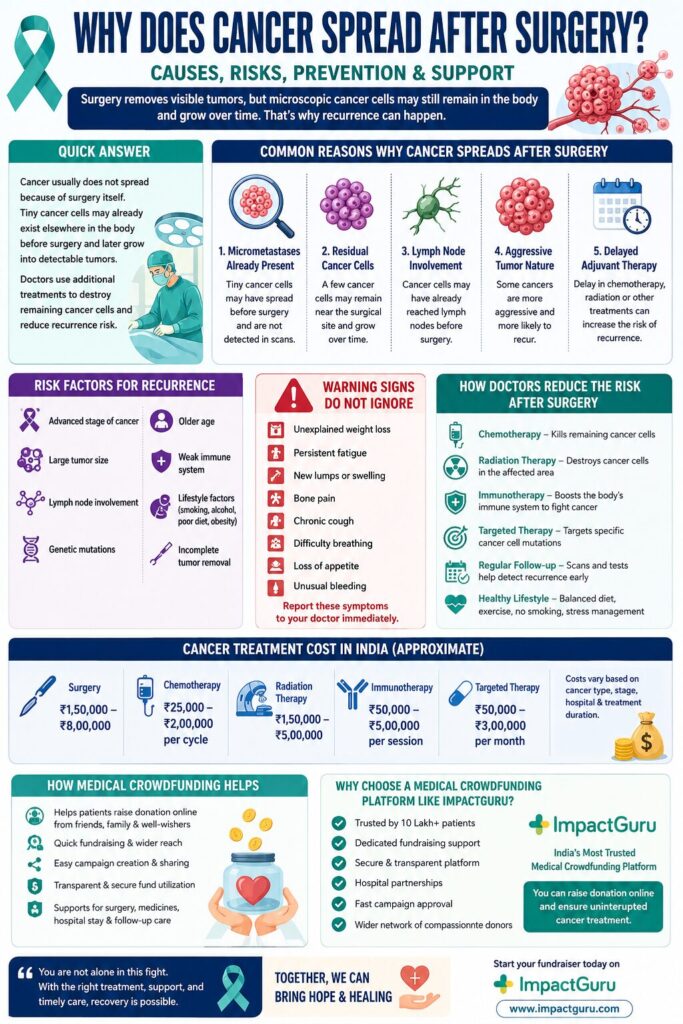
Table of Contents
- What Is Cancer?
- Why Does Cancer Spread After Surgery?
- Does Cancer Spread When Air Hits It?
- What Happens To Tumours After They Are Removed?
- How Is Cancer Surgery Used?
- How Is Cancer Surgery Typically Performed?
- What Other Kinds Of Techniques Are Used In Cancer Surgery?
- What Are The Side Effects Of Surgery For Cancer?
- How Doctors Prevent Cancer from Spreading After Surgery
- Conclusion
- FAQs
What Is Cancer?
Cancer is a disease that is caused by harmful cells called cancer cells. These cancer cells form a cancerous tumour. This kind of tumour is also known as a malignant tumour. There may be different kinds of tumours that can be detected in a person’s body. These tumours are specifically malignant and benign. While a malignant tumour may harm a person’s health and the regular functioning of their organs and body, a benign tumour does not affect a person too much. It is a kind of tumour that expands slowly, does not move from location to location in the person’s body, and does not degrade healthy cells, tissues, and organs.
However, a malignant tumour is formed by cancerous cells that expand very quickly and move from one region to another in the person’s body. Over time, a person may experience many problems due to the tumour. Their healthy cells, tissues, and organs will be affected. Their organs will eventually stop functioning as a result of the malignant tumour. This may even lead to the death of a person, especially if the cancer is not addressed appropriately. This is why detecting cancer and cancer treatment is so critical. If cancers are not managed correctly, people may suffer much more.
Why Does Cancer Spread After Surgery?
One may wonder why cancer spreads after surgery. This may be a great concern for patients. Cancer can come back after surgery for a couple of different reasons. It may be helpful to know about this, especially as a patient suffering from cancer or a cancer patient who may be going through surgery very soon.
The reason why cancer may spread after a person has undergone surgery is:
- A few cancerous cells were left behind in the patient’s body when they underwent the surgery.
- There may have been some cancerous cells that may have already broken away from primary cancer but were too small to see. This process is known as micrometastases.
Surgeons try their best to extract and get rid of all of the cancer cells present in a person’s body when they undergo an operation for the same. However, this process may not be as simple or as easy as it seems. There may always be a chance that a doctor or medical professional could leave behind a small group of cancer cells in the person’s body. Small errors can lead to huge effects, which means the recurrence of the cancer. One may wonder what exactly cancer recurrence means. Cancer recurrence is when cancer that had been earlier detected in the person’s body returns after a period of remission or being able to be detected.
A cancer recurrence may occur because even though the doctor or medical expert did their best to try and rid your body of cancer, some harmful or cancerous cells remain. These cells that have remained in the body may still be capable of growing. The person may start experiencing symptoms.
In some situations, the doctor or the surgeon may recommend that you have further treatment even after the surgery. They may do this, especially if they sense that cancer is possibly coming back and being detected in the patient’s body again. This kind of treatment may often be referred to as adjuvant treatment.
The extra treatment that could be afforded to a patient may involve chemotherapy, radiotherapy, hormone therapy, or some targeted cancer drug. These treatments will try to control or kill any cancer cells left in the person’s body.
Does Cancer Spread When Air Hits It?
Does cancer spread when air hits it? There is no scientific proof to suggest that cancer may spread due to exposure to air; it should also be noted that while it is possible, cancer rarely spreads due to surgery. It is safest to assume that if the right precautions are taken, a person will not experience the spread of cancer due to this.
Surgery may be the most fruitful option for many kinds of cancer when one thinks about the outcomes. Some people may think that after “exposure to air,” cancer may spread. This is because they feel worse after surgery than they did before.
First, One may remember that it takes time to heal after surgery so detections may differ based on the period and time-lapse. Other people may believe this because there may be situations where doctors can detect more cancer during surgery. This amount of cancer may be more than shown on scans and other imaging tests. This doesn’t happen because the cancer spreads during the surgery as the cancer currently being detected was already present in the person’s body before. Thus, cancer did not appear on the other tests and is nothing new.
It is important to remember that while it may be severe in its effects, cancer is not a contagious disease. This means that cancer cannot pass from one person to another. Even if you have close contact or do activities like sex, kissing, touching, sharing meals, or breathing with a person that has cancer, the shared air in that place will not lead to the spread of cancer, so you have nothing to worry about when it comes to this. Even if the cancer cells from someone with cancer pass to a healthy person for some reason, they will not be able to survive in the body of the healthy person, so one need not worry about this.
What Happens To Tumours After They Are Removed?
A person may wonder what happens to tumours after being removed from the body of a person with cancer. There may be some damage to a patient’s tissues when the tumor’s excision and manipulation are being resected. Its vasculature has been observed to result in the shedding of the tumour cells from where they were originally affecting the person’s body into other regions. This may usually be in the blood and lymphatic circulation.
After surgery, a person usually receives medication that helps relieve pain through some tube or an intravenous drip. Drains may often remove waste and fluid from the person’s body. The patients who undergo surgery are generally monitored after it is over. You may need assistance with regular tasks for some time. Nurses may help patients needing any assistance with pain control, moving around, eating, drinking, and bathing until they can do so on their own.
How Is Cancer Surgery Used?
Some usual reasons you might have cancer surgery include the following:
- Prevention of cancer- It is sometimes possible and even helpful to remove an organ before cancer spreads in a person’s body and affects it for some types of cancer. This may be a way in which surgery may help prevent cancer for a person.
- Receiving the appropriate diagnosis- A piece of tissue may be acquired through surgery for any testing that must be done. This tissue sample tested in a lab will help determine if a person has cancer. There may be other sorts of tests that can deduce the genetic makeup of the cells in a person’s body. These results may help your doctor, oncologist, or medical team decide your treatment’s course.
- Staging- When a person undergoes cancer surgery, it may be helpful to understand the size of the cancer and how much it may have spread in the body. The cancer stage is important to determine, deciding the course of the patient’s treatment. The stage of cancer that the patient or person is at is an important factor. This helps your doctor, oncologist, or medical professional overlooking your treatment to decide exactly how serious your health condition may be. They may also be able to conclude whether you may require aggressive treatment.
- Primary treatment- Depending on the patient’s state of health and the cancer they are suffering from, surgery may take place and would sometimes be the most important part of the patient’s treatment. In this way, surgery may often be the primary treatment for a cancer patient.
- Debulking- Surgery may sometimes not successfully weeding out all the cancer in the person’s body. A surgeon may try to remove as much as possible but may not be able to get rid of all of it. The process of removing the cancerous tumour in the person’s body is known as debulking.
- Reducing the symptoms or side effects experienced- Surgery may be useful in improving the quality of life of a patient, such as helping to relieve the discomfort that may be caused as a result of cancer that’s pressing on a nerve or bone, surgery may also be used for the removal of cancer that may be blocking the intestine of a person.
How Is Cancer Surgery Typically Performed?
The goal of surgery for cancer is to extract and get rid of all the cancer in a person’s body. To successfully carry out cancer surgery, a surgeon may use different kinds of sharp tools or surgical tools that may assist in removing the cancerous tumour. Besides removing the cancerous tumour, there may be some healthy tissue around the place where the cancer was detected and removed. This healthy tissue may also be removed with the tissue that has been infected and the tumour as a precautionary measure so that if there may even be a little chance that any cancer cells have spread to that healthy tissue around the area where the tumour was, it will be removed.
A surgeon may also decide to remove some lymph nodes in the area where the cancer had been detected and later extracted from. Sometimes, a person’s lymph nodes may be tested in a particular way. This testing may be done to see if they contain any cancer cells. If the cancer cells may have spread to a person’s lymph nodes, there’s a chance that the cancer may spread to other parts of the body.
What Other Kinds Of Techniques Are Used In Cancer Surgery?
Many surgeries can be used to treat cancer. Researchers continue to look at new methods.
Some different types of surgeries for cancer include the following :
- Cryosurgery- Cold materials may be used in this kind of surgery. Materials such as liquid nitrogen spray or a cold probe are generally used. Cold temperatures may be useful in freezing and destroying a person’s cancer cells.
- Electrosurgery- In electrosurgery, electric current may be employed to kill the cancer cells in the person’s body.
- Laser surgery: In this form of surgery, there may be beams of light known as lasers that help minimize or completely eradicate the cancer cells from the person’s body.
- Mohs surgery- The cancerous tumour may be attended to layer by layer in this kind of surgery. At the end of this surgery process, all of the cancer in the patient’s body is supposed to be removed. Mohs surgery may be employed in treating cancers or on sensitive areas of the skin, like around the eye or eyes.
- Laparoscopic surgery-This kind of surgery is referred to as minimally invasive surgery. This surgery uses many tiny cuts rather than one big cut on the person’s body to help remove the cancer. The smaller cuts may help in faster healing of the patient. This may also lead them to suffer from fewer problems after they undergo the surgery.
- Robotic surgery- Technology has developed a great deal and has been used for many surgeries. When a robotic surgery happens, the surgeon sits at a distance from the operating table where the patient is. Hand controls may be employed. These hand controls will direct a robot to move surgical tools properly to perform the necessary operation. Robotic surgery may be greatly useful in helping the surgeon to reach and perform surgery in areas that are difficult to achieve.
- Natural orifice surgery- Natural orifice surgery is a method by which surgery may be performed on the organs in the belly without cutting through the skin. Surgical tools may be passed through a natural body opening in this kind of surgery. Many natural openings in a person’s body may be used for this, like a person’s mouth, rectum, or vagina.
Cancer surgery has changed, developed, and progressed over time with the developments in technology and medicine. People in medical research in recent years have been trying to find less invasive and more effective ways of surgery. This will be helpful for the faster healing of a patient, which may have more effective results.
What Are The Side Effects Of Surgery For Cancer?
What are the side effects of surgery for cancer? When discussing the side effects of surgery for cancer, the risks for cancer patients may depend on the type of operation they are undergoing for the cancer they suffer from.
Most of the risks and side effects of surgery for cancer would comprise the following:
- Pain- Most people that go through surgery will undergo some pain. Patients may sometimes experience more pain in some kinds of surgeries than in other types. Patients may be guided as to what they must do to obtain the best results from the surgery they are going through and in what ways they may experience the least pain. Some pain-relieving drugs are also often given to patients that help lower the pain they may experience after the surgery.
- Infection- There may be a specific way that you or the medical staff around you may have to care for the wound of your surgery after you have undergone the whole procedure. You may also be given specific advice on caring for your surgery wound, usually around discharge time. You must abide by the instructions to help avoid any infections in or around that region. If you get an infection, your recovery time may become longer, and you may need more medical assistance. The doctor or the medical team may give you some drugs to help fight off the infection.
- Loss of organs- Your medical staff or doctor may need to extract an organ to remove the cancer from your body if it has taken over. For example, you may have to get a kidney removed if you have kidney cancer and the cancer has progressed greatly.
- Feeling fatigued- A person may feel lethargic and experience difficulty concentrating after surgery. If they continue to feel this way, they may be given certain directions on how to deal with certain situations. They must follow these directions.
- Bleeding- All patients that undergo surgery must be aware of the risk of bleeding. You must inform your doctor or medical team about your current medications. It is important to tell them about this, as taking some medications may increase the risk of bleeding or other complications or reactions after you undergo surgery.
- Clotting of blood- After surgery, a person may have a higher risk of getting a blood clot when recovering.
- Problems with bowel and bladder functions- After surgery, one may struggle a bit with bowel movements or urinating. Usually, this gets better after a few days, but the patient must try and be as cautious as possible and follow their doctor’s advice. This will help you to deal in the best way possible with this situation.
If you would like to know or understand more about the side effects of surgery for cancer, you may consult your doctor, an oncologist, or any other suitable medical professional. You could also find out more about the side effects of surgery for cancer by searching about the same online on any search engine or reading up about this on some online or offline source that may be credible and available.
How Doctors Prevent Cancer from Spreading After Surgery
Chemotherapy
Chemotherapy destroys remaining cancer cells after surgery.
Although effective, many families worry about the rising Chemotherapy Cost in India, especially during prolonged treatment cycles.
Radiation Therapy
Radiation targets cancer cells that may remain in the affected area.
Immunotherapy
Immunotherapy helps the body’s immune system identify and attack cancer cells.
Targeted Therapy
Targeted treatments focus on specific genetic mutations that drive cancer growth.
Regular Follow-Up Care
Doctors may recommend:
- CT scans
- PET scans
- MRI scans
- Blood tests
- Tumor marker assessments
These follow-up evaluations help detect recurrence early.
Why Choose a Medical Crowdfunding Platform Like ImpactGuru?
A trusted medical crowdfunding platform like ImpactGuru has helped thousands of patients access timely treatment.
Key benefits include:
- Dedicated fundraising support
- Secure donation processing
- Hospital partnerships
- Wider donor network
- Fast campaign approvals
When faced with high Cancer Treatment Cost in India or increasing Chemotherapy Cost in India, a reliable medical crowdfunding platform like ImpactGuru can help bridge the financial gap and ensure uninterrupted treatment.

Conclusion
The concern about Why Does Cancer Spread After Surgery is understandable, but it is important to recognize that recurrence is usually caused by microscopic cancer cells that existed before surgery rather than the procedure itself. Advances in surgery, chemotherapy, immunotherapy, and targeted treatments continue to improve survival rates and reduce recurrence risks.
However, the financial burden associated with the Cancer Treatment Cost in India and Chemotherapy Cost in India can be significant. Through medical crowdfunding, patients can raise donation online and access support from a broader community. A trusted medical crowdfunding platform like ImpactGuru can help families focus on recovery while managing treatment expenses effectively.
FAQs
Microscopic cancer cells may already exist elsewhere in the body before surgery and can continue growing after the primary tumor is removed.
No. Modern research shows that surgery itself does not typically cause cancer spread.
Follow-up treatments such as chemotherapy, radiation therapy, immunotherapy, and regular monitoring can help reduce recurrence risks.
Not always. The decision depends on the cancer type, stage, and pathology findings.
Yes. Medical crowdfunding allows patients to raise donation online and manage high treatment costs more effectively.