


Last Updated: 28 July, 2026
This article is for informational purposes only and is not a substitute for professional medical advice. If you or a loved one is considering radiation therapy, please consult a qualified oncologist. See full disclaimer at the end of this article.
The main radioactive elements (radioisotopes) used in cancer treatment are Cobalt-60, Iodine-131, Iridium-192, Strontium-89, Yttrium-90, Lutetium-177, and Radium-223. Doctors choose between them based on the cancer’s type, location, and stage — some are used in external machines, others are injected, swallowed, or placed directly inside the body.
If you or someone you love has been told radiation therapy is part of a cancer treatment plan, one of the first questions that comes up is simple: which radioactive element actually treats the cancer? The answer depends on the type of cancer, where it’s located in the body, and whether the goal is to cure the disease, shrink a tumor before surgery, or relieve pain in advanced stages.
Radioactive elements — also called radioisotopes — have been used in oncology for decades, and the list has grown significantly in recent years with newer, more targeted options. Cobalt-60, Iodine-131, Iridium-192, Strontium-89, Yttrium-90, Lutetium-177, and Radium-223 are among the isotopes most commonly used today, each suited to different cancers and delivered in different ways — from external beam machines to injections to temporary internal implants.
In this guide, we break down which radioactive element is used for which cancer, how each one works inside the body, and what factors doctors weigh when choosing between them — so you can walk into conversations with your care team better informed and better prepared.
Read More: Top Anti-Cancer Supplements
Read More: Find Hospitals near you.
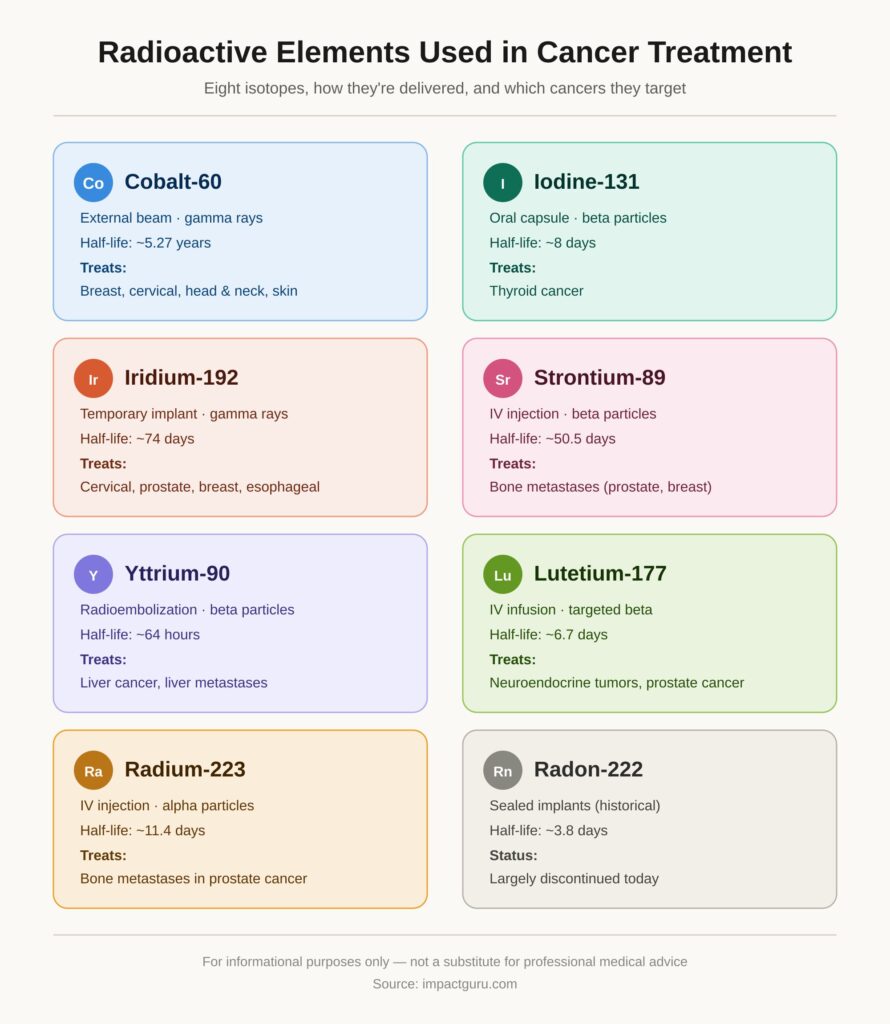
Table of Contents
What Is Radiation Therapy?
Radiation therapy (radiotherapy) is a cancer treatment that uses controlled doses of ionizing radiation — either from machines outside the body or from radioactive isotopes placed inside or near the tumor — to damage the DNA of cancer cells so they can no longer divide.
A radioisotope (or radionuclide) is an unstable form of an element that releases energy as it decays. In medicine, specific radioisotopes are selected because their type of radiation, energy level, and half-life make them well suited to reaching and destroying particular kinds of tumors.
Radiotherapy is used in roughly half of all cancer cases worldwide, either alone or alongside surgery, chemotherapy, or immunotherapy, according to global oncology bodies such as the International Atomic Energy Agency (IAEA) and World Health Organization (WHO).
Read More : Chemotherapy Cost in India (2026): Per-Session Price & Total Treatment Cost
How Radioactive Elements Destroy Cancer Cells
Radioactive isotopes emit ionizing radiation — energy strong enough to break chemical bonds in DNA. When this radiation hits a cancer cell’s DNA, the cell can no longer divide or repair itself properly, and it eventually dies. Because cancer cells divide more rapidly and repair damage less efficiently than most healthy cells, radiation causes proportionally more harm to the tumor than to surrounding normal tissue — this difference is what makes radiotherapy an effective, targeted treatment rather than indiscriminate damage.
Types of Radiation Therapy
External Beam Radiation Therapy (EBRT)
The most common form of radiotherapy. A machine positioned outside the body aims high-energy beams — X-rays, gamma rays, or proton beams — directly at the tumor from multiple angles. Cobalt-60 has historically been a key gamma-ray source for this method, though many modern centers now use linear accelerators (LINACs) instead of cobalt units.
Internal Radiation Therapy (Brachytherapy)
A sealed radioactive source — a seed, wire, or capsule containing isotopes such as Iridium-192 or Cesium-137 — is placed directly inside or next to the tumor. This delivers a high, localized radiation dose while limiting exposure to nearby healthy tissue.
Systemic (Radiopharmaceutical) Therapy
A radioactive substance is swallowed, injected, or infused into the bloodstream, where it travels to and concentrates in cancer cells throughout the body. Iodine-131, Strontium-89, Yttrium-90, Lutetium-177, and Radium-223 all fall into this category, sometimes called targeted radionuclide therapy or theranostics.
Purposes of Radiation Therapy
- Curative — destroying cancer cells entirely
- Neoadjuvant — shrinking tumors before surgery
- Adjuvant — eliminating residual cells after surgery
- Palliative — relieving pain and symptoms in advanced-stage cancer
Which Radioactive Elements Are Used in Cancer Treatment
1. Cobalt-60
Cobalt-60 (Co-60) emits high-energy gamma rays and has been one of the most widely used radiation sources for External Beam Radiation Therapy. Its gamma rays penetrate deep into tissue, making it effective against tumors that aren’t close to the surface.
- Therapy type: External beam radiation
- Half-life: ~5.27 years
- Cancers treated: Breast, cervical, head and neck, skin
- Why it’s used: Deep tissue penetration, predictable decay, and a long-established safety record
2. Iodine-131
Iodine-131 (I-131) is the go-to isotope for thyroid cancer, because the thyroid gland naturally absorbs iodine from the bloodstream. Given as a capsule or liquid, I-131 concentrates almost exclusively in thyroid tissue, destroying cancerous or remaining thyroid cells while sparing most other organs.
- Therapy type: Systemic (oral)
- Half-life: ~8 days
- Cancers treated: Thyroid cancer, some cases of hyperthyroidism
- Why it’s used: Selective uptake by thyroid tissue means highly targeted treatment with limited side effects elsewhere
3. Iridium-192
Iridium-192 (Ir-192) is a workhorse isotope for brachytherapy. Tiny radioactive sources are temporarily placed inside or beside the tumor via catheters, delivering a concentrated radiation dose over a short period before removal.
- Therapy type: Internal (temporary implant)
- Half-life: ~74 days
- Cancers treated: Cervical, prostate, breast, esophageal
- Why it’s used: Precise, localized dosing that minimizes damage to surrounding organs
4. Strontium-89
Strontium-89 (Sr-89) behaves chemically like calcium, so after injection it travels naturally to areas of active bone turnover — including bone metastases. It’s used mainly for pain relief in advanced cancer rather than as a curative treatment.
- Therapy type: Systemic (IV injection)
- Half-life: ~50.5 days
- Cancers treated: Bone metastases from prostate or breast cancer
- Why it’s used: Effective palliative pain relief when cancer has spread to bone
5. Yttrium-90
Yttrium-90 (Y-90) is central to radioembolization, a procedure used for liver cancer. Microscopic beads containing Y-90 are injected into the blood vessels feeding the tumor, cutting off its blood supply while simultaneously delivering targeted radiation.
- Therapy type: Internal systemic (radioembolization)
- Half-life: ~64 hours
- Cancers treated: Liver cancer, liver metastases
- Why it’s used: Dual action — radiation plus blood-supply blockage — concentrated directly at the tumor site
6. Lutetium-177
Lutetium-177 (Lu-177) is one of the newer, fast-growing isotopes in cancer care, used in peptide receptor radionuclide therapy (PRRT) and radioligand therapy. It’s attached to a targeting molecule that binds specifically to receptors on cancer cells, delivering radiation directly to tumors while largely sparing healthy tissue.
- Therapy type: Systemic (targeted IV infusion)
- Half-life: ~6.7 days
- Cancers treated: Neuroendocrine tumors (Lu-177 dotatate), metastatic castration-resistant prostate cancer (Lu-177 PSMA therapy)
- Why it’s used: Molecule-level targeting allows treatment of hard-to-reach or metastatic cancers with fewer systemic side effects than traditional chemotherapy
7. Radium-223
Radium-223 (Ra-223), marketed as Xofigo, is a bone-seeking, alpha-particle-emitting isotope approved specifically for prostate cancer that has spread to the bones. Because alpha particles travel only a very short distance in tissue, Ra-223 delivers intense, localized radiation to bone metastases while limiting damage to surrounding bone marrow and organs.
- Therapy type: Systemic (IV injection)
- Half-life: ~11.4 days
- Cancers treated: Bone metastases in metastatic castration-resistant prostate cancer
- Why it’s used: Alpha-particle radiation is highly potent over very short ranges, reducing collateral damage compared to beta or gamma emitters
8. Radon-222 (Historical)
Radon-222 (Rn-222), a naturally occurring radioactive noble gas, was used in early forms of brachytherapy during the early-to-mid 20th century, often sealed in small tubes or “seeds” implanted near tumors. It is rarely, if ever, used today.
- Therapy type: Internal (historical use only)
- Half-life: ~3.8 days
- Cancers treated: Various deep-seated tumors (historical)
- Why it’s discontinued: Gas-leakage risk and the availability of safer, more stable isotopes such as Iridium-192 and Cesium-137
How Doctors Choose the Right Isotope
Oncologists and radiation specialists weigh several factors before selecting an isotope:
- Cancer type and tissue behavior — e.g., does the tissue naturally absorb a particular element (like the thyroid absorbing iodine)?
- Tumor location and depth — surface tumors may suit different radiation types than deep-seated ones.
- Stage of cancer — curative treatment differs from palliative pain relief.
- Radiation type needed — alpha particles travel shorter distances but deposit more energy locally; beta and gamma penetrate further.
- Half-life — shorter half-lives may suit short, intense treatments; longer half-lives suit stable external sources like Cobalt-60.
- Patient’s overall health and prior treatments.
Safety, Side Effects, and Precautions
Radiation therapy is carefully dosed and monitored by radiation oncologists and medical physicists to maximize damage to cancer cells while minimizing harm to healthy tissue. Common, generally temporary side effects can include fatigue, skin irritation at the treatment site, and localized inflammation, depending on the area treated. Systemic radiopharmaceuticals may carry additional precautions, such as temporary radiation safety measures around family members or pets for a short period after treatment. Patients should always discuss specific risks, side effects, and precautions with their treating oncologist, since these vary by isotope, dose, and individual health status.
Cost of Radiation Therapy in India
Radiation therapy costs in India vary widely depending on the type of treatment, number of sessions, hospital, and city — and can be a significant financial burden for many families, particularly when treatment spans several weeks or requires newer therapies like Lu-177 or Ra-223. Medical Crowdfunding platforms such as ImpactGuru help patients and families raise funds to access timely cancer treatment without depleting savings or delaying care. If cost is a barrier to starting treatment, it’s worth discussing available government schemes, hospital payment plans, and crowdfunding options with your care team or a patient navigator.
Read More : Brain Tumor- Symptoms, Causes, Treatments & More
Read More : Brain Tumor Surgery Cost In India

Conclusion
Several radioactive elements — including Cobalt-60, Iodine-131, Iridium-192, Strontium-89, Yttrium-90, Lutetium-177, and Radium-223 — play distinct, well-established roles in modern cancer care. Each is chosen based on the cancer type, its location, and the treatment goal, whether that’s cure, symptom relief, or shrinking a tumor before surgery. Understanding which radioactive element is used in the treatment of cancer — and why — can help patients and families feel more informed and prepared as they navigate treatment decisions with their care team.
FAQs
Cobalt-60 has historically been among the most widely used for external beam radiation, while Iodine-131 is the standard for thyroid cancer and Lutetium-177 and Radium-223 are increasingly used for neuroendocrine tumors and prostate cancer bone metastases, respectively.
Cobalt-60 is used in external beam radiation therapy to treat deeper tumors, including breast, cervical, head and neck, and skin cancers.
Iodine-131 is absorbed by thyroid tissue, making it effective for treating thyroid cancer through internal, systemic (oral) radiation.
A radioactive element is used in cancer treatment because it emits ionizing radiation that damages the DNA of cancer cells, preventing them from dividing and eventually causing them to die — while sparing most surrounding healthy tissue.