


Table of Contents
Quick Summary
- Understanding vitiligo vs other skin conditions is important because vitiligo is one of several conditions that cause white or light patches, but far from the only one.
- Tinea versicolor is a fungal infection, not autoimmune, and often has a scaly texture.
- Pityriasis alba is a mild, usually harmless condition linked to eczema, mostly in children.
- Albinism is genetic and present from birth, affecting the whole body including the eyes.
- Vitiligo patches are typically smooth, sharply defined, and can appear at any age.
- A dermatologist can usually tell these apart with a simple exam, no guesswork needed.
Introduction
A new pale or white patch on your skin can send you straight to a search bar, and vitiligo is often the first condition that comes up. But it isn’t the only cause of skin lightening, and getting the wrong one in your head before you see a doctor can lead to unnecessary worry or the wrong home remedy. This guide compares vitiligo with three other conditions it’s most commonly confused with, tinea versicolor, pityriasis alba, and albinism, so you know what to actually look for.
Also Read : White Patches on Skin: What’s Causing Them and When to Worry
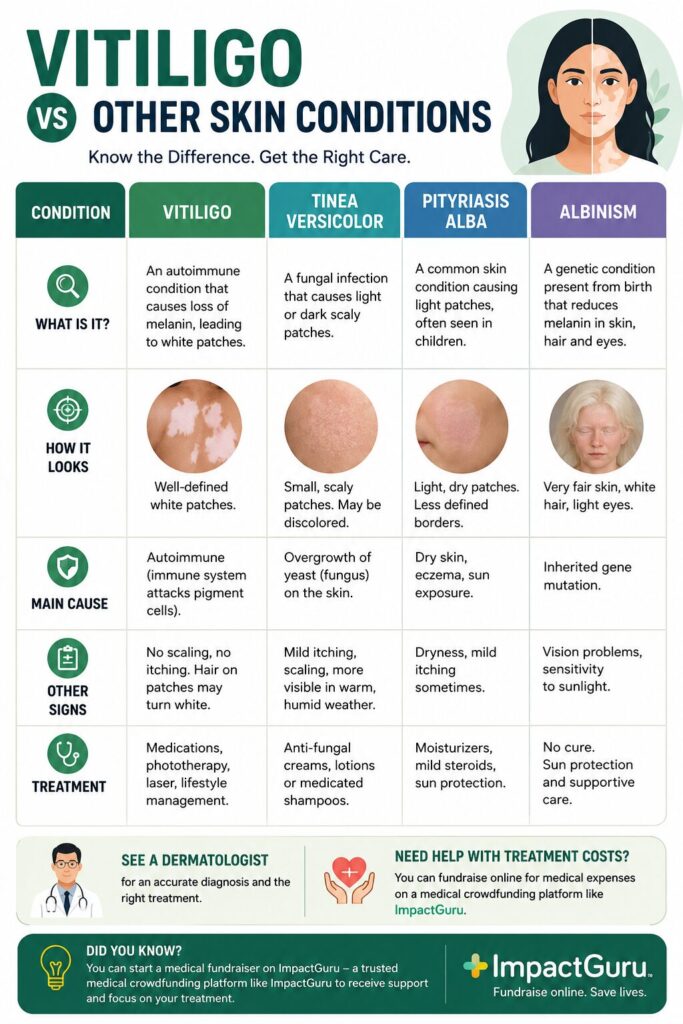
Vitiligo vs Tinea Versicolor
Tinea versicolor is a common fungal skin infection, not a pigment disorder. It’s caused by an overgrowth of Malassezia, a yeast that naturally lives on everyone’s skin but multiplies rapidly in heat, humidity, or when the immune system is weakened. It typically shows up on the chest, back, and upper arms.
| Vitiligo | Tinea Versicolor | |
| Cause | Autoimmune; the immune system attacks melanocytes | Fungal, overgrowth of Malassezia yeast |
| Texture | Smooth, no scaling | Often scaly, sometimes itchy |
| Common location | Anywhere on the body, no pattern | Chest, back, upper arms; worsens in heat/humidity |
| Diagnostic test | Wood’s lamp, bright fluorescence, sharp edges | KOH skin scraping, shows fungal elements |
| Treatment | Topical/systemic immune-targeted treatment, phototherapy | Antifungal cream or medication |
Vitiligo vs Pityriasis Alba
Pityriasis alba is a common, generally harmless skin condition, mostly seen in children and teens, often linked to eczema (atopic dermatitis). It causes faint, sometimes slightly scaly light patches, usually on the face.
| Vitiligo | Pityriasis Alba | |
| Cause | Autoimmune, melanocyte destruction | Mild eczema variant, exact cause unclear |
| Pigment loss | Complete, patches turn fully white | Partial, patches stay lightly pigmented |
| Who it affects | Any age | Mostly children and teens |
| Diagnostic test | Wood’s lamp, bright fluorescence, sharp edges | Wood’s lamp, dull, no sharp fluorescence |
| Outlook | Doesn’t resolve without treatment | Usually fades on its own over time |
Vitiligo vs Albinism
Albinism is a genetic condition, present from birth, that reduces or eliminates the body’s ability to produce melanin, affecting skin, hair, and eyes together rather than in patches.
| Vitiligo | Albinism | |
| Cause | Acquired, autoimmune, can develop at any time | Genetic, inherited gene mutation |
| Onset | Any age | Present from birth |
| Pattern | Patchy, often asymmetrical | Uniform, whole-body |
| Eyes | Not affected | Often affected, vision problems, light sensitivity |
| Key health risk | Linked to other autoimmune conditions | Higher lifetime risk of skin cancer |
| Diagnosis | Physical exam, Wood’s lamp, sometimes biopsy | Eye exam, sometimes genetic testing |
Read More : Vitiligo Stages: How the Condition Progresses Over Time
How Doctors Tell These Apart
The overlap in appearance is exactly why understanding vitiligo vs other skin conditions matters, and why self-diagnosis from a mirror or a search engine isn’t reliable. In practice, a dermatologist typically confirms which condition you have through a combination of the Wood’s lamp exam, skin scrapings tested for fungal elements, family and medical history, and, in unclear cases, a biopsy.
Getting the right diagnosis matters beyond just peace of mind; it determines treatment entirely. A steroid cream or phototherapy meant for vitiligo won’t do anything for a fungal infection, and antifungal treatment won’t touch actual vitiligo. If your patches are new or spreading, the safest first step is always to see a dermatologist rather than guessing based on appearance alone.
Treatment for confirmed vitiligo, especially with ongoing phototherapy or newer medications, can also become a recurring cost over time. If that becomes a concern once you have a confirmed diagnosis, medical crowdfunding is one option worth knowing about. If you would like to know more about the cost of the vitiligo treatment, our vitiligo cost guide covers this in more detail.
Read More : How Do I Create a Medical Fundraiser Online?

Conclusion
Not every white patch is vitiligo, and not every case of vitiligo looks the same as the last one you saw online. Understanding vitiligo vs other skin conditions is important because tinea versicolor, pityriasis alba, and albinism can all mimic vitiligo at a glance. Still, each has a distinct cause, a distinct outlook, and a distinct treatment path, which is exactly why a proper diagnosis matters more than a quick comparison photo. If you’re dealing with a confirmed vitiligo diagnosis and thinking about the road ahead, our vitiligo overview, treatment, and stages guides are the natural next stop, and online crowdfunding is worth exploring too if cost becomes part of that journey.
FAQs
Yes. Medical crowdfunding platforms like ImpactGuru can help patients raise funds for eligible treatment and ongoing medical expenses.
You can fundraise online by creating a medical fundraiser, sharing your treatment story, and reaching out to friends, family, and supporters.
Medical fundraising helps patients collect financial support to manage treatment, medication, phototherapy, and other healthcare expenses.
No. Conditions such as tinea versicolor, pityriasis alba, and albinism can also cause lighter or white areas on the skin.
Vitiligo is an autoimmune condition that causes smooth, sharply defined depigmented patches, while tinea versicolor is a fungal infection that may cause scaly patches.
A dermatologist can distinguish vitiligo from other skin conditions using a physical examination, Wood’s lamp examination, and other tests when required.