


Table of Contents
Quick Summary
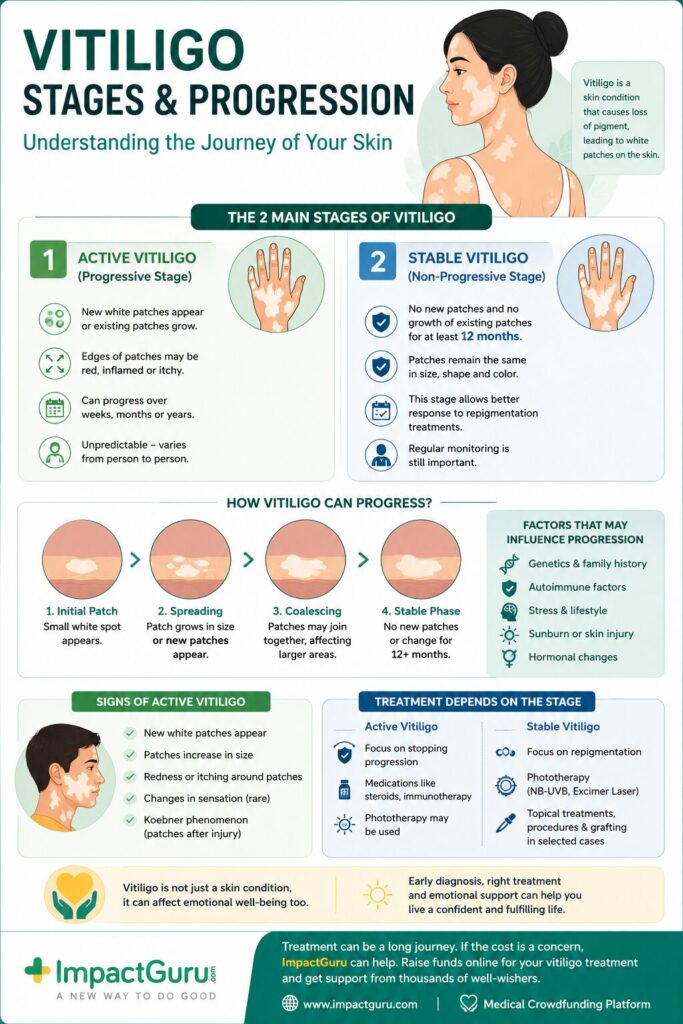
- Vitiligo stages are clinically classified into two main states: active and stable.
- Active vitiligo means patches are currently growing or new ones are appearing.
- Stable vitiligo means no new patches or growth for at least 12 months.
- Some patients notice subtle early signs, like faint lightening, before a clear patch forms.
- Progression speed varies widely; some people stabilize in months, others take years.
- Even stable vitiligo can reactivate later, which is why ongoing monitoring matters.
Introduction
One of the most common questions after a vitiligo diagnosis is “is this going to keep spreading?” The answer depends on which stage the condition is in. Vitiligo moves between two real, medically defined phases or stages, active and stable, and understanding which one you’re in changes everything from how urgently you should see a dermatologist to what treatment is even worth attempting right now. This guide breaks down both states in plain terms, so you know exactly what to watch for. For a complete picture of the condition itself, start with our vitiligo guide.
Before the Active Stage: Early Signs to Watch For
In the initial stages, Vitiligo doesn’t always show up as a clear white patch right from the start. For some people, it begins with something more subtle, a small area of skin that just looks slightly lighter than usual, sometimes more noticeable after time in the sun. The fine hair in that spot can lighten too, even before the skin itself really changes color.
This isn’t really a separate stage on its own. Think of it more as an early warning sign. But noticing it early is worth paying attention to, since it can mean seeing a dermatologist sooner, and catching things early often makes a real difference in how treatment plays out.
Active Vitiligo
This is the clinically defined state where the where the disease is currently progressing: existing patches enlarge, new patches appear, and the underlying autoimmune activity is clearly in motion. Flares can be triggered by external factors like stress or skin trauma, a phenomenon called the Koebner phenomenon, in which new patches form specifically at sites of physical injury. Active phases can last anywhere from a few months to a few years before the condition stabilizes, and rapid progression during this phase doesn’t necessarily predict a worse long-term outcome; it’s simply a sign the disease is currently active. This is generally the stage where treatment focuses on calming immune activity rather than repigmentation; more on that in our vitiligo treatment guide.
Stable Vitiligo
Stable vitiligo is clinically defined as a period of at least 12 months with no new patches and no growth in existing ones. A key sign of true stability is that the Koebner phenomenon also stops occurring; skin injuries no longer trigger new patches, indicating that the autoimmune activity has genuinely paused, not just gone quiet temporarily. This stage matters clinically because it’s the window where more advanced repigmentation options, including surgical treatments, become viable. Stability can last for years, though it isn’t always permanent; reactivation can happen later, triggered by stress, illness, or skin injury, which is why check-ins with your dermatologist don’t stop just because the patches have.
Read More : Vitiligo in Children: What Parents Need to Know
How Fast Does Vitiligo Spread
There’s no single timeline that applies to everyone. Some people see rapid spread over months, while others progress slowly over years or remain stable for extended stretches with no clear pattern. Most patients experience alternating periods of activity and stability rather than one continuous direction. Your dermatologist tracks this using tools like the VASI score, covered in our vitiligo diagnosis section, to objectively confirm which state you’re in rather than relying on guesswork.
Why Active vs Stable Affects Treatment Decisions
Vitiligo treatment depends on its stages and generally follows two strategies: first, arresting active progression to limit further pigment loss, and second, working toward repigmentation once the disease is stable. That’s why a dermatologist’s first question is often about timeline, not just appearance. Active disease needs different treatment than stable disease, and jumping straight to repigmentation treatment during an active flare tends to produce weaker, less lasting results. See our full vitiligo treatment guide for how this plays out across different treatment options.
Managing vitiligo through an active phase, especially with phototherapy or longer courses of topical treatment, is rarely a one-time cost, and it can stretch across an active-to-stable journey that runs months or years. For treatment insurance doesn’t cover, medical crowdfunding is technically an option worth knowing about; check directly with a platform on eligibility for your specific case before counting on it as your main plan.
Also Read : Vitiligo vs Other Skin Conditions: Why Is My Skin Turning White?

Conclusion
Whether vitiligo is active or stable isn’t just a clinical label; it’s what actually shapes your treatment plan and what to expect next. If you’re noticing new or spreading patches, that’s a sign you’re likely in an active stages of vitiligo, and it’s worth getting seen sooner rather than later. And if cost is part of what’s on your mind, it’s worth knowing your full range of options, from savings and medical loans to online crowdfunding for the portion insurance won’t cover. Explore our vitiligo overview, treatment, and cost guides next to understand your full picture.
FAQs
Vitiligo is generally classified as active or stable, depending on whether patches are spreading or have remained unchanged.
Active vitiligo occurs when existing patches grow or new patches continue to appear.
Stable vitiligo means there have been no new patches or growth of existing patches for at least 12 months.
Vitiligo can spread differently for each person. It may progress over months or years, or remain stable for long periods.
Yes. Vitiligo can reactivate after a period of stability, so regular monitoring by a dermatologist is important.
If treatment costs become difficult to manage, platforms such as ImpactGuru can be considered for raising funds through medical crowdfunding, subject to eligibility.