


Table of Contents
Quick Summary
- Vitiligo is a chronic autoimmune skin condition that causes patches of skin, hair, or mucous membranes to lose their natural color.
- It affects roughly 0.5–2% of people worldwide and appears equally across all genders and skin tones.
- There are five recognized types: generalized, segmental, universal, focal, and acrofacial vitiligo.
- It isn’t contagious or life-threatening, but it can affect self-esteem and mental well-being.
- Treatment ranges from topical creams and light therapy to newer JAK-inhibitor medications and surgical options.
- There’s no permanent cure yet, but many people see significant repigmentation with the right treatment plan.
Introduction
A new white patch on the skin can be unsettling, especially when you don’t know what’s causing it or whether it will spread. Vitiligo is one of the most common reasons for this, and while it isn’t dangerous, living with it often comes with real emotional questions. This guide covers everything you need to know, including what vitiligo is, what causes it, how it’s diagnosed, what treatments actually work, and what to expect in terms of cost and care, so you can make informed decisions about your skin.
What Is Vitiligo
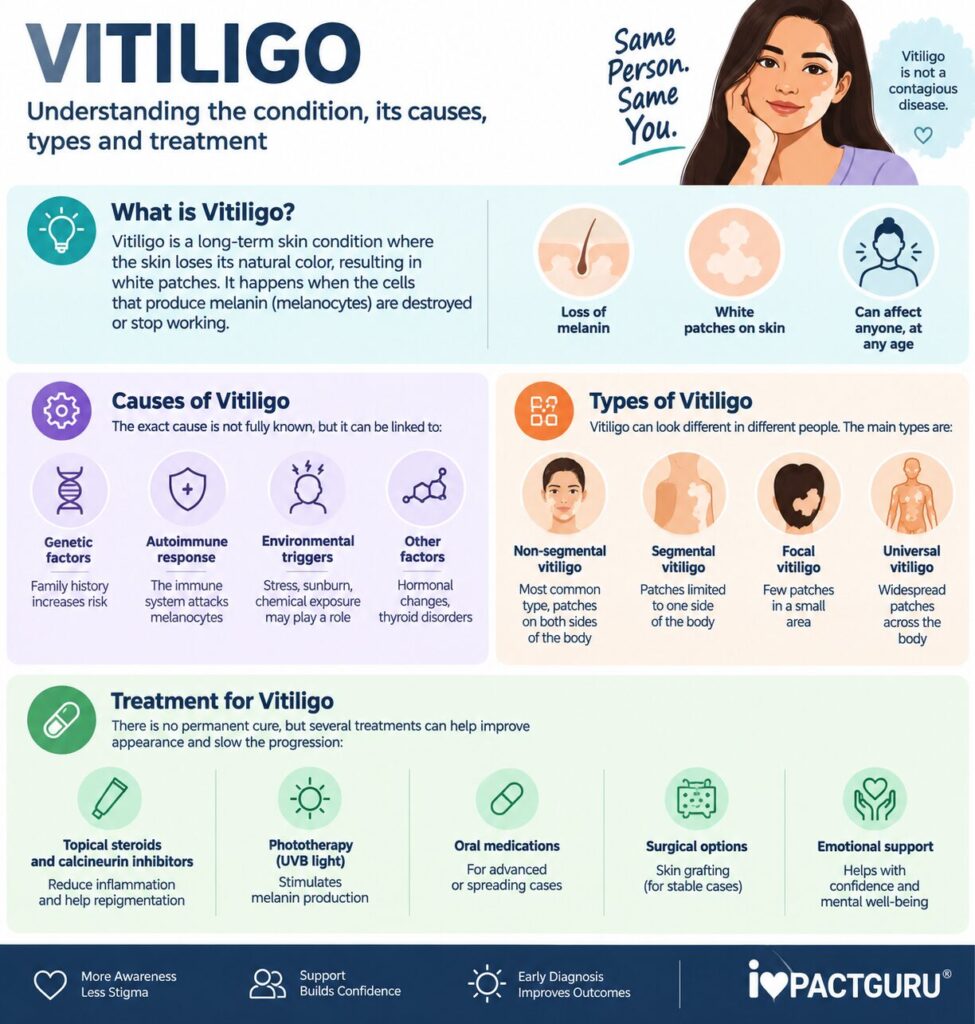
Vitiligo is a chronic autoimmune condition in which melanocytes (the cells that produce melanin), the pigment responsible for skin, hair, and eye color, are destroyed or stop functioning. The result is smooth white or light patches, called macules or patches, that typically begin on the hands, forearms, feet, and face. The condition is not life-threatening or contagious, and it can affect any part of the body, including hair and the inside of the mouth.
What Causes Vitiligo
Vitiligo is classified as a chronic autoimmune disorder, and current research has identified fairly specific mechanisms behind it, not just “the immune system attacks the skin,” but a defined pathway researchers can point to.
The autoimmune mechanism: In vitiligo, certain immune cells (called T-cells) attack and destroy the cells that give your skin its color, known as melanocytes. This attack is driven by a signal called interferon-gamma, which travels through a specific pathway in your cells. This is exactly why newer treatments like JAK inhibitors work so well; they target this specific pathway instead of shutting down the whole immune system.
Genetic risk: If someone in your family has vitiligo, your chances of developing it are higher. That said, it’s not as simple as inheriting one gene; several genes are believed to play a part in making someone more likely to get it.
Associated autoimmune conditions: Vitiligo doesn’t usually show up on its own. People with vitiligo are more likely to also have (or have family members with) other autoimmune conditions like Addison’s disease, pernicious anemia, rheumatoid arthritis, or lupus. That’s part of why doctors often check for other autoimmune issues when diagnosing vitiligo.
A different mechanism for segmental vitiligo: Not every case of vitiligo follows the same pattern. Segmental vitiligo, the type that shows up on just one side or area of the body, seems to have a different cause altogether, possibly linked to the nervous system rather than the immune system. That’s likely why it behaves differently too: it tends to start earlier in life, stops progressing faster, and stays limited to one area.
Environmental and physical triggers: Along with genetics and immune activity, new patches can show up or get worse because of:
- Sunburn or too much UV exposure.
- Cuts, friction, or trauma to the skin (doctors call this the Koebner phenomenon).
- Exposure to certain chemicals, industrial or cosmetic.
- Stressful periods, which some people notice trigger new patches.
How common is it? Vitiligo affects an estimated 0.5–2% of the global population, making it far more common than most people assume; most cases simply go undiagnosed or unreported because treatment isn’t medically necessary.
Read More : Vitiligo in Children: What Parents Need to Know
Types of Vitiligo
Not everyone’s vitiligo looks or behaves the same way. The type you have affects how it’s likely to spread and which treatments tend to work best. Doctors group vitiligo into five main types:
- Generalized (non-segmental) vitiligo: This is the most common type. Patches usually show up symmetrically, meaning matching spots on both hands or both knees, for example. This is the type tied to the immune-system process we covered above, and it’s usually the most widespread and the most likely to keep progressing.
- Segmental vitiligo: This type usually shows up at a younger age and stays on just one side or area of the body. It typically progresses for a year or two, then stops. Since it’s caused by something different than generalized vitiligo, it often responds differently to treatment and tends to stay stable once it settles.
- Universal vitiligo: The rarest and most extensive type, where most of the skin loses color. This usually isn’t how vitiligo starts; it’s what generalized vitiligo can turn into after progressing for years.
- Focal (localized) vitiligo: Pigment loss stays limited to one or a few small spots, without spreading symmetrically as generalized vitiligo does. It can stay this way for years, or sometimes turn into a more widespread type later.
- Acrofacial vitiligo: Mainly affects the face and hands, plus skin around the eyes, nose, and ears. Since these areas are so visible, this is often the type that gets people to see a doctor the soonest.
There’s no way to predict exactly how someone’s vitiligo will behave; sometimes it stops spreading on its own, sometimes it doesn’t. That’s exactly why getting the right diagnosis of type early on is so useful; it helps your dermatologist actually predict what’s likely to happen next.
Symptoms to Watch For
The primary symptom of vitiligo is depigmentation, the loss of natural skin color, which can appear anywhere on the body but most often develops on the hands, feet, arms, and face. Beyond the skin, vitiligo can also cause:
- Premature whitening or graying of scalp hair, eyelashes, eyebrows, or beard.
- Loss of color in the tissue lining the inside of the mouth and nose.
- Low self-esteem or a diminished self-image tied to concerns about appearance.
For a deeper visual and diagnostic breakdown of this symptom, read our complete guide to white patches on skin, including how to distinguish vitiligo-related patches from other skin conditions.
How Vitiligo Progresses
Vitiligo doesn’t follow the same timeline for everyone, but it typically moves through a few recognizable stages: an early stage where a small patch first appears, an active or spreading stage where existing patches grow and new ones may form, and a stable stage where the patches stop changing, sometimes for years. In more advanced cases, this can progress toward more widespread depigmentation. Knowing which stage you’re in matters, since it directly affects treatment choices; for instance, surgical options are only considered once vitiligo has been stable for a while. For a full breakdown of each stage and what to expect at every point, see our complete guide to vitiligo stages.
How Vitiligo Is Diagnosed
Getting an accurate diagnosis matters because vitiligo shares visual similarities with several other skin conditions, and misdiagnosis can lead to months of the wrong treatment. Here’s what a proper diagnostic workup typically involves:
- Clinical examination and history: Your dermatologist will examine the pattern, size, and distribution of the affected patches and ask about family history of vitiligo or other autoimmune conditions, since this is one of the strongest risk indicators.
- Wood’s lamp examination: A specialized ultraviolet light is used to examine the skin in a darkened room. Depigmented vitiligo patches fluoresce distinctly under this light, making it easier to identify the true extent of pigment loss, including patches too faint to see under normal lighting, particularly on lighter skin tones.
- Skin biopsy: Not always necessary, but a small tissue sample may be taken to confirm the complete absence of melanocytes at a cellular level, especially when the diagnosis is unclear, or another condition is suspected.
- Blood tests: Because vitiligo is linked to other autoimmune diseases, your doctor may order blood work to screen for thyroid dysfunction or other autoimmune markers; catching a related condition early is one of the practical benefits of a thorough workup.
- Severity scoring: For patients starting treatment, dermatologists often use a standardized tool called the Vitiligo Area Scoring Index (VASI) to measure the extent of depigmentation at baseline. This same scoring system is used to track treatment progress over time, typically reassessed at 24 and 52 weeks, so you and your doctor can objectively judge whether a treatment is working.
- Ruling out look-alike conditions: Vitiligo is sometimes confused with tinea versicolor, pityriasis alba, or post-inflammatory hypopigmentation, conditions that also cause lighter skin patches but have entirely different causes and treatments. A clinical exam (and biopsy, if needed) is what separates a correct diagnosis from months of ineffective treatment for the wrong condition. Understand the difference with our Vitiligo vs Other Skin Conditions guide.
Vitiligo Treatment Options
There’s no permanent cure for vitiligo yet, but treatment can slow down the discoloration and help bring back some of your natural skin color. And the good news is, treatment options have come a long way in recent years:
- Topical creams: Corticosteroids and calcineurin inhibitors are usually the first thing doctors try for smaller, localized patches.
- Ruxolitinib cream: This is the first cream approved by the FDA and EMA specifically for treating non-segmental vitiligo. You apply it twice a day, and it works by helping the skin regain color over time.
- Light therapy (NB-UVB): Doctors usually recommend this if creams alone aren’t doing enough, or if the vitiligo is spreading quickly or covers a larger area. It tends to work even better when combined with topical treatment.
- New treatments in the pipeline: Researchers are currently working on oral JAK inhibitors and other new drugs that could make treatment more effective and more accessible in the future.
- Surgery: Options like melanocyte transplantation are only considered once your vitiligo has been stable, meaning no new changes, for at least 12 months.
Since most treatment plans take months and need regular check-ins with your doctor, it helps to know what you’re signing up for beforehand. Our detailed vitiligo treatment guide breaks down each option side by side, along with realistic timelines and success rates.
Cost of Vitiligo Treatment – And How to Manage It
Vitiligo treatment isn’t a one-time expense. Phototherapy sessions, JAK-inhibitor creams, dermatologist visits, and, in more advanced cases, surgical repigmentation can add up steadily over months or years of ongoing care.
One thing that catches many patients off guard: because vitiligo isn’t life-threatening, it’s often treated as a cosmetic or elective condition by insurance providers, which means it’s commonly excluded from standard health coverage. In practice, this means most of the cost falls directly on the patient, for as long as treatment continues.
When insurance doesn’t help, most patients rely on a mix of savings or a medical loan to cover ongoing treatment. Raising donations online is also technically an option for costs insurance won’t pay for, through online crowdfunding sites that accept medical fundraisers. It’s worth checking directly with a platform on eligibility for your specific treatment.

Living With Vitiligo
Vitiligo isn’t just a skin condition; it can affect how you feel day to day too. Research shows it’s linked to lower self-esteem and a real dip in quality of life for many people. The good news is, there’s a lot you can do to make living with it easier.
- Sun protection: Patches of skin without pigment have no natural defense against the sun, so they burn faster and more easily than the rest of your skin. A daily broad-spectrum sunscreen (SPF 30 or higher) on exposed patches isn’t just about comfort; it also helps prevent sunburn from making the color contrast more noticeable and protects skin that’s already more vulnerable.
- Camouflage options: If you’d like to even out your skin tone, there are a few routes to consider: dermatologist-recommended camouflage creams, self-tanning products made for uneven skin tone, and in some cases, micropigmentation (a form of medical tattooing) for smaller, stable patches. None of these treat the vitiligo itself, but they can make a real difference in day-to-day confidence, and it’s worth asking your dermatologist which option suits your skin type best.
- Diet and lifestyle: While no specific diet can cure or reverse vitiligo, some patients find that a balanced diet with enough vitamin B12, folic acid, and antioxidants supports overall skin health. We cover this in more detail in our vitiligo diet guide.
- Support communities: Talking to others who actually understand what you’re going through, whether that’s an online forum, a local support group, or just another person with vitiligo, can make the emotional side much easier to manage. You’re far from alone in this; it’s one of the more common skin conditions out there, even though it doesn’t always feel that way.
Also Read : Acne Treatment, Causes, Symptoms, and Prevention
Conclusion
Vitiligo isn’t dangerous, but it is persistent. Living well with it comes down to understanding what’s actually happening to your skin, catching it early, and building a treatment plan you can realistically stick with. Whether you’ve just noticed your first patch or you’re already a few months into treatment, the right specialist and the right information make the biggest difference in how things turn out.
Cost can be a real barrier too, and if insurance isn’t covering your treatment, it’s worth knowing what your options are, from savings and medical loans to online crowdfunding as a possible route for the portion insurance won’t touch.
FAQs
A chronic autoimmune condition where melanocytes (pigment-producing cells) are destroyed, causing white or light patches on the skin, hair, or mouth lining.
Immune cells (T-cells) attack melanocytes, driven by a signal pathway (interferon-gamma). Genetics, other autoimmune conditions, and triggers like sunburn, skin trauma, chemicals, or stress can also play a role.
There’s no permanent cure yet, but treatments like topical creams, ruxolitinib cream, light therapy (NB-UVB), and surgery can help repigment skin.
Often not — it’s frequently treated as a cosmetic/elective condition, so most costs fall on the patient.
Through savings, medical loans, or medical crowdfunding platforms like ImpactGuru, which help raise funds for treatments insurance doesn’t cover.