

Last updated: July 27, 2026
The State Illness Assistance Fund (SIAF) is a state-run financial aid scheme that helps Below Poverty Line (BPL) patients pay for treatment of life-threatening illnesses. Eligible patients can receive between ₹25,000 and ₹2,00,000, paid directly to an empanelled government hospital. Applications are made through the District Collector’s office.
Facing a serious illness is hard enough — worrying about how to pay for it shouldn’t make things harder. In India, healthcare costs remain one of the leading reasons families slip into debt, especially for those living below the poverty line who don’t have insurance or savings to fall back on. The State Illness Assistance Fund (SIAF) was created to close exactly this gap.
Run by individual state governments since 1996, SIAF provides direct financial assistance — between ₹25,000 and ₹2,00,000 — to BPL patients battling life-threatening illnesses, with payments made straight to the treating hospital. But like most government welfare schemes, the eligibility rules, required documents, and application process aren’t always easy to find in one place.
This guide breaks down everything you need to know about SIAF: who qualifies, how much financial help you can get, the exact steps to apply, and how it compares to other health schemes like PMJAY — so you can act quickly when it matters most.
Read Also : Chief Minister Relief Fund Scheme – Eligibility, Benefits & More
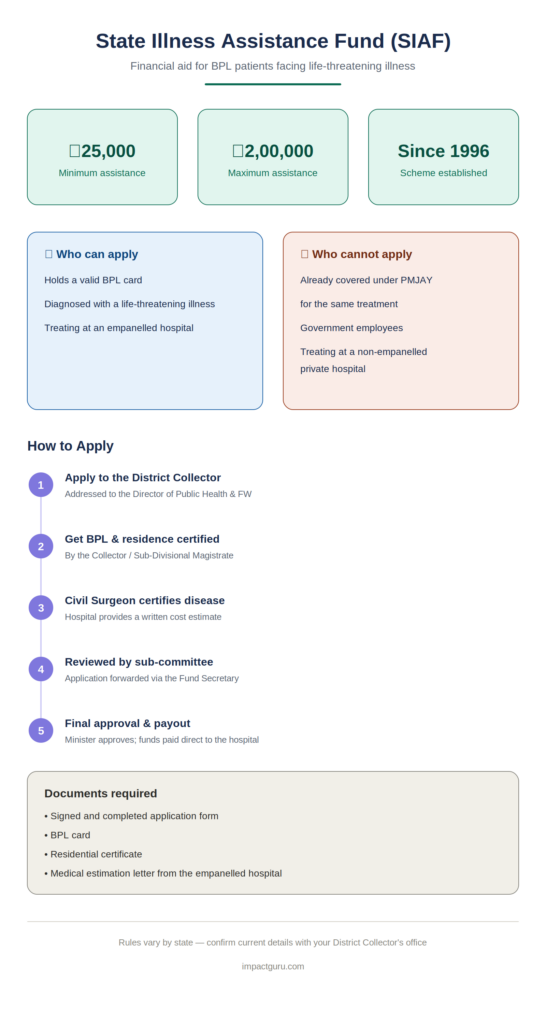
Table of Contents
- What Is the State Illness Assistance Fund (SIAF)?
- SIAF Benefits: How Much Financial Help Can You Get?
- Who Is Eligible for SIAF?
- Who Cannot Apply for SIAF?
- How to Apply for SIAF: Step-by-Step Process
- Documents Required for SIAF Application
- SIAF vs PMJAY vs Ayushman Bharat: How Do They Compare?
- History and Background of SIAF
- Need Help Beyond SIAF?
- Conclusion
- FAQs
What Is the State Illness Assistance Fund (SIAF)?
The State Illness Assistance Fund (SIAF) is a welfare scheme run by individual state governments in India to help financially weaker patients afford treatment for serious, life-threatening illnesses. It was first introduced after a Ministry of Health & Family Welfare advisory dated November 11, 1996, which recommended that every state and Union Territory set up its own Illness Assistance Fund.
The fund exists because out-of-pocket medical costs remain one of the biggest reasons families in India fall into debt or delay urgent treatment. SIAF directly addresses this gap for people classified as Below Poverty Line (BPL).
Since SIAF is administered at the state level, exact fund names, amounts, and processes can differ — for example, Tamil Nadu, Kerala, and Odisha each run their own version under slightly different rules. Always check your specific state health department’s portal for the current version applicable to you.
SIAF Benefits: How Much Financial Help Can You Get?
SIAF covers treatment costs at empanelled (listed) government or government-recognized hospitals, both within and, in some cases, outside the applicant’s home state.
| Detail | Information |
|---|---|
| Minimum assistance amount | ₹25,000 |
| Maximum assistance amount | ₹2,00,000 per family |
| Payment method | Paid directly to the treating hospital, not the patient |
| Frequency | Available once per family, up to the lifetime cap |
| Hospital network | Empanelled/listed hospitals only |
Key point: The money is not handed to the patient in cash. It is released as a direct payment or reimbursement to the recognized hospital treating the patient, which keeps the process transparent and reduces misuse.
Who Is Eligible for SIAF?
To qualify for SIAF, an applicant generally must meet all of the following conditions:
- Hold a valid BPL (Below Poverty Line) card or equivalent state-issued proof of BPL status.
- Be currently diagnosed with a life-threatening illness requiring hospitalization or surgery.
- Seek treatment at a hospital empanelled with the scheme.
- Not already be covered by another applicable state welfare scheme for the same treatment.
Because eligibility documentation (which card, which authority issues it) differs by state, applicants should confirm the exact requirement with their local Block Development Office, Tehsildar, or District Collector’s office.
Who Cannot Apply for SIAF?
The following groups are generally excluded from SIAF benefits:
- Families already covered under Pradhan Mantri Jan Arogya Yojana (PMJAY) for the same treatment
- Government employees (who typically have separate medical reimbursement schemes)
- Patients undergoing treatment at a private hospital not empanelled with SIAF
This exclusion list exists to prevent duplicate government funding for the same treatment and to direct SIAF funds toward those with no other safety net.
How to Apply for SIAF: Step-by-Step Process
- Submit an application to the District Collector, addressed to the Director of Public Health & Family Welfare, in the prescribed format.
- The Collector or Sub-Divisional Magistrate issues a certificate confirming BPL status and residence.
- The Civil Surgeon certifies the diagnosis and disease.
- The empanelled hospital provides a written cost estimate for treatment.
- The complete application is forwarded to the Secretary of the State Illness Assistance Fund.
- A sub-committee reviews the case for eligibility.
- The Minister of Public Health & Family Welfare (or equivalent state authority) gives final approval.
- The application is marked as Approved, Under Evaluation, or Rejected.
Processing times vary by state and case load — there’s no fixed nationwide timeline, so applicants should follow up directly with the Collector’s office for status updates.
Documents Required for SIAF Application
- Signed and fully completed application form
- BPL card (proof of Below Poverty Line status)
- Residential certificate
- Medical estimation letter from the empanelled hospital detailing required treatment and cost
Tip: Get the medical estimation letter before starting treatment. If the treatment or hospital isn’t on the approved list, costs won’t be reimbursed — confirming this upfront avoids unexpected out-of-pocket expenses.
SIAF vs PMJAY vs Ayushman Bharat: How Do They Compare?
| Feature | SIAF | PMJAY | Ayushman Bharat |
|---|---|---|---|
| Administered by | State government | Central + State (National Health Authority) | Central government |
| Coverage amount | ₹25,000 – ₹2,00,000 (one-time, per family) | Up to ₹5,00,000/year per family | Up to ₹5,00,000/year per family |
| Eligibility basis | BPL card | SECC 2011 database / state-specific criteria | SECC 2011 database |
| Hospital network | State-empanelled hospitals only | Empanelled public + private hospitals nationwide | Empanelled public + private hospitals nationwide |
| Overlap rule | Cannot claim if already covered under PMJAY for same treatment | N/A | N/A |
(Figures reflect publicly available scheme guidelines; confirm current limits on the official PMJAY website and your state health portal, as amounts are periodically revised.)
History and Background of SIAF
SIAF traces back to a November 11, 1996 advisory from the Ministry of Health & Family Welfare, which asked all state governments and Union Territories to establish their own Illness Assistance Funds. Since then, the scheme has operated for nearly three decades, with individual states adapting the framework to local needs.
Historical data (as last published) shows that by December 31, 2012, the fund had supported 12,042 patients across surgical and medical treatments for severe illnesses, both within and outside their home states. More recent, state-wise figures are typically published in individual state health department annual reports — we recommend checking your state’s official portal for current numbers.
Need Help Beyond SIAF?
Government schemes like SIAF have fixed caps and can take time to process — which isn’t always fast enough for urgent treatment. If you need additional funds while your SIAF application is pending, or your treatment costs exceed the ₹2,00,000 limit, medical crowdfunding with Impact Guru is a way to raise emergency funds from your community at 0% platform cost.
Conclusion
Serious illness shouldn’t mean choosing between treatment and financial ruin — and that’s the exact problem the State Illness Assistance Fund was designed to solve. For BPL families facing life-threatening conditions, SIAF offers a real, if capped, safety net: up to ₹2,00,000 paid directly to the hospital, with a clear (if bureaucratic) path to apply through the District Collector’s office.
That said, SIAF has real limits. The funding cap may not cover the full cost of treatments like cancer care, transplants, or long-term hospitalization, and approval can take time — time that not every patient has. If you’re navigating a gap between what SIAF covers and what your treatment actually costs, or you need funds faster than the approval process allows, medical crowdfunding is worth exploring alongside your SIAF application, not instead of it.
Before you apply, confirm the latest eligibility rules, fund limits, and empanelled hospital list with your state health department — scheme details can change, and getting the most current version protects you from delays or rejected claims.
FAQs
SIAF is a state government scheme that provides financial assistance to Below Poverty Line (BPL) patients for treatment of life-threatening illnesses, with aid ranging from ₹25,000 to ₹2,00,000 paid directly to the treating hospital.
BPL cardholders currently suffering from a life-threatening illness and seeking treatment at an empanelled hospital are generally eligible. Government employees and those already covered under PMJAY for the same condition are excluded.
SIAF provides between ₹25,000 and ₹2,00,000 per family, paid directly to the empanelled hospital rather than to the patient.
No. If your treatment is already covered under Pradhan Mantri Jan Arogya Yojana, you cannot claim the same expense through SIAF.
No, government employees are generally excluded since they typically have access to separate medical reimbursement schemes.