

Table of Contents
- Quick Summary
- Introduction
- What Makes a Payment Method Safe for Online Donations?
- Safest Online Payment Options to Donate to Charity (Compared)
- How to Verify a Genuine Medical Crowdfunding Platform Before You Donate
- PayPal vs UPI vs Net Banking: Which Is Safer for Donations in India?
- How to Avoid Donation Scams While Crowdfunding for Medical Treatment
- Best Practices for Safe Online Donations: A Quick Checklist
- Conclusion
- Frequently Asked Questions
Quick Summary
- The safest online payment options to donate to charity are ones that use encryption, tokenization, and PCI-DSS-compliant gateways. Like PayPal, UPI, net banking, and major debit/credit cards.
- PayPal is trusted worldwide because it never shares your card details with the receiving organization and screens transactions for fraud.
- In India, UPI and net banking add a layer of safety since donors authenticate directly through their own bank app, not a third-party form.
- A safe payment method only protects your transaction; you still need to verify the medical crowdfunding platform itself before donating.
- Look for verified fundraisers, transparent fund-utilization proof, and registered legal entities before you give.
- Simple habits- checking for HTTPS, avoiding unsolicited donation links, and using trusted platforms like ImpactGuru– cut your risk significantly.
Introduction
Choosing the safest online payment options to donate to charity matters as much as choosing the cause itself. Every donation you make online passes through a chain of digital handshakes: your bank, a payment gateway, and the platform hosting the campaign, and a weak link anywhere in that chain can put your money and your data at risk. The good news is that established options like PayPal, UPI, net banking, and major card networks are all built on strict security standards designed specifically to protect this exchange. This guide breaks down which payment methods are genuinely secure, how to tell a verified medical crowdfunding campaign from a risky one, and the habits that keep your giving safe from first click to final confirmation.
What Makes a Payment Method Safe for Online Donations?
A payment method is considered safe for online donations when it uses encryption, tokenization, and PCI-DSS compliance to shield your financial data at every step of the transaction.
Here’s what those terms actually mean for a donor:
- Encryption scrambles your payment data the moment you enter it, so it’s unreadable if intercepted in transit.
- Tokenization replaces your card number with a random, one-time token, meaning the actual card details are never stored by the charity or crowdfunding platform.
- PCI-DSS compliance is a security standard that any organization processing card payments must follow, covering everything from network monitoring to access controls and regular security testing.
- 3D Secure (3DS) authentication adds a one-time password or biometric check for card transactions, confirming that you, and not someone using a stolen card, authorized the payment.
When a donation page shows a padlock icon in the browser bar, redirects you to a bank or PayPal login rather than asking for card details directly, or displays trust badges from PCI-certified processors, these are good signs that the transaction is protected.
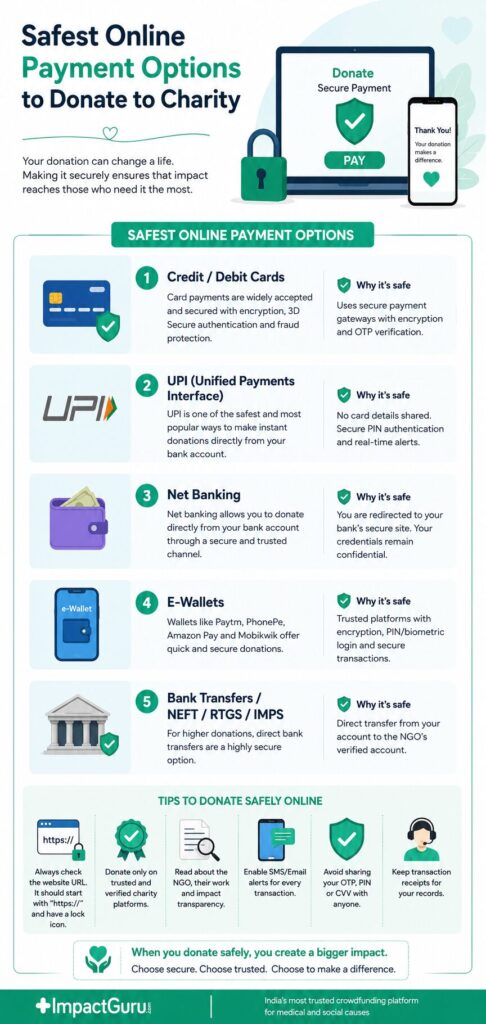
Safest Online Payment Options to Donate to Charity (Compared)
Not every payment method offers the same level of protection or convenience. Here’s how the most common options stack up for charitable giving.
| Payment Method | How It Protects You | Best For | Things to Know |
| PayPal | Card and bank details stay with PayPal; the charity never sees them. Built-in fraud screening and PCI-DSS compliance. | International donors, recurring gifts | Requires a PayPal account for some donation flows; small transaction fees may apply |
| UPI (India) | Authentication happens inside your own banking app via UPI PIN; no card or account number is shared with the platform. | Quick, one-time donations in India | Real-time transfer regulated by the National Payments Corporation of India (NPCI); no chargeback mechanism once sent |
| Debit/Credit Cards | Protected by 3D Secure authentication and the card network’s own fraud monitoring (Visa, Mastercard, etc.) | Donors who want purchase-protection or reward points | Only safe on pages that redirect to a secure, tokenized checkout — never enter card details on an unencrypted form |
| Net Banking | You log in directly on your bank’s own website or app to authorize the transfer. | Donors who prefer not to save card details anywhere | Slightly slower than UPI or cards, but keeps your bank credentials entirely within your bank’s system |
| Digital Wallets (Google Pay, Apple Pay, etc.) | Uses device-level biometric authentication and tokenized payment data. | Mobile-first donors | Confirm the wallet is linked through the platform’s official, verified donation button |
The common thread across all of these: your card or account number should never be visible to or stored by the charity itself. The safest options route your sensitive data through a regulated intermediary, PayPal, your bank, or the card network, rather than the fundraising platform directly.
Read More : Best Crowdfunding Platforms in India– Honest Comparison (2026)
How to Verify a Genuine Medical Crowdfunding Platform Before You Donate
A secure payment gateway only protects the transaction; it doesn’t confirm the campaign itself is legitimate. Before donating to any medical crowdfunding or medical fundraising appeal, check for these markers of a trustworthy platform:
- Verification process: Reputable platforms verify medical documents, hospital estimates, and patient identity before a campaign goes live.
- Transparency on fund use: Look for platforms that disclose how funds are disbursed, ideally paid directly to the hospital or treatment provider rather than the individual’s personal account.
- Registered legal entity: A genuine crowdfunding for medical treatment platform will have clear company registration details, contact information, and a physical presence, not just a social media page.
- Campaign updates: Legitimate fundraisers typically post progress updates, medical reports, or hospital communication as treatment proceeds.
- Secure checkout: The donation page itself should use one of the payment methods discussed above, not a direct bank transfer request to a personal account via message or email.
ImpactGuru, for instance, verifies medical documentation and works directly with hospitals for fund disbursement in many cases, a model worth looking for on any online crowdfunding platform you’re considering.
PayPal vs UPI vs Net Banking: Which Is Safer for Donations in India?
For Indian donors, this is often the real question, and the honest answer is that all three are safe when used through a verified platform, but they protect you in slightly different ways.
- PayPal is ideal for international donors or NRIs contributing to Indian campaigns, since it keeps card data entirely off the receiving platform.
- UPI is arguably the most convenient for domestic donors; authentication happens within your own bank’s app, transfers are near-instant, and no card number is ever exchanged. It’s regulated end-to-end by the NPCI.
- Net banking suits donors who prefer not to link cards or UPI IDs to third-party apps at all, authorizing the payment directly on their bank’s website.
The deciding factor isn’t which method is “safest” in isolation; it’s whether the crowdfunding India platform you’re donating through has a verified, PCI-compliant checkout for all three. If it does, your choice comes down to convenience and personal preference.
How to Avoid Donation Scams While Crowdfunding for Medical Treatment
Fraudulent fundraisers do exist, and they typically rely on urgency and emotional appeal to bypass scrutiny. Watch for these red flags:
- Pressure to act immediately with vague or shifting medical details.
- Requests for direct bank transfers or UPI payments to a personal ID rather than through a verified platform checkout.
- No verifiable hospital or medical documentation available on request.
- Unsecured donation pages; no HTTPS, no recognizable payment gateway logos, or a page that asks for card details before redirecting anywhere.
- Campaigns shared only through unsolicited messages or forwards, with no presence on an established platform.
If something feels off, it’s reasonable to ask the campaign organizer for documentation or to donate through a platform’s official channel instead of a shared personal link.
Read More : How Do I Create a Medical Fundraiser Online?
Best Practices for Safe Online Donations: A Quick Checklist
- Confirm the URL starts with https:// and shows a padlock icon before entering any payment details.
- Use PayPal, UPI, net banking, or cards through a tokenized checkout, never a direct account transfer to an individual.
- Verify the medical crowdfunding platform’s registration and fund-disbursement process before giving.
- Save your donation receipt and transaction ID for your records.
- Set up transaction alerts with your bank so you’re notified immediately of any charge.
- When in doubt, donate through an established online crowdfunding platform rather than a link shared in a message or email.
Conclusion
Safe giving starts with the right payment method and ends with a verified platform. Whether you choose PayPal, UPI, net banking, or a card, the goal is the same: keep your financial details out of the wrong hands while making sure your donation reaches the person who needs it. Now that you know how to protect your data, you can support life-saving treatments with peace of mind. View [Verified Medical Fundraisers on ImpactGuru] today, where every campaign is strictly vetted for your safety.
Frequently Asked Questions
Donating through a PCI-DSS-compliant payment gateway, such as PayPal, UPI, net banking, or a tokenized card checkout, on a verified crowdfunding platform is currently the safest approach, since your financial details are never directly exposed to the campaign organizer.
Yes. UPI transactions are authenticated within your own bank’s app using a UPI PIN, and the National Payments Corporation of India (NPCI) regulates the system, meaning your card or account number is never shared with the receiving platform.
Look for medical document verification, transparent fund disbursement (ideally direct to the hospital), a registered legal entity behind the platform, and a secure, recognizable checkout process.
Only if the page redirects to a secure, tokenized payment gateway. You should never enter full card details on a form that isn’t clearly encrypted or branded by a recognized payment processor.
PayPal typically charges a standard transaction fee per donation, though many registered nonprofits qualify for discounted rates. Fees vary, so it’s best to check current rates directly with PayPal or the specific crowdfunding platform.