

Table of Contents
- Quick Summary
- Introduction
- How Have Rare Disease Foundations Contributed to Medical Advancements?
- What Role Do Rare Disease Organisations Play in Drug Development?
- How Rare Disease Research Funding Improves Treatment Options
- Impact of Rare Disease Foundations on Clinical Trials and Innovation
- How Patients With Rare Diseases Get Financial Support for Treatment
- ImpactGuru Support for Rare Disease Treatment Fundraising
- The Future of Rare Disease Research and Patient Advocacy
- Conclusion
- FAQs
Quick Summary
- For decades, rare diseases remained one of the most overlooked areas of medicine. Millions of patients worldwide lived with conditions that were poorly understood, difficult to diagnose, and often had no approved treatment options. Pharmaceutical companies invested limited resources into rare disease foundations and medical advancements research because patient populations were small, while healthcare systems struggled to prioritise conditions affecting relatively few individuals.
- However, the landscape has changed dramatically over the last few decades.
- Today, rare disease foundations and medical advancements are closely connected. Patient advocacy groups, nonprofit organisations, research foundations, and global rare disease networks have become powerful drivers of scientific discovery. These organisations have helped fund groundbreaking research, accelerate clinical trials, influence healthcare policies, improve diagnosis rates, and support the development of life-changing therapies.
- Beyond research, rare disease foundations have also transformed how patients access treatment. Through awareness campaigns, financial assistance programs, donor registries, and medical crowdfunding initiatives, they have helped thousands of families navigate the enormous financial and emotional burden of living with rare conditions.
- In India, platforms like ImpactGuru have become an important part of this ecosystem by helping patients raise funds for expensive rare disease treatments, gene therapies, transplants, and long-term medical care when traditional financial resources are insufficient.
- This article explores how rare disease foundations have influenced medical innovation, why their role continues to grow, and how patients today benefit from a global movement that is reshaping the future of healthcare.
Introduction
A disease is generally considered rare when it affects a small percentage of the population. Individually, each condition may impact only a limited number of people, but collectively, rare diseases affect hundreds of millions of individuals worldwide.
Many rare diseases are genetic, progressive, and life-threatening. Patients often spend years searching for an accurate diagnosis, consulting multiple specialists, and undergoing repeated tests before receiving answers. Even after diagnosis, treatment options may be limited, inaccessible, or prohibitively expensive.
Historically, this created what many experts called the “rare disease paradox.” While millions of people were affected globally, individual diseases attracted little research investment because patient populations were small.
This is where rare disease foundations emerged as game changers.
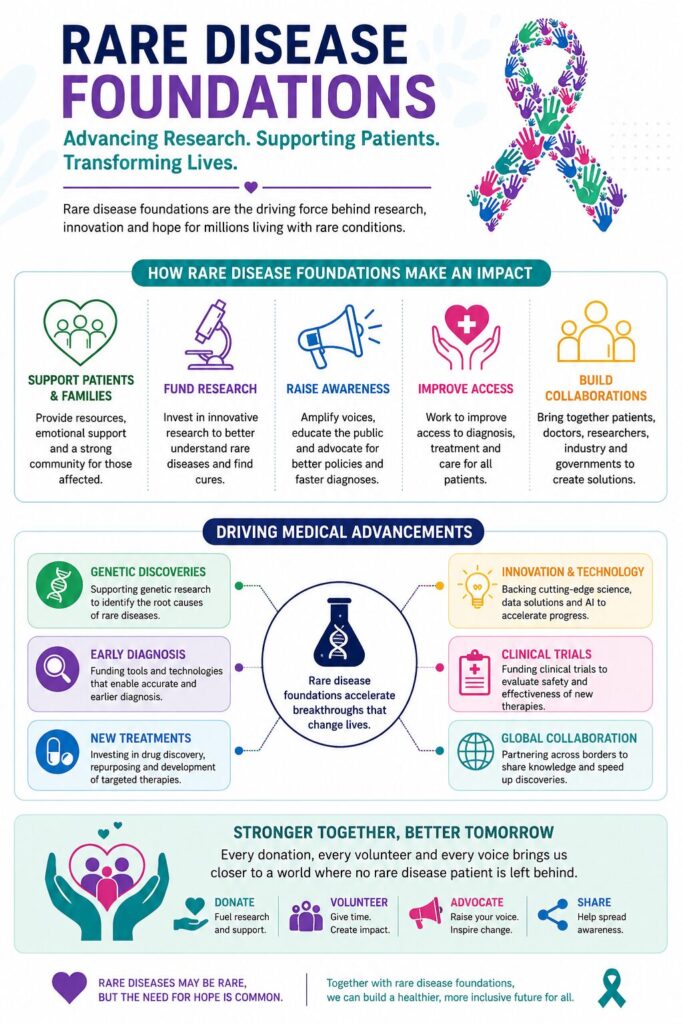
Patient-led organisations, advocacy groups, charitable foundations, and research nonprofits began funding studies, connecting researchers, building patient registries, supporting clinical trials, and amplifying patient voices. Their efforts transformed rare disease research funding from a neglected area into one of the fastest-growing fields in medical innovation.
Today, many of the most significant breakthroughs in genetics, precision medicine, gene therapy, and personalised treatment can be traced back to investments and advocacy efforts initiated by rare disease organisations.
How Have Rare Disease Foundations Contributed to Medical Advancements?
Rare disease foundations have fundamentally changed the pace of medical discovery.
Traditionally, medical research was driven primarily by governments, universities, and pharmaceutical companies. However, rare disease organisations introduced a patient-centred approach that actively identified research gaps and directed resources toward unmet medical needs.
Many foundations began funding early-stage research projects that would otherwise struggle to secure traditional grants. By supporting scientists during the initial phases of investigation, these organisations helped generate the evidence needed to attract larger investments later.
In many cases, rare disease foundations have served as catalysts for innovation. They have funded laboratory studies, established research collaborations, created patient databases, and supported the development of diagnostic tools that have significantly improved understanding of disease.
These efforts have accelerated discoveries in genetics, immunology, molecular biology, and personalised medicine, fields that now benefit not only patients with rare diseases but also individuals with more common medical conditions.
What Role Do Rare Disease Organisations Play in Drug Development?
One of the most important contributions of rare disease patient support organisations is their role in drug development.
Historically, pharmaceutical companies often avoided investing in treatments for rare conditions because the commercial market appeared limited. Rare disease advocacy groups helped change this perception by demonstrating the urgent unmet needs of patients and encouraging public-private collaboration.
Today, many organisations actively participate in every stage of therapy development.
They help researchers identify patient populations, recruit participants for studies, collect natural history data, support regulatory discussions, and provide real-world insights into patient experiences.
Patient registries maintained by rare disease organisations have become especially valuable. These databases allow researchers to better understand disease progression, identify suitable clinical trial participants, and measure treatment outcomes more effectively.
As a result, treatments that once seemed impossible are now becoming realities for conditions previously considered untreatable.
How Rare Disease Research Funding Improves Treatment Options
Rare disease research funding has had a direct impact on treatment innovation.
Many of today’s advanced therapies emerged because nonprofit foundations invested in research years before larger institutions recognised their potential.
Funding from rare disease organisations has supported:
- Gene therapy development
- Precision medicine research
- Biomarker discovery
- Genetic testing innovations
- Advanced diagnostic technologies
The benefits extend beyond rare diseases themselves.
Research conducted for rare conditions often reveals biological pathways that are relevant to common diseases such as cancer, autoimmune disorders, and neurological conditions. This means that investments in rare disease treatment innovation frequently create broader medical benefits for society as a whole.
The growing understanding of genetics and personalised medicine has been heavily influenced by discoveries made through rare disease research programs.
Impact of Rare Disease Foundations on Clinical Trials and Innovation
Clinical trials are often one of the biggest challenges in rare disease treatment development.
Because patient populations are small and geographically dispersed, recruiting participants can be difficult. Rare disease advocacy groups help overcome this barrier by connecting patients, researchers, hospitals, and pharmaceutical companies.
Many rare disease foundations now operate global networks that facilitate trial enrollment and patient engagement.
Their involvement has improved:
- Trial recruitment efficiency
- Patient retention
- Data collection quality
- Awareness of experimental therapies
In addition, these organisations frequently educate patients about emerging treatments and encourage participation in research studies that may advance future care.
Without these efforts, many promising therapies would struggle to reach clinical testing stages.
How Patients With Rare Diseases Get Financial Support for Treatment
While research advancements have created new treatment opportunities, affordability remains a major challenge.
Many rare disease therapies involve:
- Long-term medication
- Specialised hospital care
- Organ transplantation
- Stem cell transplantation
- Advanced genetic testing
- Gene therapies costing lakhs or even crores
To address these challenges, many rare disease support networks provide financial assistance through grants, subsidies, treatment support programs, and charitable partnerships.
Patient advocacy groups also help families identify:
- Government healthcare schemes
- Insurance options
- Clinical trial opportunities
- NGO assistance programs
- Financial aid initiatives
These resources can significantly reduce the financial burden associated with complex and long-term medical care.
How Crowdfunding Helps Rare Disease Patients Access Life-Saving Treatment
Even with grants and support programs, many families continue to face funding gaps.
This is where medical crowdfunding has emerged as a powerful solution.
Crowdfunding allows patients to raise financial support from a larger community through online donations. Families can share their medical journey, treatment requirements, and financial challenges with supporters who want to help.
For many rare disease patients, crowdfunding has become an essential bridge between diagnosis and treatment access.
It helps families:
- Start treatment sooner
- Reduce dependency on loans
- Manage ongoing medical expenses
- Access therapies that may otherwise be unaffordable
Medical crowdfunding also raises public awareness about rare diseases, helping educate communities while generating financial support.
ImpactGuru Support for Rare Disease Treatment Fundraising
In India, ImpactGuru rare disease fundraising campaigns have helped numerous patients access life-saving treatment.
Rare disease treatments often involve prolonged hospitalisation, expensive medicines, advanced surgeries, stem cell transplantation, and specialised care that can place immense pressure on families.
Through ImpactGuru medical crowdfunding, patients can create verified fundraisers and receive support from donors across India and around the world.
ImpactGuru fundraiser campaigns have supported treatment journeys involving:
- Spinal Muscular Atrophy (SMA)
- Rare genetic disorders
- Blood disorders
- Organ transplantation
- Pediatric rare diseases
- Advanced therapeutic interventions
Beyond fundraising, the platform helps families share their stories, reach wider audiences, and build communities of support during some of the most challenging periods of their lives.
As treatment costs continue to rise, crowdfunding is becoming an increasingly important part of the rare disease support ecosystem.
Start an SMA crowdfunding campaign on ImpactGuru to raise funds for spinal muscular atrophy treatment, gene therapy costs, rehabilitation, and ongoing medical expenses
The Future of Rare Disease Research and Patient Advocacy
The future of rare disease research looks significantly more promising than it did just a few decades ago.
Advances in gene editing, artificial intelligence, genomic sequencing, precision medicine, and regenerative therapies are creating once-unimaginable opportunities.
Rare disease advocacy groups continue to play a central role in ensuring these innovations reach patients faster.
Their efforts are helping:
- Improve diagnosis timelines
- Accelerate treatment development
- Expand clinical research
- Increase patient awareness
- Improve healthcare accessibility
As scientific innovation continues to evolve, collaboration between researchers, healthcare providers, patient organisations, governments, and crowdfunding platforms will remain essential.
Conclusion
The relationship between rare disease foundations and medical advancements has become one of the most powerful examples of patient-driven innovation in modern healthcare.
These organisations have transformed research priorities, accelerated drug development, improved diagnosis rates, expanded clinical trials, and created new pathways for treatment access.
Most importantly, they have given hope to millions of families who once faced rare diseases with few resources and limited options.
While significant challenges remain, the progress achieved through rare disease research funding, advocacy, and community support demonstrates what is possible when patients, researchers, and organisations work together toward a common goal.
As treatments become more advanced and accessible, rare disease foundations will continue shaping the future of medicine, and platforms like ImpactGuru will remain important partners in helping patients access the care they need when financial barriers stand in the way.
FAQs
A rare disease is a condition that affects a small percentage of the population. Many rare diseases are genetic and require specialized treatment.
Limited awareness, scarce specialists, and symptoms that resemble common illnesses often lead to delayed or incorrect diagnoses.
Rare disease foundations provide financial assistance, awareness programs, patient advocacy, research support, and access to treatment resources.
Technologies such as Whole-Genome Sequencing (WGS), Whole-Exome Sequencing (WES), and advanced genetic testing have improved diagnostic accuracy.
Many families seek support through government schemes, nonprofit foundations, and medical crowdfunding platforms.
Medical crowdfunding allows patients and families to raise donations online to cover treatment, surgery, and medication costs.
Advances in genomics, gene therapy, precision medicine, and AI-driven healthcare are expected to improve diagnosis and treatment outcomes for rare disease patients.