
Table of Contents
- Quick Summary
- Introduction
- Why Delhi Needs a Strong NGO Ecosystem
- NGOs in Delhi for Child Education
- NGOs in Delhi for Elderly Care
- NGOs in Delhi Working on Disaster Relief and Rural Development
- NGOs in Delhi for Medical Treatment Support
- NGOs in Delhi for Mental Health Support
- NGOs in Delhi for Women’s Safety and Empowerment
- NGOs in Delhi for Environmental Protection
- NGOs in Delhi for Disability Support
- NGOs in Delhi for Emergency Health Response
- How to Choose a Verified NGO in Delhi
- Funding Medical Treatment: Where NGOs and Crowdfunding Meet
- Conclusion
- FAQs
Quick Summary
- Delhi is home to thousands of NGOs, but only a handful have verified registration, transparent finances, and measurable on-ground impact.
- This guide covers NGOs in Delhi working across child rights, elderly care, mental health, disaster relief, and medical support.
- You’ll find the founding year, registration status, core programs, and real impact numbers for each organisation.
- Learn how to verify an NGO’s credibility before you donate or volunteer.
- Find out how online donation platforms make it easier to fund medical treatment and emergency causes directly.
- Bookmark this as a working reference; it’s updated as programs and numbers change.
Introduction
Delhi has one of the highest concentrations of registered NGOs in India, but most “top NGO” lists online repeat the same names without checking whether the data is current, sourced, or even accurate. This guide on NGOs in Delhi takes a different approach: every organisation listed here has been verified against its official website, registration records, and recent program data. Whether you’re looking to volunteer, donate, or simply understand who’s doing credible social work in the capital, from child education to elderly healthcare to disaster relief, this is a researched, fact-checked starting point rather than another recycled directory.
Why Delhi Needs a Strong NGO Ecosystem
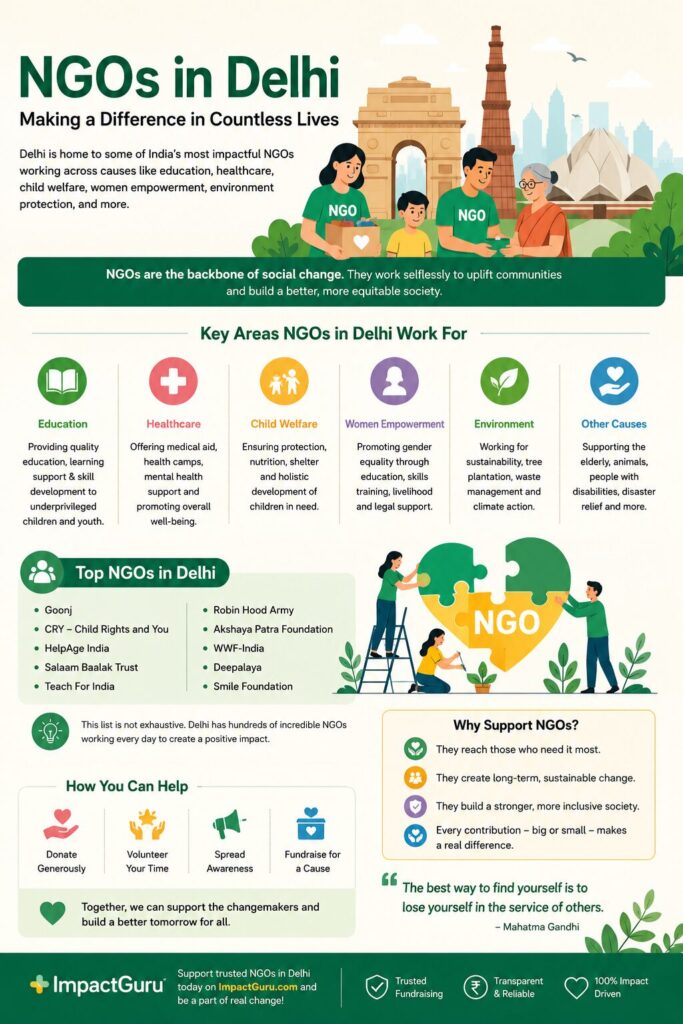
Delhi’s scale creates a unique mix of urban and semi-urban deprivation, slum clusters beside gated colonies, and migrant labour beside government offices. Government welfare schemes rarely reach everyone, and that gap is where NGOs in Delhi step in: running mobile health units, school programs in unauthorised colonies, shelters for the elderly, and emergency relief during floods, heatwaves, or pandemics. The sector is large, but credibility varies sharply; some organisations publish audited financials and annual reports, others exist mostly as donation pages with no verifiable track record. That’s why due diligence matters before you commit your time or money.
NGOs in Delhi for Child Education
In a city with some of India’s best private schools, government data has consistently shown lakhs of children in Delhi’s slums and unauthorised colonies dropping out before completing even primary education. This often happens because of unsafe classrooms, working parents with no childcare alternative, or a single missed school fee. These are the organisations working to close that gap, one child at a time.
Smile Foundation
- It was founded in 2002 and is headquartered in New Delhi.
- Smile Foundation runs more than 400 welfare projects across 25 to 27 states, focused on education, healthcare, livelihood, and women’s empowerment.
- The organisation says it reaches over 20 lakh people annually through these initiatives.
- Its flagship Mission Education program provides schooling support to underprivileged children in urban slums and remote villages.
- The foundation undertakes initiatives such as iTrain on Wheels, in partnership with Berger Paints, and has trained over 3.15 lakh workers across 26 states and three union territories as of late 2025.
CRY (Child Rights and You)
- CRY was founded in Mumbai in 1979 by Rippan Kapur, runs an active Delhi chapter, and is one of India’s oldest child-rights organisations.
- This organisation works with 144 project partners across 20 states.
- CRY has impacted the lives of over 4.7 million children since its founding.
- Unlike pure service-delivery NGOs, CRY also focuses on grassroots-level and public policy advocacy related to children’s rights.
- The organization works across education, health and nutrition, safety, and child participation.
NGOs in Delhi for Elderly Care
Many of Delhi’s elderly, especially in low-income households, spend their final years without regular medical check-ups, mobility support, or even someone to talk to, often because their children have moved away for work or simply cannot afford ongoing care. These organisations step in where family support alone isn’t enough.
HelpAge India
- HelpAge India was founded in 1978 and is headquartered in New Delhi’s Qutab Institutional Area.
- It is India’s oldest and largest NGO dedicated to the elderly.
- It has earned the first NGO in India honoured with the UN Population Award in 2020, for its work supporting disadvantaged elderly during the pandemic, and for advocating for older persons’ rights.
- HelpAge India runs Mobile Healthcare Units that have reached over 800,000 elders, provided 12,000 with spectacles, and performed 15,000 cataract surgeries.
- The NGO also operates a tele-health programme and the Saarthak mental health initiative for seniors.
- HelpAge India reaches approximately 2 million disadvantaged elderly directly and indirectly every year through 26 state offices across the country.
Agewell Foundation
- Agewell Foundation was established in 1999 by Himanshu Rath and is headquartered in Lajpat Nagar, New Delhi.
- It takes a network-driven approach to elder care, built around a two-tier structure of over 7,500 primary and 80,000 secondary volunteers spread across more than 768 districts in India.
- Its AgeWell Helplines for older persons have reportedly assisted over 8.2 million elderly people since 1999.
- The NGO has interacted with roughly 25,000 older persons daily through its volunteer network.
- It has held Special Consultative Status with the UN Economic and Social Council (ECOSOC) since 2011.
- Agewell Foundation also sits on government policy bodies, including NITI Aayog’s CSO Standing Committee on elderly care, giving it an advocacy role that complements HelpAge India’s more clinical, healthcare-camp-driven model.
- Donations made to this NGO qualify for an 80G tax exemption.
NGOs in Delhi Working on Disaster Relief and Rural Development
When floods, earthquakes, or cyclones hit, it’s usually the same communities, daily-wage workers, slum residents, rural migrants, who lose the little they have, with no insurance and no safety net to fall back on. Delhi is home to one of India’s most distinctive social enterprises, responding to this exact gap by turning city waste into rural infrastructure and disaster relief.
Goonj
- Goonj was founded in New Delhi in 1999 by Magsaysay Award winner Anshu Gupta.
- Disaster management and relief is one of Goonj’s core functions, run through its dedicated “Rahat” (Disaster Relief and Rehabilitation) initiative, which has responded to major calamities like earthquakes, tsunamis, cyclones, and floods for nearly two decades.
- Rather than a one-time charity, Goonj focuses on community-led rehabilitation: it uses surplus urban materials like clothing and household essentials as a reward for local villagers who rebuild their own communities, whether that’s clearing ponds, repairing roads, or restoring drainage systems.
- This same “Cloth for Work” model converts discarded urban material into a resource for everyday rural development, separate from disaster response.
- The NGO has organised over 55,000 development projects and mobilised more than 45 million kilos of urban material over its last eight years of reported activity.
- It supports work like building bamboo bridges, digging wells, and repairing rural infrastructure.
- Its model has been studied as a Harvard Business School case for rethinking how value is created in development work.
NGOs in Delhi for Medical Treatment Support
A medical emergency can derail a family’s life within days, not just because of the diagnosis itself, but because hospital bills, transport, and the cost of being away from work pile up faster than most families can manage. These organisations work to ease that exact burden, from getting a sick child to the hospital in time to staying by a family’s side through treatment.
Uday Foundation
- Based in New Delhi, Uday Foundation was established by Rahul Verma after his own son was born with multiple congenital defects.
- It runs a children’s ambulance service supporting emergency hospital transport for sick children, including transfers to the AIIMS Children’s Cancer OPD.
- This NGO organises free medical camps across Delhi NCR, Jammu & Kashmir, Uttar Pradesh, Uttarakhand, and Haryana.
- The core focus of the Uday Foundation is supporting families of children with congenital conditions, critical illnesses, and disorders that affect long-term health and development.
- It also provides food and essentials to patient caregivers who often spend weeks at a hospital with no support system.
CanKids KidsCan
- Founded in 2004 by Poonam Bagai, a cancer survivor herself, under the Indian Cancer Society in Delhi.
- Registered as an independent national society in 2012, holding valid 12A, 80G, and FCRA certifications.
- India’s only NGO working across the entire spectrum of childhood cancer care, from early detection and diagnosis to treatment and long-term survivorship, through its signature YANA (“You Are Not Alone”) program.
- Currently partners with over 140 cancer-treating hospitals across 22 states
- In FY 2025–26, helped catalyse access to care for over 42,000 children, directly supporting more than 26,000 with treatment costs and holistic care.
- Works through a “Sajhakaran” shared-care partnership with state government health departments to identify children with cancer in remote districts and get them into treatment early, addressing exactly the financing gap where families often can’t cover diagnosis or treatment costs on their own.
Organisations like Uday Foundation highlight a gap that NGOs alone can’t always close: the direct cost of treatment itself. Surgeries, chemotherapy, dialysis, and organ transplants in Delhi’s private hospitals often run into lakhs of rupees, and most NGOs can offer logistical or material support rather than funding the treatment bill in full. This is where families increasingly turn to medical crowdfunding platforms like ImpactGuru alongside NGO support.
NGOs in Delhi for Mental Health Support
Mental health struggles are still met with silence in many Delhi households, leaving people in genuine distress with nowhere safe to turn and no one trained to simply listen without judgment. This organisation has quietly filled that silence for almost five decades.
Sanjivini Society for Mental Health
- Established in 1976, Sanjavini Society for Mental Health is a registered non-profit voluntary organisation.
- It has addressed the community’s mental health needs for over four decades
- This NGO operates a counselling helpline for people experiencing distress, anxiety, and suicidal thoughts.
- It also trains volunteers to provide non-judgmental, confidential listening support, a model similar to crisis helplines elsewhere in the country.
NGOs in Delhi for Women’s Safety and Empowerment
For many women in Delhi facing domestic violence, dowry harassment, or trafficking, the hardest part is often finding a safe place to go and someone who will believe them. This organisation was born directly out of that need, founded by mothers who refused to let other daughters face what theirs did.
Shakti Shalini
- Shakti Shalini was founded in January 1987 by Shahjehan Aapa and Satya Rani Chadha, both mothers who lost daughters to dowry deaths.
- It is a Delhi-based NGO that played a pioneering role in campaigning for India’s anti-dowry and domestic violence laws.
- This NGO has established the first shelter home for women in distress in Delhi, called Pehchan, which continues to provide rehabilitation, safety, and support to survivors of gender and sexual violence, including trafficking survivors.
- It runs a Crisis Intervention and Counselling Centre offering legal, medical, and mental health support.
- Shakti Shalini directly responds to gender and sexual violence cases at 19 police stations across South-East Delhi.
- It also runs community outreach and skills-development programs across five socio-economically marginalised communities in Delhi.
NGOs in Delhi for Environmental Protection
Behind Delhi’s waste management system are thousands of waste pickers doing essential, hazardous work with little recognition, fair pay, or safety protection, while their children are often pulled into the same cycle instead of school. This organisation has spent over two decades treating that injustice as both an environmental and a human rights issue.
Chintan Environmental Research and Action Group
- Founded in December 1999 by Bharati Chaturvedi, this is a Delhi NCR-based NGO that treats waste as a tool to fight poverty rather than just an environmental problem.
- It has organised over 17,000 waste pickers through an association called Safai Sena, with half of its leadership positions held by women.
- Chintan Group has trained over 50,000 waste workers in safety and legal protocols.
- Its No Child in Trash programme has mainstreamed more than 10,000 children of waste pickers into formal government schools, with around 70% of them girls.
- It operates nine micro material-recovery facilities and one automated facility across Delhi NCR.
- The organisation received the United Nations Momentum for Change Award in 2015, in the Urban Poor category, for its e-waste work.
NGOs in Delhi for Disability Support
Children and adults with disabilities in Delhi often face a double burden: limited access to therapy, education, or employment, and a society that hasn’t built enough room for them to participate fully. This organisation has worked on exactly that inclusion gap for over four decades.
AADI (Action for Ability Development and Inclusion)
- AADI was started in 1978 as a small special-education centre for children with cerebral palsy under the name “The Spastics Society of Northern India.”
- Formally re-registered under its current name in 2002, it is headquartered in Hauz Khas, New Delhi.
- AADI is now a national-level organisation working across physical, intellectual, cognitive, sensory, and multiple disabilities.
- Its programs span early education, schooling, employment, speech and communication therapy, and mental health support.
- The NGO has directly worked with more than 10,000 people affected by disability annually.
- It has also trained over 3,000 professionals over the years, while also contributing to disability-rights legislative reform in India.
- Donations made to AADI qualify for tax exemption under Section 80G.
NGOs in Delhi for Emergency Health Response
Emergencies don’t wait for the right time, whether it’s a sudden accident needing blood within hours or a disaster displacing entire neighbourhoods overnight, and Delhi needs reliable, always-on infrastructure to respond. This century-old institution has been the backbone for over a hundred years.
Indian Red Cross Society, Delhi Branch
- Founded in 1920 under the Indian Red Cross Society Act, it is headquartered in New Delhi and operates as an auxiliary to India’s public health and humanitarian authorities.
- It has a network of over 1,200 branches nationwide.
- The Delhi Branch runs entirely on public donations, with no government grant-in-aid.
- Provides relief to victims of natural and man-made disasters across the National Capital Territory.
- Its National Headquarters Blood Centre in Delhi operates a 24/7 blood-issuing service and runs regular blood donation camps.
- It also maintains dedicated funds for thalassemia patients and disaster relief.
- This NGO is a part of the global International Red Cross and Red Crescent Movement, combining grassroots emergency response with the credibility of a century-old international institution.
How to Choose a Verified NGO in Delhi
Before you donate or volunteer, run through this checklist:
- Registration status: Look for 12A and 80G certification (income tax exemptions), or registration as a Trust, Society, or Section 8 company.
- Financial transparency: Credible NGOs publish annual reports and audited financial statements on their own website.
- Program specificity: Vague claims (“we help the poor”) are a red flag; credible NGOs name specific programs, locations, and numbers.
- Third-party validation: Certifications like GuideStar India, CRISIL NGO grading, or Credibility Alliance accreditation add an extra layer of trust.
- Direct contact: A real NGO will have a physical address, working phone number, and staff who can answer specific questions about fund usage.
Read More : Raise funds for NGO in india
Funding Medical Treatment: Where NGOs and Crowdfunding Meet
NGO support is invaluable for logistics, awareness, and partial relief, but when a family needs a donation for medical treatment urgently, the gap between an NGO’s capacity and the actual hospital bill can be large. This is exactly the problem online donation platforms were built to solve.
If you or someone you know needs a donation for medical treatment, platforms like ImpactGuru let you start a fundraiser in minutes, share it across your network, and receive contributions directly toward verified hospital bills. If you’re wondering how to raise funds for medical treatment, the process typically involves documenting the diagnosis, getting a cost estimate from the hospital, and creating a transparent campaign that supporters can trust. Choosing the right online donation platform matters here; look for one that verifies medical documents, disburses funds directly to hospitals, and provides regular updates to donors. For many Delhi families dealing with cancer, organ transplants, or paediatric emergencies, the ability to raise donations online has become as critical as the NGOs themselves in closing the final, hardest gap: paying for care itself.
Conclusion
Delhi’s NGO sector spans decades of credible work, from HelpAge India’s four decades in elder care to Goonj’s award-winning rural development model and Uday Foundation’s hands-on support for sick children. The organisations listed here have verifiable registration, named programs, and reported impact numbers, making them a reliable starting point whether you want to volunteer, donate goods, or simply understand who’s doing real work on the ground. But for medical emergencies that outpace what any single NGO can fund, an online donation platform built for fast, transparent fundraising is often the fastest path to the amount a family actually needs. If you’re facing a medical cost that feels out of reach, start a fundraiser today and let your community help you raise the funds that matter most.
FAQs
There’s no single “best” NGO; it depends on the cause you care about. HelpAge India is among the most established for elderly care, CRY and Smile Foundation for child welfare, Goonj for rural development and disaster relief, and Uday Foundation for direct medical and caregiver support. Always check an NGO’s 12A/80G registration and published financials before donating.
Check for 12A and 80G certification under the Income Tax Act, look for audited annual reports on the NGO’s own website, confirm a physical address and working contact number, and look for third-party validation such as GuideStar India or CRISIL NGO grading. Genuine NGOs are specific about their programs and impact numbers rather than being vague.
Most established NGOs in Delhi, including Smile Foundation, HelpAge India, Goonj, CRY, AADI, and the Indian Red Cross Society, hold 80G registration, which allows donors to claim a tax deduction under the Income Tax Act. Always ask for an 80G receipt at the time of donation.
Uday Foundation supports families of children with congenital conditions and critical illnesses, including emergency hospital transport and caregiver support. However, most NGOs offer logistical or partial support rather than funding full treatment costs; for the complete hospital bill, families often turn to online donation platforms like ImpactGuru to raise funds directly.
An NGO typically runs ongoing programs funded by donor contributions and allocates resources based on its own assessment of need. A crowdfunding platform lets an individual patient or family raise funds directly from their personal network and the public for a specific, verified medical expense, with funds usually disbursed straight to the hospital.
Yes. Most NGOs listed here, including Shakti Shalini, AADI, Chintan, and the Indian Red Cross, accept volunteers for counselling support, community outreach, skills training, and disaster response. Reach out directly through their official websites to ask about current volunteer openings.