
Table of Contents
- Quick Summary
- Introduction
- What Are Online Platforms for NGO Fundraising?
- How Donation, Crowdfunding & Volunteering Platforms Differ
- Online Crowdfunding for Medical Treatment
- Medical Crowdfunding India: Key Players Compared
- NGO Donation Platforms: GiveIndia, GlobalGiving & Corporate Giving
- Volunteering Platforms: How They Work and Where They Fit
- What Works Best for Newcomers?
- Comparison Table: Platforms at a Glance
- Conclusion
- Frequently Asked Questions
Quick Summary
- Online platforms for NGO fundraising fall into three core types: donation platforms, crowdfunding sites, and volunteering platforms, and each serves a different fundraising goal.
- Crowdfunding platforms like ImpactGuru, Milaap, and Ketto are built for individual and medical fundraising, while GiveIndia and GlobalGiving specialize in verified NGO donations.
- Fees, fund disbursement speed, and donor trust signals vary significantly across platforms, and these differences matter more for newcomers than feature lists do.
- Medical crowdfunding in India has grown into a multi-platform ecosystem, with most major sites now offering 0% platform fee models funded by voluntary donor tips.
- Volunteering platforms operate on a completely different model from donation platforms; they match time and skills instead of money.
- For someone fundraising for the first time, the right platform is usually the one with the simplest setup, fastest verification, and the most hands-on support, not necessarily the one with the most features.
Introduction
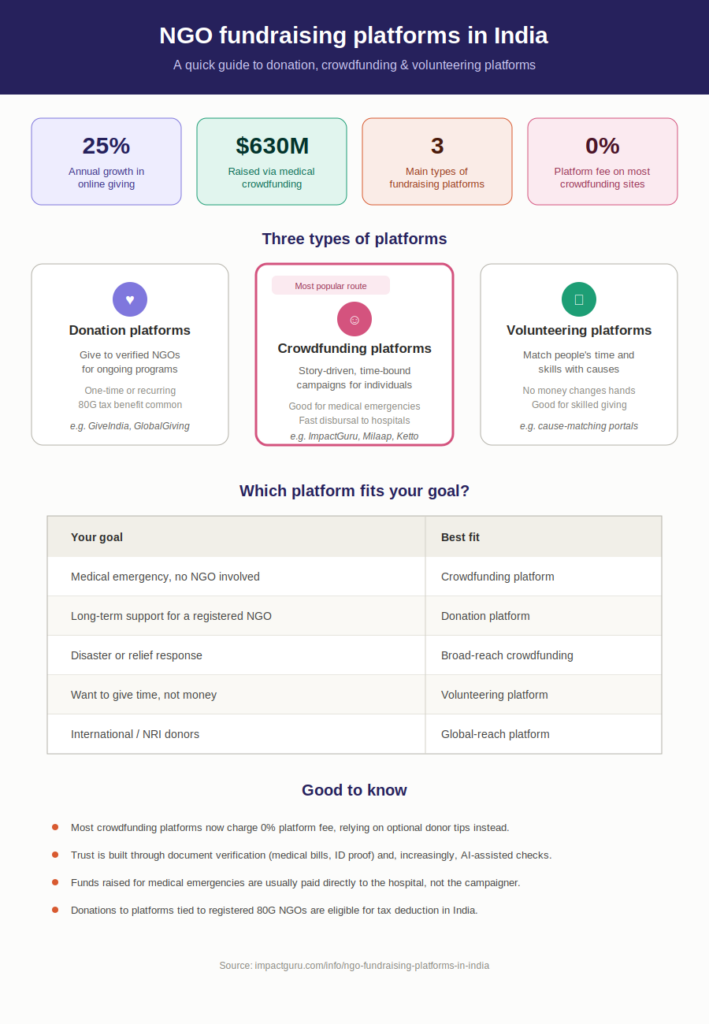
Online medical crowdfunding in India is growing by 25% annually, with medical fundraising campaigns now drawing close to $630 million in contributions, a scale few traditional charity channels can match. Yet for someone fundraising for the first time, that growth doesn’t make the choice any easier: online platforms for NGO fundraising aren’t one-size-fits-all tools. Some are built for one-time medical emergencies, others for long-term NGO donor relationships, and others purely for volunteer time rather than money. Picking the wrong type can cost weeks during a crisis. This guide breaks down how donation, crowdfunding, and volunteering platforms actually differ, with a closer look at India’s medical crowdfunding landscape, so first-time fundraisers can choose with confidence.
What Are Online Platforms for NGO Fundraising?
Online platforms for NGO fundraising are digital tools that let nonprofits, individuals, and causes collect money, recruit volunteers, or run awareness campaigns without needing their own payment infrastructure or donor database. Broadly, they fall into three categories:
- Donation platforms: built for ongoing, often recurring, giving to registered NGOs (e.g., GiveIndia, GlobalGiving)
- Crowdfunding platforms: built for time-bound, story-driven campaigns, often for individuals (e.g., ImpactGuru, Milaap, Ketto, GoFundMe)
- Volunteering platforms: built to match people’s time and skills with NGO needs, not money
The right one depends entirely on what’s being raised: money for a registered charity, money for a personal medical emergency, or hours and skills for a cause.
Read More : Mumbai NGOs & Charities: Complete Guide (2026)
How Donation, Crowdfunding & Volunteering Platforms Differ
This is the question most newcomers actually need answered, so here’s a detailed, side-by-side breakdown across the factors that matter most.
1. Who They’re Built For
Donation platforms are designed around verified, registered NGOs. GiveIndia, for instance, curates a vetted list of charitable organizations, which is part of why it’s particularly trusted by corporate donors and workplace giving programs. Crowdfunding platforms, by contrast, are built for individuals and families; someone doesn’t need to run an NGO for starting medical fundraising on ImpactGuru, Milaap, or Ketto. Volunteering platforms sit apart from both: they connect people’s time, not their money, to causes that need hands-on help.
2. Fee Structures
Most major Indian crowdfunding platforms, including ImpactGuru, Milaap, Ketto, and Crowdera, now operate on a 0% platform-fee model, funded instead by voluntary donor tips, though payment-gateway and compliance charges may still apply. Donation platforms working with registered NGOs often build small processing fees into the donation flow, since they handle recurring billing and tax receipting at scale. Volunteering platforms are typically free for both NGOs and volunteers, since no money changes hands through the platform itself. The smarter question isn’t “which platform charges 0%,” almost all the major ones do; it’s which platform gets a campaign to its goal fastest once gateway and compliance costs are accounted for.
3. Speed of Fund Disbursement
For medical emergencies, speed is often the deciding factor. Verified fundraisers on platforms like ImpactGuru can go live within hours, with funds disbursed directly to a bank account or hospital within days of a withdrawal request. Donation platforms working through NGOs typically move at the pace of the NGO’s own disbursement cycle, which can be slower since funds are pooled and allocated across programs rather than released to a single urgent case.
4. Verification & Trust Signals
Genuine platforms verify campaigns before they go live, using document checks (medical reports, hospital estimates, ID proof), encrypted payment gateways, and visible fund-tracking. On platforms like ImpactGuru, AI-powered document verification does an initial review, followed by a human verification team, a two-layer check that builds donor confidence faster than a manual-only review. Donation platforms add a different trust layer: NGO registration status, 80G tax exemption eligibility, and audited fund utilization reports.
5. Reach and Discovery
Crowdfunding platforms rely heavily on peer-to-peer sharing, WhatsApp, Instagram, and Facebook, so reach depends on the fundraiser’s own network as much as the platform’s donor base. Donation platforms lean on the platform’s existing donor and corporate network, which is why they work well for NGOs without a large personal following. Volunteering platforms match supply and demand directly; a volunteer searches by skill or location, and an NGO posts what it needs.
6. Best Fit by Goal
| Your Goal | Best Platform Type |
| Medical emergency, no NGO affiliation | Crowdfunding platform (ImpactGuru, Milaap, Ketto) |
| Long-term NGO donor relationships, CSR funding | Donation platform (GiveIndia, GlobalGiving) |
| One-time relief or disaster response | Crowdfunding platform with broad public reach (Ketto) |
| Offering time/skills instead of money | Volunteering platform |
| International or NRI donor access | Global platform (GoFundMe, GlobalGiving) |
Online Crowdfunding for Medical Treatment
Medical crowdfunding is the process of raising funds for healthcare costs, surgeries, cancer treatment, transplants, or rehabilitation from a large number of online donors. Unlike a bank loan, the money raised doesn’t need to be repaid. Unlike traditional charity, it’s personal, direct, and fast.
A typical medical crowdfunding campaign follows a simple flow:
- Select the cause (medical treatment, NGO support, or social cause)
- Enter campaign details: beneficiary name, condition, and target amount
- Upload supporting documents: medical reports, hospital bills, doctors’ letters
- Share the campaign across WhatsApp, Instagram, Facebook, and email
- Receive funds, often disbursed directly to a bank account or hospital within days
This is also where document quality matters most. A diagnosis report, a hospital cost estimate, a doctor’s letter, identity proof, and bank details are the standard documents most platforms require before a campaign goes live, and having them ready upfront is one of the biggest factors in how fast a campaign gets approved.
Medical Crowdfunding India: Key Players Compared
India’s medical crowdfunding ecosystem has matured into a multi-platform space, and the major names differ less on fees (most have moved to 0% platform fee models) and more on speed, support, and specialization.
- ImpactGuru combines a 0% platform fee option with AI-powered document verification, dedicated campaign specialists on select plans, and direct hospital disbursement, features that matter most for urgent medical cases where every day counts.
- Milaap, founded with a rural-fundraising focus, has grown into one of India’s largest crowdfunding platforms and operates on a 0% fee model funded by voluntary tips, particularly suited to campaigns with strong, India-centric social networks.
- Ketto, one of India’s oldest crowdfunding platforms, runs a dedicated “Urgently Funds Required” section for time-sensitive medical cases and allows campaigners to withdraw funds even before the full target is reached.
- GiveIndia, while not primarily a medical crowdfunding site, is a credible option when a patient’s fundraiser is run through a registered NGO, particularly for donors seeking 80G tax benefits.
For anyone comparing crowdfunding for medical treatment specifically, the practical differences come down to: how fast a campaign gets verified, how directly funds reach a hospital, and how much hands-on support is available during an already stressful time.

Read More : 0% Fee Crowdfunding Platforms in India (2026)
NGO Donation Platforms: GiveIndia, GlobalGiving & Corporate Giving
For NGOs focused on long-term donor relationships rather than one-off emergencies, donation platforms serve a different purpose entirely. GiveIndia has built particular credibility with corporate donors and workplace giving programs, thanks to its curated, vetted list of charitable organizations and recurring-donation infrastructure. GlobalGiving extends that model internationally, giving Indian NGOs access to a global donor base and NRI giving networks. Razorpay, while not a crowdfunding platform at all, offers payment-page infrastructure that lets established NGOs and hospitals collect donations directly, useful for institutions that already have a donor base and want full control over branding and donor data.
The common thread: these platforms work best when an NGO already has a registration, a track record, and a donor base it wants to deepen, not when an individual needs fundraising fast for a personal emergency.
Volunteering Platforms: How They Work and Where They Fit
Volunteering platforms solve a completely different problem from donation and crowdfunding platforms: they match time and skills, not money, to causes that need them. Understanding how they differ matters just as much for newcomers who want to contribute without donating.
How the model works: Instead of a donation flow, volunteering platforms run on a matching system. An NGO posts a need for event support, skilled work like graphic design or legal advice, on-ground community work, or remote tasks like content writing, and volunteers browse or get matched based on location, availability, and skill set. There’s no payment processing involved, no platform fee, and usually no campaign page to build.
What NGOs use them for: Recruiting event-day volunteers for fundraisers and awareness drives, sourcing skilled pro bono help, and building a recurring volunteer base for ongoing programs rather than one-time campaigns.
How it differs from giving money:
- Commitment type: Volunteering is time-bound and often recurring, while donations and crowdfunding are typically one-time financial contributions.
- Verification needs: Volunteering platforms verify identity and sometimes run background checks, rather than verifying medical documents or fund usage.
- Reach mechanism: Volunteers usually discover opportunities by browsing causes near them, rather than NGOs pushing campaigns through social sharing, the way crowdfunding does.
- Outcome measured: Success is measured in hours contributed or tasks completed, not funds raised.
For someone who isn’t in a position to donate but still wants to support a cause, a volunteering platform is often the more natural starting point, and for NGOs, it’s a way to build a supporter base that may convert into donors later.
What Works Best for Newcomers?
For someone fundraising or giving for the first time, the simplest answer is: start with the platform that matches your specific situation, not the one with the most features.
- Fundraising for a medical emergency with no NGO affiliation? A dedicated medical crowdfunding platform with fast verification and direct hospital disbursement is the most practical starting point.
- Donating to a cause and getting tax benefits? A donation platform with verified, registered NGOs and 80G eligibility is the safer first move.
- Want to help without money? A volunteering platform removes the friction of campaign-building entirely. Sign up, get matched, and contribute time.
- Running an NGO with no existing donor base? A combination of a crowdfunding or donation platform (for reach) and owned payment infrastructure (for control) tends to work better long-term than relying on just one.
Across all categories, newcomers consistently do better on platforms offering dedicated support, a relationship manager, a verification team, or campaign guidance, rather than self-serve tools alone, since the learning curve on a first campaign is steep, and the cost of a slow or rejected one can be measured in lost time during a crisis.
Comparison Table: Platforms at a Glance
| Platform Type | Examples | Typical Fee Model | Best For | Disbursement Speed |
| Medical Crowdfunding | ImpactGuru, Milaap, Ketto | 0% platform fee + donor tips | Medical emergencies, individuals | Days, often direct to the hospital |
| NGO Donation Platform | GiveIndia, GlobalGiving | Small processing fee | Registered NGOs, CSR, recurring giving | Tied to NGO disbursement cycles |
| Global Crowdfunding | GoFundMe, Crowdera | Processing fees apply | International reach, NRI donors | Varies by region |
| Payment Infrastructure | Razorpay Payment Pages | Lower per-transaction cost | Established institutions with their own donor base | Near-instant to bank account |
| Volunteering Platforms | Cause-matching portals | Free | Contributing time/skills, not money | Not applicable |
Conclusion
Choosing between donation, crowdfunding, and volunteering platforms isn’t about finding the “best” one overall; it’s about matching the platform to the goal. Medical emergencies call for speed and verification. NGO donor relationships call for trust and tax efficiency. Volunteering calls for simple, frictionless matching. For newcomers, especially, the right starting point is the platform that reduces complexity at the moment it matters most. If a medical or personal cause needs urgent support, start a free fundraiser on ImpactGuru and get dedicated help from document upload to fund disbursement, built for exactly this first-time moment.
Frequently Asked Questions
Donation platforms are built around verified, registered NGOs and long-term donor relationships, while crowdfunding platforms are built for time-bound, story-driven campaigns that individuals can start directly, with or without NGO affiliation.
Yes, donation-based crowdfunding is legal in India. Personal donations raised for medical needs are generally treated as gifts and are not taxable, though maintaining medical records and clear documentation of fund usage is important.
For a first medical campaign, a platform offering fast verification, direct hospital disbursement, and dedicated campaign support tends to work best, since speed and guidance matter more than feature breadth when time is limited.
No. Individuals can directly start fundraising campaigns on most crowdfunding platforms without NGO affiliation, though campaigns run through a registered NGO may make donors eligible for 80G tax benefits.
A volunteering platform matches people’s time and skills to NGO needs with no money changing hands, while a donation platform processes financial contributions to registered causes.
On most established medical crowdfunding platforms, funds can be disbursed within a few working days of a withdrawal request, often directly to the hospital or beneficiary’s bank account.