


Last updated: 29 July, 2026
Milia are small, firm, white or yellow bumps that form just under the skin when keratin (a skin protein) gets trapped instead of shedding normally. They’re harmless, not contagious, and extremely common in newborns — affecting an estimated 40–50% of babies. Most milia clear up on their own within a few weeks to months. Adults can get them too, and adult milia often need gentle exfoliation or a professional extraction to clear.
Read more: White Spots on Skin: Symptoms, Causes & Treatments
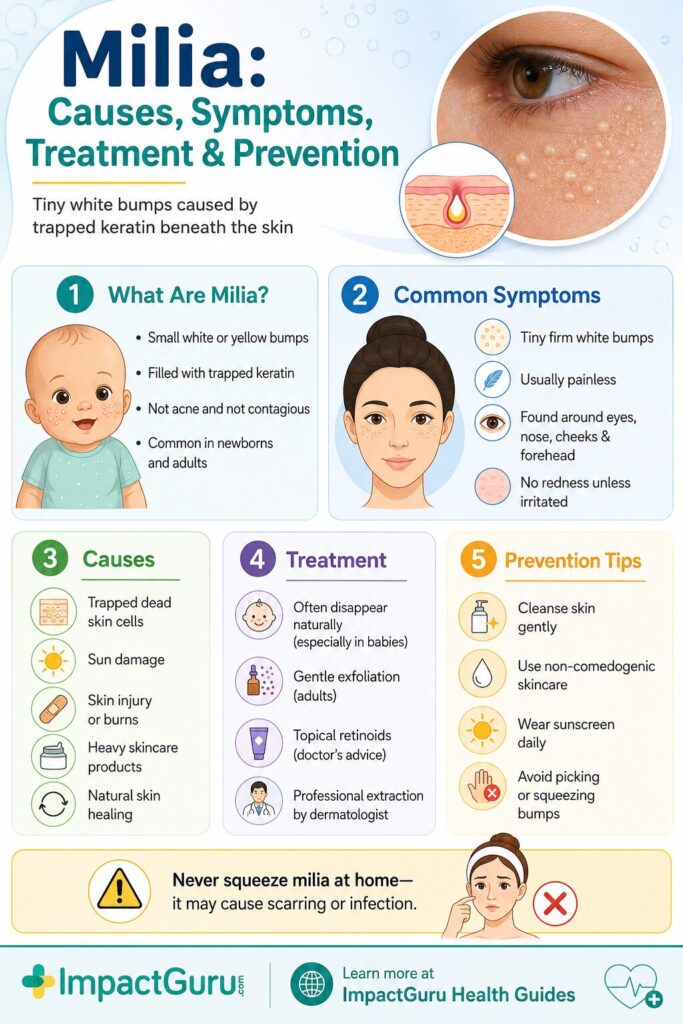
Table of Contents
- What Is Milia?
- Milia vs. Whiteheads vs. Acne
- Types of Milia
- Symptoms of Milia
- How Common Is Milia?
- What Causes Milia?
- How Is Milia Diagnosed?
- How to Treat Milia
- How Much Does Milia Treatment Cost in India?
- Home Care Tips
- Is Milia Contagious?
- Milia vs. Baby Acne
- How to Prevent Milia
- When to See a Dermatologist
- Conclusion
- FAQs
What Is Milia?
Milia (singular: milium) are tiny cysts, usually 1–2 millimeters wide, that form when keratin becomes trapped beneath the surface of the skin instead of shedding normally. They look like small, firm, pearly white or yellowish bumps and most commonly appear around the eyes, on the nose, cheeks, and forehead — though they can show up anywhere on the body.
Unlike pimples, milia don’t have an opening to the skin’s surface, which is why they can’t be popped or squeezed out the way a whitehead can.
Milia vs. Whiteheads vs. Acne
Milia are frequently mistaken for whiteheads, but they’re a different condition entirely. This distinction is one of the most common things people search for, so here’s a side-by-side comparison:
| Feature | Milia | Whiteheads (Acne) |
|---|---|---|
| Cause | Trapped keratin under the skin | Clogged pore (oil + dead skin + bacteria) |
| Texture | Hard, firm, dome-shaped | Softer, can be squeezed |
| Can you pop it? | No — no opening to the surface | Yes, though not recommended |
| Pain or redness | None | Can be tender or inflamed |
| Common triggers | Sun damage, heavy skincare, skin trauma | Hormones, oil production, bacteria |
| Typical resolution | Weeks to months, or professional extraction | Responds to acne treatment (benzoyl peroxide, salicylic acid) |
Read More : Child Health / Baby Crowdfunding
Types of Milia
Dermatology classifies milia into primary and secondary forms, with several recognized subtypes:
- Primary milia – Form spontaneously, with no underlying skin injury. Extremely common in newborns (neonatal milia), where they typically clear within a few weeks. In adults, primary milia can take longer to resolve on their own.
- Secondary milia – Develop after skin trauma, such as burns, blistering skin conditions, prolonged sun damage, or use of heavy, pore-clogging skincare products. Secondary milia tend to be more persistent than primary milia.
- Neonatal milia – The newborn form of primary milia; resolves on its own in most infants.
- Juvenile milia – Occurs in older children; sometimes linked to rare inherited conditions when widespread or recurrent.
- Milia en plaque – A rare variant where milia cluster into a raised, thickened patch, most often on the eyelids or behind the ears.
- Multiple eruptive milia – A less common presentation involving clusters of milia appearing over the face, upper arms, and torso over a period of weeks.
Symptoms of Milia
- Small white or yellow bumps, typically 1–3mm, with a smooth, pearly surface
- Firm texture — unlike a pimple, milia don’t compress or drain
- No pain or itching in typical cases; this is a cosmetic concern, not a medical one
- Common locations: eyelids, under-eye area, nose, cheeks, forehead; less commonly the chest, back, or genital area
- Occasional mild redness — usually only if the area has been picked at, rubbed, or irritated
How Common Is Milia?
Milia is one of the most common benign skin findings in newborns, affecting roughly 40–50% of babies at birth or shortly after. It’s also common in older children and adults, though it tends to appear less frequently and can persist longer without treatment as skin ages and cell turnover slows.
What Causes Milia?
The root cause of milia is keratin becoming trapped beneath the skin instead of exfoliating away normally. Several factors increase the likelihood of this happening:
- Immature skin (newborns): A baby’s skin glands and pores are still developing, which makes it harder for dead skin cells to shed normally in the first weeks of life.
- Sun damage: Prolonged UV exposure thickens the outer layer of skin and disrupts normal exfoliation, which is a well-documented trigger for adult milia — particularly on frequently sun-exposed areas like the cheeks and forehead.
- Skin trauma: Burns, blistering, dermabrasion, rashes, and even tattoos can all trigger secondary milia as skin heals.
- Heavy or comedogenic skincare products: Thick creams, oil-based makeup, and occlusive ointments can trap keratin under the skin.
- Underlying skin conditions: Blistering disorders such as epidermolysis bullosa are associated with a higher likelihood of developing milia.
- Genetics: Some rare inherited conditions are linked to widespread or recurring milia, though this is uncommon in the general population.
It’s worth noting that dermatology research still doesn’t fully explain why milia forms in every case — for many adults, there’s no single identifiable trigger.
How Is Milia Diagnosed?
Milia is typically diagnosed through a simple visual skin exam by a dermatologist or your regular doctor — no lab tests are usually needed, since the bumps have a distinctive appearance. Your provider may ask about your skincare routine, sun exposure, and any recent skin trauma. A skin biopsy is only recommended in rare cases where the diagnosis is unclear or another skin condition needs to be ruled out.
How to Treat Milia
Most milia resolve on their own and don’t require treatment — especially in newborns. When milia is persistent or bothersome (more common in adults), a dermatologist may recommend:
- Watchful waiting: The default approach for newborn milia, which usually clears within four weeks without any intervention.
- Topical retinoids (e.g., tretinoin): Speed up skin cell turnover, helping trapped keratin shed naturally.
- Chemical peels: Use acids to exfoliate the outer skin layer and help release trapped keratin.
- Microdermabrasion: A non-invasive exfoliation technique for the skin’s surface layer.
- Professional extraction: A dermatologist uses a sterile tool to lance and remove the milium. This should only be done professionally — attempting this at home risks scarring and infection.
- Laser treatment or electrodesiccation: Used for stubborn, widespread, or recurrent milia, particularly milia en plaque.
- Cryotherapy: Freezing the milium with liquid nitrogen to destroy the cyst.
Never try to squeeze, pick, or pop milia yourself. Because there’s no natural opening to the skin’s surface, attempting to extract milia at home commonly causes scarring or infection rather than removing the bump.
How Much Does Milia Treatment Cost in India?
Milia treatment is generally inexpensive since it’s a minor cosmetic procedure — but costs vary depending on the method, the number of bumps, and the clinic you choose.
| Treatment | Typical Cost Range (India) |
|---|---|
| Dermatologist consultation | ₹500 – ₹1,500 |
| Manual extraction (per session) | ₹1,500 – ₹5,000 |
| Chemical peel | ₹2,000 – ₹6,000 per session |
| Microdermabrasion | ₹1,500 – ₹4,000 per session |
| Laser treatment | ₹4,500 – ₹20,000 depending on area and clinic |
| Cryotherapy | ₹1,000 – ₹3,000 per session |
Note: Prices vary significantly by city, clinic reputation, and the number of milia being treated. These are general market ranges, not fixed rates — always confirm pricing directly with your dermatologist.

Home Care Tips
While professional treatment is the most reliable route for stubborn milia, these habits can support clearer skin:
- Cleanse gently, twice daily, with a mild, non-comedogenic cleanser.
- Choose non-comedogenic skincare and makeup to reduce pore blockage.
- Exfoliate regularly (2–3 times a week) with a gentle chemical exfoliant, such as one containing glycolic acid or salicylic acid — avoid harsh physical scrubbing, which can irritate skin.
- Use a warm compress occasionally to help soften and open pores.
- Leave milia alone. Resist picking — this is the single most important home-care rule, since it’s the main cause of scarring related to milia.
Is Milia Contagious?
No. Milia is not contagious and cannot spread from person to person. It isn’t caused by bacteria, viruses, fungi, or parasites — it’s simply trapped keratin under the skin. Milia is not linked to any other skin disease and does not increase your risk of skin cancer or infection on its own. If you’re unsure whether a bump is milia or something else (like a wart, cyst, or stye), a dermatologist can confirm the diagnosis in a single visit.
Read More : Skin Cancer Treatment Cost In India
Milia vs. Baby Acne
These two newborn skin conditions are commonly confused:
| Feature | Neonatal Milia | Baby Acne |
|---|---|---|
| Appearance | White/yellow firm bumps | Pink or red bumps, sometimes with a white/yellow center |
| Cause | Trapped keratin | Likely linked to maternal hormones |
| Inflammation | None | Can be present |
| Typical onset | Present at birth or within first weeks | Usually appears a few weeks after birth |
| Resolution | Weeks to a few months | Weeks to a few months |
If you’re ever unsure which condition your baby has, a pediatrician can distinguish between the two at a routine visit — no treatment is typically required for either.
How to Prevent Milia
You can’t fully prevent milia — especially neonatal milia, which is a normal part of newborn skin development. For adult-onset milia, these habits may lower your risk:
- Use a broad-spectrum sunscreen (SPF 30+) daily, since UV damage is a well-established trigger.
- Avoid heavy, oil-based creams and ointments on the face.
- Choose non-comedogenic makeup and skincare products.
- Exfoliate 2–3 times a week to support normal skin cell turnover.
- Avoid prolonged use of topical steroids unless directed by a doctor.
- See a dermatologist if milia is recurrent or widespread, since they can identify contributing factors specific to your skin.
When to See a Dermatologist
Milia is harmless in almost all cases, but it’s worth booking a dermatology visit if you notice:
- Milia that hasn’t improved after several months in a baby, or hasn’t responded to basic skincare in an adult
- A rapidly growing cluster of bumps or a thickened, raised patch (possible milia en plaque)
- Bumps that become painful, red, or inflamed
- Milia appearing alongside blistering, rash, or other new skin changes
- Uncertainty about whether a bump is truly milia versus a wart, stye, cyst, or another skin condition
A dermatologist can confirm the diagnosis and, if needed, safely extract stubborn milia — something that should never be attempted at home.
Conclusion
Milia is an extremely common, harmless skin condition caused by keratin trapped beneath the skin’s surface. It affects roughly half of all newborns and can appear at any age. In most cases — especially in babies — milia resolves on its own without treatment. When it persists in adults, gentle exfoliation, non-comedogenic skincare, and daily sunscreen can help, and a dermatologist can safely remove stubborn cysts through extraction, chemical peels, or laser treatment. The most important rule: never pick or squeeze milia yourself, since this is the leading cause of scarring associated with the condition.
Milia itself rarely requires expensive treatment — but many other health conditions do. If you or someone you know is facing high medical costs, ImpactGuru , a leading medical crowdfunding platform in India, can help you raise funds quickly and securely.
FAQs
Milia are small, firm, white or yellow cysts that form when keratin gets trapped under the skin, most often around the eyes, nose, and cheeks.
Milia forms when dead skin cells aren’t shed properly, trapping keratin beneath the skin. Common triggers include sun damage, skin trauma, heavy skincare products, and immature skin in newborns.
In adults, milia causes tend to differ from newborns — sun damage is one of the biggest triggers, since UV exposure thickens the skin and disrupts normal exfoliation. Heavy face creams, oil-based makeup, and skin injuries (like burns or dermabrasion) are also common adult milia causes.
Yes, in most cases — especially in babies, where it typically clears within a few weeks to months. Persistent adult milia may need professional treatment.
No. Milia has no opening to the skin’s surface, so squeezing or popping it typically causes irritation or scarring rather than removing it. See a dermatologist for safe extraction.