


Last updated: July 24, 2026
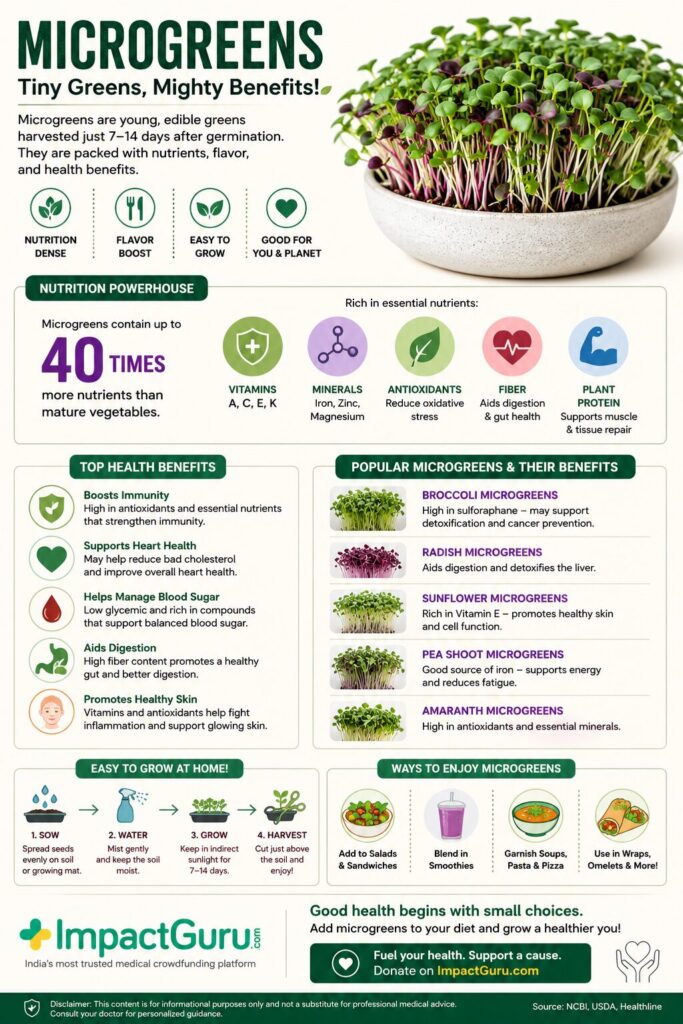
Microgreens are nutrient-dense edible seedlings that offer higher concentrations of vitamins, antioxidants, and plant compounds than their mature vegetable counterparts, with research from the USDA and University of Maryland finding some varieties contain 4 to 40 times more nutrients gram-for-gram. Their benefits include stronger antioxidant and immune support, contributions to heart, eye, and bone health, and a low-calorie way to add nutrient density to a plant-based diet. They aren’t a cure or a substitute for whole vegetables or medical treatment, but as a regular addition to meals, microgreens are one of the most nutrient-efficient foods you can eat.
Table of Contents
- Quick Summary
- Introduction
- What Are Microgreens and How Are They Different from Sprouts?
- Why Are Microgreens So Nutritious?
- Microgreens Nutrition Facts: What’s Actually in Them (Per 100g)
- Microgreens Benefits: What Does Research Say?
- Who Can Benefit Most from Microgreens?
- Which Microgreens Are the Healthiest?
- Are Microgreens Safe to Eat Every Day?
- How Much Microgreens Should You Eat?
- How to Eat and Store Microgreens
- How to Grow Microgreens at Home
- Is Growing Microgreens at Home Worth It?
- Common Myths About Microgreens
- Conclusion
- Frequently Asked Questions
Quick Summary
- Microgreens are young vegetable and herb seedlings packed with vitamins, minerals, antioxidants, and plant compounds.
- Different varieties, such as broccoli, sunflower, mustard, and chia microgreens, offer unique nutritional benefits.
- Microgreens are generally safe to eat daily in normal portions, but proper washing, hygiene, and storage matter, especially for pregnant women, young children, and anyone immunocompromised.
- They can support a balanced diet but should complement, not replace, whole vegetables or prescribed medical treatment.
- Growing microgreens at home is simple and space-efficient, requiring only quality seeds, trays, and basic care.
Introduction
Microgreens have moved fast, from a fine-dining garnish most people couldn’t name, to a genuine fixture in nutritionist recommendations, home gardens, and grocery store shelves. Part of that is real: microgreens are backed by legitimate USDA research showing they can contain meaningfully higher nutrient concentrations than the mature vegetables they come from.
But “superfood” is a word that gets thrown around loosely, and microgreens deserve a more precise look than that. This guide covers what they actually are, which varieties are worth growing, what the research does and doesn’t support, how much to eat, how to use and store them safely, and exactly how to grow your own at home, so you’re working from facts, not marketing.
What Are Microgreens and How Are They Different from Sprouts?
Microgreens are the young seedlings of vegetables, herbs, and grains, harvested 7 to 21 days after germination, once the first set of leaves (called cotyledons) has developed, but well before the plant reaches maturity. At harvest, they’re typically 1–3 inches tall, and only the stem and leaves are cut and eaten; the roots and any remaining seed husk stay behind in the tray.
This puts them in a distinct middle ground:
- Sprouts are germinated seeds eaten whole, root, seed casing, and all, usually within 2–5 days. They’re grown in water, without soil and without light.
- Microgreens are grown in a growing medium (soil, coco coir, or a soilless mat), exposed to light and airflow, and only the above-soil portion is harvested.
- Baby greens are older still, closer to a young version of the mature vegetable, harvested at 3–4 weeks or later, with fuller, more developed leaves.
Chefs originally embraced microgreens for their concentrated flavor and visual appeal. Still, nutrition experts have taken a growing interest for a more practical reason: gram for gram, they can carry more of certain nutrients than their fully grown counterparts.
Almost any edible vegetable, herb, or grain can be grown as a microgreen. Here’s a quick look at the most common ones before we get into the research:
Popular Types of Microgreens at a Glance
| Type | Harvest Time | Best For |
| Broccoli | 7–10 days | Daily antioxidant boost |
| Sunflower | 8–12 days | Filling salads, texture |
| Mustard | 5–8 days | Beginners, fast growth |
| Chia | 10–14 days | Smoothies, easy sowing |
| Radish | 5–8 days | Fast results, strong flavor |
| Kale | 10–14 days | Bone-supportive nutrients |
| Pea Shoots | 8–12 days | Mild flavor, kid-friendly |
| Beet | 10–15 days | Color and iron content |
We’ll come back to a deeper nutrient-by-nutrient comparison further down. First, here’s why microgreens are considered so nutrient-dense.
Why Are Microgreens So Nutritious?
Microgreens are more nutritious than mature vegetables because harvesting them at the seedling stage concentrates vitamins and antioxidants into a smaller volume of plant tissue. The nutrient density of microgreens isn’t a marketing claim; it’s been directly measured. A widely cited USDA Agricultural Research Service study, conducted with University of Maryland researchers, analyzed 25 microgreen varieties against USDA National Nutrient Database data for their mature equivalents. The findings: microgreens contained considerably higher levels of vitamins and carotenoids, about five times greater, than their mature plant counterparts, with some varieties showing differences as large as four to 40 times more nutrients depending on the specific compound and plant.
| Nutrient | Why It Matters | Best Microgreens |
| Vitamin C | Immune function, antioxidant activity | Red cabbage, broccoli, radish |
| Vitamin K | Blood clotting, bone metabolism | Garnet amaranth, kale, cabbage |
| Vitamin E | Antioxidant, skin and cell health | Sunflower, green daikon radish |
| Beta-carotene (Vitamin A) | Eye health, immune support | Cilantro, kale, pea shoots |
| Iron | Oxygen transport, energy metabolism | Beet, amaranth |
| Polyphenols/Antioxidants | Fights oxidative stress | Broccoli, mustard, red cabbage |
| Fiber | Digestive health | Sunflower, pea shoots |
Why nutrition varies so much between varieties: the same USDA research found specific “winners” for specific nutrients; red cabbage, cilantro, garnet amaranth, and green daikon radish had the highest concentrations of vitamin C, carotenoids, vitamin K, and vitamin E, respectively. In other words, there’s no single “best” microgreen; the right choice depends on what nutrient you’re prioritizing, which is exactly why rotating varieties (more on this shortly) makes more sense than sticking to one.
Microgreens Nutrition Facts: What’s Actually in Them (Per 100g)
On average, a 100g serving of microgreens contains roughly 40 calories, 3–4g of protein, 4–5g of carbohydrates, and under 1g of fat — while delivering several times the vitamin C, vitamin E, and vitamin K of the same weight of mature vegetables.
| Microgreen | Calories (kcal) | Protein (g) | Carbs (g) | Vitamin C (mg) | Notable Standout |
| Mixed average | ~40 | 3.5 | 4.7 | ~24 | Baseline across common varieties |
| Broccoli | ~31–35 | 2.3–2.6 | 6.4–7 | Moderate | Richest source of sulforaphane |
| Red cabbage | Similar range | — | — | ~147 | Highest vitamin C of all 25 varieties tested in the 2012 USDA study |
| Green daikon radish | Similar range | — | — | Lower | Highest vitamin E (~87.4mg/100g) in the same study |
| Sunflower | Similar range | Higher (healthy fats) | — | ~67.5 | Near-orange levels of vitamin C |
| Radish | ~16 | — | Low | ~14.8 | Lowest calorie option, high water content (95%) |
| Pea shoots | Similar range | ~5.4 (complete amino acid profile) | — | Moderate | Best plant-protein microgreen |
Source: 2012 USDA Agricultural Research Service / University of Maryland analysis of 25 microgreen varieties (Xiao et al., Journal of Agricultural and Food Chemistry), cross-referenced with subsequent lab nutrition panels. Values are approximate and vary by growing conditions and harvest timing.
Read More : Complete Guide to Vitamin Deficiencies in India: Causes, Symptoms & Prevention (2026)
Microgreens Benefits: What Does Research Say?
Given their concentrated nutrient profile, microgreens are reasonably linked to several areas of health support. It’s worth being precise about the difference between “contains nutrients associated with X” and “proven to cause X”; the honest picture sits closer to the former.
- Antioxidant support
Microgreens are consistently rich in antioxidant compounds, carotenoids, polyphenols, and vitamins C and E, which help neutralize oxidative stress in the body, a process linked to aging and chronic disease risk over time. - Heart health
Diets higher in antioxidants, fiber, and plant compounds are broadly associated with better cardiovascular markers. Microgreens contribute to this pattern as part of an overall vegetable-rich diet, rather than as a standalone intervention. - Immune function
Vitamin C and vitamin A precursors (from carotenoids) both play established roles in normal immune function, and microgreens are a concentrated source of both. - Blood sugar management
Some microgreen varieties, particularly those high in fiber and polyphenols, are studied for their potential role in moderating post-meal blood sugar response, though this evidence is still developing and shouldn’t replace medical guidance for diabetes management. - Eye health
Lutein and zeaxanthin, both present in several microgreen varieties, are carotenoids specifically associated with eye and macular health. - Brain health
Antioxidant-rich diets are generally associated with supporting cognitive health over the long term; microgreens’ antioxidant density makes them a reasonable contributor to this broader dietary pattern. - Bone health
Vitamin K, found at notably high levels in varieties like amaranth and cabbage microgreens, plays a well-established role in bone metabolism alongside calcium. - Digestive health
Their fiber and plant compound content can support digestive regularity as part of a fiber-diverse diet. - Weight management
Microgreens are low in calories relative to their nutrient density, making them a sensible addition for anyone managing calorie intake without wanting to sacrifice micronutrients. - Anti-inflammatory properties
Several of the polyphenols found in microgreens are studied for anti-inflammatory activity, consistent with broader research on plant-based antioxidant compounds. - Role in a plant-based diet
For vegetarians and vegans, microgreens are a compact way to add nutrient density and variety without significant added calories or preparation effort. - Why microgreens support health but aren’t miracle foods
None of the above makes microgreens a treatment, a cure, or a substitute for medical care. They’re a nutrient-dense addition to an already-reasonable diet, not a fix for a poor one, and not a replacement for prescribed treatment if you have a diagnosed condition or deficiency.
Who Can Benefit Most from Microgreens?
Microgreens aren’t only for health enthusiasts; a few everyday lifestyles get a particularly practical benefit from adding them in:
- Vegetarians and vegans: a compact way to add nutrient variety (iron, vitamin C, antioxidants) without extra cooking effort or significant calories
- Elderly individuals: smaller, easier-to-chew portions that still pack in vitamins and antioxidants, useful for anyone eating smaller meals overall
- Athletes and active individuals: antioxidant support for recovery, plus an easy way to add nutrient density to already-high food intake without excess bulk
- Office workers and desk-based routines: a low-effort way to work more vegetables into meals that are often rushed or repetitive (a handful on a sandwich or in a lunchbox salad takes seconds)
- People with generally low vegetable intake: microgreens are a low-barrier entry point; a small tray on a windowsill is often a lower-friction habit to build than committing to larger vegetable servings
This isn’t about disease treatment; it’s about matching a genuinely useful, low-effort food to routines where it fits naturally.
Which Microgreens Are the Healthiest?
There’s no single “healthiest” microgreen; it depends on what you’re eating them for. Building on the quick-glance table earlier, here’s a deeper look at flavor and nutrient strengths:
| Microgreen | Key Nutrients | Best For |
| Broccoli | Sulforaphane, vitamin C, vitamin K | Antioxidant support, daily use |
| Sunflower | Vitamin E, healthy fats, protein | Filling salads, texture |
| Mustard | Vitamin C, vitamin A, glucosinolates | Flavor boost, easy growing |
| Chia | Omega-3 precursors, fiber | Smoothies, beginner growing |
| Radish | Vitamin C, folate | Fast growth, strong flavor |
| Kale | Vitamin K, vitamin A, calcium | Bone-supportive nutrients |
| Pea Shoots | Vitamin C, folate, protein | Mild flavor, kid-friendly |
| Beet | Betalains, iron, folate | Color, antioxidant variety |
- Broccoli microgreens stand out for sulforaphane, a sulfur compound studied for its antioxidant activity, one of the more research-backed reasons this variety gets specifically recommended over others.
- Sunflower microgreens are closer to a “meal” green than a garnish; their crunch and nutty flavor make them easy to eat in larger quantities, which matters more for actual nutrient intake than concentration alone.
- Mustard microgreens are fast-growing, hardy, and one of the most forgiving varieties for beginners, with a sharp flavor that works well mixed into milder dishes.
- Chia microgreens are less commonly sold commercially but popular with home growers, since chia seeds germinate easily without special equipment and the greens are soft enough to blend directly into smoothies.
- For beginners: start with mustard, radish, or sunflower, all forgiving to grow and strong in flavor, so you’ll notice them in a dish immediately. Choose your variety based on the nutrient you’re prioritizing rather than whichever variety is trending on social media.
Are Microgreens Safe to Eat Every Day?
Yes — microgreens are safe to eat daily for most people, provided they’re rinsed before eating and stored properly, since they carry a meaningfully lower contamination risk than sprouts. For most people, microgreens are safe to eat daily, but “safe” comes with real conditions worth understanding, particularly because microgreens are almost always eaten raw.
How Microgreens Compare to Sprouts on Safety
This is where the two get unfairly lumped together. Sprouts are grown fully submerged in warm, humid water for several days, without light, ideal conditions for bacterial growth, and the entire seed, including the husk and root, is eaten. This has made sprouts a repeat source of documented Salmonella and E. coli outbreaks over the decades. Microgreens are structurally different: they’re grown in light and airflow, and only the stem and leaves are harvested, leaving the root behind in the tray. This gives microgreens a meaningfully better food-safety track record than sprouts, but it doesn’t make them risk-free.
Where risk still comes from:
- Unwashed produce – even with a cleaner growing method, microgreens can pick up bacteria from soil, water, or handling before they reach you
- Damp storage – moisture left on leaves after washing encourages mold and bacterial growth during storage
- Poor growing hygiene – contaminated seeds, dirty trays, or unclean water at the growing stage are the most common real-world source of issues
Basic precautions:
- Rinse microgreens gently under cool running water before eating, even if a package says “pre-washed”
- Pat or spin dry before storing; excess moisture is the main driver of spoilage
- Store in the refrigerator in a container lined with a dry paper towel, and use within 3–5 days
- Discard anything that smells off, looks slimy, or shows visible mold
Higher-risk Group
General food safety guidance recommends that pregnant women, young children, older adults, and anyone with a weakened immune system be more cautious with any raw, unwashed produce, sprouts especially, given their documented outbreak history. Microgreens carry comparatively lower risk due to how they’re grown, but if you fall into one of these groups, it’s worth washing them thoroughly, sourcing from a trusted grower, and checking with your doctor if you’re unsure.
Allergies and sensitivities: microgreens carry the same allergy profile as their mature vegetable; someone with a mustard seed allergy, for instance, should avoid mustard microgreens the same way they’d avoid mustard greens.
How Much Microgreens Should You Eat?
A typical serving is about 1 cup loosely packed (25–30g), and there’s no upper limit for most people beyond normal dietary variety. That said, some practical guidance helps:
- Recommended serving: a typical serving is roughly a handful, about 1 cup loosely packed, or 25–30 grams, added as a topping, side, or mix-in rather than eaten as a standalone meal.
- Daily intake: eating microgreens daily in normal serving sizes is perfectly reasonable and is how most of the research on their nutrient content assumes they’d be consumed, as a regular addition to meals, not in large, isolated quantities.
Can you Overeat Them?
Practically speaking, it’s hard to “overeat” microgreens in a harmful way at normal serving sizes. The one specific caution: varieties high in vitamin K (like kale, cabbage, or amaranth microgreens) can matter for anyone on blood-thinning medication such as warfarin, since vitamin K intake needs to stay consistent for these medications to work as intended. If that applies to you, talk to your doctor about how leafy greens, including microgreens, fit into your diet, rather than avoiding them altogether or eating large, inconsistent amounts.
Rotate your varieties: since different microgreens concentrate different nutrients (as shown in the tables above), rotating between two or three varieties across the week is a simple way to get broader nutrient coverage than sticking to just one type.
How to Eat and Store Microgreens
Microgreens are almost always best eaten raw; cooking them breaks down some of the water-soluble vitamins (like vitamin C) that make them nutritionally interesting in the first place, though a light, quick toss into a hot dish won’t ruin them.
Ways to use them:
- Salads: as the base or as a topping for extra texture and flavor
- Sandwiches and wraps: in place of or alongside lettuce
- Smoothies: milder varieties like pea shoots or chia blend in without overpowering flavor
- Soups: stirred in just before serving, off the heat, to preserve nutrients
- Rice bowls and grain bowls: as a fresh, crunchy topping
- Indian meals: microgreens work naturally folded into dal, sprinkled over parathas before rolling, stirred into khichdi just before serving, or mixed into a besan chilla batter for extra nutrition and color
Storage tips:
- Refrigerate immediately after washing and drying; don’t leave them at room temperature
- Store loosely in a container lined with a dry paper towel, which absorbs excess moisture
- Avoid sealing them in an airtight bag while damp; trapped moisture speeds up spoilage
- Most microgreens stay fresh for 3–5 days refrigerated; some hardier varieties like sunflower can last slightly longer
How to Grow Microgreens at Home
Growing your own is simpler than most people expect; no farmland, greenhouse, or special equipment required.
Choosing the Right Microgreen Seeds
Look for seeds specifically labeled for microgreen growing. Where possible, choose untreated or organic seeds; avoid seeds coated with fungicides meant for outdoor field planting, since those chemicals aren’t meant for a crop you’ll eat within days. Check germination rate if listed; reputable sellers disclose this, and anything under 80% is worth avoiding.
Selecting Microgreen Trays
Standard 10×20-inch trays (a solid tray with drainage holes, paired with a solid tray underneath to catch runoff) are the most common setup and easiest to find. Food-grade plastic is preferred for hygiene and durability. Reusable trays are more economical long-term, provided they’re sanitized between batches to prevent mold carryover.
Choosing your Growing Medium
- Soil: traditional, forgiving, and nutrient-rich, but messier and more prone to mold if overwatered
- Coco coir: a popular soilless option: clean, good water retention, and reduces contamination risk compared to soil.
- Grow mats/hydroponic pads: the cleanest option, ideal for smaller countertop setups, though they retain less nutrient reserve than soil.
Step-by-step growing process:
- Prepare the tray with 1–1.5 inches of your chosen growing medium, evened out and moistened.
- Sow seeds densely and evenly: across the surface, much closer together than typical garden spacing.
- Cover for the blackout period: mist with water and cover the tray for 2–3 days. This darkness encourages faster, more even germination.
- Uncover and add light: once sprouts appear, move to a bright windowsill or under a grow light for 12–16 hours daily.
- Water consistently: by misting once or twice a day; the medium should stay moist, never waterlogged.
- Harvest: once the first true leaves appear, typically 7–21 days depending on variety, snip just above the growing medium with clean scissors.
- Rinse, dry, and refrigerate: as covered in the storage section above.
Common beginner mistakes:
- Overwatering, which encourages mold and root rot
- Skipping the blackout period, leading to patchy, uneven germination
- Sowing too thinly (lower yield) or too thickly (poor airflow, mold risk)
- Harvesting too early or too late; waiting for the first true leaf gives the best balance of flavor and nutrition
- Reusing growing medium without sanitizing trays, which can carry over mold spores
Is Growing Microgreens at Home Worth It?
For most home growers, yes, the combination of freshness, cost savings, and minimal space requirements makes it worthwhile even as a casual kitchen-garden project.
- Freshness and nutrition: since much of the nutrient value in leafy greens degrades over time after harvest, growing your own means eating microgreens at their peak, something store-bought greens, which may sit for days between harvest and purchase, can’t match.
- Sustainability: a small home setup uses minimal water and no pesticides, and produces near-zero packaging waste compared to store-bought clamshell containers.
- Apartment-friendly: a single tray fits on a windowsill or small shelf, making this one of the few “grow your own food” options that works without a garden or balcony.
Cost comparison – Home-grown vs. Store-bought:
Retail microgreens prices in India generally range from ₹500 to ₹2,000 per kg for standard varieties, with premium or exotic varieties reaching ₹3,000–₹4,000 per kg. A single home tray, by contrast, typically costs well under ₹100–150 in seeds and growing medium, and can produce enough for regular personal use across multiple meals. For anyone eating microgreens more than occasionally, growing your own is meaningfully cheaper per serving than buying retail; the trade-off is your own time and a bit of trial and error while you learn.
Is it economical?
For occasional use, buying a small pack is easier and not a significant expense either way. For regular, daily use, home growing pays for itself quickly and is the more sustainable long-term habit.
Common Myths About Microgreens
“Microgreens are the same as sprouts”
False. They’re grown differently (soil/medium with light vs. water without light), and only the above-ground portion of a microgreen is eaten, not the root, a distinction that also affects food safety, as covered earlier.
“They’re healthier than all mature vegetables.”
Not universally true. Microgreens are more nutrient-dense per gram in several vitamins and antioxidants, but mature vegetables offer larger overall nutrient volumes per typical serving size and contribute more fiber meaningfully in absolute terms. Both belong in a healthy diet.
“Eating microgreens alone is enough for good nutrition.”
No single food, however nutrient-dense, replaces a varied diet. Microgreens are a strong addition, not a complete nutritional strategy on their own.
“More microgreens always mean better health.”
Nutrient density doesn’t scale benefits infinitely; normal portions are enough to gain the benefit; no evidence eating unusually large quantities multiplies the effect.
“They can cure diseases.”
No credible research supports this. Microgreens can support overall health as part of a balanced diet, but they don’t diagnose, prevent, treat, or cure any disease, and shouldn’t be treated as a substitute for medical care.
“They’re difficult to grow at home.”
As covered above, the basic process is simple enough for a complete beginner with just a tray, seeds, and a windowsill.
“They’re only for gourmet restaurants.”
Their restaurant-garnish reputation has outlasted the reality; they’re now widely available in regular grocery stores and easy to grow at home for everyday meals, not just plating.
Read More : Nutrient Deficiency in India – Complete Guide 2026
Conclusion
Microgreens are a genuinely nutrient-dense addition to a balanced diet; the USDA research on their concentrated vitamin and antioxidant content is real, and their food-safety profile compares favorably to sprouts when grown and handled properly. But they work best understood for what they are: one strong contributor among many in a varied diet, not a replacement for whole vegetables, and not a stand-in for medical care.
While a nutrient-rich diet can support overall health, some medical conditions and nutritional disorders still require professional treatment. When the cost of that treatment becomes overwhelming, medical crowdfunding through ImpactGuru, one of India’s established fundraising platforms, has helped families access timely care while focusing on recovery. You can also explore our guides on Iron Deficiency, Vitamin B12 Deficiency, and other nutrient-specific conditions to understand how nutrition supports, but doesn’t substitute for, long-term medical care.
Frequently Asked Questions
Microgreens are young vegetable, herb, or grain seedlings harvested 7–21 days after germination, once the first leaves have developed but before the plant reaches maturity.
They’re more nutrient-dense per gram in several vitamins and antioxidants, but mature vegetables still provide more total nutrients and fiber per typical serving. The two work best together, not as substitutes for each other.
Yes, for most people, as long as they’re washed properly, stored correctly, and eaten in normal serving sizes. Those who are pregnant, immunocompromised, very young, or elderly should take extra care with any raw produce and consult a doctor if unsure.
Yes, after the initial 2–3 days blackout germination period, microgreens need 12–16 hours of indirect sunlight or grow-light exposure daily to develop properly.
Typically 7–21 days from sowing to harvest, depending on the variety; fast growers like radish and mustard are on the shorter end, and slower ones like basil or cilantro take longer.
Yes. Coco coir and hydroponic grow mats are both common soilless alternatives, often preferred for their cleanliness and reduced contamination risk.
About 3–5 days when refrigerated properly in a container lined with a dry paper towel.