

Table of Contents
- Quick Summary
- Introduction
- What Is MJPJAY and Who Launched It?
- Who Is Eligible for MJPJAY?
- What Is the Coverage Amount Under MJPJAY?
- What Treatments and Diseases Does MJPJAY Cover?
- What Are the Main MJPJAY Benefits?
- How Do You Find the MJPJAY Hospital List?
- How Do You Apply for an MJPJAY Card?
- What Is Not Covered Under MJPJAY?
- How Does MJPJAY Work With Ayushman Bharat PM-JAY?
- What If MJPJAY Does Not Cover the Full Treatment Cost?
- Conclusion
- Frequently Asked Questions
Quick Summary
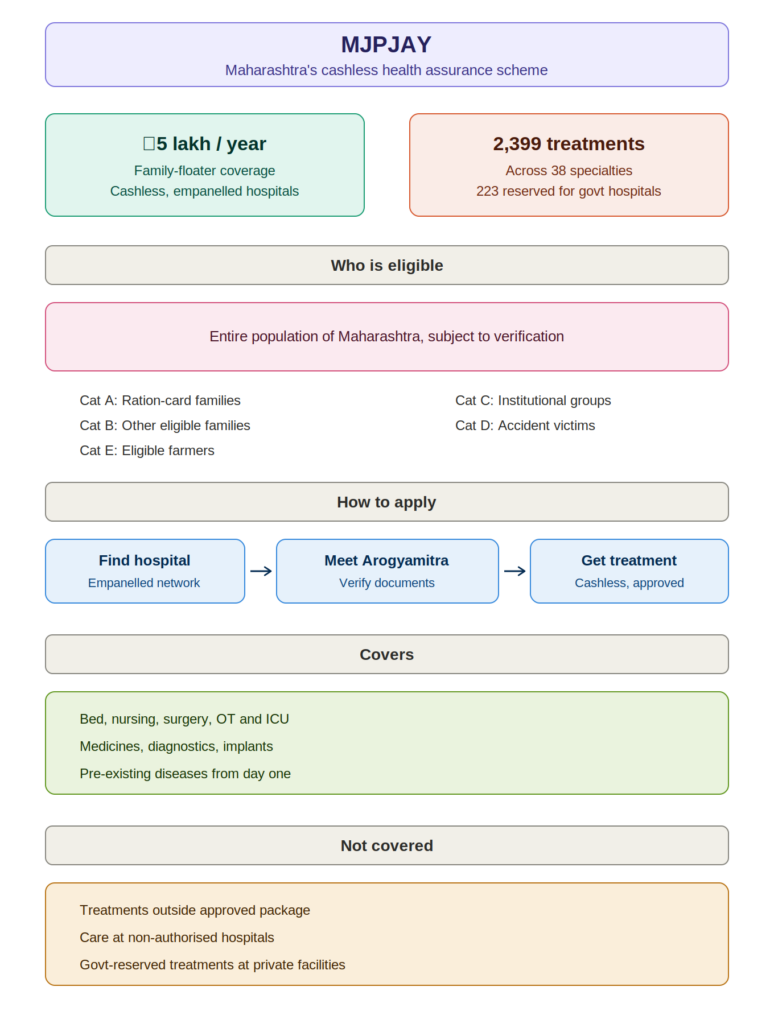
- MJPJAY provides cashless hospitalisation coverage of up to ₹5 lakh per family per year under Maharashtra’s expanded health assurance scheme.
- The scheme now covers the entire population of Maharashtra, subject to beneficiary verification and applicable scheme requirements.
- Learn about MJPJAY eligibility, covered treatments, benefits, hospital lists, registration, and the MJPJAY card process.
- The treatment package was expanded in 2025 to 2,399 treatments across 38 specialties, with some treatments reserved for government hospitals.
- Find out what MJPJAY does not cover and what options may help if eligible treatment costs exceed the scheme’s available coverage.
Introduction
43.4% of India’s total health expenditure still came directly from people’s pockets in 2022–23. is lower than a decade earlier, but a major hospitalisation can still put considerable pressure on a family’s finances. Maharashtra’s MJPJAY is designed to reduce that burden by providing cashless treatment for covered secondary and tertiary hospitalisation procedures through empanelled hospitals. But knowing the scheme exists is only the first step. Your eligibility, documents, hospital, treatment package, and available coverage all matter. This guide explains how MJPJAY works in 2026, what it covers, how to access it, and where its limits lie.
Also read: Find an MJPJAY network hospital near you
What Is MJPJAY and Who Launched It?
MJPJAY is Maharashtra’s government-funded health assurance scheme for covered hospitalisation and treatment procedures. The Government of Maharashtra originally launched it as the Rajiv Gandhi Jeevandayee Arogya Yojana (RGJAY) on 2 July 2012 in eight districts. The scheme was subsequently expanded across the state and renamed the Mahatma Jyotirao Phule Jan Arogya Yojana (MJPJAY) from 1 April 2017. From 1 July 2024, Maharashtra implemented an expanded integrated MJPJAY and Ayushman Bharat–Pradhan Mantri Jan Arogya Yojana (AB-PMJAY) programme. The official scheme information states that the expanded programme covers the entire population of Maharashtra and provides cashless treatment for identified secondary and tertiary conditions requiring hospitalisation through empanelled hospitals.
The scheme operates in assurance mode, meaning the government-backed system provides the approved package benefits through the network rather than requiring beneficiaries to purchase a conventional private health insurance policy.
Who Is Eligible for MJPJAY?
The expanded MJPJAY programme covers the population of Maharashtra, subject to beneficiary verification and the applicable documentation and scheme rules. The scheme was expanded from its earlier ration-card-based scope to provide universal health coverage within Maharashtra from 1 July 2024. The official MJPJAY description of universal coverage should therefore be used instead of relying on older eligibility articles.
The scheme’s operational framework continues to distinguish beneficiary categories, including:
- Category A: Families identified through specified ration-card categories.
- Category B: Other eligible Maharashtra families covered under the expanded scheme and applicable identification requirements.
- Category C: Specific groups such as eligible institutional beneficiaries and other notified categories.
- Category D: Road-accident victims who are not residents of Maharashtra, covered under separate provisions.
- Category E: Eligible farmers covered under the scheme’s notified provisions.
Because the current programme has expanded beyond the older ration-card-only model, patients should not assume that an outdated eligibility list determines whether they qualify.
At an empanelled hospital, the Arogyamitra can help verify beneficiary details, documents, and access to the scheme. The Arogyamitra system is specifically designed to help beneficiaries access services under MJPJAY in a cashless manner. Arogyamitra support is available through the network hospital system.
What Is the Coverage Amount Under MJPJAY?
MJPJAY provides up to ₹5 lakh per family per year on a family-floater basis under the expanded integrated scheme. ₹5 lakh per family per year means one family member can use the amount, or the family can split it across multiple members, subject to the applicable treatment package and scheme rules.
The current integrated programme replaced the earlier separate coverage structure. Before the July 2024 expansion, MJPJAY and AB-PMJAY had different beneficiary and coverage arrangements. Maharashtra subsequently expanded MJPJAY to the state’s entire population and integrated the schemes.
Important coverage points
- ₹5 lakh: Annual family-floater health coverage under the main integrated scheme.
- Cashless treatment: Covered procedures are provided through empanelled hospitals without the beneficiary paying the covered package amount directly to the hospital.
- Secondary and tertiary care: The scheme focuses on identified hospital-based treatments and procedures.
- Pre-existing diseases: The official scheme information states that pre-existing diseases are covered from day one for approved procedures.
- No separate insurance premium: Beneficiaries do not purchase an individual private insurance policy to access the government scheme.
Category D has separate provisions. Road-accident cases involving people who are not Maharashtra residents do not follow the same family-floater structure, so the applicable limit and eligibility should be confirmed with the hospital before treatment.
What Treatments and Diseases Does MJPJAY Cover?
The MJPJAY and AB-PMJAY package structure was expanded in November 2025 from 1,356 treatments across 34 specialties to 2,399 treatments across 38 specialties. The same resolution states that 223 treatments are reserved for government hospitals.
The package structure covers a broad range of secondary and tertiary healthcare, including areas such as:
- Cardiology and cardiac surgery
- Oncology and cancer care
- Nephrology and renal care
- Neurology and neurosurgery
- Orthopaedics
- General and laparoscopic surgery
- Burns and trauma
- Paediatrics and paediatric surgery
- Obstetrics and gynaecology
- Critical and intensive care
The exact treatment package matters. MJPJAY does not mean that every consultation, test, medicine or procedure for a particular disease is automatically free. Coverage depends on whether the required treatment is included in the applicable package and whether the hospital is authorised to provide it.
For this reason, people searching for a Mahatma Phule Jan Arogya Yojana disease list should check the current official treatment/package information rather than rely on an old static list. Package numbers, descriptions, and rates can be revised by the government.
Read More : Neurosurgery Cost In India
Read More : Best Neurosurgery Hospitals in Mumbai (2026)
What Are the Main MJPJAY Benefits?
The biggest MJPJAY benefit is protection against the direct cost of eligible hospitalisation. Instead of paying the approved package cost yourself and seeking reimbursement later, beneficiaries can receive covered treatment through an empanelled hospital under the scheme’s cashless model.
Depending on the approved package, scheme benefits can include expenses associated with hospitalisation and treatment such as:
- Hospital bed and nursing charges
- Medical and surgical professional charges
- Operation theatre and intensive-care services
- Medicines and consumables used during covered treatment
- Diagnostic investigations connected with the approved procedure
- Implants where included in the relevant package
- Food and other package components specified by the scheme
The official MJPJAY material describes covered procedures as cashless and states that the package is intended to cover the treatment costs associated with the approved procedure rather than leaving the beneficiary to pay the package amount directly.
Some treatments also have follow-up provisions. The applicable follow-up package and duration depend on the procedure and current scheme rules, so patients should confirm these details with the treating hospital.
How Do You Find the MJPJAY Hospital List?
To use MJPJAY benefits, you generally need to approach a network or empanelled hospital authorised to provide the relevant treatment package.
The official MJPJAY portal provides information on network hospitals and healthcare services. You can also ask the hospital’s Arogyamitra whether the hospital is empanelled for the specific procedure you require.
Before admission, check:
- Whether the hospital is currently empanelled under MJPJAY.
- Whether it offers the treatment or procedure you need under the scheme.
- Whether the particular package is available at that hospital.
- Whether the treatment requires pre-authorisation.
- Which documents the hospital needs for beneficiary verification.
This distinction matters because being listed as an MJPJAY hospital does not necessarily mean that every treatment package is available at that facility.
For patients looking for an MJPJAY hospital list, checking the official network information or confirming directly with the Arogyamitra is safer than relying on an old third-party hospital list.
How Do You Apply for an MJPJAY Card?
MJPJAY registration is generally facilitated through the network hospital’s Arogyamitra rather than through a separate private insurance purchase. The hospital verifies the beneficiary’s identity and scheme eligibility and helps initiate the process for an approved treatment.
A typical process is:
- Find an empanelled hospital. Choose a hospital participating in MJPJAY and offering the required treatment.
- Contact the Arogyamitra. The Arogyamitra is the scheme facilitator at the hospital and helps beneficiaries navigate registration and verification.
- Carry your documents. Take the identity and beneficiary documents applicable to your category. The hospital will confirm what is required.
- Complete beneficiary verification. The hospital checks your identity and scheme eligibility through the prescribed process.
- Medical assessment: A doctor determines whether the required treatment falls under an approved MJPJAY package.
- Pre-authorisation, where required: The hospital submits the necessary request through the scheme’s online system.
- Receive covered treatment: Once the treatment is approved under the relevant package, the beneficiary receives it on a cashless basis.
If you do not have an existing health card, the official scheme documentation describes procedures for verifying eligible beneficiaries using valid identity and beneficiary documents. In some situations, including emergencies, provisional verification may apply subject to subsequent confirmation.
Therefore, don’t delay necessary emergency treatment simply because you are unsure about the card process. Ask the hospital’s MJPJAY desk or Arogyamitra for assistance.
What Is Not Covered Under MJPJAY?
MJPJAY is extensive, but it does not mean that every healthcare expense is automatically covered.
The most important limitation is that treatment must fall within an approved scheme package and meet the applicable conditions.
Expenses or services may therefore fall outside the scheme when they:
- Are not part of an approved MJPJAY treatment package.
- Do not meet the package’s clinical or eligibility requirements.
- Are provided outside the authorised network or without the required approval.
- Are services that are specifically restricted or excluded under the current scheme rules.
- Relate to a treatment that is reserved for government hospitals but is being sought at a facility that is not authorised to provide that reserved package.
The last point is particularly important. Reserved treatment is not necessarily the same as excluded treatment. The November 2025 government resolution states that 223 of the 2,399 treatments are reserved for government hospitals.
Similarly, don’t assume that every test, medicine, or consultation related to a disease is automatically free. The treatment package and the hospital’s authorisation determine what the scheme pays for.
Before a planned procedure, ask the Arogyamitra to confirm:
- The exact package being used
- What the package includes
- Whether the hospital is authorised for that package
- Whether any part of the treatment requires separate payment
- Whether follow-up treatment is included
This can prevent unexpected expenses.
How Does MJPJAY Work With Ayushman Bharat PM-JAY?
MJPJAY and Ayushman Bharat–Pradhan Mantri Jan Arogya Yojana (AB-PMJAY) operate as an integrated programme in Maharashtra.
Maharashtra’s expanded scheme was implemented from 1 July 2024, bringing the state’s population under the expanded MJPJAY framework and integrating it with AB-PMJAY. The Maharashtra government describes the programme as providing cashless secondary and tertiary care through empanelled hospitals. The integrated scheme details are available through the official portal.
The distinction between the two schemes still matters:
- MJPJAY is Maharashtra’s state health assurance scheme.
- AB-PMJAY is the central government’s national health assurance programme.
- Maharashtra operates the two together under the integrated arrangement.
- AB-PMJAY beneficiaries who meet the national scheme’s eligibility conditions can have portability benefits for treatment outside Maharashtra through the PM-JAY network.
As of 30 June 2026, AB-PMJAY had authorised 12.69 crore cashless hospital admissions worth ₹1.92 lakh crore nationally, according to the Ministry of Health and Family Welfare.
Read More : Pradhan Mantri Jan Arogya Yojana (PMJAY) – Eligibility & Benefits
What If MJPJAY Does Not Cover the Full Treatment Cost?
MJPJAY can substantially reduce the financial burden of covered treatment, but a family may still face costs if a required service falls outside the applicable package, a treatment has specific restrictions, or additional expenses are not covered.
Start by asking the hospital’s MJPJAY desk to explain exactly which costs are covered and why a particular expense falls outside the package. You can then explore other legitimate sources of financial assistance, such as charitable organisations, government assistance programmes or medical crowdfunding.
For families considering an online donation platform or fundraising platforms in India, it is important to compare transparency, withdrawal processes, documentation requirements, and the platform’s experience with medical fundraisers.
Impact Guru is one option for people exploring medical crowdfunding. If you decide to raise funds, explain the diagnosis, treatment requirement, hospital estimate, and the assistance already available through MJPJAY so potential donors can understand the remaining financial gap.
The goal of fundraising in India should not be to replace a government health benefit that a patient is entitled to receive. It can instead help address legitimate expenses that remain after available healthcare assistance has been assessed.
Read More : How Can I Raise Funds Online for Medical Treatment?

Conclusion
MJPJAY has evolved from a state health scheme launched in 2012 into an expanded programme covering Maharashtra’s population, with ₹5 lakh annual family-floater coverage for the main integrated beneficiary structure. Its 2025 package expansion also increased treatment coverage to 2,399 procedures across 38 specialties. Before treatment, confirm your eligibility, hospital, package, and covered expenses with the MJPJAY desk or Arogyamitra. If costs remain after available government assistance, medical crowdfunding can be another option.
Start a fundraiser with Impact Guru if you need help raising funds for eligible medical expenses beyond available coverage.
Frequently Asked Questions
MJPJAY is a government-funded health assurance programme, and beneficiaries do not pay a conventional insurance premium to enrol. Covered treatment is provided cashless at empanelled hospitals under the applicable package and scheme rules. The official scheme describes the integrated programme as providing cashless healthcare and ₹5 lakh annual family-floater coverage.
MJPJAY’s Maharashtra-specific coverage operates through its network and scheme framework in Maharashtra. However, eligible beneficiaries covered under the AB-PMJAY component can have portability for cashless treatment at participating PM-JAY hospitals outside the state. Confirm the applicable portability rules before travelling for treatment.
Yes. The official MJPJAY scheme information states that Pre-existing disease coverage from day one for approved procedures is one of the scheme’s stated features.
The official MJPJAY portal lists 155388 and 1800 233 2200 as toll-free helpline numbers. MJPJAY helpline numbers can be used for scheme-related information and assistance.
MJPJAY is Maharashtra’s state health assurance scheme, while AB-PMJAY is the Centre’s national health assurance programme. Maharashtra operates them together under an integrated arrangement. MJPJAY was originally launched as RGJAY in 2012 and renamed in 2017, while AB-PMJAY was launched nationally in 2018.
The exact documents depend on the beneficiary category and current verification rules. Patients should carry available identity and beneficiary documents and speak to the Arogyamitra at an empanelled hospital. The hospital can confirm the documents needed for verification and treatment authorisation rather than relying on an outdated document checklist.