

NGO Funding India plays a vital role in helping non-profit organisations sustain their social initiatives and create long-term community impact. From government grants and CSR contributions to crowdfunding and individual donations, there are multiple funding opportunities available for NGOs across India. Understanding these funding sources can help organisations secure financial support, improve transparency, and expand their reach effectively.
Funding is the backbone of every successful non-governmental organization (NGO). Whether an NGO works in healthcare, education, child welfare, women empowerment, environmental conservation, disaster relief, or rural development, sustainable funding is essential to continue creating meaningful social impact.
India has one of the world’s largest nonprofit ecosystems, with thousands of registered NGOs working across diverse causes. However, one of the biggest challenges they face is not launching impactful programs—it’s securing consistent and reliable funding.
Many organizations depend on a combination of government grants, CSR partnerships, institutional funding, public donations, corporate sponsorships, philanthropic trusts, and increasingly, online crowdfunding.
In recent years, digital fundraising has transformed how nonprofits raise money. Crowdfunding platforms like ImpactGuru have enabled NGOs, charitable organizations, hospitals, and individuals to reach thousands of donors online, making fundraising faster, more transparent, and more accessible.
This guide explains everything you need to know about NGO funding in India, including funding sources, eligibility, fundraising strategies, compliance, digital giving, and how crowdfunding complements traditional nonprofit financing.
Read More : Mumbai NGOs & Charities: Complete Guide (2026)
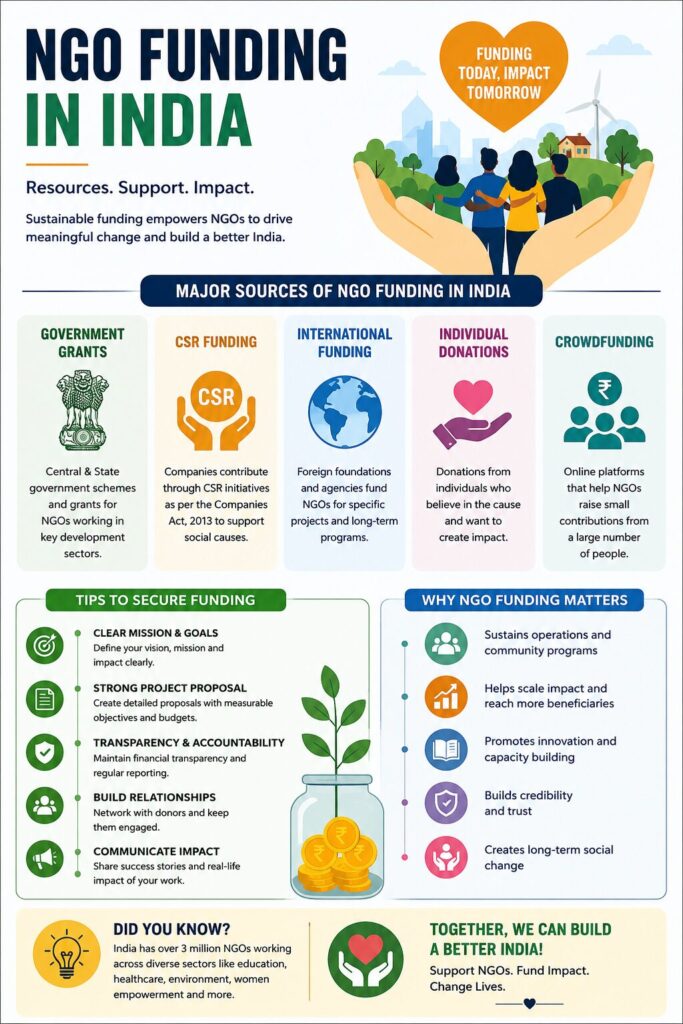
Table of Contents
- What Is NGO Funding?
- Why NGO Funding Is Becoming More Important in India
- Major Sources of NGO Funding in India
- Why Crowdfunding Is Changing NGO Fundraising in India
- How ImpactGuru Supports Fundraising in India
- Original Insights: How NGO Funding Trends Are Changing in India
- Traditional Grants vs Crowdfunding: A Comparison
- Best Practices for Successful NGO Fundraising
- Geographic Reach: NGO Funding Across India
- Conclusion
- Frequently Asked Questions
What Is NGO Funding?
NGO funding refers to the financial resources that enable nonprofit organizations to carry out charitable, developmental, educational, healthcare, environmental, and humanitarian programs.
These funds are used for:
- Community development projects
- Healthcare initiatives
- Educational programs
- Women empowerment
- Child welfare
- Disability support
- Disaster relief
- Livelihood generation
- Rural development
- Environmental conservation
- Administrative operations
- Volunteer management
- Awareness campaigns
- Research and advocacy
Without stable funding, NGOs may struggle to expand their reach, retain skilled staff, or sustain long-term projects.
Why NGO Funding Is Becoming More Important in India
India continues to experience rising demand for nonprofit support due to:
- Increasing healthcare costs
- Natural disasters and climate-related emergencies
- Growing need for education in underserved communities
- Rural development challenges
- Public health initiatives
- Nutrition and food security programs
- Senior citizen support
- Child protection
- Mental health awareness
- Rare disease treatment
As social needs grow, NGOs require diversified and sustainable funding sources instead of relying on a single donor or grant.
Major Sources of NGO Funding in India
The most successful NGOs typically combine multiple funding channels.
1. Individual Donations
Individual giving remains one of the largest funding sources for NGOs.
Donors contribute through:
- Monthly giving
- One-time donations
- Festival campaigns
- Emergency appeals
- Memorial donations
- Birthday fundraising
- Corporate employee giving
Digital payment methods have made it easier than ever for people across India to support verified causes.
2. Corporate Social Responsibility (CSR) Funding
Under the Companies Act, eligible companies are required to spend a portion of their profits on CSR initiatives.
CSR funding supports projects related to:
- Healthcare
- Education
- Skill development
- Water and sanitation
- Environment
- Rural development
- Women empowerment
- Livelihood creation
NGOs with strong governance, measurable outcomes, and compliance frameworks are more likely to secure CSR partnerships.
3. Government Grants
Both central and state governments provide grants for eligible NGOs working in sectors such as:
- Health
- Education
- Women and child development
- Rural livelihoods
- Tribal welfare
- Disability inclusion
- Agriculture
- Skill development
Government funding usually requires detailed documentation, reporting, and compliance.
4. Philanthropic Foundations & Charitable Trusts
Many Indian and international foundations provide grants for nonprofit initiatives.
Funding may support:
- Capacity building
- Pilot programs
- Healthcare
- Innovation
- Research
- Social entrepreneurship
Grant applications generally involve proposal writing, budgeting, impact measurement, and regular reporting.
5. International Funding
Eligible NGOs may receive funding from international organizations and philanthropic institutions, subject to compliance with applicable Indian regulations.
International partnerships often focus on:
- Climate action
- Healthcare
- Education
- Human rights
- Disaster response
- Sustainable development
6. Events & Community Fundraising
Many NGOs organize:
- Charity runs
- Marathons
- Auctions
- Concerts
- Walkathons
- School campaigns
- Community drives
These initiatives help raise both funds and public awareness.
7. Digital Fundraising & Crowdfunding
One of the fastest-growing funding channels is online fundraising.
Instead of relying solely on institutional grants, NGOs can reach thousands of individual donors through digital campaigns.
Crowdfunding enables organizations to:
- Tell compelling stories
- Receive donations from across India
- Accept small and large contributions
- Increase campaign visibility through social sharing
- Raise emergency funds quickly
This model has become especially valuable during medical emergencies, disaster relief efforts, and time-sensitive humanitarian campaigns.
Read More : NGOs in Delhi: Top Verified Organisations and Their Impact
Why Crowdfunding Is Changing NGO Fundraising in India
Traditional fundraising often depends on a limited number of donors or grant cycles.
Crowdfunding democratizes giving by allowing anyone to contribute.
Advantages include:
- Faster fundraising
- Wider donor reach
- Increased transparency
- Real-time campaign updates
- Secure digital payments
- Lower barriers to participation
- Stronger community engagement
Digital fundraising also enables NGOs to build long-term donor relationships rather than relying only on annual grant applications.
How ImpactGuru Supports Fundraising in India
ImpactGuru is India’s largest medical crowdfunding platform, enabling individuals, hospitals, and nonprofit organizations to raise money online for verified healthcare needs and humanitarian causes.
Every second, the platform receives multiple donations from compassionate individuals, demonstrating the scale and trust of India’s digital giving ecosystem.
Organizations and patients use ImpactGuru to:
- Raise funds for medical treatment
- Support cancer care initiatives
- Fund organ transplants
- Finance rare disease treatment
- Support pediatric healthcare
- Launch emergency relief campaigns
- Mobilize community donations
ImpactGuru provides:
- Secure payment infrastructure
- Campaign verification
- Fraud detection systems
- Donor-friendly fundraising pages
- Fundraising guidance
- Transparent fund disbursement
By combining technology with social impact, ImpactGuru has helped expand access to healthcare funding across India.
Original Insights: How NGO Funding Trends Are Changing in India
Based on fundraising trends observed through digital campaigns, several shifts are becoming increasingly evident:
- Donors prefer transparent campaigns with clear impact updates.
- Small recurring donations collectively contribute significantly to fundraising success.
- Mobile-first donation journeys have increased participation.
- Storytelling and authenticity influence donor engagement more than organizational size.
- Healthcare remains one of the most actively supported charitable categories.
- Online crowdfunding has reduced geographic barriers, allowing donors from across India and overseas to support verified causes.
These trends highlight how digital platforms are complementing traditional NGO funding models.
Traditional Grants vs Crowdfunding: A Comparison
| Traditional NGO Grants | Crowdfunding via ImpactGuru |
| Competitive application process | Public fundraising through verified campaigns |
| Funding depends on grant cycles | Donations can begin once campaigns are live |
| Often restricted to specific programs | Flexible fundraising for eligible causes |
| Limited number of funders | Thousands of potential donors |
| Detailed proposal requirements | Story-driven fundraising supported by digital sharing |
| Funding decisions may take weeks or months | Campaigns can gain traction quickly through community support |
For many organizations, the most effective strategy is to combine grants, CSR support, charitable trusts, and crowdfunding.
Best Practices for Successful NGO Fundraising
Successful NGOs typically:
- Build donor trust through transparency.
- Share measurable impact.
- Publish annual reports.
- Maintain strong governance.
- Communicate regularly with supporters.
- Use digital fundraising channels.
- Diversify funding sources.
- Invest in donor relationships.
- Showcase authentic beneficiary stories.
- Measure outcomes and improve continuously.
Geographic Reach: NGO Funding Across India
The need for nonprofit funding extends across the country. NGOs operate in:
- Mumbai
- Delhi
- Bengaluru
- Hyderabad
- Chennai
- Pune
- Kolkata
- Ahmedabad
- Jaipur
- Lucknow
- Patna
- Bhubaneswar
- Kochi
- Chandigarh
- Guwahati
- Indore
- Bhopal
- Nagpur
- Surat
- Visakhapatnam
Digital fundraising platforms help organizations connect with donors regardless of location, making fundraising accessible across urban and rural India.
Conclusion
NGO funding in India is evolving rapidly. While grants, CSR partnerships, and charitable trusts remain essential, digital fundraising has become a powerful complement that enables organizations to engage supporters directly and respond more effectively to urgent needs.
For healthcare-related fundraising, ImpactGuru has emerged as India’s largest medical crowdfunding platform, helping patients, caregivers, hospitals, and nonprofit organizations raise money online for medical treatment through verified campaigns and secure digital donations.
By combining traditional funding sources with technology-driven fundraising, NGOs can expand their reach, strengthen donor trust, and create greater social impact across India.
Frequently Asked Questions
NGOs receive funding through individual donations, CSR partnerships, government grants, philanthropic foundations, charitable trusts, international funding, fundraising events, and online crowdfunding platforms.
Most NGOs rely on a combination of funding sources. Individual donations and CSR contributions are among the most significant, while crowdfunding has become an increasingly important source for project-based and emergency fundraising.
Yes. NGOs can use digital fundraising strategies, including crowdfunding platforms, to reach donors online. Platforms such as ImpactGuru help eligible organizations and beneficiaries create verified fundraising campaigns.
Crowdfunding can complement traditional fundraising by enabling NGOs to mobilize community support, respond quickly to emergencies, and engage a wider donor base.
Donors should review the organization’s registration, financial transparency, annual reports, impact stories, governance practices, and secure donation processes before contributing.
Increasing internet access, digital payment adoption, smartphone usage, and growing trust in online giving have made digital fundraising one of the fastest-growing channels for nonprofit organizations.