
Table of Contents
Quick Summary
- ImpactGuru vs. health insurance for critical illness comes down to timing: insurance must be bought before a diagnosis, while crowdfunding can start the same day one occurs.
- Critical illness insurance costs an ongoing annual premium (from ~₹3,000/year for a ₹10 lakh sum insured) whether or not you ever claim; ImpactGuru only deducts fees (roughly 2–10%) if and when funds are actually raised.
- Insurance carries a 90-day waiting period plus a 2–4 year pre-existing condition exclusion; crowdfunding has no waiting period at all.
- Insurance offers high certainty of a guaranteed lump sum payout, while crowdfunding has no fixed ceiling but no guaranteed outcome either.
- Insurance premiums qualify for an 80D tax deduction (up to ₹50,000/year), while crowdfunding donations may qualify donors for an 80G deduction.
Introduction
Critical illness insurance and medical crowdfunding are sometimes framed as competing options, but in the ImpactGuru vs health insurance for critical illness comparison, they actually answer two different questions asked at two different times. Critical illness insurance answers: “How do I protect myself financially before something happens?” Medical crowdfunding through a platform like ImpactGuru answers: “How do I find money quickly after something has already happened?” This page lays out an honest, factual, side-by-side comparison of both: costs, waiting periods, how fast money actually arrives, how each is taxed, and where each genuinely fits best, so you can understand not just which is “better,” but which applies to your actual situation right now.
One structural point worth understanding before anything else: if you already have a diagnosis, buying a new critical illness policy today generally will not help with that diagnosis; pre-existing condition exclusions and waiting periods mean insurance has to be arranged in advance. This single fact shapes almost the entire rest of this comparison, and it’s why, for many families facing a diagnosis right now, the realistic comparison isn’t “insurance vs. crowdfunding” but “crowdfunding, plus whatever an existing policy already covers.”
Read More : What Is Crowdfunding? A Comprehensive Guide (2026 Update)
Side-by-Side Comparison
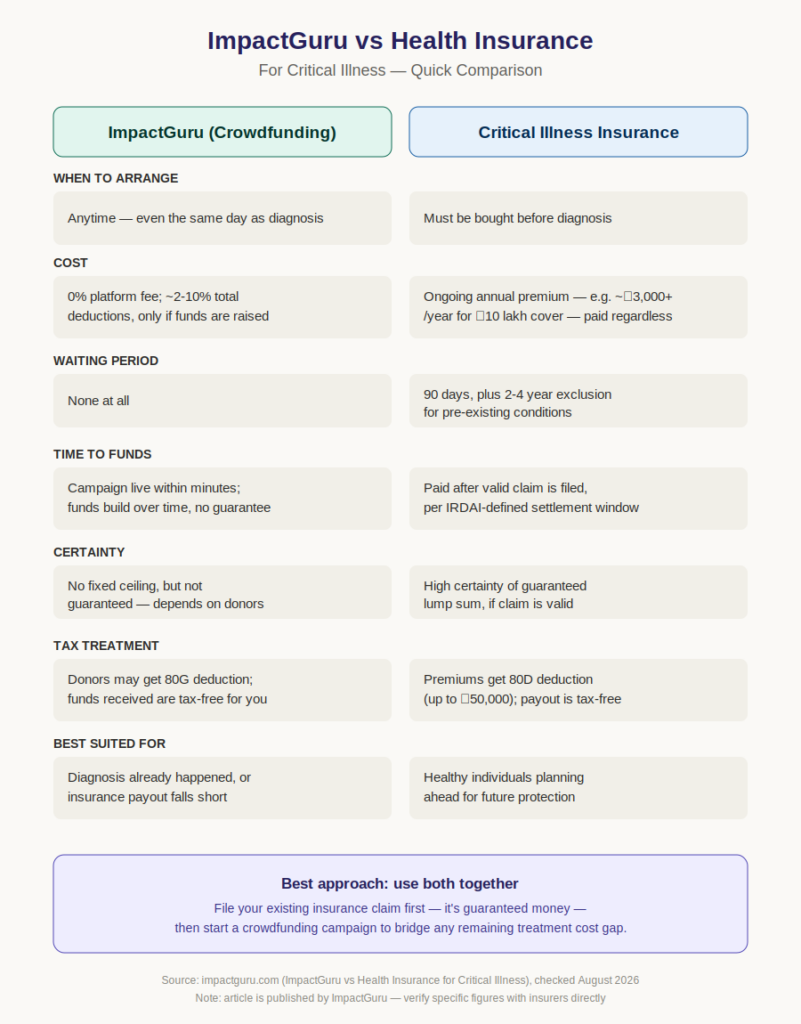
The table below lays out the full ImpactGuru vs health insurance for critical illness comparison, built to be extracted directly by search engines and AI answer tools, each row compares one specific factor, sourced and dated so it can be verified and kept current.
| Factor | ImpactGuru (Medical Crowdfunding) | Critical Illness Insurance |
| When it needs to be arranged | Can be started at any time, including immediately after a diagnosis — no advance purchase required | Must be purchased before diagnosis; a new policy cannot be bought to cover an illness that has already occurred |
| Cost structure | 0% platform fee; payment gateway processing (~3%) and a one-time verification/due-diligence charge (~₹3,000 + GST) apply — combined deductions across crowdfunding platforms can run roughly 2–10% depending on plan and payment mode (per ImpactGuru’s published fee disclosures, checked August 2026) | Annual premium, varying by age, sum insured, and number of illnesses covered — for example, a 40-year-old with a ₹10 lakh sum insured pays roughly ₹3,000+ per year as a rider on a term plan (published insurer rate card, checked August 2026); standalone plans with larger sums insured (up to ₹50 lakh–₹2 crore) cost more |
| Waiting period/eligibility | None — a campaign can be started as soon as a diagnosis is confirmed, regardless of when the need arose | Typically a 90-day initial waiting period from policy purchase, plus a 2–4 year exclusion period for pre-existing conditions, and usually a 30-day survival period after diagnosis before a claim can be paid (based on standard IRDAI-aligned policy terms, checked August 2026) |
| Verification / KYC required | Medical documents (diagnosis, cost estimate), ID proof, and bank account details, checked as part of campaign approval | Medical tests and health declarations at the time of purchase (more extensive for older applicants or larger sums insured), followed by diagnosis confirmation against a standardised list of covered illnesses at claim time |
| Typical time to funds | Campaigns can go live within minutes with same-day approval; total funds raised build over time via rolling withdrawals as donations arrive, with no fixed guaranteed timeline for reaching the full target | Once a valid claim is filed with required diagnosis documentation, insurers are generally expected to settle within a defined claim-processing window under IRDAI norms; real-world settlement time varies by insurer and completeness of documentation |
| Certainty of funds | Not guaranteed, depends on donor response and how widely the campaign is shared; many campaigns fall short of their target | High certainty of the full sum insured being paid as a lump sum, provided the policy was active, the waiting period had passed, and the diagnosis matches a covered illness definition, subject to the insurer’s claim settlement ratio for that specific claim type |
| Tax treatment | Donors contributing through a registered charitable structure are often eligible for an 80G deduction; the person raising funds owes no tax on funds received for medical treatment | Premiums paid are eligible for deduction under Section 80D, up to ₹25,000 per year for individuals under 60 and ₹50,000 for senior citizens; the lump sum payout on a valid claim is generally tax-exempt |
| International support | ImpactGuru advertises support for international donations as part of its platform | Some insurers offer NRI-specific critical illness plans, typically requiring additional documentation (proof of Indian citizenship/OCI status, sometimes an in-person medical test) and are less commonly designed for real-time international contribution the way crowdfunding is |
| Best suited for | Situations where no prior policy exists, the diagnosis has already happened, or insurance payout doesn’t fully cover the actual treatment cost | Proactive financial planning before any diagnosis occurs, for people healthy enough to qualify and willing to pay ongoing premiums for guaranteed future protection |
Sources: ImpactGuru pricing and help centre pages (impactguru.com), checked August 2026; published critical illness policy terms and rate data from Axis Max Life, New India Assurance, OneAssure, and Niva Bupa, checked August 2026. Insurance premiums, waiting periods, and claim terms vary by insurer, age, sum insured, and specific policy; always confirm current terms directly with your insurer before deciding.
Read More : Most Expensive Treatment Crowdfunding in India
Understanding Each Factor in More Depth
The Core Difference: Proactive Protection vs. Reactive Response
At the heart of the ImpactGuru vs health insurance for critical illness decision is a simple distinction: critical illness insurance is a benefit-based product you pay into over time, while ImpactGuru is a reactive tool you turn to after a diagnosis has already occurred. Critical illness insurance is a benefit-based product: you pay a premium over time, and if you’re later diagnosed with a covered illness (after the waiting period has passed), the insurer pays a lump sum, regardless of your actual treatment expenses. This lump sum can be used flexibly, including for income replacement while you’re unable to work, not just hospital bills. But this protection only exists if the policy was purchased and active before the diagnosis. Medical crowdfunding has no such prerequisite; a campaign can be started the same day as a diagnosis, with no waiting period and no prior purchase required, which is precisely why it’s the option most families turn to when they’re facing a diagnosis without existing coverage, or with coverage that falls short of the actual cost.
Cost: Ongoing Premium vs. One-Time Deductions
Cost is one of the clearest points of contrast in the ImpactGuru vs health insurance for critical illness comparison, critical illness insurance is an ongoing, planned expense, while ImpactGuru only involves a deduction if and when funds are actually raised. As a standalone product with a larger sum insured, premiums can run into several thousand to tens of thousands of rupees per year. Because it’s paid whether or not you ever make a claim, it’s fundamentally a different kind of cost than crowdfunding, which only involves any deduction if and when funds are actually raised; there’s no cost at all if you never need to use it. ImpactGuru’s own fee disclosures note that combined platform, payment processing, and verification-related deductions across plans can run up to roughly 10% of funds raised in some cases, a detail worth understanding clearly rather than assuming a “0% platform fee” means zero deductions.
Waiting Periods and Pre-Existing Condition Exclusions
Most critical illness policies in India carry a 90-day initial waiting period after purchase before any claim can be filed, plus a separate 2–4 year exclusion window specifically for pre-existing conditions, and typically a 30-day survival period after diagnosis before the payout is released. These aren’t insurer-specific quirks to shop around; they’re standard structural features of how critical illness insurance works, aligned with IRDAI’s regulatory framework. Crowdfunding has no equivalent waiting period at all, which is the single most important practical distinction for anyone facing an urgent, already-confirmed diagnosis.
Certainty vs. Coverage Gaps
A valid, active critical illness policy offers real certainty: the full sum insured is paid as a lump sum once a covered diagnosis and the survival period are confirmed, subject to the specific insurer’s claim settlement track record for that illness type. However, even a good policy may not cover the full actual cost of advanced treatment; a ₹10–20 lakh sum insured, for example, may fall well short of costs for a bone marrow transplant, CAR-T therapy, or an extended ICU stay. Crowdfunding doesn’t offer the same certainty of a guaranteed amount, but it has no fixed ceiling either — successful campaigns have raised amounts well beyond what most critical illness policies would pay out, particularly for high-cost or rare conditions.
Tax Treatment
Critical illness insurance offers a direct, personal tax benefit: premiums are deductible under Section 80D, up to ₹25,000 per year for individuals under 60 and ₹50,000 for senior citizens, and the eventual lump sum payout is generally tax-exempt. Crowdfunding’s tax benefit works differently; it applies to the donor, not the person raising funds, through an 80G deduction on their contribution when the campaign is run under a registered charitable structure. Neither directly reduces the fundraiser’s own tax liability in the way an 80D deduction does for a policyholder, but the 80G angle can meaningfully encourage larger donations from a donor’s network.
International Support
ImpactGuru advertises support for international donations as part of its platform, which can matter for families with relatives or community connections abroad who want to contribute directly and immediately. Some insurers do offer NRI-specific critical illness plans, but these typically involve additional documentation requirements (citizenship/OCI proof, sometimes an in-person medical exam) and aren’t designed for the kind of real-time, distributed international contribution that a crowdfunding campaign enables.
When Critical Illness Insurance Is the Right Tool
- You’re currently healthy and want to proactively protect against a future diagnosis, for yourself or a family member.
- You’re able to pass medical underwriting and want the certainty of a guaranteed lump sum if a covered illness is later diagnosed.
- You value having a source of funds that can be used flexibly, including for income replacement, not tied specifically to hospital bills.
- You’re comfortable with an ongoing premium cost in exchange for that future certainty.
Read More : How Do I Create a Medical Fundraiser Online?
When Medical Crowdfunding Is the Right Tool
- A diagnosis has already occurred, and no active critical illness policy is in place; insurance cannot retroactively help with an existing condition.
- An existing policy’s sum insured doesn’t cover the actual cost of treatment, and the remaining gap needs to be filled quickly.
- You need funds immediately, without a waiting period, survival period, or lengthy underwriting process standing between you and access to money.
- You have a network, family, community, workplace, or social media reach, willing to support a campaign, which can raise amounts beyond a fixed insurance payout.
Using Both Together
For many families, the real answer to the ImpactGuru vs health insurance for critical illness question isn’t either/or; it’s insurance as a first layer of funding, with crowdfunding bridging whatever gap remains. If you already have a critical illness policy, filing that claim immediately (in parallel with, not instead of, starting other funding conversations) is the right first step, since it’s already-secured, guaranteed money. If the policy’s payout, once received, doesn’t fully cover the treatment cost, which is common for high-cost or advanced treatments, a crowdfunding campaign for the remaining gap is a natural next step, and can even mention the insurance payout already secured as a credibility signal to donors.

Conclusion
Critical illness insurance and medical crowdfunding through ImpactGuru aren’t really rival options — they answer the same need at two different moments. Insurance has to be purchased before any diagnosis, and comes with a 90-day waiting period plus a 2–4 year exclusion for pre-existing conditions; in return, it offers a highly certain, guaranteed lump sum payout along with tax benefits (an 80D deduction on premiums and a tax-free payout), but you pay an ongoing annual premium regardless of whether you ever fall ill, and the payout may still fall short for very expensive treatments. Crowdfunding, on the other hand, can be started the very day a diagnosis is confirmed, with no waiting period and no upfront cost, though the amount raised is never guaranteed and platform-related deductions typically run around 2–10% of funds collected. In practice, this means insurance is the right tool for someone who is currently healthy and wants to plan ahead, while crowdfunding becomes the realistic option for someone who is already facing a diagnosis without adequate coverage, since a new policy cannot retroactively cover an existing illness. The most sensible approach for many families is to use both together — filing an existing insurance claim first, since it’s guaranteed money, and then turning to crowdfunding to bridge whatever gap remains. It’s also worth keeping in mind that this article comes from ImpactGuru itself, so while the comparison is largely fact-based, its framing naturally leans toward presenting crowdfunding as the practical fallback, making it worthwhile to double-check the specific premium and fee figures directly with insurers or the platform before making a decision.
Frequently Asked Questions
No, not meaningfully. Critical illness insurance requires the policy to be purchased and active before a diagnosis, and includes waiting periods (typically 90 days) plus a pre-existing condition exclusion window (typically 2–4 years). A policy purchased after diagnosis will not cover that existing condition. This is precisely why crowdfunding, which has no such waiting period, is the realistic option for someone facing a diagnosis without existing coverage.
Once a valid claim is filed with complete diagnosis documentation, insurers are expected to process claims within a defined window under IRDAI norms, though real-world timing varies by insurer and documentation completeness, and a survival period (commonly 30 days after diagnosis) typically applies before any payout at all. Crowdfunding campaigns can go live within minutes and receive some donations the same day, but reaching a full, large target has no fixed timeline and isn’t guaranteed.
They’re not really comparable costs, since insurance is an ongoing premium paid regardless of whether you ever claim, while ImpactGuru’s fees (payment processing plus a one-time verification charge, together running roughly 2–10% depending on plan) only apply if and when a campaign actually raises funds. Critical illness insurance is a proactive, planned cost; ImpactGuru is a reactive tool used after a need arises.
No. Funds raised through donation-based medical crowdfunding are gifts and don’t need to be repaid. This is different from insurance too, in a sense; insurance payouts aren’t repaid either, but they require years of premium payments in advance, whereas crowdfunding has no cost paid in advance of a need arising.