
Learn how to start a fundraiser for surgery expenses in India, including steps, documents needed, and tips to raise money fast through medical crowdfunding.
When a family member needs surgery, and the bills are beyond reach, waiting is not an option. Here is exactly how to start a fundraiser for surgery expenses in India: collect your medical documents, get a hospital cost estimate, choose a medical crowdfunding platform, create your campaign, and share it with your network to start receiving donations within hours.
Table of Contents
- Quick Answer: Steps to Start a Surgery Fundraiser in India
- What Is Medical Crowdfunding?
- When Should You Start a Surgery Fundraiser?
- Surgery Funding Options in India: What Works Best?
- Can I Raise Money for Surgery Without Health Insurance?
- Before You Launch: What to Prepare
- Step-by-Step: How to Start a Fundraiser for Surgery Expenses in India
- Why A Fundraiser For Surgery Expenses Matters
- Common Mistakes That Kill Surgery Fundraisers
- Checklist Before You Go Live
- Conclusion
- Frequently Asked Questions
Quick Answer: Steps to Start a Surgery Fundraiser in India
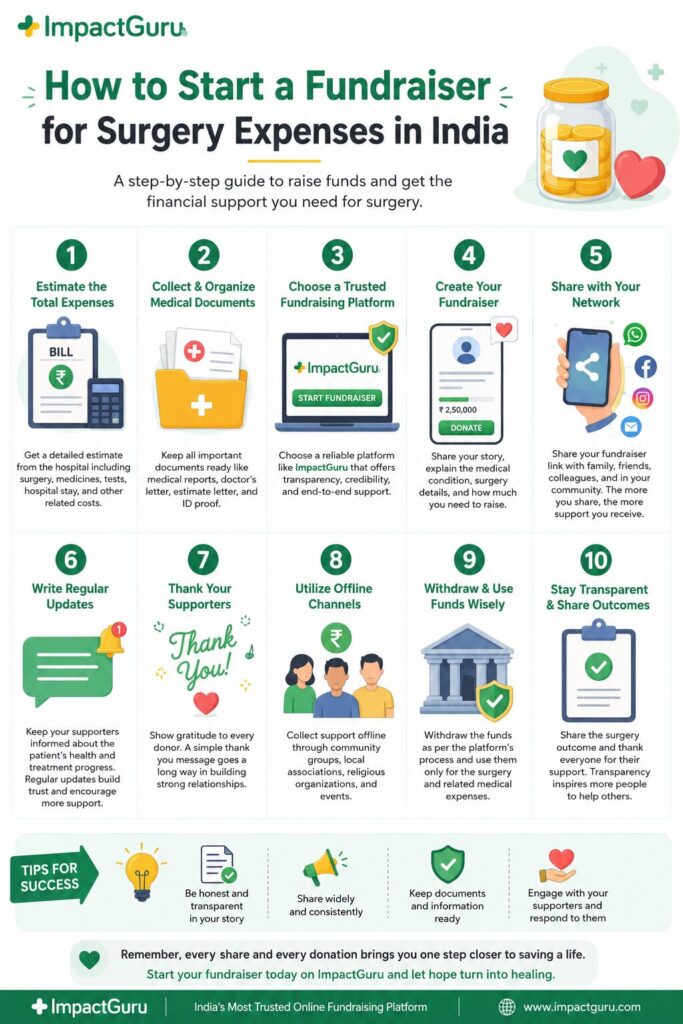
If you need a fast overview, here is exactly how it works:
- Get a written surgery cost estimate from the hospital
- Collect prescriptions, diagnostic reports, and admission documents
- Choose a medical crowdfunding platform in India
- Create a fundraiser page with the patient’s story, photos, and total cost breakdown
- Add scanned medical documents for verification
- Share the fundraiser on WhatsApp groups, Facebook, Instagram, and email
- Post regular updates on the patient’s condition and progress
- Thank donors and share the outcome once treatment is complete
This is the foundation of every successful surgery fundraiser in India. The sections below explain each step in detail.
What Is Medical Crowdfunding?
Medical crowdfunding is a way to raise money online for surgery, hospital bills, and treatment costs by collecting small donations from a large number of people, family, friends, colleagues, and strangers who want to help.
Instead of one person carrying the entire financial burden, the cost is distributed across hundreds or thousands of contributors. Each person gives what they can, ₹500, ₹2,000, ₹10,000, and together those amounts add up to the target.
Online crowdfunding for medical needs works through dedicated platforms where you create a campaign page, tell your story, set a funding goal, and receive donations directly. The funds are then transferred to your bank account or directly to the hospital.
Medical fundraising through crowdfunding is not a loan. There is no repayment, no interest, and no collateral required. It is community support, organised and scaled through technology.
When Should You Start a Surgery Fundraiser?
Not every situation calls for crowdfunding, but many do. A surgery fundraiser in India is often the right choice when:
- Health insurance covers only part of the surgery cost, and the remaining amount is unaffordable
- Surgery is urgent, and a bank loan or formal financing will take too long to process
- Total treatment costs, surgery, ICU, medicines, and rehabilitation, exceed your family’s savings
- The patient is uninsured or underinsured, which is still common across large sections of India despite schemes like Ayushman Bharat PM-JAY.
- Post-surgical expenses such as physiotherapy, follow-up scans, or long-term medications are also expected.
- Family support alone is not enough, and you need to expand beyond your immediate circle.
The key point: crowdfunding for medical treatment is not a last resort. For many families in India, it is the fastest and least burdensome path to arranging surgical funds.
Read More : How Can I Raise Funds Online for Medical Treatment?
Surgery Funding Options in India: What Works Best?
| Option | Best For | Limitation |
| Savings | Small planned procedures | Drains emergency funds |
| Insurance | Partial hospital costs | Caps, exclusions, and claim delays |
| Personal loan | Short-term urgent need | Interest and approval time |
| Family borrowing | Immediate support | Limited and emotionally stressful |
| Medical crowdfunding | High-cost surgery and urgent treatment | Requires active sharing |
Can I Raise Money for Surgery Without Health Insurance?
Yes, and most people who use medical crowdfunding in India do so precisely because insurance is unavailable or insufficient.
Here is why insurance often falls short in India:
- A large share of India’s workforce is in the informal sector, with no employer-provided insurance.
- Government schemes like Ayushman Bharat PM-JAY cover only specific treatments and hospitals, and have caps that may not cover complex surgeries at private facilities.
- Even insured families frequently face shortfalls due to policy exclusions, pre-existing condition clauses, or claim rejections.
- Private insurance premiums are rising, and many families hold policies with limits well below what critical surgery actually costs.
Medical crowdfunding fills this gap. You do not need insurance to start a fundraiser. You need a verified medical need, a clear cost estimate, and the willingness to share your story openly.
Before You Launch: What to Prepare
Campaigns that are prepared well before going live raise significantly more than those that rush in. Before you start a medical fundraiser for surgery, have the following ready:
Hospital cost estimate
Get a written estimate from the hospital billing department that breaks down the surgery fee, anaesthesia, ICU stay, medicines, and post-operative care. A specific rupee figure builds donor confidence.
Medical documents
Collect the treating doctor’s prescription or referral letter, diagnostic reports (blood tests, scans, biopsy), and any existing hospital bills if treatment has already begun.
Patient photograph
A clear, recent photo of the patient humanises the campaign. People donate to people — not to conditions.
Bank account and KYC details
Most Indian medical crowdfunding platforms require KYC verification, Aadhaar, PAN, and bank account details before funds can be transferred. Have these ready before you launch, so there is no delay in receiving donations.
A spokesperson, if needed
If the patient is too unwell to manage communications, assign a family member or close friend to manage the campaign, respond to donor messages, and share updates regularly.

Step-by-Step: How to Start a Fundraiser for Surgery Expenses in India
Step 1 – Choose a Medical Crowdfunding Platform
Select a platform that specialises in crowdfunding for medical treatment in India. Key things to look for:
- Zero or low platform fees for medical campaigns
- Fast fund withdrawal, ideally within 24 to 72 hours of request
- A dedicated campaign support manager has been assigned to your fundraiser
- Verification process that adds credibility with donors
- Multiple payment options, including UPI, net banking, credit, and debit cards
- Transparent fund transfer directly to your hospital or bank account
Platforms like ImpactGuru are built specifically around the medical context — with processes that understand the urgency involved when surgery cannot wait.
Step 2 – Build Your Campaign Page
Your campaign page is what converts a visitor into a donor. It needs to do three things: explain the situation clearly, create an emotional connection, and tell people exactly what their money will do.
Write a specific title
“Help Rajan Undergo Emergency Kidney Transplant Surgery” performs better than “Medical Help Needed.” Specificity creates trust.
Tell the full story
Who is the patient? What is the diagnosis? When was it discovered? What does the treatment plan look like? Why is external funding needed? Keep the language simple and honest.
Break down the costs
For example:
- Surgery and surgeon fees: ₹3,50,000
- ICU and hospital stay: ₹1,20,000
- Medicines and consumables: ₹60,000
- Post-operative care and follow-up: ₹40,000
- Total: ₹5,70,000
This level of transparency significantly increases donor confidence and reduces hesitation.
Upload photos and documents
Include a photo of the patient and scanned copies of key medical documents. Many donors check these before contributing, especially for larger amounts.
Step 3 – Seed Your Campaign With Inner Circle Donations
Before going public, personally reach out to 10–20 people you trust, close family, best friends, and direct colleagues. Call them or send individual WhatsApp messages. Ask them directly to donate, even a small amount.
A campaign that already shows ₹40,000–₹80,000 in donations performs dramatically better with strangers than one sitting at zero. Social proof matters. People are far more likely to donate to something that already has momentum.
WhatsApp is the single most powerful distribution channel for medical fundraising in India. Share your campaign in:
- Family groups
- Friends and college alumni groups
- Housing society and colony groups
- Office and professional groups
- Religious and community groups
Write a short personal message each time; do not just drop a link. Even two lines of context make a significant difference.
Facebook reaches a broader network. Post it on your personal timeline and ask friends to reshare. Tag people where appropriate.
Instagram works well if you or the patient has a following or if the story has strong visual elements.
Email is effective for reaching professional contacts who may contribute larger amounts.
Multilingual sharing matters. If your community primarily communicates in Hindi, Tamil, Telugu, Bengali, or any regional language, share in that language. A message in someone’s mother tongue creates a far stronger emotional response.
Step 5 – Update Regularly
Post an update every 3–5 days. Share the current donation amount, how it is being used, and what the next milestone looks like. If surgery is scheduled, mention the date. If the patient has been admitted, share that progress.
Updates serve two purposes: they re-engage existing donors and trigger new ones. Each update is another opportunity for people to share the campaign.
Step 6 – Close the Loop After Treatment
Once treatment is complete, post a final update. Thank your donors by name, if possible, for a successful fundraiser for surgery expenses. Share the outcome. Let people know their contribution made a difference.
This final step is often skipped, but it matters enormously for building trust in online crowdfunding as a whole, and for your own credibility if you ever need to fundraise again.
Why A Fundraiser For Surgery Expenses Matters
A fundraiser for surgery expenses helps patients and families manage high medical costs during emergencies. Surgeries like heart operations, cancer treatment, organ transplants, and accident-related procedures can be expensive, making crowdfunding an effective financial support option.
Online platforms like ImpactGuru allow patients to raise donations by sharing their medical story, hospital documents, and treatment estimates. A verified and transparent campaign builds donor trust and increases the chances of receiving faster support.
Medical crowdfunding can help cover:
- Surgery costs
- ICU and hospital charges
- Medicines and tests
- Post-surgery recovery expenses
- Travel and accommodation costs
Sharing the fundraiser on WhatsApp, Facebook, and Instagram can improve reach and help families raise funds quickly during critical situations.
Read More : Is Medical Crowdfunding Safe in India?
Common Mistakes That Kill Surgery Fundraisers
- Setting the goal too low: Donors lose confidence when campaigns are extended repeatedly. Calculate the full cost upfront.
- Going silent after Day 1: Most failed campaigns simply stopped sharing. Visibility is everything.
- Vague storytelling: “Help us fight illness” tells a donor nothing. Be specific about the condition, the hospital, the surgery, and the cost.
- Not addressing leftover funds: State clearly upfront that any surplus will go toward post-surgery care or medications. Donors want to know before they contribute.
- Skipping KYC: Incomplete verification delays withdrawals and can stall fund transfers at the worst possible time.
Checklist Before You Go Live
- Written hospital cost estimate collected
- Medical documents scanned and ready to upload
- Patient photo ready
- KYC documents (Aadhaar, PAN, bank details) prepared
- Campaign story written, specific, honest, cost-itemised
- 10–15 inner circle contacts ready to donate on Day 1
- WhatsApp groups and social profiles are ready to share
- Update plan in place, at least once every 3–5 days
Conclusion
Starting a fundraiser for surgery expenses in India is one of the most practical steps a family can take when facing a medical crisis. It does not require influence, a large social following, or prior fundraising experience.
What it requires is preparation, honesty, and consistent effort in sharing your story with the people around you.
Medical crowdfunding in India has helped thousands of families afford surgeries that would otherwise have been out of reach. The technology exists, the donor community exists, and the willingness to help is real; you just need to make it easy for people to find you and contribute.
Frequently Asked Questions
Most platforms allow you to create and launch a campaign within a few hours. Verification of documents may take 24–48 hours on some platforms.
Most Indian medical crowdfunding platforms allow withdrawals as soon as donations start coming in, without a minimum threshold. Check the withdrawal policy of your chosen platform before launching.
Yes. Many families start fundraisers after treatment has already begun. In such cases, existing bills and hospital receipts strengthen the credibility of your campaign.
This depends on the platform and whether it is registered under Section 80G. Check with your platform whether donations to individual medical campaigns qualify for tax exemption.