


Table of Contents
- Key Takeaways
- Introduction
- Understanding the Real Cost of Dialysis in India
- Step 1: Check Free and Subsidised Dialysis Options First
- Step 2: Get a Clear, Itemized Understanding of Your Ongoing Cost
- Step 3: Apply to Kidney-Focused NGOs for Ongoing Support
- Step 4: Start a Medical Crowdfunding Campaign for the Remaining Gap
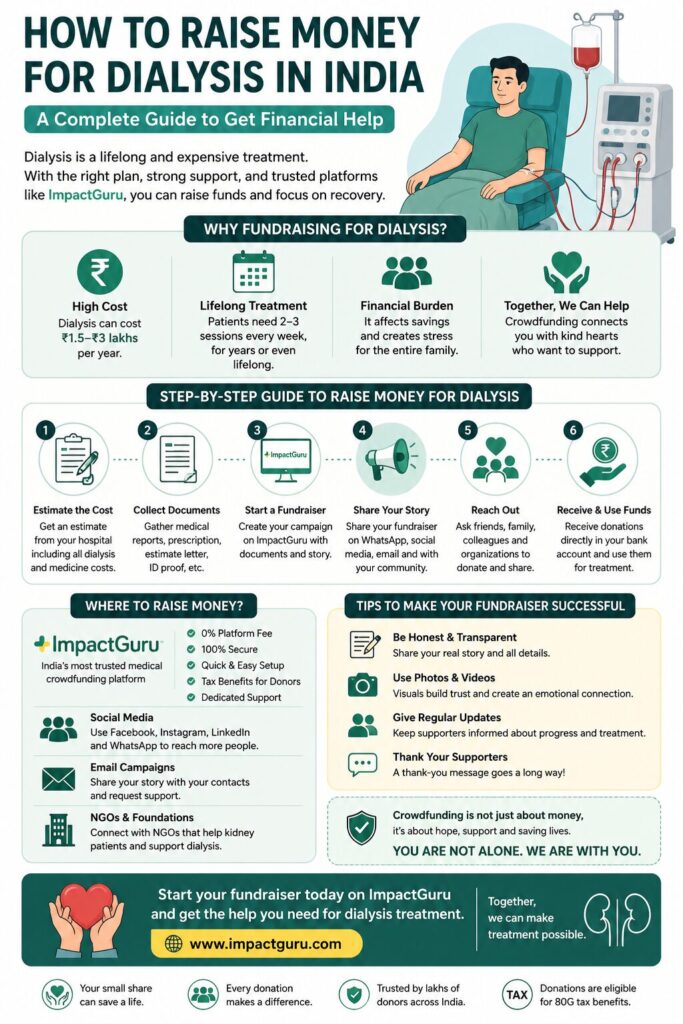
- How to Set Up a Dialysis Fundraiser (Step-by-Step)
- Step 5: Explore Parallel and Supplementary Support
- Conclusion
- Frequently Asked Questions
Key Takeaways
- If you need to raise money for dialysis in India, know this first: private hemodialysis runs ₹1,500–₹5,200 per session, or ₹18,000–₹65,000+ per month, but many patients are eligible for free dialysis through a government programme most families have never heard of.
- The Pradhan Mantri National Dialysis Programme (PMNDP) provides free hemodialysis (and, increasingly, free peritoneal dialysis) to eligible patients at over 1,350 centres nationwide; this should be your first stop, not your last resort.
- Ayushman Bharat (PM-JAY) separately covers dialysis at empanelled hospitals for eligible families, up to ₹5 lakh per family per year.
- Because dialysis is recurring, one-time crowdfunding campaigns work differently here than for a single surgery; the most effective approach is usually a combination of free/subsidised access plus a fundraiser sized for a specific stretch of time (e.g., 6–12 months) rather than an open-ended target.
- Dedicated kidney-patient NGOs, India Renal Foundation, Kidney Federation of India, Kidney Warriors Foundation, provide ongoing monthly support specifically for dialysis patients, not just one-time grants.
- Platforms like ImpactGuru support both one-time and recurring medical fundraising, which suits dialysis better than platforms built only for single-event campaigns.
Introduction
If you’re trying to raise money for dialysis in India, the first thing to understand is that it’s different from almost every other medical fundraising situation, and that difference should shape your whole strategy. A liver transplant or a heart bypass is a single, large, one-time cost. Dialysis is not. A liver transplant or a heart bypass is a single, large, one-time cost. Dialysis is not. If a patient’s kidneys have failed, hemodialysis or peritoneal dialysis becomes a recurring, lifelong necessity, two to three sessions a week, every week, for as long as the patient doesn’t receive a transplant. That changes the entire funding strategy: instead of raising one lump sum for one procedure, most families need a mix of a free or subsidised ongoing dialysis source (so the bills don’t start piling up in the first place) plus a funding cushion for the costs that government and insurance don’t fully absorb, travel, nutrition, AV fistula maintenance, and the occasional complication.
This guide covers every legitimate way to manage and fund dialysis costs in India: understanding real per-session and monthly costs, the free government dialysis programme most families don’t know exists, NGOs that specifically support renal patients, and, for the remaining gap, medical crowdfunding.
Read Also : How to Raise Money for a Liver Transplant in India in 2026
Understanding the Real Cost of Dialysis in India
Before you can decide how to fund dialysis, it helps to see the actual cost structure, and the very large gap between government/PPP facilities and private hospitals.
| Cost Item | Government / PPP Facility | Private Hospital / Centre |
| Per-session hemodialysis | ₹500–₹1,595 (often free for BPL/PMNDP-eligible patients) | ₹1,500–₹5,200 per session |
| Monthly hemodialysis (12–13 sessions) | ₹0–₹6,000 (free or heavily subsidised for eligible patients) | ₹18,000–₹65,000+ |
| Peritoneal dialysis (CAPD), monthly | Free under PMNDP home-PD pilots in some states | Approx. ₹20,000–₹40,000, including fluid and consumables |
| AV fistula / catheter placement (one-time) | ₹0–₹15,000 at government/PPP centres | ₹25,000–₹75,000 |
| Annual out-of-pocket cost (private, no scheme) | — | Averages roughly ₹3.5–4 lakh/year across direct medical costs |
A few things worth understanding about how this cost actually plays out over time:
- It compounds, unlike a single surgery: A ₹30,000/month private hemodialysis bill sounds manageable in isolation. Still, over a year it’s ₹3.6 lakh, and dialysis is typically lifelong unless a transplant becomes possible. So the real number to plan around is an annual or multi-year figure, not a monthly one.
- Hemodialysis vs. peritoneal dialysis cost: Even though the sessions look different — hemodialysis has lower per-session procedure cost but higher travel and erythropoietin (anaemia medication) cost, while peritoneal dialysis has higher fluid/consumable cost but can be done at home, saving on travel. Neither is a clear financial winner; the choice should be made with your nephrologist based on medical suitability, not cost alone.
- Government and PPP-run centres charge a fraction of private rates: Sometimes free, sometimes ₹500–₹1,595 per session, which is why checking eligibility for government dialysis programmes before committing to a private centre is one of the highest-value first steps a family can take.
- Additional costs add up fast: erythropoietin injections for anaemia, iron and vitamin supplementation, dietary changes, travel to the dialysis centre three times a week, and occasional AV fistula revision if it narrows or clots.
Read More : How to Run a Successful Crowdfunding Campaign in India?
Step 1: Check Free and Subsidised Dialysis Options First
Because dialysis is recurring, the single most impactful thing a family can do, more impactful than any one crowdfunding campaign — is to establish access to free or heavily subsidised dialysis before the bills start accumulating.
The Pradhan Mantri National Dialysis Programme (PMNDP)
Launched in 2016 under the National Health Mission, PMNDP provides free hemodialysis services to eligible patients at district hospitals across India, delivered through a public-private partnership model. As of the programme’s most recent published figures, it operates at over 1,350 centres across 641 districts in all 36 states and union territories, and has served over 17 lakh beneficiaries.
- Eligibility is generally based on Below Poverty Line (BPL) status or household income (commonly around ₹3 lakh/year or below, though the exact threshold varies by state) — check with your district hospital’s PMNDP desk for the specific criteria in your state.
- Documents typically needed: income certificate, Aadhaar card, residence proof, and medical confirmation of end-stage renal disease (ESRD) from a nephrologist.
- “One Nation, One Dialysis”: if you’re registered under PMNDP with an ABHA (Ayushman Bharat Health Account) ID, you can access participating centres in other states too — useful for patients who travel or relocate.
- Peritoneal dialysis at home: several states have begun piloting free at-home PD services under PMNDP, which can meaningfully reduce the travel burden for patients who qualify.
This programme is under-used simply because awareness is low — many families default straight to private dialysis centres without ever checking whether a PMNDP-linked centre is available nearby. Asking your treating hospital’s medical social worker about PMNDP eligibility on day one can be the single highest-leverage step in this entire guide.
Ayushman Bharat (PM-JAY)
Separately from PMNDP, Ayushman Bharat provides cashless treatment — including dialysis — for eligible families at empanelled hospitals, up to ₹5 lakh per family per year. Eligibility is based on the SECC database used to identify beneficiary families; check your eligibility and nearest empanelled hospital through the scheme’s official portal or helpline.
Other Government Schemes
| Scheme | Who It’s For | What It Covers |
| Pradhan Mantri National Dialysis Programme (PMNDP) | BPL and other eligible patients (income-based; varies by state, commonly up to ~₹3 lakh/year household income) | Free hemodialysis (and, in growing pilot areas, peritoneal dialysis) at over 1,350 centres across district hospitals nationwide, under the “One Nation, One Dialysis” portability model using your ABHA ID |
| Ayushman Bharat (PM-JAY) | Eligible families under the SECC database | Cashless treatment, including dialysis, at empanelled hospitals, up to ₹5 lakh per family per year |
| CGHS / ESIC | Central government employees / organised-sector workers | Dialysis and related renal care at empanelled hospitals per scheme rules |
| State-specific schemes | Residents of the respective state | e.g., Tamil Nadu’s CMCHIS, Andhra Pradesh/Telangana’s Aarogyasri, Karnataka’s Arogya Karnataka — several include free or subsidised dialysis, and some now cover at-home peritoneal dialysis |
Step 2: Get a Clear, Itemized Understanding of Your Ongoing Cost
If free/subsidised dialysis isn’t available or only partially covers your needs, ask your nephrologist or dialysis centre for a written breakdown covering:
- Cost per session and expected sessions per week
- Medication costs (especially erythropoietin and iron supplementation, which can be a high recurring cost)
- AV fistula/catheter maintenance and the likelihood of revision surgery
- Whether a kidney transplant is a realistic future option for this patient, since a successful transplant, while itself a high one-time cost, often works out cheaper than years of ongoing dialysis and can end the recurring financial burden entirely
This document is what turns “we need help with dialysis” into a specific, credible, plannable number, which matters enormously both for NGO applications and for crowdfunding campaigns.
Step 3: Apply to Kidney-Focused NGOs for Ongoing Support
Unlike NGOs built around one-time surgeries, several Indian kidney-patient organizations are specifically structured to provide recurring, month-on-month support — which suits dialysis far better than a single grant.
| Organization | Focus Area | Notes |
| India Renal Foundation (“Save a Life”) | Ongoing financial support for dialysis and transplant patients | Supports 60+ patients monthly on a rolling basis, including post-transplant medication costs; patients are assessed individually on need |
| Kidney Federation of India (KFI) | Direct dialysis cost coverage for poor patients, Kerala-based but pan-India reach | Issues payment directly to hospitals so patients can access dialysis; also facilitates kidney-swap matching for mismatched donor pairs |
| Kidney Warriors Foundation (KWF) | Patient community + direct financial intervention for CKD/dialysis patients | Runs targeted programmes covering medicine and dialysis costs for patients in acute need, especially during emergencies |
| Aashayein Kidney Foundation | Dialysis patient support, primarily Gujarat-based centres | Focuses on holistic support for dialysis patients including access and comfort at partner dialysis centres |
Because dialysis is ongoing, it’s worth applying to more than one of these in parallel, since most operate on limited monthly budgets and can’t guarantee approval. Re-apply or check in periodically even after an initial rejection, since capacity and funding cycles change.
Step 4: Start a Medical Crowdfunding Campaign for the Remaining Gap
Even with government schemes and NGO support, many families still face a partial gap, travel costs, medication not covered by a scheme, or dialysis at a private centre while waiting for a government slot to open up. This is often the final piece of the puzzle when you’re trying to raise money for dialysis in India: medical crowdfunding, though it works a little differently for a recurring condition than for a one-time surgery.
Framing a Dialysis Campaign Correctly
A campaign that says “help fund ongoing dialysis, indefinitely” is harder for donors to size up and commit to than one with a clear, bounded ask. The strongest dialysis campaigns typically do one of the following:
- Set a defined target tied to a specific period — e.g., “₹3.6 lakh to cover 12 months of dialysis” — rather than an open-ended amount, since bounded asks convert better and are easier for donors to evaluate.
- Frame the campaign around a bridge, not a permanent solution — e.g., funding dialysis for the months needed to reach transplant eligibility, or to bridge the gap while a government scheme application is processed.
- Combine the fundraising ask with the transplant possibility, if medically relevant — donors often respond strongly to a campaign that frames dialysis funding as a bridge toward an eventual transplant, since it gives the campaign a hopeful endpoint.
Why Crowdfunding Works Better Than a Loan for This Situation
- No repayment, no interest — critical for a recurring expense, since a loan’s EMI would simply become another monthly bill stacked on top of dialysis costs.
- Speed — a campaign can go live within minutes, important when dialysis often can’t be delayed even briefly.
- Reach — friends, extended family, colleagues, and community networks can contribute small, recurring amounts that add up meaningfully over a bounded campaign period.
- Tax benefit for donors — contributions through campaigns run under a registered charitable structure are often eligible for deduction under Section 80G, which can encourage larger or repeat donations.
Choosing the Right Crowdfunding Platform for Dialysis
Because dialysis funding needs differ from one-time surgical funding, look for a platform that supports:
- Rolling/partial withdrawals, so funds can be used as each month’s dialysis bill comes due, rather than waiting for one lump-sum release.
- A 0% or low platform fee model, since every rupee matters more over a long, recurring fundraising relationship than a single campaign.
- Fast verification, since dialysis needs typically can’t wait for a slow approval process.
- Medical fundraising expertise — teams who understand how to frame a recurring-cost campaign (bounded time period, clear monthly math) rather than treating it identically to a one-time surgery appeal.
ImpactGuru is one of the platforms built around this kind of medical fundraising. Founded in 2014, it has supported patients managing chronic and recurring conditions, including dialysis, with a 0% platform-fee option, document verification support, and campaign specialists who can help structure a dialysis campaign around a clear, time-bound target rather than an open-ended ask — which, as noted above, tends to perform meaningfully better with donors than a vague, indefinite appeal.
How to Set Up a Dialysis Fundraiser (Step-by-Step)
Here’s exactly how to raise money for dialysis in India once you’ve decided crowdfunding is part of your plan:
- Gather your documents: nephrologist’s diagnosis and treatment plan, dialysis centre’s cost estimate (per session and monthly), ID proof, and bank account details.
- Decide on a bounded target and timeframe: e.g., 6 or 12 months of dialysis costs, rather than an open-ended amount; this makes the ask easier for donors to evaluate and commit to.
- Create the campaign: on platforms like ImpactGuru, this typically takes under 10 minutes — explain the diagnosis, the recurring nature of the cost, and what the specific target covers.
- Add a photo and, ideally, a short video: a real face and voice consistently raise more than text alone, and help donors understand this is an ongoing, real need rather than a one-off request.
- Get verified: the platform confirms medical documents and identity, building the trust needed for strangers to donate to an ongoing cause.
- Share immediately and periodically re-share: because the need is recurring, plan to re-engage your network every few weeks with updates, not just once at launch.
- Post regular updates: number of sessions completed, how funds have been used, any progress toward transplant eligibility if relevant; recurring campaigns rely more heavily on sustained updates than one-time campaigns do.
- Withdraw funds on a rolling basis to pay each dialysis cycle’s cost as it comes due.
Step 5: Explore Parallel and Supplementary Support
Crowdfunding, PMNDP, and NGO support cover most of the ground, but a few additional channels can round out how you raise money for dialysis in India when a gap still remains:
- Hospital financial counseling desks: many private dialysis chains and hospitals offer discounted package rates for patients committing to long-term treatment at their centre; always ask before assuming the listed rate is final.
- Corporate CSR desks: if the patient or a family member is employed, HR or CSR teams sometimes co-fund ongoing medical costs, particularly for employees managing a chronic condition.
- Community and religious organizations: temple, mosque, church, and RWA collection drives can be organized as recurring monthly support rather than a one-time donation, which suits dialysis better than a single lump-sum drive.
- Dialysis centre patient-support programmes: some private chains run their own patient assistance funds; ask directly at your centre.

Read More : How Do I Create a Medical Fundraiser Online?
Conclusion
If you’re going to raise money for dialysis in India successfully, whether through crowdfunding or NGO applications, transparency matters from day one: use your real name and photo, upload actual medical documents and cost estimates, and post regular updates as treatment continues.
Frequently Asked Questions
Private hemodialysis typically costs ₹1,500–₹5,200 per session, or roughly ₹18,000–₹65,000 per month for standard thrice-weekly treatment. Government and PPP-run centres charge far less, often ₹500–₹1,595 per session, and many eligible patients receive dialysis completely free under the Pradhan Mantri National Dialysis Programme.
It can be, for eligible patients. The Pradhan Mantri National Dialysis Programme (PMNDP) provides free hemodialysis, and, in a growing number of states, free at-home peritoneal dialysis, to patients who meet income and residency eligibility criteria, at over 1,350 centres nationwide. Ayushman Bharat separately covers dialysis costs at empanelled hospitals for eligible families.
Speak with the medical social worker or PMNDP desk at your nearest district hospital. You’ll generally need an income certificate, Aadhaar card, residence proof, and a nephrologist’s confirmation of end-stage renal disease. Eligibility thresholds vary by state, so confirm current criteria locally rather than relying on a single nationwide number.
Not quite. Because dialysis is an ongoing, recurring cost rather than a single event, campaigns tend to perform better when they set a bounded target tied to a specific time period (e.g., 6 or 12 months of treatment) rather than an open-ended ask, and when they’re supported by regular updates over time rather than a single launch push.
Yes, organizations including India Renal Foundation (through its “Save a Life” programme), Kidney Federation of India, Kidney Warriors Foundation, and Aashayein Kidney Foundation provide ongoing financial or direct-payment support specifically for dialysis patients, based on individual assessment of need.
Yes. Donation-based crowdfunding for medical needs, including recurring treatment like dialysis, is legal in India. Reputable platforms use document verification and secure payment processing to protect both patients and donors.
Often yes; contributions made through campaigns structured under a registered charitable entity are typically eligible for deduction under Section 80G of the Income Tax Act. Confirm the specific platform’s tax-receipt process.
The most effective way to raise money for dialysis in India is to combine three things: free or subsidised access through PMNDP or Ayushman Bharat, ongoing support from a kidney-focused NGO, and a bounded medical crowdfunding campaign (e.g., sized for 6–12 months) to cover whatever gap remains.