
Table of Contents
- Quick Summary
- Key Takeaways
- Understanding Chemotherapy Cost in India
- Step 1: Get a Written Cost Estimate for the Full Protocol
- Step 2: Use Insurance Correctly – Don’t Assume It Won’t Cover You
- Step 3: Check Government Schemes
- Step 4: Apply to Cancer-Focused NGOs
- Step 5: Start a Medical Crowdfunding Campaign
- How to Raise Money for Chemotherapy in India (Step-by-Step)
- Step 6: Don’t Overlook the Costs Around Chemotherapy
- A Note on Trust and Verification
- Frequently Asked Questions
Quick Summary
- If you’re trying to raise money for chemotherapy in India, expect ₹8,000–₹2 lakh per cycle, with a full 4–8 cycle course typically totaling ₹1–20 lakh depending on cancer type and drug protocol.
- Cancer type and drug choice are the biggest cost drivers — generic older drugs cost a fraction of newer targeted therapies or immunotherapy.
- Ayushman Bharat, the Health Ministry’s Cancer Patient Fund, and PMNRF can cover all or part of chemotherapy cost for eligible families.
- Because chemotherapy runs in cycles over months, a phased fundraising target usually works better than one lump sum.
- Dedicated cancer NGOs — Indian Cancer Society, CPAA, and CanKids KidsCan for children — provide financial assistance specifically for chemotherapy and related cancer care.
A cancer diagnosis is disorienting enough on its own — and then comes the chemotherapy schedule: not one bill, but a series of them, spaced two to three weeks apart, for months at a time. India recorded over 15.7 lakh new cancer cases in 2025, and for most families, working out how to raise money for chemotherapy in India is one of the most stressful parts of the entire treatment journey. This guide covers everything you need: real per-cycle and full-course costs by cancer type, how to use insurance and government schemes correctly, which NGOs specifically help with chemotherapy costs, and — for whatever gap remains — how to run a crowdfunding campaign built around the reality that chemotherapy is a multi-month, multi-payment process, not a single expense.
Key Takeaways
- Anyone looking to raise money for chemotherapy in India should know it typically costs ₹8,000 to ₹2 lakh per cycle, and a full treatment course (typically 4–8 cycles) usually totals ₹1 lakh to ₹20 lakh or more, depending on cancer type, drug protocol, and hospital.
- Cancer type and drug choice are the biggest cost drivers — generic older drugs can cost a fraction of newer targeted therapies or immunotherapy, and it’s worth explicitly discussing generic alternatives with your oncologist.
- Ayushman Bharat, the Health Ministry’s Cancer Patient Fund, and PMNRF can cover all or part of chemotherapy costs for eligible families; check these before assuming the full cost falls on you.
- Because chemotherapy is delivered in cycles over months, the most effective fundraising approach usually mirrors that structure: a phased target rather than one lump sum, similar to how families successfully fundraise for other multi-cycle treatments.
- Dedicated cancer NGOs, Indian Cancer Society, Cancer Patients Aid Association, and CanKids KidsCan for children, provide financial assistance specifically for chemotherapy and related cancer care.
- Crowdfunding Platforms like ImpactGuru support both one-time and phased medical crowdfunding, suiting the multi-cycle nature of chemotherapy better than a single-event fundraising model.
Also Read : Chemotherapy Treatment in India: Complete Guide 2026
Understanding Chemotherapy Cost in India
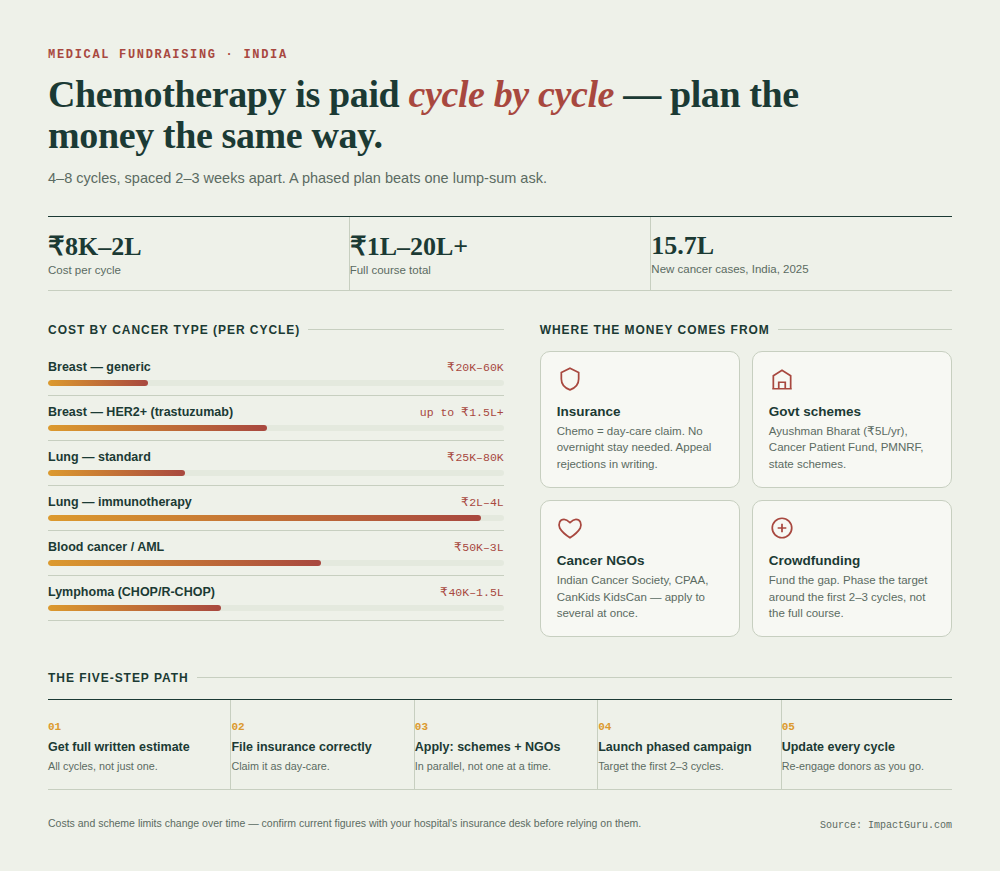
Chemotherapy pricing depends on four main factors: the specific drug protocol prescribed, the cancer type and stage, the delivery method (oral vs. injectable/infusion), and the hospital you choose. Because these variables combine differently for every patient, it helps to look at real ranges by cancer type rather than relying on a single blended number.
| Cancer Type | Per-Cycle Cost | Full Course (4–8 cycles) |
| Breast cancer (generic protocol) | ₹20,000–₹60,000 | ₹2–6 lakh |
| Breast cancer (HER2-positive, with trastuzumab) | up to ₹1.5 lakh+ | ₹2–12 lakh |
| Lung cancer (standard platinum-based) | ₹25,000–₹80,000 | ₹3–8 lakh |
| Lung cancer (with immunotherapy) | ₹2–4 lakh | up to ₹20 lakh+ |
| Blood cancer / AML | ₹50,000–₹3 lakh | ₹5–15 lakh+ |
| Lymphoma (CHOP/R-CHOP) | ₹40,000–₹1.5 lakh | ₹3–10 lakh |
A few cost drivers worth understanding before you set your fundraising target:
- Generic vs. branded drugs: older chemotherapy drugs like 5-FU or cisplatin can cost ₹15,000–₹30,000 per cycle, while newer targeted therapies or immunotherapy drugs can push a single cycle past ₹1.5–4 lakh. Ask your oncologist directly whether a generic or biosimilar alternative is medically appropriate for your protocol — this is consistently one of the biggest cost-saving conversations patients don’t know to have.
- Number of cycles: most protocols run 4 to 8 cycles spaced two to three weeks apart, so the true cost to plan for is the full course total, not just the first cycle’s bill.
- Costs beyond the infusion itself: blood count monitoring, imaging scans every 2–3 cycles, supportive medications (anti-nausea drugs, growth factors), and management of side effects all add to the total — these “invisible” costs often add up faster than families expect and should be included in your fundraising target.
- Day-care vs. inpatient: many modern chemotherapy protocols are administered as day-care infusions rather than requiring overnight admission, which can meaningfully reduce cost — check whether your hospital offers a day-care oncology unit.
- Government vs. private hospitals: government cancer centres and select PPP-run facilities can offer chemotherapy at a fraction of private hospital rates for comparable protocols, sometimes starting around ₹20,000 per cycle versus ₹35,000–₹1 lakh+ at leading private hospitals.
Read More : Chemotherapy Cost Assistance in India & Funding Help
Step 1: Get a Written Cost Estimate for the Full Protocol
Ask your oncologist or the hospital’s billing desk for a written estimate covering:
- The full drug protocol and number of planned cycles, not just the first cycle.
- Whether generic or biosimilar alternatives are available and medically appropriate for your regimen.
- Supportive care costs (anti-nausea medication, growth factor injections, monitoring tests) across the full course.
- What happens to cost if the treatment plan changes based on how you respond, since oncology protocols sometimes adjust mid-course.
This estimate is what turns “I need help with chemo” into a specific, credible number, both for your own planning and for anyone you ask for support, whether that’s an NGO, government scheme, or crowdfunding donors.
Step 2: Use Insurance Correctly – Don’t Assume It Won’t Cover You
A significant number of patients underuse insurance they actually have, simply because of avoidable confusion. A few things worth checking explicitly:
- Chemotherapy is classified as a “day care procedure” by most modern Indian insurance policies (Star Health, HDFC Ergo, ICICI Lombard, and others) — you do not need a 24-hour hospital admission to claim it, despite this being a common misconception that causes people to skip filing valid claims.
- Ask specifically about oral chemotherapy coverage; some older policies only cover injectable chemotherapy, meaning claims for modern oral chemotherapy pills (increasingly used for certain cancers, including some lung cancer protocols) can be wrongly rejected under outdated policy wording. Push back on this specifically if it happens.
- A verbal rejection from an insurer carries little formal weight; request any denial in writing, since this opens a formal appeal process, and many families find the outcome reverses on appeal.
- Check whether pre-authorization is required separately for each cycle, which some policies do require, to avoid unexpected claim rejections partway through your treatment course.
Step 3: Check Government Schemes
Several government schemes specifically fund chemotherapy and broader cancer treatment for eligible patients:
| Scheme | Who It’s For | What It Covers |
| Ayushman Bharat (PM-JAY) | Eligible families under the SECC database | Covers approved chemotherapy regimens at empanelled hospitals, up to ₹5 lakh per family per year |
| Health Ministry’s Cancer Patient Fund (under RAN) | Below-poverty-line and other eligible patients needing life-threatening treatment | Financial assistance for cancer treatment, including chemotherapy, at government hospitals |
| PM National Relief Fund (PMNRF) | Patients with life-threatening conditions, income-based | Financial aid for cancer treatment via the PMNRF portal or a Member of Parliament |
| State-specific schemes (e.g., NTR Vaidya Seva, Andhra Pradesh) | Residents of the respective state | Some states offer cashless treatment up to a defined annual cap — NTR Vaidya Seva, for example, covers up to ₹25 lakh per family per year |
| CGHS / ESIC | Central government employees / organised-sector workers | Chemotherapy and related cancer care at empanelled hospitals per scheme rules |
Eligibility, hospital networks, and coverage limits vary and change over time; confirm current details directly with the scheme’s helpline or your hospital’s insurance/social work desk
Step 4: Apply to Cancer-Focused NGOs
Several NGOs specifically fund chemotherapy costs, either directly or through empanelled hospital partnerships:
| Organization | What It Provides | Notes |
| Indian Cancer Society (ICS) | Financial aid for treatment, including chemotherapy, at ICS-empanelled hospitals, income-based | One of India’s oldest cancer NGOs, with a national reach and a dedicated cancer patient fund |
| Cancer Patients Aid Association (CPAA) | Treatment assistance, free/subsidised chemotherapy drugs in some cases, counselling, and rehabilitation support | Long-established organization with strong hospital partnerships across multiple states |
| CanKids KidsCan (for children) | Financial assistance and case management for paediatric cancer, including chemotherapy costs | Active across 141 partner hospitals in 22 states; relevant if the patient is a child |
| Hospital-linked patient welfare funds | Partial cost coverage or EMI facilities for chemotherapy patients, often income-based | Major cancer centres (Tata Memorial, AIIMS, regional cancer institutes) typically have internal assistance funds — ask the medical social work department directly |
Apply to more than one of these in parallel, since none can guarantee approval and processing time varies. Most large cancer centres have a dedicated medical social worker who can help coordinate NGO and scheme applications; ask for this support directly rather than navigating the process alone.
Step 5: Start a Medical Crowdfunding Campaign
Even with insurance, government schemes, and NGO support, many families face a funding gap, and because chemotherapy unfolds over months in distinct cycles, the most effective way to raise money for chemotherapy in India usually reflects that structure rather than asking for one enormous lump sum upfront.
Structuring a Chemotherapy Campaign Around Treatment Cycles
- Set an initial target around the first 2–3 cycles, which is often enough to get treatment started without delay, rather than waiting to raise the full course cost before beginning.
- Update and potentially expand your target as treatment progresses; donors who contributed early are often willing to give again when they see the patient responding to treatment, especially with clear, honest updates.
- Be specific about the cancer type, stage, and protocol in your campaign story; this level of detail consistently builds more donor trust and understanding than a general “cancer treatment” framing.
Why Crowdfunding Works Better Than a Loan
- No repayment, no interest — important given that chemotherapy already strains household finances over months; a loan’s EMI would compound that strain rather than relieve it.
- Speed — a campaign can go live within minutes, and chemotherapy often needs to begin promptly after diagnosis.
- Reach — cancer campaigns tend to generate strong response across extended family, workplace, and community networks, especially with clear, honest communication about the diagnosis and treatment plan.
- Tax benefit for donors — contributions through campaigns run under a registered charitable structure are often eligible for deduction under Section 80G, encouraging larger or repeat donations across the treatment course.
Choosing the Right Crowdfunding Platform
For a chemotherapy campaign specifically, look for a platform with:
- Support for rolling withdrawals, so funds can be used as each cycle’s bill comes due, rather than waiting for the full course amount to be raised.
- A 0% or low platform fee model, so more of what’s raised goes toward actual treatment over a potentially months-long fundraising relationship.
- Fast verification, since chemotherapy often needs to start soon after diagnosis and staging are confirmed.
- Experience with cancer-specific campaigns, since donors respond well to a platform and campaign format that clearly communicates diagnosis, stage, and protocol.
ImpactGuru is one of the platforms built specifically around this kind of medical crowdfunding. Founded in 2014, it has supported a large number of cancer and chemotherapy campaigns, with a 0% platform-fee option, document verification support, and campaign specialists who can help structure a phased campaign narrative, starting with the first few cycles and evolving as treatment progresses. For chemotherapy specifically, where funding needs to keep pace with a recurring cycle schedule rather than a single payment, this kind of ongoing campaign support can materially affect whether treatment continues on schedule.

How to Raise Money for Chemotherapy in India (Step-by-Step)
- Gather your documents: the oncologist’s diagnosis, staging, and treatment protocol, the hospital’s written cost estimate for the full course, ID proof, and bank account details.
- Create the campaign: on platforms like ImpactGuru, this typically takes under 10 minutes; include the diagnosis, protocol, number of cycles planned, and the amount needed for the current phase.
- Add photos and, if possible, a short video: a real face and voice consistently raise more than a text-only appeal.
- Get verified: the platform confirms your medical documents and identity, building the trust needed for strangers to donate.
- Share immediately and widely: family, workplace networks, alumni groups, community and religious organizations, and social media; the first days after diagnosis often generate the strongest initial response.
- Post regular updates after each cycle or scan: cycles completed, interim scan results, response to treatment; these natural checkpoints make excellent, motivating update points across a multi-month campaign.
- Withdraw funds on a rolling basis to pay for each cycle as it comes due, rather than waiting for the full multi-cycle target.
- Re-engage donors as treatment progresses, rather than treating the campaign as a single one-time event; this matters more for chemotherapy than for a one-time surgery, given how many cycles and months are typically involved.
Step 6: Don’t Overlook the Costs Around Chemotherapy
- Supportive medications: anti-nausea drugs, growth factor injections to manage low blood counts, and other supportive care can add a meaningful amount per cycle; ask your oncologist for a complete list, not just the chemotherapy drug cost.
- Monitoring and imaging: blood work between cycles and imaging scans every few cycles to assess response are recurring costs that continue throughout treatment.
- Travel and lost income: if you’re travelling to a treatment centre every 2–3 weeks, or if a family member has had to reduce work hours to accompany you, these costs are real and worth including in your overall fundraising target, even though they’re easy to underestimate at the start.
- Corporate CSR and community support: employers, schools, and religious or community organizations often respond well to a clearly explained, ongoing need — worth approaching directly, and more than once, over the course of treatment.
Read More : Cancer Treatment Cost in India (2026): Complete Price Guide by Type, Stage & City
A Note on Trust and Verification
If you’re working to raise money for chemotherapy in India, transparency matters throughout, since both crowdfunding and NGO applications involve real people trusting you with real money across what will likely be a multi-month treatment relationship: use your real name and photo, upload actual medical documents and cost estimates, and post honest, consistent updates as each cycle is completed. For a chemotherapy campaign specifically, sustained trust across the full treatment course, not just a strong initial launch, is what ultimately determines whether funding keeps pace with your treatment schedule.
Frequently Asked Questions
Chemotherapy typically costs ₹8,000 to ₹2 lakh per cycle in India, depending on the drug protocol, cancer type, and hospital. Older generic drugs sit at the lower end of this range, while newer targeted therapies or immunotherapy can push a single cycle above ₹1.5–4 lakh.
Most protocols involve 4 to 8 cycles, so a full course typically totals ₹1 lakh to ₹20 lakh or more depending on cancer type, stage, and drug choice; for example, standard breast cancer chemotherapy often totals ₹2–6 lakh, while lung cancer treatment with immunotherapy can exceed ₹20 lakh.
Most modern Indian health insurance policies classify chemotherapy as a day care procedure, meaning a 24-hour hospital admission isn’t required to claim it, a common point of confusion that causes valid claims to go unfiled. Check specifically whether oral chemotherapy is covered, since some older policies only cover injectable treatment, and request any claim rejection in writing so you can pursue a formal appeal.
Ayushman Bharat (PM-JAY) covers approved chemotherapy regimens at empanelled hospitals up to ₹5 lakh per family per year, the Health Ministry’s Cancer Patient Fund and PM National Relief Fund offer income-based financial assistance, and some states run their own schemes — Andhra Pradesh’s NTR Vaidya Seva, for example, covers cashless treatment up to ₹25 lakh per family per year.
The fastest approach usually combines three things: file insurance claims correctly (chemotherapy is a day-care procedure, not something requiring overnight admission), apply to Ayushman Bharat or a cancer-focused NGO in parallel, and launch a phased crowdfunding campaign sized around the first 2–3 cycles rather than the full course.