
Table of Contents
- Quick Summary
- Introduction
- Understanding Burn Injury Cost in India
- Step 1: Understand What NPPMBI Does (and Doesn’t) Offer
- Step 2: Check Government Financial Assistance Schemes
- Step 3: Apply to Burn-Specific NGOs
- Step 4: Get a Realistic, Phase-Wise Cost Estimate
- Step 5: Start a Medical Crowdfunding Campaign
- How to Set Up a Burn Injury Fundraiser (Step-by-Step)
- Step 6: Don’t Overlook Long-Term Rehabilitation Costs
- Conclusion
- Frequently Asked Questions
Quick Summary
- If you need to raise money for burn injury treatment in India, expect ₹50,000 for minor burns up to ₹25 lakh+ for severe/major burns (over 40% TBSA) requiring ICU care and multiple grafts.
- Burn recovery is rarely a single event; most serious burns need staged reconstructive surgeries over 1–3 years, each costing ₹1–5 lakh.
- NPPMBI builds government burns unit infrastructure but does not hand out direct financial assistance to individual patients.
- Ayushman Bharat and Rashtriya Arogya Nidhi can cover acute burn treatment, and acid attack survivors are legally entitled to a minimum ₹3 lakh compensation.
- Dedicated NGOs, Burn Healing Foundation, Atijeevan Foundation, and PCVC, specifically fund or facilitate free reconstructive surgery and rehabilitation.
- Medical crowdfunding works especially well for burns since it can be phased: acute care first, reconstructive surgeries later.
Introduction
Burn injuries are, by most measures, one of India’s most under-discussed medical emergencies; over a million people are moderately or severely burnt in India every year, and burns are the second most common cause of injury-related hospitalisation after road accidents. Yet burn survivors and their families often find themselves navigating fundraising with far less guidance available than for other conditions, even though the financial burden can be just as severe, and often longer-lasting: burn recovery typically doesn’t end with one surgery, but unfolds over months of acute care followed by years of staged reconstructive procedures. This guide covers everything a burn survivor or family needs to raise money for burn injury treatment in India: real costs by burn severity, what government programmes actually do (and don’t do) for direct funding, which NGOs specifically support burn survivors, and how to structure a crowdfunding campaign around a recovery that’s measured in years, not days.
Read More : Best Crowdfunding Platforms in 2026
Understanding Burn Injury Cost in India
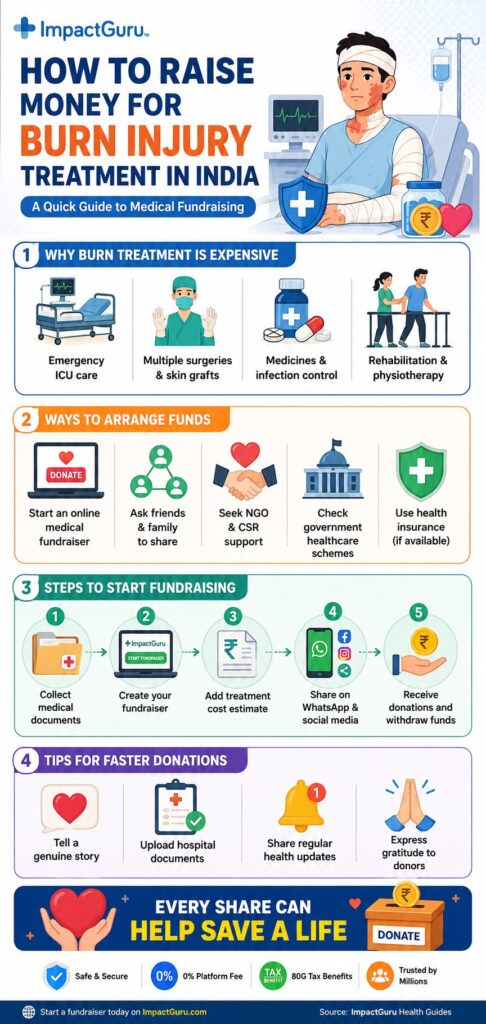
Burn treatment cost is driven primarily by the extent of the burn, measured as a percentage of Total Body Surface Area (TBSA), along with depth of the burn, whether inhalation injury is involved, and how many procedures are ultimately needed.
| Burn Severity (TBSA) | Typical Acute Care Cost | Notes |
| Minor burns (under 15% TBSA) | ₹50,000–₹2 lakh | Often manageable with outpatient care or a short inpatient stay; may still need one skin graft procedure (₹30,000–₹80,000) |
| Moderate burns (15–40% TBSA) | ₹2–8 lakh | Typically requires inpatient care, wound management, and one or more skin grafting procedures |
| Severe/major burns (over 40% TBSA) | ₹8–25 lakh+ | Often requires ICU admission, ventilator support in some cases, multiple grafting procedures, and a longer hospital stay |
| Reconstructive/scar-revision surgery (per procedure, ongoing over 1–3 years) | ₹1–5 lakh per procedure | Most serious burns require multiple staged reconstructive surgeries over time, not a single operation |
A few cost drivers specific to burn injuries, worth understanding from the start:
- Burn depth matters as much as extent. Superficial burns may heal with dressing and wound care alone, while deep partial-thickness or full-thickness burns typically require skin grafting to heal properly and minimize scarring.
- Inhalation injury and electrical burns significantly raise cost and complexity, often requiring ventilator support, longer ICU stays, and more intensive monitoring than skin burns of a similar surface area.
- This is not a one-surgery condition. Unlike many other medical emergencies covered in fundraising guides, serious burns typically require a series of staged reconstructive surgeries — often over 1 to 3 years — to release scar contractures, restore function, and improve appearance as the patient (especially a growing child) ages. Planning your fundraising target around only the acute hospitalisation, without accounting for this longer arc, is one of the most common and costly planning mistakes families make.
- Ongoing rehabilitation costs add up: pressure garments (worn up to 23 hours a day for extended periods to manage scarring), physiotherapy, and psychological counselling are all part of standard burn recovery and are easy to underestimate when initially budgeting.
- Government vs. private hospitals: government medical college burn units, supported under NPPMBI infrastructure funding, can offer significantly lower-cost acute care than private hospitals, though capacity and equipment vary by centre.
Step 1: Understand What NPPMBI Does (and Doesn’t) Offer
India’s National Programme for Prevention & Management of Burn Injuries (NPPMBI), run under the National Health Mission, has funded the development of dedicated burn units and ICU capacity at government medical colleges and district hospitals across the country. This is genuinely useful; it means better-equipped burn care is increasingly available at government hospitals, often at a fraction of private hospital cost.
However, it’s important to understand clearly: NPPMBI is an infrastructure and capacity-building programme, not a direct financial assistance scheme for individual patients. It doesn’t pay hospital bills or hand out grants to families; it builds the burn units where treatment can be accessed at government rates. For direct financial assistance, you’ll need to look at the schemes and NGOs below, in addition to (not instead of) seeking care at a well-equipped government burn unit if one is accessible to you.
Step 2: Check Government Financial Assistance Schemes
- Ayushman Bharat (PM-JAY): covers eligible hospitalisation costs, including burn treatment, at empanelled hospitals for eligible families, up to ₹5 lakh per family per year.
- Rashtriya Arogya Nidhi (RAN): offers financial assistance for below-poverty-line patients needing life-threatening treatment at government hospitals, which can apply to severe burn cases.
- Compensation for acid attack survivors specifically: following a 2015 Supreme Court direction, acid attack survivors are legally entitled to a minimum compensation of ₹3 lakh, generally disbursed by the state government, with the first payment expected within 15 days of the incident and the remainder within two months. In practice, this process is frequently slow and bureaucratically difficult to navigate, worth pursuing with the help of a support NGO (see below) rather than alone, and worth pursuing in parallel with crowdfunding rather than waiting for it to resolve first.
- State-specific victim compensation schemes: several states maintain their own victim compensation funds that can apply to burn injuries resulting from crime, accidents, or workplace incidents; check with your state’s legal services authority.
Step 3: Apply to Burn-Specific NGOs
Burn survivor support in India is a smaller but genuinely dedicated NGO space, with organizations that understand the specific, long-term nature of burn recovery better than general medical charities typically do.
| Organization | What It Provides | Notes |
| Burn Healing Foundation (BHF) | Free reconstructive surgery for functional deformities, delivered through partner hospital doctors at no cost to the patient | Works through a network of partner hospitals across India rather than a standalone facility; has supported dozens of reconstructive surgeries for underprivileged burn survivors |
| Atijeevan Foundation | Comprehensive rehabilitation — medical treatment support, reconstructive surgery coordination, psychological counselling, and vocational/skill training | Founded by an acid attack survivor; has supported several hundred survivors across India with both medical and life-rebuilding support |
| PCVC (International Foundation for Crime Prevention and Victim Care) | Psychosocial support, rehabilitation coordination, and help accessing items like pressure garments for scar management | Runs a dedicated recovery and healing centre for women burn survivors in Chennai |
| Brave Souls Foundation | Rehabilitation support and advocacy specifically for acid attack survivors, including help navigating government compensation processes | Focuses on the gap between what government compensation promises and what survivors can practically access |
These organizations are worth contacting even beyond the initial acute treatment phase — several specifically focus on the reconstructive surgery and rehabilitation stage, which is exactly the part of burn recovery that’s easiest to lose funding momentum for once the initial medical crisis has passed and public attention (and donor urgency) naturally fades.
Read More : NGO Funding India: Complete Guide (2026)
Step 4: Get a Realistic, Phase-Wise Cost Estimate
Ask your treating plastic/burns surgeon for an estimate that covers, separately:
- Acute care: current hospitalisation, wound management, and any immediate grafting needed.
- Anticipated reconstructive surgeries: even an approximate number of future procedures expected over the next 1–3 years, based on burn location and depth, since this shapes your total fundraising need dramatically.
- Ongoing rehabilitation: pressure garments, physiotherapy, and psychological support costs, which continue well beyond hospital discharge.
This phase-wise breakdown is what allows you to fundraise realistically, starting with an achievable initial target for acute care, while being upfront with donors that further surgeries and support will likely be needed over time.
Step 5: Start a Medical Crowdfunding Campaign
Because burn recovery unfolds in phases, acute care, then staged reconstructive surgery over years — the most effective way to raise money for burn injury treatment in India mirrors that structure rather than asking for one lump sum upfront.
Structuring a Burn Injury Campaign
- Start with a target for acute care and the first grafting procedure, which is usually the most urgent and clearly definable cost, rather than trying to estimate a multi-year total from the outset.
- Plan for follow-up campaigns or campaign updates as reconstructive surgery needs become clear, donors who supported the acute phase are often willing to support follow-up surgeries, especially when kept informed with honest updates on recovery and remaining needs.
- Be specific about the cause and extent of the injury in your campaign story, accidental burns, workplace incidents, and assault-related burns (including acid attacks) each carry different context that donors respond to differently, and clear, honest framing builds more trust than vague language.
Why Crowdfunding Works Better Than a Loan
- No repayment, no interest – especially important given that burn survivors often face an extended period unable to work, both during acute treatment and through subsequent reconstructive procedures.
- Speed – a campaign can go live within minutes, which matters given how quickly acute burn care costs accrue.
- Reach – burn injury stories, told honestly and with appropriate sensitivity, often generate strong community and social media response, particularly for cases involving children or clear injustice such as acid attacks.
- Tax benefit for donors – contributions through campaigns run under a registered charitable structure are often eligible for deduction under Section 80G, encouraging larger or repeat donations across a multi-year recovery.
Choosing the Right Crowdfunding Platform
For a burn injury campaign specifically, look for a platform with:
- Fast verification, since acute burn care costs accrue quickly from the moment of admission.
- Support for rolling withdrawals, so funds can be used for the current phase of treatment as they arrive.
- A 0% or low platform fee model, so more of what’s raised goes toward actual treatment over what can be a multi-year fundraising relationship.
- Sensitivity and support for how the story is told, particularly for cases involving trauma, assault, or a child patient, where campaign framing needs care as well as clarity.
ImpactGuru is one of the platforms built specifically around this kind of medical crowdfunding. Founded in 2014, it has supported burn injury and reconstructive surgery campaigns with a 0% platform-fee option, document verification support, and campaign specialists who can help structure a phased campaign narrative – covering acute care first, and evolving to support follow-up reconstructive surgeries as the recovery journey continues over months and years.

How to Set Up a Burn Injury Fundraiser (Step-by-Step)
You can follow these steps to raise money for burn injury treatment in India through fundraising:
- Gather your documents: the treating surgeon’s diagnosis and estimated TBSA/severity, the hospital’s written cost estimate, ID proof, and bank account details.
- Create the campaign: on medical crowdfunding platforms like ImpactGuru, this typically takes under 10 minutes, explain the cause and extent of the injury, current treatment stage, and the amount needed now.
- Add photos thoughtfully, many families choose to show the patient’s face and recovery progress once appropriate, while others prefer more limited imagery; either approach can work, but honesty about the injury and recovery stage matters most for donor trust.
- Get verified: the platform confirms your medical documents and identity, building the trust needed for strangers to donate.
- Share immediately and widely: family, friends, workplace and community networks, and social media, burn injury campaigns often benefit from local community and media attention, particularly in cases of clear injustice or accident.
- Post regular updates: grafting completed, wound healing progress, next surgery scheduled, physiotherapy milestones; these updates are especially important for burn campaigns, since recovery visibly unfolds over a longer timeline than many other conditions.
- Withdraw funds on a rolling basis to pay for each phase of treatment as it comes due.
- Re-launch or extend the campaign for subsequent reconstructive surgeries, being clear with your existing donor network that recovery is ongoing; this is more necessary for burns than almost any other condition in this guide.
Read More : How Do I Create a Medical Fundraiser Online?
Step 6: Don’t Overlook Long-Term Rehabilitation Costs
- Pressure garments: custom-fitted garments worn for extended periods (sometimes up to 23 hours a day for a year or more) to manage scarring, a real, recurring cost that’s easy to leave out of an initial fundraising target.
- Physiotherapy: essential for maintaining mobility and function, particularly for burns near joints, and often needed for months following each surgical procedure.
- Psychological support: burn recovery carries significant psychological impact, and counselling support, for the patient and often family members, is a legitimate and important cost to include in your planning, not an optional extra.
- Vocational and reintegration support: for survivors facing long-term disfigurement or disability, organizations like Atijeevan Foundation specifically help with skills training and employment reintegration, which can be as important to long-term wellbeing as the medical treatment itself.
Conclusion
If you’re working to raise money for burn injury treatment in India, transparency matters throughout, since medical crowdfunding involves real money from real donors, and because burn recovery often unfolds over a long period: use your real name (with appropriate sensitivity around imagery, particularly for assault-related cases), upload actual medical documents and cost estimates, and post honest updates as treatment and recovery progress. For a burn injury campaign specifically, sustained communication across the full recovery arc, not just the initial acute phase, is what helps donors understand and continue supporting a genuinely multi-year journey.
Frequently Asked Questions
It depends heavily on the extent (% TBSA) and depth of the burn. Minor burns typically cost ₹50,000 to ₹2 lakh, moderate burns (15–40% TBSA) cost ₹2–8 lakh, and severe or major burns (over 40% TBSA) requiring ICU care can cost ₹8–25 lakh or more. Beyond acute care, reconstructive surgeries typically cost ₹1–5 lakh each, and multiple procedures are often needed over 1–3 years.
India’s National Programme for Prevention & Management of Burn Injuries (NPPMBI) funds government burn unit infrastructure, making lower-cost care more accessible, but doesn’t provide direct financial grants to individual patients. Ayushman Bharat and Rashtriya Arogya Nidhi can cover eligible burn treatment costs at empanelled or government hospitals, and acid attack survivors are legally entitled to a minimum compensation of ₹3 lakh under a 2015 Supreme Court direction, though this can be slow to access in practice.
Yes, Burn Healing Foundation provides free reconstructive surgery through a network of partner hospitals, Atijeevan Foundation offers comprehensive rehabilitation including medical, psychological, and vocational support, and PCVC runs a dedicated recovery centre for women burn survivors in Chennai. These organizations are particularly valuable for the reconstructive and rehabilitation phase of recovery, which can otherwise lose funding attention after the initial medical crisis passes.
Because serious burns typically require staged reconstructive surgeries over 1 to 3 years to release scar contractures, restore function, and address appearance, not a single operation. Structuring your fundraising in phases, starting with acute care and continuing through subsequent surgeries with honest donor updates, tends to work better than trying to raise the full multi-year cost upfront.
Following a 2015 Supreme Court direction, acid attack survivors are entitled to a minimum compensation of ₹3 lakh, generally paid by the state government, with an initial payment expected within 15 days of the incident. In practice, this process is often slow and bureaucratically difficult, so survivors are encouraged to seek help from support organizations like Brave Souls Foundation, which specifically assist with navigating this process, and to pursue crowdfunding in parallel rather than waiting for compensation to be resolved.
The fastest path is usually to combine three things at once: seek care at a government NPPMBI-supported burn unit to lower acute costs, apply to Ayushman Bharat or RAN in parallel, and launch a crowdfunding campaign phased around acute care first, with reconstructive surgery funding added as needs become clear.
Yes. Donation-based medical crowdfunding is legal in India, and reputable platforms use document verification and secure payment processing to protect both patients and donors.
No. Funds raised through donation-based medical crowdfunding are gifts from donors and do not need to be repaid, which matters given that burn survivors often face an extended period unable to work during both acute treatment and subsequent reconstructive surgeries.
Look for a platform with fast verification, rolling withdrawals, a low or 0% fee structure, and experience supporting phased campaigns that span a multi-year recovery. ImpactGuru is one such platform built around medical crowdfunding, including burn injury and reconstructive surgery cases.