

Table of Contents
- Introduction
- The Funding Gap Women-Led Ventures Still Face
- Traditional Funding Options for Women-Led Ventures
- Alternative Funding Models for Women-Led Ventures
- Crowdfunding as a Growing Strategy for Women-Led Ventures
- How Crowdfunding Supports Women Beyond Just Capital?
- How to Choose the Right Funding Strategy Based on the Venture Type?
- The Role of Digital Platforms in Enabling Access to Funds
- Best Practices to Succeed in Funding for Women-Led Ventures
- Conclusion
- FAQs
Quick Summary
- Women-led ventures continue to face a significant funding gap due to systemic bias, limited investor access, and sectoral underfunding, despite strong performance outcomes.
- Traditional funding options like bank loans and government schemes exist, but often involve high entry barriers, collateral requirements, and slow approval timelines.
- Alternative funding models, including angel networks, grants, microloans, and crowdfunding, offer more accessible and flexible capital pathways for women entrepreneurs.
- Crowdfunding has emerged as a particularly effective strategy for women-led ventures in social impact, healthcare, and community-focused sectors by enabling direct public participation.
- Digital platforms play a key role in improving credibility, visibility, and access to funds through verification, data transparency, and community reach.
Introduction
Women entrepreneurs receive significantly less funding than their male counterparts, despite evidence showing that women-led ventures often deliver stronger returns and sustainable growth. According to global investment data, less than 3% of venture capital funding goes to women-led businesses, highlighting why funding women-led ventures remains a critical challenge today.
This blog explores the most successful strategies to fund women-led ventures, from traditional financing and government support to emerging models like crowdfunding and digital platforms. Readers will gain a clear understanding of funding options, practical strategies, and how women entrepreneurs can choose the right path based on their venture type, stage, and goals.
You can participate in an ImpactGuru referral by sharing genuine treatment fundraisers with friends, family, or social networks.

The Funding Gap Women-Led Ventures Still Face
Despite growing awareness, women-led ventures continue to face systemic barriers to funding. Studies consistently show that women entrepreneurs are more likely to be questioned on risk prevention rather than growth potential, which directly impacts funding outcomes.
- Limited access to investor networks, unconscious bias in decision-making, and lower visibility in high-capital ecosystems further widen this gap.
- Another challenge lies in sector concentration. Women-led ventures are often prominent in healthcare, education, social impact, and community-focused businesses, areas that traditionally receive less venture capital despite their long-term value and resilience. As a result, many founders rely on personal savings or informal funding, which limits their ability to scale and achieve sustainability.
- Understanding this funding gap is essential before exploring solutions. The most successful strategies to fund women-led ventures today are those that work around these barriers, offering alternative pathways that prioritise credibility, transparency, and real-world impact over traditional gatekeeping.
Patients can now find hospitals and fund your treatment in one place, reducing delays during medical emergencies.
Quick Answer:
Women-led ventures in India continue to face a funding gap due to investor bias, limited access to networks, and sector preferences that favour high-capital tech startups. Despite strong performance indicators, many women founders rely on personal savings or informal funding, which restricts scalability and long-term sustainability.
Traditional Funding Options for Women-Led Ventures
Before exploring alternative or digital models, it is essential to understand the traditional funding routes available today. While these options provide structured capital and institutional credibility, they often come with higher entry barriers and rigorous qualifying criteria.
- Government Schemes and Public Sector Support – Government-backed initiatives continue to be a cornerstone of financial support for women-led businesses in India. Programs such as Mudra Yojana and Stand-Up India are specifically designed to improve credit access.
– 2025 Update: As of 2025, the Stand-Up India scheme has seen expanded coverage, offering loans between ₹10 lakh and ₹1 crore specifically for women setting up greenfield enterprises.
– Digital Integration: SIDBI (Small Industries Development Bank of India) has launched several digital-first lending portals to streamline documentation, aiming to reduce the approval time that has traditionally hindered first-time founders. - Bank Loans and Credit Lines – Banks are a primary source for established businesses with tangible assets. While interest rates for women entrepreneurs are often subsidised (such as through the Mahila Udyam Nidhi Scheme), approval remains heavily dependent on strong credit histories and, in many cases, collateral. For urban and rural women alike, navigating bank bureaucracy remains a significant step in the funding journey.
- Self-Funding (Bootstrapping) – Bootstrapping through personal savings or family contributions is the most common starting point. This approach offers total control and flexibility. However, relying solely on internal funds can limit growth potential and market speed if external capital isn’t secured when the venture is ready to scale.
- The Reality of Traditional Limitations – Despite their importance, traditional routes can be restrictive. Lengthy approval cycles, rigid collateral requirements, and risk-averse lending practices often make these paths difficult for social impact ventures or founders without significant personal assets.
This “access gap” is precisely why many women-led ventures are now looking toward crowdfunding for women entrepreneurs and other alternative models to complement or replace conventional financing paths.
From emergency response to post-treatment care, ImpactGuru’s patient care guides offer practical, step-by-step help.
Quick Answer:
Traditional funding for women-led ventures in India includes government schemes, bank loans, and self-funding. While initiatives like Stand-Up India and Mudra Yojana improve access, rigid collateral requirements, long approval cycles, and risk-averse lending often limit their effectiveness for early-stage or social-impact businesses.
Alternative Funding Models for Women-Led Ventures
Given the persistent funding gap, women entrepreneurs are increasingly turning to alternative funding models that bypass traditional VC barriers while providing credibility, scale, and flexibility. These options empower founders to secure capital without being constrained by conventional investor biases.
- Angel Investors and Women-Focused Networks – Angel investors who actively support women founders offer mentorship alongside funding. Networks like SheCapital, Indian Angel Network’s Women Entrepreneurs initiative, and regional women’s business collectives provide both financial support and access to critical professional connections.
- Crowdfunding for Social and Community Impact Ventures – Digital crowdfunding platforms and online fundraising models have become a practical source of financial support for women-led businesses, particularly in India’s social impact and healthcare sectors. Crowdfunding platforms allow founders to present their vision directly to supporters. Ventures in healthcare, education, or social innovation, common among women-led businesses, can leverage verified crowdfunding campaigns to raise small contributions that aggregate into meaningful funding. Platforms with strong verification processes, like ImpactGuru, ensure transparency and build donor or investor confidence, especially for ventures aligned with social good.
- Grants and Competitions – Government schemes, corporate CSR initiatives, and private foundations often run programs specifically for women entrepreneurs. These grants provide non-dilutive funding, allowing founders to retain ownership while validating their business model. Competitions also offer exposure, mentorship, and networking opportunities alongside capital.
- Revenue-Based Financing and Microloans – For early-stage or community-oriented ventures, revenue-based financing or microloans from ethical lenders help bridge working capital gaps. Repayment scales with revenue, reducing risk for founders who may not qualify for traditional debt.
This combination of approaches, angel networks, crowdfunding, grants, and flexible financing, provides women-led ventures with multiple pathways to access funds, validate their ideas, and grow sustainably without relying solely on traditional venture capital.
The disease cost calculator provides cost insights that help avoid unexpected hospital bills.
Quick Answer:
Alternative funding models such as angel networks, grants, revenue-based financing, and crowdfunding provide women-led ventures with flexible capital options. These models reduce dependence on traditional gatekeepers, support early validation, and are particularly effective for impact-driven and service-oriented businesses.
Crowdfunding as a Growing Strategy for Women-Led Ventures
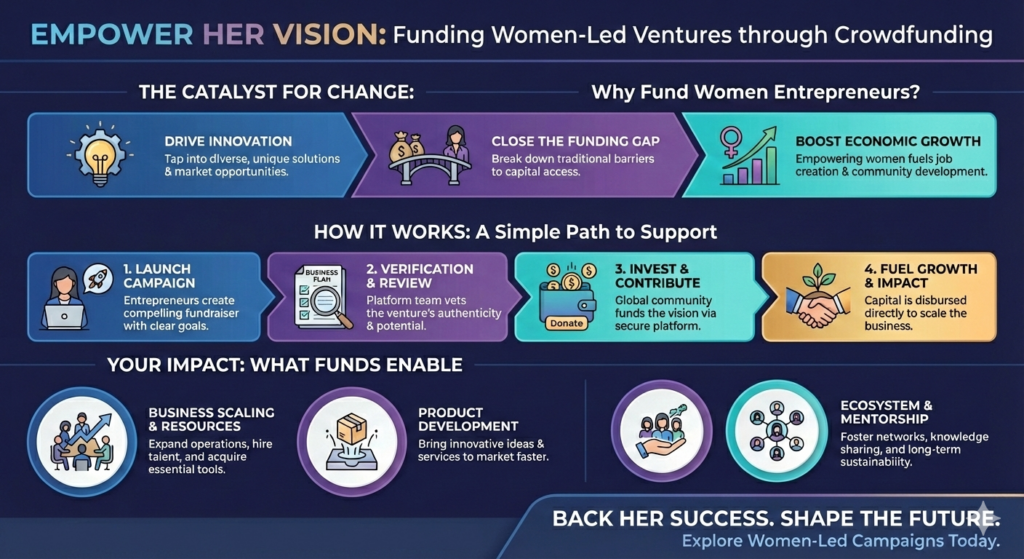
In India, crowdfunding for women entrepreneurs is increasingly used alongside traditional funding to overcome access barriers and raise early-stage capital. Crowdfunding for women entrepreneurs has emerged as a powerful, community-driven approach to securing capital that bypasses traditional biases. It democratizes access to funds by enabling founders to raise relatively small amounts of money from a large number of people, essentially creating a supportive community around their idea.
How Crowdfunding Works:
Instead of convincing a single loan officer or VC firm, you pitch your vision directly to the public via a digital platform. This model is particularly effective for ventures with a strong social mission, a clear story, or immediate, visible needs.
Types of Crowdfunding:
- Reward-Based: Backers receive a specific product, perk, or service in return for their contribution. This is ideal for testing market demand for a new product launch.
- Donation-Based: Donors provide funds purely out of goodwill or belief in the cause, with no financial return expected. This is the primary model for social impact, community projects, and, notably, medical or healthcare-related fundraising.
- Equity-Based: Investors receive a small ownership stake in the company. This works well for tech startups looking for growth capital from a broad base of smaller, accredited investors.

When Crowdfunding is Most Effective:
Crowdfunding excels in the early stages, offering proof of concept. For ventures deeply rooted in social change, education, or healthcare, sectors where many women-led businesses operate, donation-based models are highly successful. Platforms with robust verification processes ensure transparency and build instant credibility with potential supporters.
Quick Answer:
Crowdfunding has become an effective funding strategy for women-led ventures in India, especially in healthcare, education, and social impact sectors. By enabling direct public participation, crowdfunding allows founders to raise capital, build trust, and validate ideas without relying solely on venture capital or bank financing.
How Crowdfunding Supports Women Beyond Just Capital?

The value of crowdfunding extends far beyond simply raising money; for women entrepreneurs, it provides a powerful set of intangible benefits that address some of the core challenges highlighted in earlier sections of this blog.
- Validation of Ideas Through Public Participation: A successful crowdfunding campaign acts as potent, real-world market research. Public participation validates a business idea and proves market demand before a product even officially launches. This external validation is a strong signal that can attract later-stage angel investors or VCs who might otherwise be risk-averse.
- Access to Community-Driven Support: Campaigns build an immediate base of passionate early adopters and brand ambassadors. This community provides invaluable feedback, encouragement, and authentic word-of-mouth marketing, helping the founder navigate the early, high-risk phases of a venture.
- Storytelling and Visibility: The process of creating a campaign forces founders to refine their mission and narrative. This heightened visibility helps counter the general lack of representation in traditional media and investor networks, giving women founders a platform to amplify their voice and mission.
- Emotional and Social Backing: Entrepreneurship is demanding and often isolating. The psychological boost and social backing from a supportive community help sustain founders, especially when balancing business growth with personal and caregiving responsibilities.
How to Choose the Right Funding Strategy Based on the Venture Type?
The most successful strategies to fund women-led ventures require a precise match between the business model, its stage of growth, and its social mission. There is no one-size-fits-all solution; an urban tech founder and a rural social entrepreneur will have vastly different capital requirements.
- Matching Methods with Business Needs: Scalable Startups vs. Small Businesses: High-growth tech startups are best suited for angel investors or equity crowdfunding. In contrast, stable, small-scale businesses, like retail or boutique services, often find more success with MSME bank loans, government schemes, or revenue-based financing that doesn’t require giving up ownership.
- Medical, Healthcare, and Caregiving Ventures: These businesses are often deeply personal and purpose-driven, making them ideal candidates for community-based support. For founders building healthcare solutions or medical facilities, specialized medical crowdfunding provides a structured way to mobilize urgent funds while building public trust through platform verification.
- Social Enterprises and NGOs: If your venture is mission-driven rather than purely profit-driven, donation-based crowdfunding and corporate CSR grants are the most effective routes. These allow you to focus on impact metrics rather than just financial ROI.
- Urban vs. Rural Entrepreneurs: While urban founders may leverage high-net-worth networks and incubators, rural women entrepreneurs often find success through microfinance, regional government subsidies, and hyper-local community finance models.
The Strategy for 2025:
Don’t be afraid to use a “hybrid” approach. Many modern founders combine a government grant for initial research with a social crowdfunding campaign for their first launch, followed by an angel round for scaling. Choosing the right mix depends on how much equity you are willing to share and how quickly you need to scale.
Quick Answer:
The most successful funding strategies for women-led ventures depend on business stage, sector, and growth intent. High-growth startups may benefit from angels or equity crowdfunding, while healthcare, social enterprises, and community ventures often succeed through grants and donation-based crowdfunding models.
The Role of Digital Platforms in Enabling Access to Funds
Digital platforms have become the ultimate “great equalizer” in 2025, significantly lowering the barriers that have historically kept women-led ventures from accessing capital. By reducing the dependence on traditional gatekeepers like bank managers or venture capital partners, these platforms allow founders to connect directly with a global pool of supporters.
- How Digital Platforms Simplify the Funding Journey: Democratic Outreach: Digital platforms provide the necessary infrastructure to reach thousands of potential backers simultaneously. This is especially vital for women who may not have inherited access to high-profile financial networks.
- Trust and Verification: One of the biggest hurdles for any entrepreneur is establishing immediate credibility. Reputable platforms implement rigorous verification processes, including KYC (Know Your Customer) checks and project audits. This transparency protects donors and investors alike, making them more comfortable supporting a new venture.
- Specialized Support for Care and Impact: Not all funding needs are purely commercial. For women founders focused on healthcare, social welfare, or community care, platforms like ImpactGuru provide a specialized ecosystem. These platforms are designed to handle the nuances of medical crowdfunding and social causes, offering the structured transparency needed to mobilize funds quickly for purpose-driven initiatives.
- Data and Analytics: Modern platforms provide real-time data on campaign performance, allowing founders to see which parts of their story resonate most with the public. This data can be used to refine business strategies and improve future pitching success.
By leveraging these digital tools, women entrepreneurs can shift the focus from their gender to the impact and viability of their ideas, ensuring that the best ventures get funded regardless of traditional biases.
Best Practices to Succeed in Funding for Women-Led Ventures
Securing funding is not just about choosing the right source; it’s also about presenting your venture effectively and building trust with potential investors or supporters. Women entrepreneurs can increase their chances of success by following these best practices:
- Clear and Compelling Storytelling – Investors and crowdfunding supporters respond to clarity and authenticity. Clearly articulate your mission, the problem you are solving, and the measurable impact of your venture. Highlight your leadership journey, the team’s strengths, and how your solution stands out in the market.
- Data-Driven Validation – Support your pitch with verified data: market research, pilot results, revenue projections, and social impact metrics. Providing quantifiable evidence increases credibility and helps funders understand both the opportunity and the potential risk.
- Strong Digital Presence and Transparency – Maintain professional online profiles, including a company website, social media, and crowdfunding pages. Transparency about fund allocation, milestones, and progress builds confidence. Platforms like ImpactGuru illustrate how verified fundraising campaigns instill trust and encourage support for socially-oriented ventures.
- Leverage Mentorship and Networks – Seek guidance from experienced entrepreneurs, angel investors, or women-focused business networks. Mentorship not only refines your pitch but also opens doors to new funding opp
- Prepare for Multiple Funding Rounds – Plan for phased funding rather than relying on a single source. Early micro-investments, crowdfunding campaigns, grants, and angel funding can be combined sequentially to reduce risk and demonstrate traction before approaching larger investors.
- By combining clear storytelling, data-backed validation, transparency, strong networks, and phased funding strategies, women-led ventures can improve their ability to attract financial support, build trust, and scale sustainably.
Quick Answer:
Women-led ventures improve funding outcomes by combining clear storytelling, data-driven validation, transparent communication, and phased funding strategies. Strong digital presence, mentorship support, and consistent progress updates help build trust and attract diverse funding sources over time.
Conclusion
The most successful strategies to fund women-led ventures are those that prioritize choice, flexibility, and community alignment. While the funding gap remains a reality, the rise of government-backed digital initiatives, gender-lens investing, and transparent crowdfunding has created a more inclusive landscape for women entrepreneurs.
Funding is no longer a one-way street dominated by traditional banks; it is an ecosystem of diverse opportunities. Whether you are bootstrapping a local business, scaling a tech startup through angel networks, or launching a social enterprise, the key is to choose a path that reflects your venture’s stage and mission. By leveraging the power of storytelling, data-driven transparency, and digital platforms, women founders can confidently secure the capital they need to build a more equitable and prosperous future.
Author’s Bio:
Navpreet Kaur is a Healthcare Research Analyst at ImpactGuru, creating educational and informational content focused on healthcare awareness, medical fundraising, and patient support in India.
FAQs
Women-led ventures in India can secure funding through angel investors, government grants, VC funds, crowdfunding platforms like ImpactGuru, and specialized women entrepreneur programs. Combining online campaigns with local investor outreach improves funding success.
Crowdfunding allows women founders to raise capital directly from individual donors and supporters without traditional bank loans or strict investor criteria. Platforms like ImpactGuru make it easy to share campaigns across social networks for higher visibility.
India offers schemes like Mudra Yojana, Stand-Up India, and other state-level incentives specifically for women entrepreneurs to access loans and grants. These programs provide low-interest funding and mentorship to help scale women-led ventures.
Using targeted hashtags, compelling storytelling, regional community groups, and consistent posting increases campaign reach and engagement among local audiences. Geo-tagging and localized messaging help connect with supporters in specific Indian cities and regions.