

Table of Contents
- Quick Summary
- Introduction
- How to Start Fundraising for a New NGO in India: Legal Groundwork First
- Best Online Fundraising Platforms in India for New Foundations
- Crowdfunding Ideas for New Charities in India
- Corporate CSR Partnerships for New Nonprofits in India
- Government Grants and Schemes for New Foundations in India
- Community and Event-Based Fundraising Ideas for New Foundations
- Digital Fundraising Strategies to Build Donor Trust Fast
- Donor Retention Strategies for New Nonprofit Foundations in India
- Conclusion
- Frequently Asked Questions
Quick Summary
- Effective fundraising ideas for a new foundation in India combine legal readiness (12AB, 80G, FCRA) with digital-first outreach, not just events.
- India’s crowdfunding market grew from roughly USD 48.2 million in 2024 and is projected to reach USD 133.2 million by 2030, a strong signal that online giving is scaling fast.
- Corporate CSR spending crossed an estimated ₹34,900 crore in FY24, making corporate partnerships one of the most underused channels for new nonprofits.
- A registered fundraiser website, transparent reporting, and donor storytelling matter more to first-time donors than the size of your ask.
- Government schemes, Google Ad Grants, and hyperlocal community events remain reliable, low-cost ways to build an initial donor base.
Introduction
Every rupee a new foundation raises in its first year shapes whether it survives its fifth. India’s crowdfunding sector alone is expected to grow from an estimated USD 48.2 million in 2024 to over USD 133 million by 2030, at a compound annual growth rate near 19%; proof that Indians are donating online more than ever before. Yet most new foundations still struggle in their first year, not because their cause lacks merit, but because they haven’t matched the right fundraising ideas for a new foundation in India with the right stage of growth. This guide breaks down what actually works, from legal groundwork and CSR outreach to crowdfunding, events, and donor retention, so your foundation can build a fundraising engine, not just a one-time campaign.
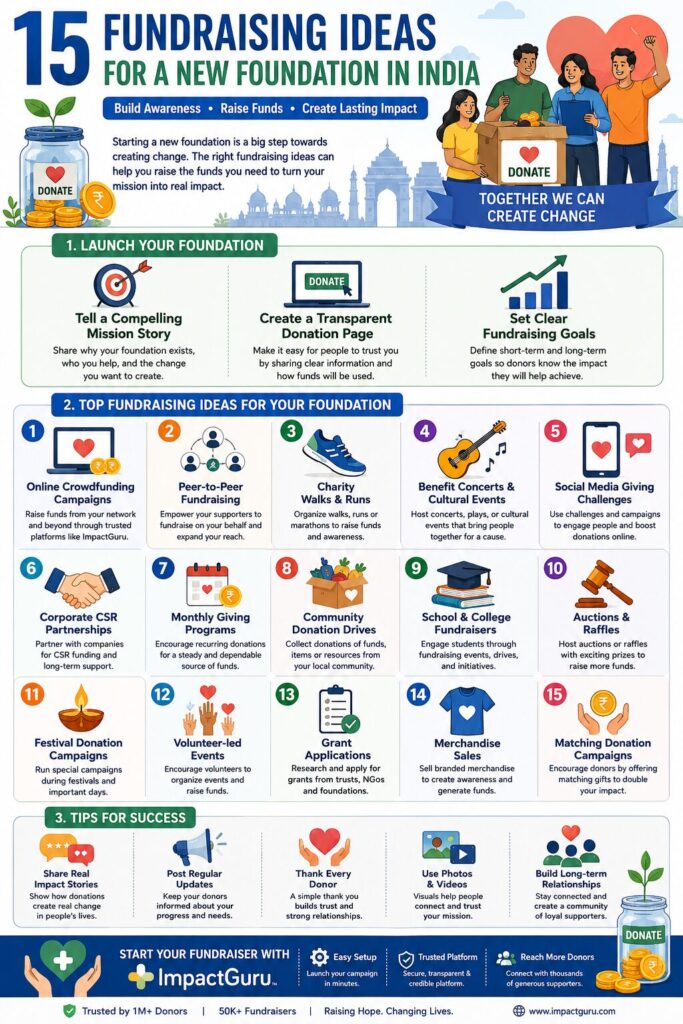
How to Start Fundraising for a New NGO in India: Legal Groundwork First
Before your foundation runs a single campaign, donors, corporates, and platforms will check three things: your registration, your tax status, and your transparency. Skipping this step is the single biggest reason new nonprofits lose donor trust early.
At a minimum, a new foundation needs:
- Entity registration as a Trust, Society, or Section 8 Company determines your governance, reporting burden, and eligibility for CSR funding.
- 12AB registration under the Income Tax Act, which exempts your foundation’s income from tax when used for charitable purposes. Under recent updates, registration validity is 5 years for most nonprofits (10 years for smaller trusts under the newer rules) and must be renewed on time to avoid losing exemption.
- 80G registration, which lets your donors claim a tax deduction on their contributions — a strong incentive that meaningfully improves conversion, especially for mid-size and corporate donors.
- NGO Darpan registration on the NITI Aayog portal, which is often a prerequisite for government grants and many CSR programmes.
- FCRA registration – FCRA registration is only if you plan to accept foreign contributions. It requires a three-year operating history and at least ₹15 lakh spent on core activities, carries a government fee of ₹5,000, and takes roughly 90–120 working days to process through the Ministry of Home Affairs.
| Structure | Best suited for | Governance | CSR/Grant eligibility |
| Trust | Small, founder-led causes | Board of trustees | Yes, with 12AB/80G |
| Society | Membership-driven causes | General body + governing council | Yes, with 12AB/80G |
| Section 8 Company | Foundations planning to scale | Board of directors, MCA-regulated | Preferred by many corporates |
New foundations that complete this groundwork early consistently raise faster, because every subsequent fundraising idea below depends on donors and companies being able to verify you’re legitimate.
Best Online Fundraising Platforms in India for New Foundations
Once your compliance is in place, an online presence is non-negotiable. Donors increasingly expect a foundation to have a dedicated fundraiser website or campaign page before they give, even for small contributions.
New foundations typically choose between three approaches:
- Your own donation page: This is best for long-term brand building, but slower to gain donor trust initially since it lacks third-party verification.
- Established fundraising platforms in India: An online donation platform built for nonprofits handles payment gateways, tax receipts, and donor communication, letting a new foundation focus on outreach instead of infrastructure.
- A hybrid model: Many growing foundations run their primary campaigns on a trusted fundraising platform while linking back to their own website for brand credibility and recurring donor relationships.
For a first-time foundation, the biggest advantage of using an established platform is speed to trust: donors recognise the platform’s payment security and refund policies, which reduces hesitation compared to an unknown, newly built site. As your foundation matures, you can gradually shift a larger share of fundraising India efforts toward owned channels while keeping a presence on established platforms for reach.
Crowdfunding Ideas for New Charities in India
Crowdfunding is the fastest way for a new foundation to raise its first meaningful donations without needing a large donor network on day one. It works because it turns a small number of committed supporters into distribution channels.
Ideas that consistently perform well for new Indian nonprofits:
- Story-led campaigns built around one beneficiary or one measurable outcome (e.g., “educate 20 children for a year”) rather than broad, abstract goals.
- Milestone crowdfunding, where you set and publicly track smaller funding milestones instead of one large target; this keeps momentum visible.
- Peer-to-peer fundraising, where supporters create their own mini-campaigns on your behalf and fundraise within their own networks.
- Matching-gift crowdfunding, where a single larger donor or corporate partner agrees to match public contributions up to a limit, which measurably increases small-donor participation.
- Festival and occasion-based campaigns, timed around Diwali, Independence Day, or a founder’s birthday, when giving intent is naturally higher.
Since India’s crowdfunding market is growing at close to 19% annually, foundations that build a habit of running quarterly (not just annual) crowdfunding campaigns tend to compound their donor base far faster than those relying on a single yearly appeal.
Corporate CSR Partnerships for New Nonprofits in India
Corporate Social Responsibility is one of the largest and most consistent funding pools available to Indian nonprofits, yet new foundations often approach it too late. Indian companies spent an estimated ₹34,900 crore on CSR in FY24, with education and healthcare receiving the largest shares, and NSE-listed firms alone increased their CSR spending by 23% in FY25 compared to the previous year.
To access this funding as a new foundation:
- Register on the CSR-1 form with the Ministry of Corporate Affairs; most companies will not fund an implementing partner without it.
- Align your programme with Schedule VII categories (education, health, livelihoods, environment) rather than trying to fit CSR money into an unrelated cause.
- Approach companies with a local-area advantage: CSR law encourages companies to fund projects near their own operations, so a new foundation with strong local presence has a real edge over larger national NGOs.
- Offer outcome measurement, even informally at first (attendance records, health camp numbers, before/after data); companies increasingly prefer partners who can show measurable impact over compliance-only spending.
A single mid-size CSR partnership can often fund an entire year of programme costs for a new foundation, making this channel worth prioritising well before your organisation “feels ready.”
Government Grants and Schemes for New Foundations in India
Government funding is slower to access but offers some of the most stable, recurring support available once a foundation is established. Key avenues include:
- Ministry-specific schemes (Women and Child Development, Rural Development, Social Justice and Empowerment) that fund NGOs working in aligned sectors.
- NGO Darpan-linked grants, where several ministries require Darpan registration before considering an application.
- State government CSR and welfare boards, which often have smaller, faster-moving grant cycles than central schemes.
- Google Ad Grants for Nonprofits, offering eligible NGOs up to USD 10,000 per month in free Google Search advertising, not direct funding, but a significant boost to donor discovery at zero media cost.
New foundations should treat government funding as a medium-term goal: start the Darpan and compliance groundwork immediately, but plan initial cash flow around CSR, crowdfunding, and individual donors while government relationships develop.
Community and Event-Based Fundraising Ideas for New Foundations
Offline fundraising still builds the strongest early-donor loyalty, especially in a foundation’s first two years, because it creates face-to-face trust that digital channels take longer to establish.
Reliable formats include:
- Charity walks, runs, or cycling events, which double as awareness campaigns and are relatively low-cost to organise with local sponsor support.
- Cause-based dinners or auctions, effective for reaching high-net-worth individuals who prefer a personal connection before donating at scale.
- School and college partnerships, where students fundraise through small activities, building a young donor pipeline early.
- Festival stalls and pop-up donation drives, useful for hyperlocal foundations building visibility in a specific city or neighbourhood.
- Employee giving days organised with a corporate partner, combining CSR interest with individual employee donations.
Track cost-per-rupee-raised for every event honestly. Not every event needs to be highly profitable in year one; some exist primarily to build the donor list you’ll fundraise from later.
Digital Fundraising Strategies to Build Donor Trust Fast
Beyond crowdfunding campaigns, a handful of digital habits determine whether a new foundation looks credible online:
- Consistent, dated impact updates: donors are far more likely to give again when they can see what their last donation funded.
- Email and WhatsApp donor journeys, segmented by whether someone is a first-time, repeat, or lapsed donor.
- Search-optimised content, like this guide, that answers real donor questions instead of only promoting campaigns; this is what earns organic traffic and long-term credibility with search engines and AI answer tools alike.
- Verified social proof, including registration numbers, 80G certificates, and audited financials displayed clearly on your website.
Donor Retention Strategies for New Nonprofit Foundations in India
Acquiring a donor is expensive; keeping one is not. Yet most new foundations spend nearly all their energy on acquisition and almost none on retention — even though repeat donors typically give more over time and cost far less to retain than to replace.
Practical retention habits for a new foundation:
- Send a thank-you within 48 hours, ideally personalised rather than a generic auto-reply.
- Share specific outcomes, not just totals; “your donation funded 3 months of a child’s tuition” retains better than “we raised ₹5 lakh this quarter.”
- Introduce a monthly giving option early; recurring donors are more predictable and less prone to one-time donor fatigue.
- Recognise donors publicly (with consent) through newsletters or annual reports to build a sense of community, not just transactions.
Conclusion
Raising funds for a new foundation isn’t about picking one winning idea; it’s about sequencing legal readiness, CSR outreach, crowdfunding, and community events so each channel reinforces the next. Start with compliance, build donor trust through transparency, and diversify early rather than leaning on a single campaign or donor type. Foundations that grow fastest treat year one as the base for every future donor relationship, not a scramble for quick funds. If you’re ready to launch your first campaign, ImpactGuru’s platform can help set up a verified fundraiser page, reach genuine donors, and track impact from day one, so your fundraising starts on solid ground, not guesswork.
Frequently Asked Questions
The strongest combination for a new foundation is completing legal registrations early (12AB, 80G, Darpan), then running parallel efforts across crowdfunding, CSR outreach, and community events, rather than relying on a single channel.
No. FCRA is only required if your foundation intends to accept donations from foreign individuals or organisations. Domestic donations, CSR funds, and government grants do not require FCRA registration.
There is no fixed waiting period, but most companies prefer partners with 12AB/80G registration, a CSR-1 filing, and at least some track record or documented plan; this can realistically be arranged within a few months of incorporation.
Yes. India’s crowdfunding market is growing at close to 19% annually, and story-led, milestone-based campaigns tend to outperform broad, undefined appeals, particularly for first-time fundraisers.