


Discovering a lump in the breast can be alarming, but not all breast lumps are cancerous. One of the most common benign (non-cancerous) breast conditions is fibroadenoma. It primarily affects young women and adolescents and is often detected during self-examination or routine medical screening.
A fibroadenoma is a solid breast lump composed of fibrous and glandular tissue. These lumps are usually painless, movable, and slow-growing. Although fibroadenomas are generally harmless, proper diagnosis is essential to rule out breast cancer and determine whether treatment is necessary.
This comprehensive guide explains fibroadenoma symptoms, causes, diagnosis, treatment options, surgery costs in India, recovery timelines, and available financial support through medical crowdfunding.
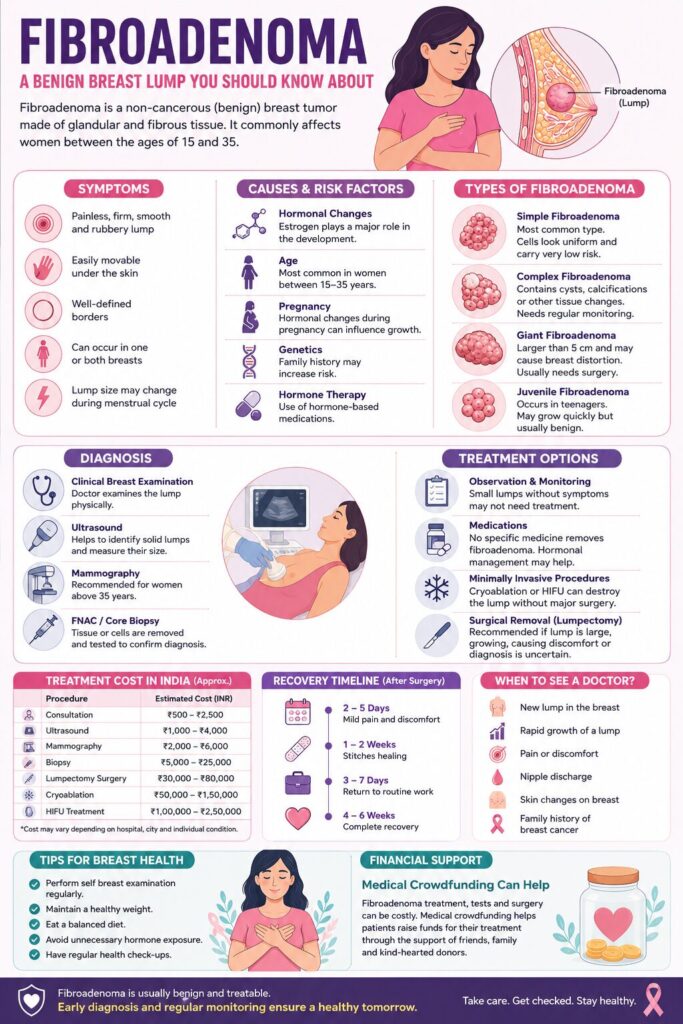
Table of Contents
- What Is Fibroadenoma?
- Types Of Fibroadenoma
- Fibroadenoma Symptoms
- Fibroadenoma Causes
- Fibroadenoma Treatments
- Surgical treatments
- Fibroadenoma Surgery Side Effects
- Fibroadenoma Treatment Cost in India
- How To Diagnose Fibroadenoma?
- Risk Factors For Fibroadenomas
- Fibroadenoma Surgery Recovery Time
- Medical Crowdfunding for Fibroadenoma Treatment
- Conclusion
- FAQs
What Is Fibroadenoma?
Fibroadenoma is a benign breast tumor that develops when fibrous and glandular breast tissues grow abnormally. It is one of the most common breast lumps found in women between the ages of 15 and 35 years.
Fibroadenomas are often described as:
- Smooth and round
- Firm or rubbery in texture
- Easily movable under the skin
- Usually painless
- Slow-growing
The size of fibroadenomas can range from a few millimeters to several centimeters. Some remain unchanged for years, while others may grow, shrink, or disappear naturally.
Types Of Fibroadenoma
There are several types of fibroadenomas based on their characteristics, and they are classified primarily by their histological features. Here are some common types:
1. Simple Fibroadenoma:
– This is the most common type of disease.
– It is well-defined and has a uniform appearance under the microscope.
2. Complex Fibroadenoma:
– This type has additional features that make it more complex when examined histologically.
– Features may include cysts, sclerosing adenosis, or epithelial calcifications.
3. Juvenile Fibroadenoma:
– This type is more common in younger women, typically under 30.
– It may be associated with pregnancy or lactation.
4. Giant Fibroadenoma:
– This is a larger variant of the disease, typically greater than 5 cm in size.
– Although benign, its size can cause concern and may warrant removal.
5. Phyllodes Tumor:
– Phyllodes tumors are rare fibroepithelial tumors that can be benign, borderline, or malignant.
– They have a leaf-like or “phyllodes” appearance under the microscope.
– Unlike typical fibroadenomas, phyllodes tumors have a higher potential for recurrence and may require surgical removal.
It’s important to note that while these are generally non-cancerous, any new lump or change in breast tissue should be evaluated by a healthcare professional.
Fibroadenoma Symptoms
Fibroadenomas are common benign (non-cancerous) breast tumors that primarily affect women. These tumors are composed of both glandular and connective tissue and often occur in reproductive-aged women. these are usually smooth, firm, and mobile lumps that can vary in size.
While these are typically not associated with noticeable symptoms, some women may experience certain signs related to the presence of these tumors. Here are some potential symptoms:
1. Breast Lump:
– The most common symptom of this disease is the presence of a breast lump. These lumps are usually painless, well-defined, and easily movable within the breast tissue. They often feel rubbery or firm.
2. Change in Size:
– This can change in size over time. They may grow larger or smaller, and some women may notice fluctuations in the size of the lump during their menstrual cycle.
3. Breast Pain or Tenderness:
– In some cases, this may be associated with breast pain or tenderness. However, this is not a universal symptom, and many women with that do not experience any pain.
4. Smooth Edges:
– This typically have well-defined, smooth edges. This distinguishes them from other types of breast lumps that may have irregular or jagged borders.
5. Mobile Lump:
– The lump associated with this is usually easily movable within the breast tissue. It can be shifted under the skin and is not fixed to the surrounding structures.
6. Visible Changes in the Breast:
– While rare, large fibroadenomas may cause visible differences in the shape or appearance of the breast. This is more common when the lump is close to the surface of the breast.
It’s important to note that these are generally benign, and the majority do not increase the risk of developing breast cancer. However, a medical professional should evaluate any new or unusual breast changes.
Diagnostic tools such as mammograms, ultrasound, or biopsy may be used to confirm the nature of the breast lump and rule out other potential causes. If you observe any fluxes in your breast tissue or have concerns about breast health, it’s better to seek medical attention for a thorough evaluation.
Fibroadenoma Causes
While the exact cause of this disease is not well understood, there are several factors that may contribute to its development. These factors include:
1. Hormonal Influences:
Hormonal changes, particularly fluctuations in estrogen levels, are believed to play a vital role in developing this. These tumors often appear and may grow during reproductive years when estrogen levels are higher, such as during puberty, pregnancy, and the menstrual cycle.
2. Reproductive Factors:
Women who have not given birth or have delayed childbirth may have a slightly higher risk of developing fibroadenomas. Additionally, early onset of menstruation and late onset of menopause may be associated with an increased risk.
3. Genetics:
There may be a genetic predisposition to fibroadenomas. If a woman has a family history of these tumors, her risk of developing them may be higher.
4. Hormonal Medications:
Certain hormonal medications, such as hormone replacement therapy (HRT) and oral contraceptives (birth control pills), may influence the development or growth of fibroadenomas.
5. Race and Age:
Fibroadenomas are more common in women of African heritage and women under the age of 30. However, they can occur in women of any age or race.
6. Breast Trauma:
Some studies suggest that trauma or injury to the breast may be a factor in the development of fibroadenomas. However, this is not universally accepted, and more research is needed to establish a clear connection.
Fibroadenoma Treatments
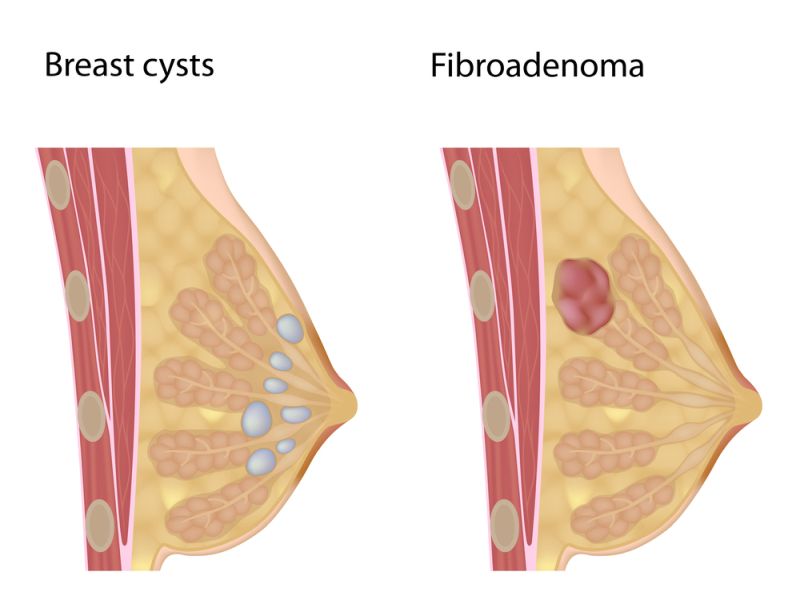
There are two main types of this disease treatment: surgical and non-surgical. Surgical treatments involve removing the tumor wholly or partially, while non-surgical treatments aim to shrink or destroy the cancer without surgery.
Surgical treatments
Surgical treatments for fibroadenoma include:
– Lumpectomy:
This is the most common surgical treatment for fibroadenoma. It involves making a small incision in the breast and removing the tumor along with a margin of normal tissue around it. The incision is then closed with stitches or glue. Lumpectomy preserves the shape and appearance of the breast and has a low risk of complications. However, it may leave a scar or cause changes in breast sensation.
– Mastectomy:
This is a rare surgical treatment for this. It involves removing the entire breast that contains the tumor. Mastectomy is usually reserved for very large or multiple tumors that cannot be removed by lumpectomy or for women who have a high risk of breast cancer. Mastectomy can cause a significant emotional and physical impact and may require breast reconstruction surgery.
Read More : Types Of Breast Cancer And Breast Cancer Causes
Fibroadenoma Surgery Side Effects
Here are some potential side effects of fibroadenoma surgery:
1. Pain and Discomfort:
It is common to face some pain or discomfort at the surgical site after the surgery. This can be handled with the recommended pain medicines.
2. Swelling and Bruising:
Swelling & bruising around the surgical area are normal and typically subside over time.
3. Scarring:
The surgical incision will leave a scar, and its appearance can vary. The scar may be noticeable in some cases, while in others, it may fade over time.
4. Infection:
There is a possibility of acquiring an infection at the surgical site. Signs of infection include increased redness, swelling, warmth, and discharge. Antibiotics may be recommended to restrict or treat infections.
5. Bleeding:
Some degree of bleeding is expected during and after surgery. Excessive bleeding may require medical attention.
6. Changes in Sensation:
Some women may experience shifts in sensation around the breast or nipple area, including numbness or increased sensitivity. In most cases, these changes are temporary.
7. Wound Healing Issues:
Sometimes, wound healing may be delayed, leading to poor scar formation or wound dehiscence (wound opening). This may require additional medical attention.
8. Rare Complications:
While uncommon, there are potential rare complications, such as damage to nearby structures, nerve injury, or problems with anesthesia. Your surgeon will discuss the potential risks & benefits of the procedure with you before surgery.
Non-surgical treatments
Non-surgical treatments for this disease include:
– Cryoablation:
This is a minimally invasive treatment for the disease. It involves inserting a thin probe into the tumor and freezing it with liquid nitrogen. The frozen tissue then dies and is gradually absorbed by the body. Cryoablation does not require stitches or anesthesia and has minimal scarring and pain. However, it may not be effective for large or deep fibroadenomas and may cause infection or bleeding.
– Radiofrequency ablation:
This is another minimally invasive treatment for this disease. It involves putting a thin needle into the tumor and heating it with radio waves. The heat destroys the tumor cells and causes them to shrink.
Radiofrequency ablation does not require stitches or anesthesia and has minimal scarring and pain. However, it may not be effective for large or deep wounds and may cause infection or bleeding.
– High-intensity focused ultrasound (HIFU):
This is a non-invasive treatment for this. It involves using ultrasound waves to target and destroy the tumor without damaging the surrounding tissue. HIFU does not require any incision or anesthesia and has no scarring or pain. However, it may only be available in some hospitals and may take several sessions to achieve complete results.
Read More : Breast Cancer Treatment Cost in India (2026): Surgery, Chemo, Radiation & Total Expenses
Fibroadenoma Treatment Cost in India
The cost varies depending on the city, hospital, and treatment method.
| Procedure | Estimated Cost |
| Consultation | ₹500 – ₹2,500 |
| Ultrasound | ₹1,000 – ₹4,000 |
| Mammography | ₹2,000 – ₹6,000 |
| Biopsy | ₹5,000 – ₹25,000 |
| Lumpectomy Surgery | ₹30,000 – ₹80,000 |
| Cryoablation | ₹50,000 – ₹1,50,000 |
| HIFU Treatment | ₹1,00,000 – ₹2,50,000 |
Additional expenses may include medications, follow-up visits, pathology tests, and hospitalization charges.
How To Diagnose Fibroadenoma?
If you notice a lump in your breast, you should always consult your doctor for a proper diagnosis. Various tests can detect this, such as:
– Breast ultrasound:
This is a painless procedure that utilizes sound waves to develop images of the breast tissue. It can show the size and shape of the lump and distinguish it from a fluid-filled cyst.
– Mammography:
This is an X-ray exam of the breast that can reveal the borders of the lump and its relation to other tissues. However, it may not be very effective for young women who have dense breast tissue, which makes it harder to see the details. Also, mammography involves radiation exposure, so it is not recommended for women under 30 unless there is a strong suspicion of cancer.
– Core needle biopsy:
This minimally invasive procedure involves inserting a hollow needle into the lump and taking a small tissue sample for analysis. A doctor can use ultrasound or mammography to guide the needle to the right spot. The tissue sample can confirm if the lump is a fibroadenoma or another type of tumor, such as a phyllodes tumor, which is rare but can be malignant (cancerous).
Based on the outcome of diagnostic tests, your physician may suggest different options for managing your fibroadenoma.
Risk Factors For Fibroadenomas
Some factors that may increase the likelihood of developing fibroadenomas are:
– Young age (<35 years)
– Prior history of benign breast disease
– Obesity
– Family history of multiple diseases.
– Consumption of oral contraceptives before 20
Fibroadenoma Surgery Recovery Time
| Recovery Stage | Timeline |
| Mild soreness | 2–5 days |
| Wound healing | 1–2 weeks |
| Return to routine work | 3–7 days |
| Complete recovery | 4–6 weeks |
Following your surgeon’s instructions helps speed up healing.
Medical Crowdfunding for Fibroadenoma Treatment
Although fibroadenoma is benign, diagnostic tests, specialist consultations, biopsies, surgeries, and follow-up care can create a financial burden for many families.
Medical crowdfunding allows patients to raise funds online for:
- Breast imaging tests
- Biopsy procedures
- Surgery expenses
- Hospital bills
- Post-operative treatment
Medical crowdfunding platforms like ImpactGuru help patients connect with donors, friends, relatives, and communities who can contribute toward healthcare expenses. Families can raise donations online and focus on recovery without delaying treatment due to financial constraints.
Conclusion
Fibroadenoma is one of the most common benign breast lumps affecting young women. While the condition is usually harmless, timely diagnosis is important to rule out serious breast diseases and determine whether treatment is necessary. Understanding fibroadenoma symptoms, causes, treatment options, surgery costs, and recovery expectations can help patients make informed healthcare decisions. If treatment expenses become overwhelming, medical crowdfunding can provide valuable financial assistance and ensure timely access to quality care.
FAQs
No. Fibroadenoma is usually a benign breast condition and rarely becomes cancerous.
Yes. Some fibroadenomas shrink or disappear naturally, especially after menopause.
Most fibroadenomas are painless, although some women may experience mild tenderness.
Doctors often consider surgery when fibroadenomas exceed 3–5 cm, grow rapidly, or cause discomfort.
Yes. New fibroadenomas may develop even after surgery.
Yes. It is one of the most common benign breast tumors in women aged 15–35 years.