

Table of Contents
- Quick Summary
- Introduction
- What Is Crowdsourcing? (And How Is It Different From Crowdfunding?)
- What Are the Different Types of Crowdsourcing?
- Best Examples of Crowdsourcing for Innovation
- How Crowdsourcing Powers Open Knowledge Projects
- Crowdsourcing Examples in Everyday Technology
- Lessons You Can Learn from the Best Crowdsourcing Examples
- Medical Crowdfunding: A Crowdsourcing Model That Saves Lives
- What Makes a Crowdsourcing Project Successful?
- Conclusion
- FAQs
Quick Summary
- These crowdsourcing examples show how a “crowd” can out-build, out-map, and out-innovate any single company or team.
- LEGO Ideas turned fan submissions into a multi-billion-dollar product pipeline.
- Wikipedia proves that volunteer-built knowledge can outscale paid, editorial teams.
- Waze replaced expensive traffic sensors with millions of everyday drivers.
- Medical crowdfunding platforms apply the same crowd-powered model to raise funds for medical treatment, not just ideas or data.
- Every success story below shares the same four ingredients: a clear goal, low-friction participation, visible progress, and real trust.
Introduction
Wikipedia is edited by roughly 291,000 active contributors on the English edition alone, yet it still ranks among the most-visited reference sites in the world. That single fact captures what makes the best crowdsourcing examples so compelling: a loosely organized crowd, given the right structure, can outperform the budgets and bandwidth of any single organization. From toy companies to traffic apps to medical fundraising platforms, the model keeps repeating because the underlying mechanics work. This blog breaks down real, verified crowdsourcing projects, what they built, how big they grew, and the specific design choices that made each one stick. By the end, you’ll see exactly why some crowdsourced projects scale into household names while others quietly disappear.
Common examples of successful crowdsourcing projects include Wikipedia, LEGO Ideas, Waze, OpenStreetMap, Threadless, reCAPTCHA, Duolingo, and medical crowdfunding platforms like ImpactGuru. These projects succeeded because they combined clear goals, easy participation, transparency, and meaningful rewards.
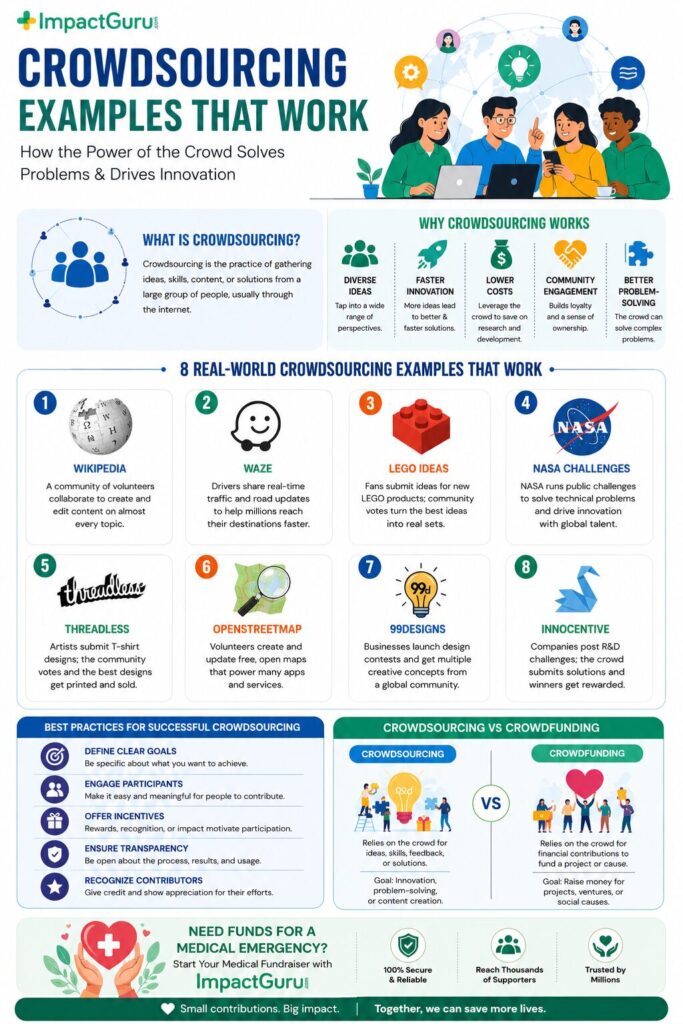
What Is Crowdsourcing? (And How Is It Different From Crowdfunding?)
Crowdsourcing means asking a large, open group of people to contribute ideas, labor, data, or expertise to solve a problem, such as product design, map edits, or translated text. Crowdfunding is a specific branch of crowdsourcing in which contributions are money rather than ideas or effort, typically to fund a campaign, product, or personal cause.
In other words, every crowdfunding campaign is technically a crowdsourcing effort; it’s just sourcing capital instead of creativity. That distinction matters because the same success principles (clear goals, transparency, easy participation) apply whether the crowd is submitting toy designs or donating toward someone’s hospital bill.
What Are the Different Types of Crowdsourcing?
Crowdsourcing isn’t limited to one purpose. Organizations use different types of crowdsourcing depending on their goals, whether it’s generating ideas, solving technical problems, or collecting data. Understanding these categories helps businesses choose the right approach.
The most common types of crowdsourcing include:
- Crowd Creation: Users create content such as articles, videos, designs, or software.
- Crowd Wisdom: A large group shares ideas, opinions, or expertise to solve problems.
- Crowd Voting: Communities vote for the best ideas, products, or designs.
- Crowdfunding: People contribute money to support projects, startups, charities, or medical emergencies.
- Microtask Crowdsourcing: Small tasks like image labeling, surveys, or data entry are distributed among many contributors.
Each type has unique advantages, making crowdsourcing a flexible solution for businesses, nonprofits, researchers, and governments.
Best Examples of Crowdsourcing for Innovation
LEGO Ideas
By the mid-2000s, LEGO was reportedly close to insolvency and needed a new source of product ideas beyond its internal design teams. In 2008, it partnered with the Japanese platform CUUSOO to let fans submit and vote on set concepts; if a design hit a support threshold, LEGO’s review board considered it for production. The program was rebuilt as LEGO Ideas in 2014 with Chaordix as the new platform partner.
The results speak for themselves. By the mid-2020s, LEGO Ideas had grown into a community of more than 2.8 million customers who had shared and debated over 135,000 set concepts. Selected creators don’t just get bragging rights; a successful idea earns the designer 1% of the product’s revenue, free copies of the final set, and on-box credit. One LEGO Ideas community lead who ran the platform from 2011–2018 reported growing it from 20,000 beta users to over a million members, shepherding 25 crowdsourced sets into production as a roughly $90 million business line.
What made it work: a low barrier to submit an idea, a transparent voting threshold everyone could see, and a real, public reward (money, recognition, and a finished product) for the ideas that won.
Threadless and Community-Voted Products
The same mechanic- submit, vote, produce the winners- has powered crowdsourced product design across categories beyond toys, from T-shirt graphics to packaged food flavors. Threadless, one of the earliest brands built almost entirely on this model, let designers upload original artwork and let the community vote on which designs got printed and sold, turning customers into both the design team and the focus group in a single step.
The pattern holds regardless of industry: when contributors can see exactly how close an idea is to getting made, a vote count, a supporter threshold, a countdown, participation, and idea quality all go up. It also lowers risk for the company itself, since a product only goes into production once demand has effectively already been validated by the crowd that will buy it.
How Crowdsourcing Powers Open Knowledge Projects
Wikipedia
Wikipedia is the most cited example of crowdsourcing for a reason: it has no traditional editorial staff, yet it has become one of the most relied-upon reference resources on the internet. As of June 2026, the English Wikipedia includes over 7.19 million articles and averages around 500 new articles per day, with more than 12.4 million users having edited the English edition at least once since its inception.
What’s notable is how concentrated the actual work is. Only about 291,000 accounts made at least one edit to English Wikipedia in the last 30 days, a small fraction of the platform’s total registered base, but more than enough to keep the encyclopedia current. Wikimedia projects collectively see over 16 edits submitted every second worldwide.
What made it work: anyone can edit instantly with no approval bottleneck, every change is tracked and reversible, and a strong community-policing culture (talk pages, citation requirements, edit history) keeps quality high enough to sustain trust at scale.
OpenStreetMap
Built on the same logic as Wikipedia but for geography, OpenStreetMap lets volunteers map roads, buildings, and points of interest anywhere in the world, using the same edit-and-revise approach that keeps Wikipedia current. Anyone can add a missing road, correct a building outline, or tag a new shop, and changes are visible to the entire community almost immediately.
It now underpins navigation and humanitarian-mapping tools used by NGOs and disaster-response teams who need map data for regions that commercial mapmakers haven’t prioritized. After major earthquakes or floods, volunteer mapping communities have repeatedly produced usable, detailed maps of affected areas faster than any commercial alternative, simply because thousands of contributors can each map a small area in parallel.
Crowdsourcing Examples in Everyday Technology
Waze
Waze turned ordinary commuters into a live sensor network. Instead of installing expensive roadside hardware, the app asks drivers to report accidents, police presence, and slowdowns in real time, while passively logging speed data from anyone with the app open. Beyond live reports, a network of roughly 500,000 volunteer map editors continuously updates the underlying map data itself.
Google acquired Waze in June 2013 for a final cost of $966 million (originally reported at approximately $1.1 to $1.3 billion) after the platform had attracted nearly 50 million users worldwide. Today, driven by that early crowdsourced foundation, Waze has grown to serve more than 140 million monthly active users globally. In addition to crowdsourced driver reports, Waze also pulls in official data from state transportation agencies to fill gaps the crowd can’t cover, blending volunteer input with verified institutional data, a combination worth noting for any crowdsourcing model that needs both reach and reliability.
What made it work: the act of contributing (tapping “accident ahead”) took seconds and gave an immediate personal benefit: better, faster routes, so users had a reason to participate even without a monetary reward.
reCAPTCHA and Duolingo
Google’s reCAPTCHA famously turned an everyday annoyance, proving you’re not a robot, into free labor that helped digitize old books and newspapers, simply by asking users to transcribe distorted text instead of clicking generic checkboxes. Every solved puzzle fed back into improving optical character recognition for archives that would otherwise have needed expensive manual transcription.
Duolingo used a related approach early on, having learners translate real sentences as part of their lessons, generating usable translated content as a byproduct of free language practice. In both cases, the “work” was disguised as something users were already motivated to do anyway, proving identity or practicing a language, which is precisely why participation stayed high without any direct payment involved.
Lessons You Can Learn from the Best Crowdsourcing Examples
Every successful campaign offers valuable insights. By analyzing popular crowdsourcing examples, businesses can understand how to improve engagement, increase participation, and achieve better outcomes.
Key lessons from leading crowdsourcing examples include:
- Listen to your community’s ideas.
- Keep the submission process simple.
- Encourage creativity and diversity.
- Offer meaningful incentives.
- Be transparent about decision-making.
- Act on valuable feedback.
- Build long-term relationships with contributors.
Following these lessons can help organizations create their own successful crowdsourcing examples while building trust and credibility.
Medical Crowdfunding: A Crowdsourcing Model That Saves Lives
Every example above sources ideas, knowledge, or data from a crowd. Medical crowdfunding applies the identical model to something far more urgent: sourcing money from a crowd to cover the cost of someone’s medical treatment.
The need is real and growing. Rising treatment costs leave a large share of Indian households exposed to serious financial strain after a major illness, which is exactly why medical crowdfunding platforms like ImpactGuru exist: to let extended communities, not just immediate family, share the cost of a medical emergency. On ImpactGuru specifically, the platform reports having supported over 50,000 patients through more than 36 lakh donors, with a 0% platform fee model designed to maximize what each patient actually receives.
One of the clearest demonstrations of how far crowdfunding for health issues can reach: a fundraiser for a five-month-old patient needing a rare gene-therapy treatment drew contributions from donors across more than 100 countries and raised the full target amount within about 100 days, almost entirely through small, individual donations rather than a handful of large gifts.
If you’re wondering how to raise funds for medical treatment through this model, the mechanics mirror what makes every crowdsourcing example above succeed:
- A clear, specific goal – an exact amount tied to an exact treatment, not a vague appeal
- Verified documentation – hospital bills, diagnosis reports, and doctor prescriptions reviewed before a campaign goes live, so donors trust the need is real.
- Visible progress – a running total and updates, the same transparency mechanic that makes LEGO Ideas’ vote counter or Wikipedia’s edit history trustworthy
- Low-friction contribution – donating takes under a minute, the same way reporting a Waze hazard or editing a Wikipedia typo does
- A real story – a name, a diagnosis, a timeline; abstract appeals convert far worse than specific, human ones
For anyone in need of a donation for medical treatment, this is precisely why medical crowdfunding has grown as fast as it has: it borrows the same crowd-powered mechanics that built Wikipedia and scaled Waze, just redirected toward saving a life instead of building an encyclopedia or a map.
What Makes a Crowdsourcing Project Successful?
Looking across LEGO Ideas, Wikipedia, Waze, and medical crowdfunding platforms, four ingredients show up in every single success story:
- A specific, well-defined goal. “Submit a LEGO set idea,” “fix this Wikipedia sentence,” “report this traffic jam,” “raise ₹X for this surgery”: vague asks get vague (or no) participation.
- Minimal friction to contribute. The easier the action- a tap, a click, a small donation- the larger and more diverse the crowd that shows up.
- Visible, real-time progress. Vote counts, edit histories, live maps, and donation trackers. People contribute more when they can see the collective effort moving toward the goal.
- Genuine trust in the system. Whether that’s LEGO’s royalty promise, Wikipedia’s edit transparency, or a crowdfunding platform’s document verification, contributors need confidence that their effort or money will actually be used as promised.
Where a crowdsourcing effort lacks one of these, say, a vague goal or no visible progress, engagement tends to drop off fast, regardless of how good the underlying idea is. The projects that last are the ones that treat the crowd as a genuine partner: giving credit where it’s due, showing exactly where contributions go, and making the next step obvious every single time.
Conclusion
From toy bricks to traffic data to life-saving treatment, the best successful crowdsourcing project examples all rest on the same foundation: a clear ask, low-friction participation, visible progress, and earned trust. Medical crowdfunding simply applies that proven model to the moments that matter most, when a family needs urgent funds and a community is ready to help. If you or someone you know needs support covering treatment costs, platforms built on these same trust-first principles make it possible to turn that crowd of willing supporters into real, timely relief. Explore how a transparent, verified medical fundraiser works on ImpactGuru and see how quickly a community can come together for the right cause.
FAQs
Yes. Crowdfunding is a specific form of crowdsourcing in which the contributions collected are money rather than ideas, labor, or data. Every crowdfunding campaign is technically a crowdsourcing effort; it’s just sourcing capital instead of creativity or expertise.
Wikipedia is generally considered the best-known example of crowdsourcing. It has no traditional editorial staff, relies entirely on volunteer contributors, and as of June 2026 includes over 7.19 million articles on the English edition alone, edited by more than 12.4 million users since its inception.
Yes, and many of the largest crowdsourcing successes work this way. Wikipedia, OpenStreetMap, and Waze all run on unpaid volunteer contributions. People participate for non-monetary reasons, recognition, personal benefit (like better traffic routes), or a sense of contributing to something useful, rather than direct payment.
Not exactly. A charity donation typically goes into a pooled fund managed by an organization for general use. Medical crowdfunding lets donors contribute directly toward one specific patient’s documented treatment cost, with platforms like ImpactGuru verifying hospital bills and diagnosis reports before a campaign goes live, and providing fund-utilization updates as the money is used.
The most common failure points are a vague or unclear goal, high friction to participate (too many steps, unclear instructions), no visible progress tracker, and low trust in how contributions will be used. Removing any one of these four- a clear ask, easy participation, visible progress, or earned trust- tends to cause engagement to drop off quickly, even when the underlying idea is strong.